
Best Online TRT Clinic: How to Choose and What to Avoid

Updated
Top takeaways
- Online TRT clinics cannot perform physical exams or administer certain medications, which limits what telemedicine can safely deliver for testosterone therapy.
- Many clinic websites fail to describe monitoring requirements or cite sources for their claims, making it harder to evaluate quality before you sign up.
- Choosing a clinic requires checking pricing transparency, cancellation terms, privacy practices, and whether the provider follows published treatment guidelines.
- Common pitfalls include unclear subscription models, inadequate lab monitoring, and marketing that overstates benefits while understating risks.
- A structured scoring method helps you compare clinics on factors that matter: cost, regulatory compliance, and alignment with clinical standards.
Best Online TRT Clinic: How to Choose and What to Avoid
Online testosterone replacement therapy (TRT) and enclomiphene clinics have grown rapidly, offering convenience and lower barriers to treatment. That convenience comes with trade-offs. Telemedicine for TRT has significant limitations, including the inability to perform physical exams and administer specific medications that require in-person care. Before choosing a clinic, you need to know what those limitations are and how to tell whether a provider compensates for them with rigorous lab monitoring and transparent policies.
Most clinic websites emphasize speed and simplicity. A 2018 analysis found that only 40% of TRT information websites cited sources for their claims, and many failed to describe the need for regular monitoring. A more recent global review identified widespread breaches of advertising standards, with clinics routinely offering non-guideline-based treatments and making unsupported claims about efficacy. The result is a market where the loudest marketing often comes from providers least aligned with clinical standards.
This guide walks through the specific factors that separate a well-run online clinic from one that cuts corners. You will learn how to evaluate pricing models, cancellation terms, privacy practices, and regulatory records. You will also see a scoring method that lets you compare clinics on the dimensions that affect cost, safety, and treatment quality. The goal is to give you the checklist you need before handing over a credit card or uploading a driver's license. For context on how enclomiphene differs from TRT in mechanism and trade-offs, see the linked research summary.
This guide details how to choose the best online TRT clinic, including key factors, pricing, privacy practices, and common pitfalls to avoid.
Understanding TRT and Enclomiphene
Testosterone replacement therapy (TRT) is a treatment designed to raise testosterone levels in men with low testosterone. Enclomiphene is another approach that stimulates the body to produce more testosterone naturally. TRT delivers synthetic testosterone directly into your system through injections, gels, or pellets. Enclomiphene stimulates your body to produce more of its own testosterone by blocking estrogen receptors in the brain, which signals the pituitary to release more luteinizing hormone.
The mechanism matters because it determines what happens to your fertility and what monitoring you need. TRT typically shuts down sperm production within months, though not always completely. Enclomiphene usually preserves it, and in some men improves it, because the same hormonal pathway that raises testosterone also drives sperm production.
How TRT Works and What It Costs You
TRT raises testosterone levels reliably in most men. The trade-off is testicular suppression: your body stops making its own testosterone and, in most cases, stops producing sperm. Reversal is possible after stopping TRT, but it can take months to years, and some men do not fully recover baseline sperm counts.
Direct-to-consumer telemedicine platforms offering TRT largely follow practice guidelines in evaluation and treatment, but the cost of ongoing treatment through these platforms is high compared to traditional care. You pay for convenience, but the price difference over 12 months can be significant.
How Enclomiphene Works and What the Evidence Shows
Enclomiphene is the active isomer of clomiphene citrate, a medication used off-label for male hypogonadism for decades. The research shows that enclomiphene improves testosterone levels with a lower rate of documented adverse events compared to clomiphene. It is considered a comparable treatment option for hypogonadal men while minimizing the risk of adverse effects.
The mechanism is indirect: enclomiphene blocks estrogen feedback at the hypothalamus and pituitary, which increases gonadotropin-releasing hormone (GnRH), luteinizing hormone (LH), and follicle-stimulating hormone (FSH). Higher LH stimulates the testes to produce more testosterone. Higher FSH supports sperm production.
Not every man responds. Some men have primary testicular failure, where the testes cannot produce more testosterone no matter how much LH is present. That is why testing LH and FSH before starting matters: if LH is already elevated and testosterone is low, enclomiphene will not help.
Comparing the Two Options
For men who want to preserve fertility or prefer to maintain their own production, enclomiphene is worth testing first. For men who do not respond to enclomiphene, who have elevated LH already, or who need higher and more stable testosterone levels, TRT is the more reliable option. More detail on what the research shows about enclomiphene is available if you want to compare trial data.
What You Need Before Choosing Either
Before choosing between TRT and enclomiphene, you need two morning testosterone results, ideally drawn before 10 AM and at least a week apart. You also need LH, FSH, and a full panel that includes SHBG, estradiol, hematocrit, and PSA. Without those numbers, nobody can tell you which option fits your situation.
If your LH is already high and your testosterone is low, that suggests primary testicular failure, and enclomiphene will not raise your testosterone. If your LH is low or normal and your testosterone is low, that suggests secondary hypogonadism, and enclomiphene may work. TRT works in both cases, but the fertility trade-off is real.
Key Factors to Consider When Choosing an Online TRT Clinic
Before signing up for an online TRT or enclomiphene clinic, you need a checklist that filters out the operations selling shortcuts. The clinics that advertise fastest results or lowest prices are often the ones skipping the steps that matter: two morning tests, a full hormone panel, and follow-up monitoring that tracks what the drugs actually do to your body.
Here is what to check before you hand over a credit card.
Initial Testing Protocol
A legitimate clinic requires two morning testosterone measurements, taken on separate days, before prescribing anything. Total testosterone, free testosterone, SHBG, LH, FSH, estradiol, hematocrit, and PSA should all appear on the initial panel. If the clinic offers to start treatment after one test or a questionnaire alone, that is a red flag.
Many online platforms skip LH and FSH entirely. Those two numbers tell you whether your pituitary is signaling your testes correctly—information that changes which treatment makes sense. Without them, you are choosing between TRT and enclomiphene in the dark.
Physical Exam and Medical History
Telemedicine for TRT has documented limitations: no physical exam, no ability to palpate for testicular atrophy or gynecomastia, and no in-person assessment of cardiovascular risk factors. A 2021 review noted that the inability to perform a physical exam and administer specific medications are significant barriers to telemedicine-based TRT management.
The clinic should ask about sleep apnea, cardiovascular disease, prostate symptoms, and fertility goals in writing. If the intake form is shorter than a standard primary-care questionnaire, the clinic is not gathering enough information to prescribe safely.
Monitoring Schedule and Lab Frequency
Once treatment starts, you need follow-up labs at defined intervals: typically 6–12 weeks after starting, then every 6 months. The monitoring panel should include testosterone, hematocrit, PSA, and estradiol at minimum. Clinics that offer "unlimited refills" without requiring updated labs are not monitoring; they are selling.
Ask how the clinic handles abnormal results. If hematocrit climbs above 54% or PSA rises unexpectedly, what is the protocol? A good answer includes dose adjustment, temporary hold, or referral to a specialist. A bad answer is silence.
Prescriber Credentials and Availability
Check whether the prescriber is a physician, nurse practitioner, or physician assistant, and whether they are licensed in your state. Telehealth prescribing rules vary by state; some require an established patient relationship or a video visit before the first prescription.
Find out if you can message your prescriber between visits and how long responses typically take. For ongoing TRT or enclomiphene, you will have questions about side effects, lab results, and dose adjustments. A clinic that routes all questions through a call center is not set up for individualized care.
Medication Source and Formulation
Ask whether the clinic prescribes FDA-approved testosterone products (e.g., testosterone cypionate, enanthate) or compounded formulations. Compounded drugs are not FDA-approved; they are mixed by a pharmacy under section 503A or 503B of the Federal Food, Drug, and Cosmetic Act. Compounded products can be cheaper, but they do not undergo the same batch testing or stability studies as approved drugs.
For enclomiphene, no FDA-approved product exists as of 2025. All enclomiphene prescriptions are compounded and off-label. That is not automatically disqualifying, but it means you are relying on the compounding pharmacy's quality control, not the manufacturer's.
Support for Fertility Preservation
If you might want children in the next few years, ask whether the clinic offers hCG alongside TRT or enclomiphene as a first-line option. TRT suppresses sperm production in most men; adding hCG can preserve it, but not always. Enclomiphene typically maintains or increases sperm count, but the long-term data are thin.
A clinic that does not ask about fertility goals before prescribing TRT is skipping a conversation that matters. You can read more about how enclomiphene compares to TRT in the research.
Pricing Transparency and Cancellation Terms
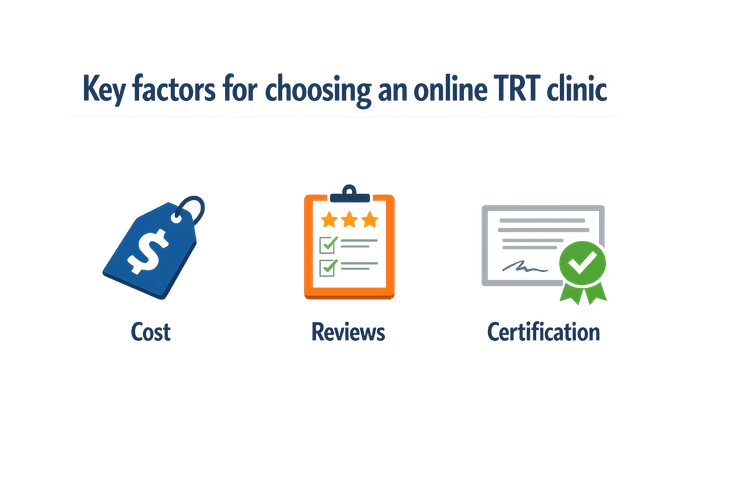
The first number to check is the total monthly cost after the promotional period ends. Many clinics advertise a consultation fee or first-month price, then bury the recurring medication, lab, and membership charges in separate line items. A 2022 comparison of direct-to-consumer telemedicine platforms found that while most follow American Urological Association guidelines for evaluation, ongoing treatment costs varied widely and were often higher than traditional tertiary-center care.
What the All-In Price Includes
Ask for a written breakdown that covers consultation, prescription, shipping, follow-up labs, and any platform or membership fees. Some clinics charge separately for each blood draw; others bundle quarterly monitoring into a flat rate. The number that matters is what you pay every month for twelve months, not the teaser rate in the ad.
If you are comparing testosterone supplements to prescription therapy, remember that supplements carry no monitoring or consultation cost but also no regulatory requirement to prove efficacy.
Cancellation Terms and Refund Policies
Read the cancellation clause before you enter payment details. Some memberships require 30 days' written notice; others auto-renew and charge a cancellation fee if you stop mid-cycle. The contract should state whether unused medication is refundable and how quickly the clinic processes the cancellation.
A clinic that makes cancellation difficult is betting you will not read the terms until you want to leave. Worth knowing before you sign up: the easiest contract to exit is the one you never needed to cancel because the pricing was clear from day one.
Privacy Practices and Regulatory Records
Your testosterone result, diagnosis code, and prescription history are protected health information. Before you hand them to a telehealth clinic, check what the clinic does with that data and whether regulators have flagged the company.
What to Look for in a Privacy Policy
Read the privacy policy before you create an account. Look for clear statements about who sees your lab results, how long the clinic keeps your records, and whether the company shares data with advertisers or third-party analytics platforms. If the policy is vague or missing, that is a red flag.
Ask whether the clinic sells or shares de-identified data. Some telehealth platforms aggregate patient information for research or marketing. That practice is legal, but you should know about it before signing up. If the privacy page does not say, email customer service and ask directly.
Regulatory Compliance and Advertising Practices
A 2025 review of testosterone clinics worldwide identified serious and frequent breaches of advertising law and regulations, with practices that carry the potential to cause harm to men. Clinics that advertise treatments not supported by clinical guidelines, omit side-effect disclosures, or make unqualified performance claims are operating outside regulatory standards.
Before you enroll, search the clinic's parent company name plus "FDA warning letter" or "state board action." Check the Better Business Bureau for complaint patterns. If the clinic has been cited for misleading advertising, billing disputes, or privacy violations, move on.
Questions to Ask Before You Sign Up
- Does the clinic require informed consent that lists specific risks, monitoring requirements, and fertility effects?
- Will you receive copies of all lab results, or does the clinic gate access behind a patient portal you cannot export?
- Can you request full deletion of your records if you cancel, or does the company retain them indefinitely?
- Does the clinic use a HIPAA-compliant telehealth platform, or does it conduct consultations over standard video chat?
If the clinic cannot answer these questions clearly, that tells you how seriously it takes compliance. For more context on what clinical guidelines actually recommend for testosterone treatment, see Enclomiphene Citrate: What the Research Actually Shows.
Scoring Method for Evaluating Clinics
No published scoring tool exists for direct-to-consumer testosterone clinics. You build your own checklist by weighting the factors that matter to you, then scoring each clinic against it. The method below uses the elements covered earlier—pricing transparency, lab adherence, privacy practices, and regulatory records—and assigns points based on verifiable criteria rather than marketing.
Build a Weighted Checklist
Start with the five categories that predict whether a clinic will cost you more than expected or expose you to regulatory or privacy risk:
- Pricing transparency (0–3 points): 3 if the site lists consultation, lab, medication, and membership fees before signup; 2 if it lists most but not all; 1 if you must email or call; 0 if pricing appears only after you create an account.
- Lab adherence (0–2 points): 2 if the clinic requires two morning total testosterone results plus LH before prescribing; 1 if it requires one morning result; 0 if it accepts a single result at any time of day or skips LH.
- Privacy policy (0–2 points): 2 if the policy names the specific third parties that receive identifiable data and offers an opt-out; 1 if it names them but offers no opt-out; 0 if it uses blanket language like "partners and affiliates."
- Regulatory record (0–2 points): 2 if the clinic's prescribers and pharmacy hold current state licenses with no disciplinary actions in the past five years; 1 if licenses are current but you cannot verify disciplinary history; 0 if you cannot confirm current licenses.
- Cancellation terms (0–1 point): 1 if you can cancel online without a phone call and receive a prorated refund; 0 otherwise.
Total possible: 10 points. A score of 8 or above indicates the clinic meets baseline standards for transparency and regulatory compliance. A score below 5 suggests you will encounter surprise costs, unclear data practices, or difficulty leaving.
Where to Find the Information
Most clinics do not publish all five categories on a single page. You gather the data from:
- Pricing page or FAQ: Look for line-item costs, not package deals that bundle consultation, labs, and medication into one monthly price without breakdown.
- Terms of service and privacy policy: Usually linked in the footer. Read the sections on data sharing, third-party analytics, and advertising partners.
- State licensing boards: Search the prescriber's name and the pharmacy's name in the state medical board and pharmacy board databases. Disciplinary actions appear in the public record.
- Support email or chat: If a category is missing from the site, ask directly. A clinic that refuses to answer before signup will not answer after.
Apply the Checklist to Multiple Clinics
Score at least three clinics using the same criteria. The one with the highest score is not necessarily the one you choose—price, formulary, and whether they offer enclomiphene or hCG may override a point difference—but the score tells you which clinic is least likely to surprise you six months in.
A 2022 observational study compared three direct-to-consumer telemedicine platforms offering testosterone therapy and found that all three largely followed American Urological Association guidelines for evaluation, but ongoing treatment costs were high relative to in-person care. The study did not score the platforms on transparency or privacy, only on guideline adherence and cost. You add those dimensions yourself.
If you want a deeper look at what the research shows about enclomiphene versus TRT, that comparison covers mechanism, fertility impact, and trial endpoints in detail.
What the Score Does Not Tell You
The checklist above measures transparency and compliance, not clinical quality. A clinic can score 10 out of 10 and still prescribe outside guideline thresholds, skip follow-up labs, or use compounded formulations without explaining the regulatory difference. The score tells you whether the clinic will be straightforward about what it does and what it costs—it does not tell you whether what it does is right for you.
Common Pitfalls to Avoid When Choosing an Online Clinic

A 2025 global review of 253 testosterone clinics found serious and frequent breaches of advertising law and clinical guidelines, with practices that have the potential to cause harm to men. The most common red flags appear in the first five minutes of browsing a clinic's website — before you ever speak to a provider.
Non-Guideline Treatment Claims
Many clinics routinely advertise testosterone secretagogues (such as gonadotrophins) or non-testosterone androgens as first-line treatments for symptoms, despite a lack of guideline support for these uses. The same review identified clinics offering these alternatives without explaining that they are off-label or that evidence for their use in healthy men is limited. If a clinic leads with enclomiphene, hCG or clomiphene before discussing standard testosterone therapy and its trade-offs, ask why — and ask for the evidence they are citing.
Incomplete Safety Information
A 2018 content analysis of 20 TRT-information websites found that online information is often incomplete, frequently failing to describe important safety information and the need for regular monitoring. Most sites reviewed did not mention hematocrit monitoring, cardiovascular screening or fertility impacts. When a clinic's marketing focuses on benefits and omits monitoring schedules, cancellation terms and known risks, that gap is intentional.
Low Patient Education Rates
A quality-improvement study in a clinical setting found that even after implementing a structured testosterone order template, a low proportion of men received education regarding the risks and benefits of TRT. This gap is wider in telehealth settings, where the consultation is shorter and the incentive to convert a lead into a prescription is higher. If your intake call does not include a discussion of fertility, monitoring labs and what happens if you want to stop, the clinic is not meeting the standard for informed consent.
Marketing That Contradicts Guidelines
Clinics around the world are breaching advertising law and regulations, with the potential to cause harm. Common violations include guaranteeing symptom improvement, advertising to men without a confirmed diagnosis, and omitting the fact that some treatments are compounded or off-label. National regulators have enforcement authority but enforcement is inconsistent. Until that changes, the responsibility to spot these breaches falls to you.
Red Flags Checklist
Before signing up, check for these:
- The clinic does not require two morning testosterone tests before prescribing
- No mention of monitoring labs (hematocrit, PSA, estradiol) or their frequency
- Pricing is not listed until after the consultation
- Cancellation terms are buried or require a phone call
- The clinic advertises "optimized" or "peak" testosterone levels rather than symptom relief
- No explanation of whether the medication is compounded, off-label or FDA-approved
- The intake form does not ask about fertility plans or cardiovascular history
For more on how specific treatments compare in mechanism and evidence, see Enclomiphene Citrate: What the Research Actually Shows.
Conclusion
Choosing the best online TRT clinic starts with two morning testosterone tests and a full panel that includes LH, FSH and estradiol. Without those numbers, nobody can tell you whether TRT, enclomiphene or no treatment at all fits your situation. The clinic that pushes you toward a prescription before you have those results is selling a product, not diagnosing hypogonadism.
Once you have the labs, compare clinics on five non-negotiable points: upfront pricing with no surprise membership fees, clear cancellation terms you can execute without a phone call, a privacy policy that names the EHR vendor and explains breach notification, published monitoring schedules that match the AUA or Endocrine Society guidelines, and a prescriber license you can verify in the state database. Any clinic that hides pricing behind a consultation, requires you to call to cancel, or refuses to name its software vendor fails the transparency test.
Cost matters, but the cheapest option is not always the one that saves you money. A clinic that charges less per month but requires quarterly labs you pay for separately, or one that auto-renews a membership you cannot cancel online, will cost you more over twelve months than a higher-priced competitor with transparent billing. Read the terms of service before you enter a credit card. If the document does not explain how to cancel or what happens to your medical records if you leave, that is the answer.
The research shows that many direct-to-consumer platforms do not follow evidence-based diagnostic guidelines, and adherence to monitoring protocols remains inconsistent even when a template is introduced. That gap between the guidelines and actual practice means you need to verify that your clinic orders the right tests at the right intervals, not assume it will happen automatically. Ask for the monitoring schedule in writing before you sign up.
For a detailed comparison of treatment options and what the trials actually measured, see Enclomiphene Citrate: What the Research Actually Shows. If you are considering supplements alongside or instead of prescription therapy, Testosterone Supplements for Men: Ingredients and Evidence grades the human evidence for each ingredient.
The clinic that meets all five criteria, publishes its monitoring protocol, and lets you cancel online without a phone call is the one worth your money. Everything else is marketing.
Sources(24)
- The journal of sexual medicine (2022)
- The aging male : the official journal of the International Society for the Study of the Aging Male (2018)
- BMJ open (2017)
- International journal of impotence research (2023)
- American journal of cardiovascular drugs : drugs, devices, and other interventions (2025)
- The Journal of clinical endocrinology and metabolism (2018)
- Therapeutics and clinical risk management (2009)
- The Journal of clinical endocrinology and metabolism (2026)
- The Journal of clinical endocrinology and metabolism (2018)
- European journal of endocrinology (2024)
- American family physician (2024)
- U.S. Food and Drug Administration — Drug Safety Communication: FDA cautions about using testosterone products for low testosterone due to aging; requires labeling change to inform of possible increased risk of heart attack and stroke with use (2015)
- The Journal of urology (2015)
- The Journal of urology (2020)
- JAMA (2017)
- International journal of pharmaceutical compounding (2015)
- U.S. Food and Drug Administration — FDA issues class-wide labeling changes for testosterone products (2025)
- Thrombosis research (2021)
- Frontiers in endocrinology (2025)
- The journal of sexual medicine (2021)
- The aging male : the official journal of the International Society for the Study of the Aging Male (2015)
- International journal of impotence research (2023)
- International journal of general medicine (2022)
- American Urological Association — Evaluation and Management of Testosterone Deficiency (AUA Guideline) (2018)