hCG for Men: What It Does On and Off TRT

Updated
Top takeaways
- hCG preserves testicular function and sperm production during testosterone therapy by mimicking the signal your pituitary normally sends
- About 3 million men in the United States take testosterone, many unaware of how it affects fertility
- Exogenous testosterone suppresses the body's own production and usually reduces sperm count; hCG can counteract that suppression
- Off TRT, hCG may raise testosterone by stimulating the testes directly, though evidence for long-term use in that context is limited
- The choice between hCG on TRT, hCG alone, or alternatives depends on fertility goals, cost, and monitoring requirements
Introduction to hCG for Men
Human chorionic gonadotropin — hCG — is a hormone that acts like luteinizing hormone (LH) in men. LH is the pituitary signal that tells the testes to produce testosterone and support sperm production. When you take exogenous testosterone, your pituitary stops releasing LH because it senses adequate circulating testosterone. That shutdown is why TRT usually suppresses intratesticular testosterone and reduces sperm count, sometimes to zero.
hCG steps in as a substitute LH signal. It keeps the testes working even when the pituitary is quiet. That makes it useful in two contexts: preserving fertility while on TRT, and raising testosterone in men who are not on TRT but whose own LH production is low. The mechanisms are the same; the trade-offs differ.
Many reproductive-age men start testosterone without understanding the fertility impact. The effect is not always permanent — discontinuing TRT often allows sperm production to recover — but recovery can take months to years, and adding hCG during TRT is simpler than stopping and waiting. For men who want to preserve the option of biological children, hCG is the most studied approach to keeping sperm production online while using testosterone.
Off TRT, hCG can raise total testosterone by directly stimulating the testes. This is less common than using enclomiphene or clomiphene, which work by increasing the pituitary's own LH output, but hCG may be an option when those drugs do not work or are not tolerated. The evidence base for hCG monotherapy in hypogonadal men is thinner than for its use alongside TRT, and the cost and injection schedule are less convenient than oral alternatives. Enclomiphene Citrate: What the Research Actually Shows covers how the oral option compares in mechanism and trial results.
This article walks through what hCG does on and off TRT, how it is dosed and monitored, what it costs in money and convenience, and where the evidence is strong versus where it is still thin.
The Problem: Low Testosterone and Fertility Issues
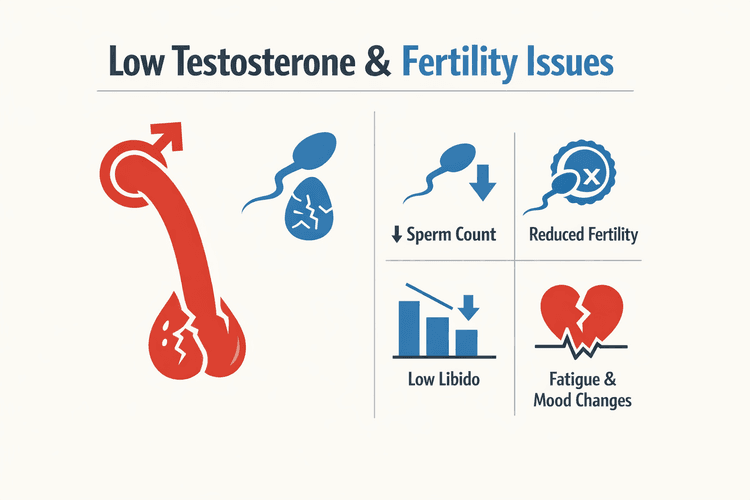
Testosterone replacement therapy raises the number on the lab report. It also shuts down sperm production in most men who take it. The mechanism is simple: exogenous testosterone suppresses the hypothalamic-pituitary-gonadal axis, which stops the testes from making their own testosterone and sperm. Many men starting TRT do not know this happens.
The Fertility Trade-Off Nobody Mentions
About three million men in the United States take testosterone. A large portion of them are of reproductive age. Research shows that many of these men were unaware of the negative impact on fertility before they started. The shutdown is not a side effect—it is how the drug works. When your body detects testosterone from an external source, it stops signaling the testes to produce it internally. Sperm production stops with it.
Discontinuation of exogenous testosterone may allow recovery, but the timeline is unpredictable and recovery is not guaranteed. Some men regain fertility within months. Others wait longer or do not recover at all.
What Low Testosterone Looks Like Before Treatment
Low testosterone alone does not always mean infertility. Many men with low total testosterone still produce sperm, especially if their luteinizing hormone and follicle-stimulating hormone levels remain intact. The problem arises when TRT is started without measuring those markers or discussing fertility goals.
The question is not whether TRT works to raise testosterone. It does. The question is whether the man starting it knows what he is trading. If fertility matters now or in the next few years, choosing the right online TRT clinic means finding one that tests LH and FSH before prescribing and discusses alternatives that preserve sperm production.
The shutdown is not a side effect—it is how exogenous testosterone works.
Men who discover the fertility issue after starting TRT face a harder decision: stay on and accept infertility, stop and wait for uncertain recovery, or add medications like hCG to try to restart sperm production while continuing therapy. None of those paths is fast or simple.
Solution Steps: Understanding hCG and Its Role
What hCG Actually Does
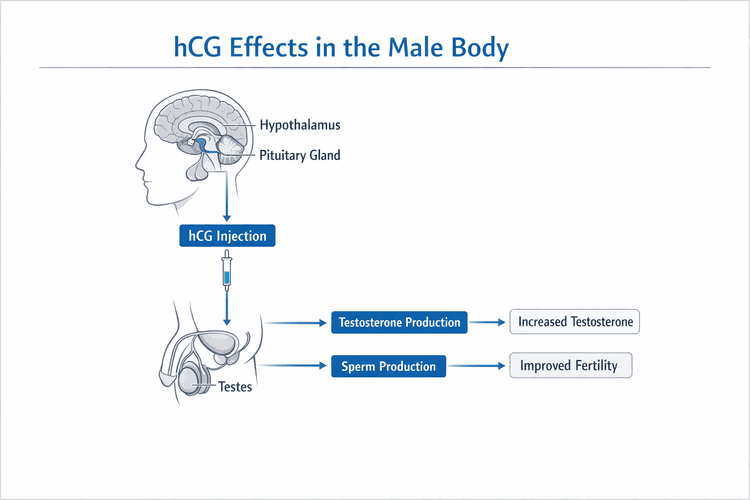
Human chorionic gonadotropin (hCG) mimics luteinizing hormone (LH) in the body. When you inject it, it binds to the same receptors in the testes that LH normally activates. That signal tells Leydig cells to produce testosterone locally. Unlike exogenous testosterone, which shuts down your own production, hCG keeps the testes working.
The practical result: hCG raises testosterone while preserving testicular function and usually maintaining sperm production. That is the core difference between hCG and traditional TRT.
hCG for Men On TRT
When you are on testosterone replacement therapy, your pituitary stops releasing LH and FSH because it detects high testosterone levels. Without LH, the testes shrink and stop making sperm. Adding hCG to your TRT protocol replaces the missing LH signal.
One retrospective study of men with previous testosterone use found that hCG monotherapy increased mean testosterone levels from 307 ng/dL to 422 ng/dL. The same group saw PSA levels drop from 0.91 ng/mL to 0.69 ng/mL, suggesting hCG may carry a lower risk for secondary erythrocytosis compared to standard testosterone therapy.
Most men on TRT who add hCG do so at doses between 500 and 1,000 IU two to three times per week. The goal is testicular size maintenance and continued sperm production, not maximal testosterone elevation. If you are already on TRT and considering hCG, ask your doctor for baseline labs: total testosterone, free testosterone, LH, FSH, and a semen analysis if fertility matters to you.
hCG for Men Off TRT
Some men use hCG monotherapy — hCG alone, without exogenous testosterone — as an alternative to traditional TRT. This approach works when your testes still respond to stimulation but your pituitary is not sending enough LH on its own.
A 2024 single-center retrospective analysis tracked 77 men with previous testosterone use who were seeking fertility treatment. They received 3,000 IU of hCG and 75 IU of FSH three times per week. The study reported optimal recovery of spermatogenesis, and concurrent testosterone therapy did not impede the hCG/FSH-mediated recovery.
This tells you two things. First, hCG can restart sperm production even in men who have been on TRT. Second, the combination of hCG and FSH appears more effective for fertility recovery than hCG alone, though the studies are small and retrospective.
How hCG Compares to Enclomiphene and Clomiphene
Both enclomiphene and clomiphene work by blocking estrogen receptors in the hypothalamus and pituitary, which increases your own LH and FSH output. hCG bypasses that step entirely — it replaces LH directly at the testes.
The trade-off: enclomiphene and clomiphene require your pituitary to function normally. hCG works even if your pituitary is suppressed, which is why it is the standard option for men already on TRT or recovering from it. Enclomiphene may raise testosterone more predictably in men with secondary hypogonadism who have not been on exogenous testosterone, but once you are suppressed, hCG is the tool that keeps the testes active.
What We Don't Know Yet
The studies on hCG monotherapy are small and retrospective. We do not have large randomized controlled trials comparing hCG head-to-head with enclomiphene or standard TRT over multiple years. We also do not have clear data on the optimal dose for fertility preservation versus testosterone elevation, or how long men can stay on hCG before diminishing returns set in.
Most of the published evidence comes from fertility clinics tracking men who want to conceive. If your goal is testosterone optimization without fertility concerns, the evidence is thinner.
Tips and Tricks for Using hCG Effectively
Using hCG requires more than just starting injections. The monitoring, the timing, and the doctor you work with all matter. Here is what to know before you sign up.
Who Should Prescribe hCG for Men
hCG should be prescribed by physicians experienced with infertility problems and familiar with patient selection criteria, contraindications, warnings, precautions, and adverse reactions. This is not a medication to start based on a single telehealth questionnaire. Ask your doctor how many patients they have treated with hCG, what labs they monitor, and what their protocol is if sperm count does not respond.
If you are working with an online TRT clinic, confirm they order baseline and follow-up semen analyses when fertility is the goal. Not all clinics do this, and without it you are guessing whether the treatment is working.
Monitoring Labs and Fertility
When hCG is used alongside testosterone, the number that matters is sperm count, not just testosterone level. Testosterone can rise while sperm production stays suppressed. A semen analysis at baseline and again at three to six months tells you whether the testicular stimulation is working.
For men using hCG off TRT to raise testosterone, monitor total and free testosterone, LH, estradiol, and hematocrit. LH should stay in range or rise slightly; if it drops, the dose may be too high. Estradiol can rise because hCG stimulates testicular aromatase, so some men need an aromatase inhibitor added.
Dosing and Injection Frequency
Low-dose hCG can be used alongside exogenous testosterone to protect testicular function. Typical doses range from 250 to 500 IU two to three times per week. Higher doses do not necessarily produce better results and may increase estradiol or desensitize Leydig cells over time.
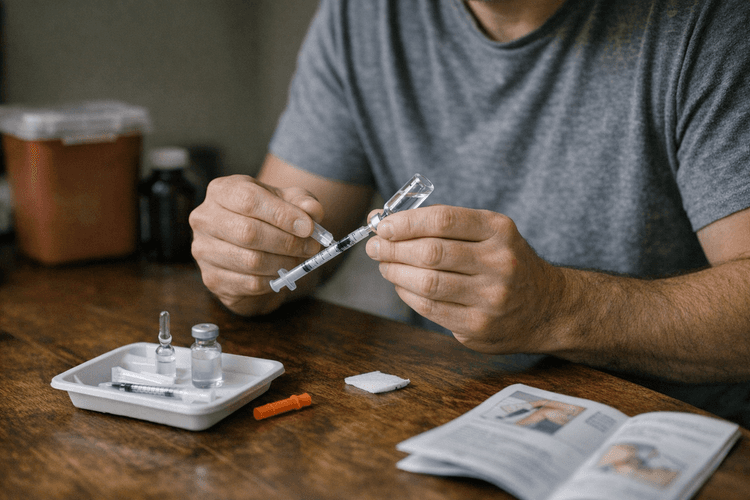
hCG is injected subcutaneously, usually in the abdomen or thigh. It comes as a powder that must be reconstituted with bacteriostatic water and stored in the refrigerator. Once mixed, it is stable for 30 to 60 days depending on the preparation.
What to Watch For
If you develop testicular pain, swelling, or tenderness, contact your doctor. Some discomfort is common in the first few weeks, but persistent pain may indicate overstimulation or a cyst. Gynecomastia can develop if estradiol rises unchecked, so monitor it and adjust treatment if needed.
Fluid retention and elevated hematocrit are less common with hCG than with testosterone alone, but they can still occur. If your blood pressure rises or you notice swelling in your ankles, get labs checked.
Cost and Insurance
Pharmacy-grade hCG is FDA-approved for fertility indications but is often used off-label in men. Insurance may cover it for documented infertility but rarely covers it for use alongside TRT. Out-of-pocket cost ranges from $50 to $150 per month depending on dose and pharmacy.
Compounded hCG is cheaper, often $30 to $60 per month, but regulatory oversight is lighter. The FDA has issued warnings about compounded hCG potency and sterility. If you use a compounded product, confirm the pharmacy is registered with the state board and follows USP 797 sterile compounding standards.
Conclusion: Weighing the Options for hCG Treatment
The short answer: hCG preserves testicular function and usually maintains fertility while you are on TRT. Off TRT, it can raise testosterone in men with secondary hypogonadism, though the evidence is thinner and the cost is higher than enclomiphene or clomiphene.
What it costs you depends on what you are trying to preserve. If fertility is the goal and you are already on TRT, hCG is the option with the most published support. The trials are small and old, but they show sperm production continuing or resuming when hCG is added to exogenous testosterone. If you stop TRT to recover fertility, the axis may restart on its own, but not everyone rebounds and not everyone can tolerate low testosterone while waiting.
Off TRT, hCG monotherapy raises testosterone by stimulating the testes directly. It works for men whose pituitary still makes LH but whose testes need a stronger signal. It does not work if your own LH is already high and your testes are not responding. The number that matters here is baseline LH: if it is low or low-normal and your total testosterone is low, hCG may raise both. If LH is already elevated, hCG will not fix primary testicular failure.
Nobody selling it will tell you that the evidence for hCG monotherapy in eugonadal or mildly hypogonadal men is limited. The published trials focus on severe hypogonadotropic hypogonadism or on preserving fertility during TRT. The dose, frequency and monitoring protocols used in telehealth clinics are extrapolated from those contexts, not tested in large randomized trials of men with garden-variety low testosterone.
The cheapest option is the one whose monitoring you can afford to do correctly, not the one with the lowest sticker price.
What we don't know yet: long-term cardiovascular and metabolic outcomes for hCG monotherapy, head-to-head comparisons with enclomiphene at equivalent testosterone targets, and whether the cost and injection burden justify the marginal fertility advantage over SERMs in men not yet on TRT. For a detailed comparison of treatment options and how to choose a provider, see Best Online TRT Clinic: How to Choose and What to Avoid.
Before you sign up, ask the clinic what labs they require at baseline and on treatment, how often, and what those labs cost you if insurance does not cover them. Ask whether the hCG is FDA-approved or compounded, and whether the protocol changes if you later want to stop or switch. The answers tell you whether the clinic is running a trial-informed monitoring plan or a flat monthly fee with optional labs.
Test first, test twice, and know your LH before choosing between hCG and other options. One morning result is not a diagnosis, and a low total testosterone with high LH points you away from hCG and toward TRT or investigation of primary testicular causes.
Related reading
How to Increase Testosterone Naturally: What Actually Moves the Number
Sources(18)
- Cureus (2022)
- Cureus (2022)
- The journal of sexual medicine (2015)
- Cureus (2022)
- Cureus (2022)
- Hormone research (1984)
- Fertility and sterility (2024)
- The world journal of men's health (2026)
- Translational andrology and urology (2025)
- Journal of endocrinological investigation (2010)
- Journal of andrology (2003)
- The Journal of clinical endocrinology and metabolism (2015)
- Current pharmaceutical design (2021)
- The Journal of urology (2012)
- Asian journal of andrology (2019)
- DailyMed (U.S. National Library of Medicine) — FDA prescribing information: Chorionic Gonadotropin kit [Fresenius Kabi USA, LLC] (2025)
- European journal of obstetrics, gynecology, and reproductive biology (2003)
- Steroids (1995)