At-Home Testosterone Kits vs Lab Draw: What You Need to Know
Updated
Top takeaways
- At-home testosterone kits typically measure saliva, while lab draws measure serum testosterone from blood
- Lab draws provide a full hormone panel including LH, FSH, SHBG and free testosterone; most at-home kits measure total testosterone only
- Morning fasting blood draws remain the clinical standard for diagnosing low testosterone
- At-home kits cost less up front but may require a follow-up lab draw anyway
- The sample type and timing determine whether your result is actionable
Introduction
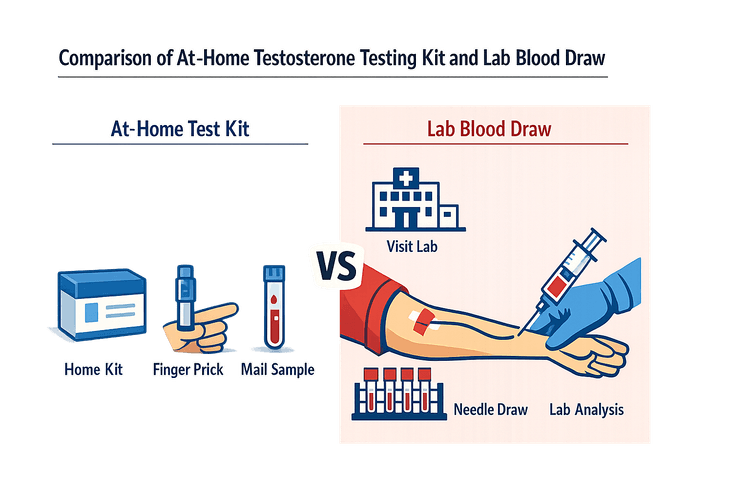
When comparing at-home testosterone kits vs lab draw, you face two paths: order a kit, spit in a tube at home, mail it back. Or schedule a lab appointment, fast overnight, get blood drawn in the morning. The first costs less and requires no appointment. The second gives you the numbers a doctor needs to make a treatment decision.
The difference is not just convenience. Saliva and blood measure different things. One morning blood result includes total testosterone, free testosterone, SHBG, LH and FSH. Most at-home kits measure total testosterone from saliva and stop there. If your number is low, you will need a lab draw anyway before starting treatment.
Hormone imbalances show up as low energy, reduced sex drive, mood changes and physical symptoms. Testing is the first step. Choosing the right test determines whether you get an answer or just a number that leads to more testing.
This guide walks through what each testing method measures, what it costs you in time and money, and when each one is the right tool. Test first, test twice, test correctly.
What Are the Limitations of At-Home Testosterone Testing?
At-home testosterone kits promise convenience: a finger prick, a prepaid envelope, and results in your inbox. What they do not promise is the standardization, reference range consistency, or inter-kit comparability that lab draws provide. The gap between marketing convenience and measurement reliability is where most people make their first mistake.
Lack of Standardization Across Kits
Different manufacturers use different assay methods, different reference ranges, and different sample types—saliva, capillary blood, or dried blood spots. The inter-comparability of these kits has not been established. One kit may report your testosterone at 450 ng/dL; another, using a different method on the same sample, may report 380 ng/dL. Neither is necessarily wrong, but neither can tell you which number to trust.
Lab draws use standardized liquid chromatography-tandem mass spectrometry (LC-MS/MS) or electrochemiluminescence immunoassay (ECLIA) platforms with certified reference materials. At-home kits typically use enzyme-linked immunosorbent assay (ELISA) methods that are cheaper, faster, and less precise. The difference shows up in reproducibility: run the same sample twice at a lab, and the results cluster tightly. Run it twice with two different at-home kits, and the spread widens.
What At-Home Kits Do Not Measure
Most at-home kits measure total testosterone only. A full lab panel includes free testosterone, sex hormone-binding globulin (SHBG), luteinizing hormone (LH), follicle-stimulating hormone (FSH), and estradiol. Without these, you cannot tell whether a low total testosterone is primary hypogonadism, secondary hypogonadism, or high SHBG masking normal free testosterone.
If you are choosing an online TRT clinic, they will require a full panel before prescribing. An at-home total testosterone result alone will not satisfy that requirement. You will retest at a lab anyway, which makes the at-home kit a screening step that costs you time and money without moving you closer to a diagnosis.
One number without context is not a diagnosis—it is a reason to get the full panel.
Timing, Collection, and User Error
Testosterone peaks in the morning and declines through the day. Lab draws are timed and controlled: you show up fasting, between 7 and 10 a.m., and a phlebotomist draws venous blood under standardized conditions. At-home kits rely on you to prick your finger at the right time, collect enough blood, avoid hemolysis, and ship the sample without temperature excursions.
Each step introduces variability. A capillary sample taken at 2 p.m. after lunch will read lower than a venous sample taken at 8 a.m. fasting. A dried blood spot that sat in a hot mailbox for two days may degrade before it reaches the lab. The kit's instructions tell you to control these variables, but they cannot enforce it—and the lab processing your sample has no way to know whether you followed them.
Cost and Retesting
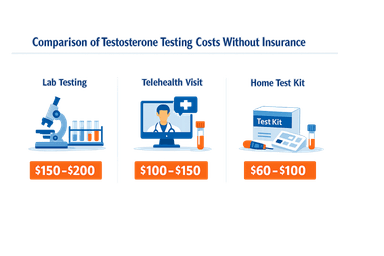
At-home kits cost $50 to $150 for a single total testosterone measurement. A lab draw with a full panel—total and free testosterone, SHBG, LH, FSH, estradiol—costs $100 to $200 through a direct-to-consumer lab or $20 to $50 with insurance. If your at-home result is borderline or unclear, you will retest at a lab anyway. The at-home kit becomes an expensive detour, not a shortcut.
If you are testing to confirm a suspicion, go straight to the lab. If you are tracking a known condition over time, at-home kits may have a role—but only if you use the same kit, the same collection time, and the same shipping conditions every time. Even then, the variability is higher than a lab draw.
How to Get Accurate Testosterone Test Results
Before you order any test, you need two morning results and a full panel. One number from a finger prick tells you almost nothing.
Step 1
Talk to your provider first
Ask your doctor whether an at-home test fits your situation. If you are already on testosterone replacement therapy and using intramuscular injections, dried blood spot sampling may work for monitoring. If you use testosterone gel, contamination makes at-home finger-prick collection unreliable. If you have never tested before, you need a baseline venous draw with a full panel: total testosterone, free testosterone, SHBG, LH, FSH, estradiol, hematocrit and PSA.
Step 2
Collect the sample correctly
Follow your provider's instructions exactly. For at-home kits, that means reading the collection guide before you start, washing your hands, using the lancet on the side of your fingertip and letting the blood drip into the collection card without squeezing. Squeezing dilutes the sample with tissue fluid. For venous draws, the phlebotomist handles technique; your job is to show up fasting, between 7 and 10 AM, having slept at least six hours.
Step 3
Return the kit on time
Most at-home kits require you to mail the dried blood spot card back within 24 to 48 hours. The lab uses liquid chromatography-tandem mass spectrometry to measure testosterone from the dried spot. If the card sits in your drawer for a week, the sample degrades and the result is not valid. Check the kit instructions for the return window and ship it the same day you collect it.
Step 4
Repeat the test if the first result is abnormal
One morning result is not a diagnosis. If your total testosterone comes back below 300 ng/dL or above 1000 ng/dL, you need a second test at least one week later, same conditions: morning, fasted, rested. If both results are abnormal, your provider will order the full panel to see LH, FSH and SHBG before deciding what comes next.
When to use an at-home kit
At-home dried blood spot kits are feasible for monitoring if you are already on intramuscular testosterone and your provider has confirmed the method works for your treatment. They are not suitable for initial diagnosis, for patients using testosterone gel, or for anyone who needs LH, FSH, estradiol or other markers that require venous blood.
When to go to the lab
Go to a lab for your first test, for any diagnostic workup, and whenever you need more than total testosterone. The full panel requires a venous draw. If you are comparing testosterone supplements or deciding between treatment options, you need to see LH and FSH to know whether your pituitary is still signaling your testes. A finger prick will not give you that.
Tips and Tricks
Before you order any test, know what time you will draw. Testosterone peaks in the morning and drops through the day. A 7 AM sample and a 2 PM sample from the same person can differ by 30 percent. If you test at home at noon and your doctor draws at 8 AM, you are comparing two different numbers.
Test at the Same Time Every Time
When you track testosterone over weeks or months, consistency matters more than the method. Pick a two-hour window in the morning — ideally between 7 and 9 AM — and stick to it. If your first test was at 8 AM in a lab, your second test should be at 8 AM, whether that is another lab draw or a finger prick at home. The number that matters is the trend, and the trend only shows up when the timing is locked.
Understand What Contamination Means for At-Home Kits
If you use testosterone gel, at-home finger-prick sampling is not reliable. A study of patients on testosterone replacement therapy found that dried blood spot samples from gel users showed contamination issues that made the results unusable. The problem is transfer: gel on your hands, on surfaces, or absorbed through skin near the puncture site skews the reading. Injections do not carry the same risk. If you are on gel and want to test at home, you need to confirm with the kit manufacturer that their protocol accounts for topical contamination — most do not.
Follow the Instructions Exactly
At-home kits rely on you to collect the sample correctly. In the trial that tested dried blood spot sampling, participants received written instruction materials and verbal guidance from an andrology consultant before collecting their samples. Even with that support, proper technique was critical. If you skip a step — failing to clean the puncture site, using the first drop of blood instead of the second, or underfilling the collection card — the lab cannot correct for it. The result comes back, but it may not reflect your actual testosterone level.
Step 1
Prepare the night before
Wash your hands thoroughly and avoid touching any testosterone gel, cream, or topical product for at least 12 hours before the test. Set out your kit, a timer, and a clean surface.
Step 2
Warm your hands before the prick
Cold fingers produce slow, incomplete drops. Run warm water over your hands for 30 seconds, then dry them completely. Do not use lotion.
Step 3
Discard the first drop
The first drop of blood from a finger prick often contains tissue fluid and surface contaminants. Wipe it away with a clean gauze pad, then collect the second and third drops on the test card.
Know When a Lab Draw Is Worth the Trip
If you are testing for the first time, if your symptoms are unclear, or if a previous result was borderline, a venous draw gives you the full panel: total testosterone, free testosterone, SHBG, LH, FSH, estradiol, hematocrit, and PSA. At-home kits rarely measure all of these, and the ones they skip — LH and FSH in particular — tell you whether low testosterone is primary (testicular) or secondary (pituitary). That distinction changes the treatment. A $50 at-home kit that measures total testosterone alone does not answer the question a doctor needs to answer before writing a prescription.
For monitoring an established treatment, at-home sampling can work if you are on injections, your dose is stable, and you are only tracking total testosterone. For everything else, the lab draw remains the standard. The blood draw itself takes less than five minutes, and the slight sting when the needle goes in is over before you notice it.
If you are deciding between testing methods or starting treatment, start with a baseline lab panel. Use at-home kits for follow-up only after you know what normal looks like for you.
Conclusion
The choice between at-home testosterone kits vs lab draw comes down to what you need the number for. If you want a rough signal that something might be off — a first screen before talking to a doctor — a finger-prick kit can give you that. If you need a number that holds up under clinical scrutiny, that a physician will use to write a prescription or rule out a diagnosis, you need venous blood drawn in the morning at a certified lab.
The data show that lab accuracy has improved: 87.7% of participant laboratories now meet the minimum allowable error limits for testosterone measurement, a 14.7% improvement over earlier proficiency testing. That improvement matters most at the low end of the range, where a few dozen ng/dL separate borderline-low from clearly low, and where treatment decisions hinge on precision. At-home kits — especially those using immunoassay platforms — still struggle at those concentrations. Mass spectrometry remains the gold standard for total testosterone, and equilibrium dialysis followed by direct assessment is the gold standard for free testosterone. Most at-home kits do not use either method.
If cost or convenience is the barrier, start with an at-home kit to see if the number is worth investigating further. If it comes back low, follow up with a lab draw and a full panel: total and free testosterone, SHBG, LH, FSH, estradiol, hematocrit and PSA. That panel tells you not just whether testosterone is low, but why, and what your options are. No at-home kit gives you that.
Before you sign up for a telehealth subscription or a treatment protocol based on a single at-home result, ask what method the lab used, whether the result meets clinical diagnostic standards, and whether the clinic requires a confirmatory venous draw. The answer tells you whether they are selling you a test or selling you a treatment. For a detailed breakdown of what to look for in a telehealth provider, see Best Online TRT Clinic: How to Choose and What to Avoid.
Test first, test twice, and make sure the second one is a number your doctor will trust.
Frequently asked questions
What is the difference between at-home testosterone kits vs lab draw?
At-home testosterone kits vs lab draw differ in sample type, accuracy, and scope. At-home kits typically measure total testosterone from saliva or capillary blood using ELISA methods. Lab draws measure serum testosterone from venous blood using LC-MS/MS or ECLIA platforms and include a full hormone panel: total testosterone, free testosterone, SHBG, LH, FSH, and estradiol. Lab draws provide standardized, reproducible results suitable for clinical diagnosis; at-home kits serve as screening tools but often require lab confirmation.
Are at-home testosterone tests accurate?
At-home testosterone tests vary in accuracy. Most use ELISA immunoassays, which are less precise than the LC-MS/MS platforms used in clinical labs. Inter-kit comparability has not been established, so the same sample may yield different results across brands. Timing, collection technique, and shipping conditions introduce additional variability. At-home kits can signal whether further testing is warranted but are not reliable enough to diagnose low testosterone or guide treatment decisions without lab confirmation.
How much do at-home testosterone kits cost compared to lab draws?
At-home testosterone kits cost $50 to $150 for total testosterone only. A lab draw with a full panel—total and free testosterone, SHBG, LH, FSH, estradiol—costs $100 to $200 through direct-to-consumer labs or $20 to $50 with insurance. If an at-home result is borderline or unclear, you will need a follow-up lab draw anyway, making the at-home kit an added expense rather than a cost-saving measure.
When should I use a lab draw instead of an at-home kit?
Use a lab draw for initial diagnosis, for any diagnostic workup, and whenever you need more than total testosterone. If you are testing for the first time, if symptoms are unclear, or if a previous result was borderline, a venous draw provides the full hormone panel required for clinical decision-making. Lab draws are also necessary if you use testosterone gel, as topical contamination makes at-home finger-prick sampling unreliable.
Can I use at-home testosterone kits to monitor TRT?
At-home dried blood spot kits may work for monitoring if you are on intramuscular testosterone injections, your dose is stable, and your provider has confirmed the method is appropriate for your treatment. They are not suitable for patients using testosterone gel due to contamination risk, or for anyone requiring LH, FSH, estradiol, or other markers that need venous blood. Always confirm with your provider before relying on at-home kits for treatment monitoring.
Related reading
Sources(29)
- MedlinePlus (U.S. National Library of Medicine) (2025)
- Scandinavian journal of clinical and laboratory investigation (2017)
- Clinical chemistry and laboratory medicine (2026)
- Quest Diagnostics (questhealth.com) (2026)
- The Urologic clinics of North America (2022)
- American Urological Association — Evaluation and Management of Testosterone Deficiency (AUA Guideline) (2018)
- The world journal of men's health (2026)
- F&S reviews (2020)
- The Journal of urology (2020)
- The Journal of urology (2015)
- European journal of endocrinology (2024)
- Internal medicine journal (2020)
- American family physician (2024)
- The aging male : the official journal of the International Society for the Study of the Aging Male (2015)
- JAMA (2017)
- Public health reports (Washington, D.C. : 1974) (2015)
- U.S. Food and Drug Administration — Drug Safety Communication: FDA cautions about using testosterone products for low testosterone due to aging; requires labeling change to inform of possible increased risk of heart attack and stroke with use (2015)
- The Journal of clinical endocrinology and metabolism (2025)
- The journal of nutrition, health & aging (2016)
- Maturitas (2026)
- Oncoscience (2025)
- The Journal of clinical endocrinology and metabolism (2023)
- Translational andrology and urology (2020)
- The Chinese journal of physiology (2022)
- Sexual medicine reviews (2016)
- International braz j urol : official journal of the Brazilian Society of Urology (2025)
- International journal of pharmaceutical compounding (2015)
- Andrology (2025)
- The journal of sexual medicine (2014)