Testosterone Test Cost Without Insurance: Every Route Compared
Updated
Top takeaways
- Testosterone test cost without insurance ranges from $30 for a single total testosterone measurement to $300+ for a full hormone panel
- Direct-to-consumer lab orders, telehealth memberships, and at-home kits price differently and test different markers
- Quest and LabCorp publish self-pay rates; telehealth clinics bundle testing with consultation fees; home kits add shipping and processing
- Two morning tests are the clinical standard—factor that into your total cost before choosing a route
- Knowing what each option measures and what it leaves out helps you compare the real price per data point
Introduction
Testosterone test cost without insurance depends on which lab draws it, what the panel includes, and who places the order. You need a testosterone test. Your doctor ordered one, your insurance denied it, or you want the number before sitting in a waiting room. The bill varies by a factor of ten for tests that look identical on paper. Over a million commercially insured men get new testosterone tests each year, and the ones paying out-of-pocket see prices that range from $30 to $300.
The confusion starts with the word "testosterone test." A single total testosterone measurement costs $30 to $50 at a walk-in lab. A full panel—total and free testosterone, SHBG, LH, FSH, estradiol—runs $200 to $300. Telehealth clinics advertise $45 testing but tie it to a $100 consultation. At-home finger-stick kits list at $79 and measure one or two markers. You are comparing four routes that bundle different things and call them all a testosterone test.
This guide breaks down the testosterone test cost without insurance across every major route: Quest and LabCorp self-pay, third-party lab-order sites, telehealth memberships, and at-home kits. Each section lists what you pay, what you get, and what the order does not include. The comparison tables show per-marker costs so you can see where the markup lives. By the end, you will know which route fits your budget and which one gives you the panel you actually need. For context on what to do with the results once you have them, see Best Online TRT Clinic: How to Choose and What to Avoid.
What Drives Testosterone Test Cost Without Insurance?
The price you pay for a testosterone test depends on who orders it, where you go, and whether you ask first. Most men find out the cost after the bill arrives.
Insurance claims data show that about 20 percent of men who received testosterone prescriptions had no insurance claims for laboratory testing of testosterone levels. That means one in five men started treatment without a documented baseline, or they paid out of pocket and the insurer never saw it. Either scenario points to the same gap: testing happens outside the standard reimbursement path more often than most people expect.
Why Pricing Stays Hidden
Laboratories publish a "list price" that almost nobody pays. Insurance negotiates a lower rate. Self-pay patients see a third number, sometimes lower than the insured rate, sometimes higher. The same panel at the same lab can cost $80 or $400 depending on how you walk in the door.
Telehealth platforms bundle the test into a membership or consultation fee. Some include the lab draw, some don't. The line items are rarely separated until you receive the receipt. Home test kits advertise one price on the box and add shipping, processing, or "physician review" fees at checkout.
The Insurance Coverage Problem
When insurance does cover testosterone testing, it typically requires a diagnostic code and prior symptoms documented in your chart. If you order the test yourself—through a direct-to-consumer lab or a men's health clinic—there is no claim to submit and no negotiated rate to lean on. You pay the self-pay price, and that number varies by more than most people guess.
Blue Cross Blue Shield-associated firms have largely denied requests for coverage of compounded medications, including testosterone troches. That coverage stance extends upstream: if the insurer will not cover the treatment, it is less likely to cover repeat monitoring panels. Men who choose compounded or off-label options often pay for every test out of pocket from the start.
What You Need to Know Before You Test
Before you can compare routes, you need to know what you are buying. A "testosterone test" can mean total testosterone alone, or it can mean a full panel with free testosterone, SHBG, LH, FSH, estradiol, hematocrit, and PSA. The single-marker test costs less and tells you less. The full panel costs more and gives you the reference points that matter for choosing what to do next.
The next section walks through each route—direct lab, telehealth, and home kit—with the line items that actually appear on the bill.
Solution Steps
Three routes get you a testosterone number without insurance. Each differs in price, what you get measured, and how much of your time it takes. Here is what each costs you in money and monitoring.
Route One: Walk-In Lab Testing
Step 1
Find a direct-access lab
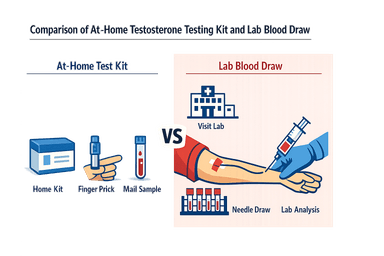
Quest and LabCorp both sell testosterone panels directly to consumers in most states. You order online, pay upfront, and walk into a patient service center without a doctor's order. New York, New Jersey and Rhode Island prohibit direct-access lab testing; you need a physician order in those states.
Step 2
Choose your panel
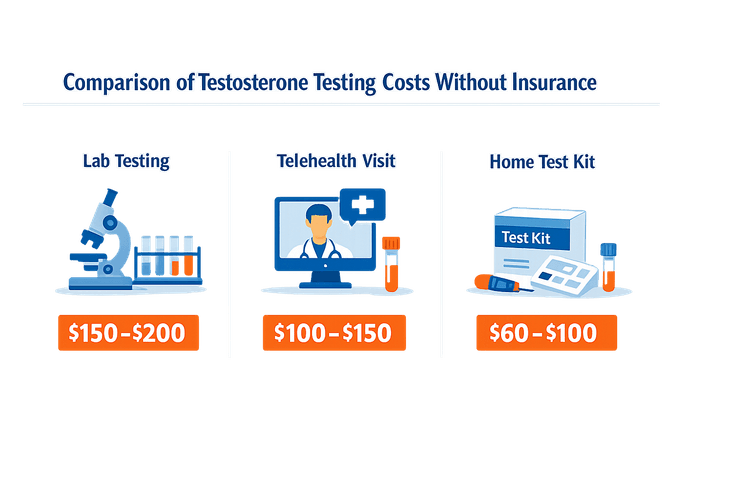
A total testosterone test alone runs $35–$69 at Quest and LabCorp. A full panel—total and free testosterone, SHBG, LH, FSH and estradiol—costs $150–$250 depending on the lab and your region. The single-marker test tells you less; without LH and SHBG, you cannot tell whether low testosterone is primary or secondary, and you cannot calculate free testosterone accurately.
Step 3
Schedule and draw
Most patient service centers take walk-ins for pre-paid tests. Expect a five- to ten-minute visit. Results post to an online portal in one to three business days. The lab sends you a PDF with each value and its reference range; no interpretation is included.
Walk-in lab testing gives you the raw numbers at the lowest per-test price. It does not give you a prescription, a treatment plan, or a physician review. If your result is low, you take that PDF to a doctor separately.
Route Two: Telehealth Testosterone Clinics
Online TRT and hormone clinics bundle the lab work into a membership or consultation fee. The advertised lab is often free, but the consultation fee and monthly medication cost are where the real expense sits.
Typical structure: $99–$199 for an initial consult that includes a lab order. You go to a Quest or LabCorp draw site with that order. The clinic reviews your results and, if you qualify, writes a prescription. Monthly medication cost after that runs $99–$250 depending on the drug, the dose, and whether it is compounded or brand-name.
Some clinics require you to start treatment to get the initial lab reviewed. Others will review the lab and give you the results without obligating you to a prescription. Ask before you pay which model the clinic uses. If they will not review your lab unless you commit to treatment, you are paying for access to medication, not for diagnostic clarity.
The cheapest consult is the one that gives you your numbers and lets you leave without signing up for a monthly auto-ship.
For a full comparison of how telehealth clinics structure their pricing and what to check before you sign up, see Best Online TRT Clinic: How to Choose and What to Avoid.
Route Three: At-Home Test Kits
At-home testosterone kits let you collect a blood or saliva sample at home and mail it to a lab. The kit includes the collection supplies and prepaid return shipping. Results post to an online account in roughly one week.
Pricing ranges from $49 for a single total-testosterone finger-prick test to $200+ for a panel that includes free testosterone, SHBG and other markers. Saliva tests are cheaper than blood tests but measure a different fraction of testosterone; the reference ranges and clinical interpretation differ, and most physicians do not use saliva results to guide treatment decisions.
Some kits include a physician review; others give you only the lab report. Check what the kit price covers before you order. A $69 kit that includes a doctor consult may be a better deal than a $49 kit that leaves you with a number and no next step.
At-home testing costs less than a telehealth consult and more than a walk-in single marker. It suits people who want convenience and are comfortable following sample-collection instructions without supervision. It does not suit people who need a prescription written the same week or who want a venous draw supervised by a phlebotomist.
Tips and Tricks
Before you order, know what you are actually buying. A total testosterone result alone does not tell you whether low testosterone is primary or secondary, and it does not tell you whether treatment will help. The panel you need includes total and free testosterone, SHBG, LH, FSH, and estradiol. Some direct-to-consumer labs sell total testosterone for under $50 and call it a hormone panel. It is not. You will end up ordering a second test.
Test in the morning
Testosterone peaks in the early morning and drops through the day. The Endocrine Society guideline says test before 10 a.m. If you test at 3 p.m., your result may look low when it is not. Most labs do not enforce collection time, so you have to enforce it yourself. One afternoon result is not a diagnosis.
Order the full panel once, not total testosterone twice
If total testosterone comes back low, your next question is why. LH and FSH tell you whether the signal from the pituitary is working. SHBG tells you whether free testosterone is low even when total looks normal. Estradiol and hematocrit matter if you start treatment. Ordering these one at a time through a lab menu costs more than ordering them together. Quest's basic hormone panel runs around $150 and includes the markers that matter. Ordering total testosterone alone for $40, then adding LH, FSH, and SHBG individually later, costs you $200.
Compare the membership math before you sign up
Telehealth clinics bundle testing, consultation, and prescription access into monthly subscriptions. The headline price is often lower than the real price. One service advertises $49 per month but charges a separate lab fee, a separate medication fee, and a physician-review fee on top of that. Another charges $199 per month and includes everything. Read the billing page, not the landing page. Ask what the total cost is for three months, including labs and medication, before you enter a card number.
The cheapest test is the one that answers the question you actually need answered, the first time.
Use HSA or FSA funds where allowed
Most direct lab companies and home-test kits accept HSA and FSA cards. Testosterone testing qualifies as a diagnostic expense. If you have an HSA balance, this is a valid use. Some telehealth memberships also qualify, but the IRS draws a line between diagnostic services and wellness coaching. Check the receipt description before you submit it for reimbursement.
Retest before you treat
One low result is not enough. The guideline says test twice, on separate mornings, before starting treatment. Testosterone varies day to day. Stress, sleep, illness, and alcohol all move the number. If you test once, get a low result, and start treatment the same week, you do not know whether the first result was real. Retesting costs you another $50 to $150, but it costs less than six months of treatment you did not need.
If you are comparing telehealth options and are not sure which model fits, read how to evaluate a clinic before signing up. For natural approaches to supporting testosterone levels, see How to Increase Testosterone Naturally: What Actually Moves the Number.
Conclusion
The testosterone test cost without insurance ranges from $30 for a basic total testosterone measurement at a walk-in lab to $200 for a full panel through telehealth. The number that matters is what you pay out of pocket, not the list price a billing department sends to an insurer.
Quest and LabCorp publish self-pay menus. At-home finger-prick kits ship a result in days but measure fewer markers. Telehealth bundles the test with a consultation, which raises the upfront cost and adds a subscription if you continue. Each route trades money for convenience, breadth of the panel, and whether a physician reviews the result.
Before you order, confirm the panel includes total testosterone, free testosterone, SHBG and LH. A single number without context tells you less than the reference range printed beside it. Best Online TRT Clinic: How to Choose and What to Avoid covers what to check before signing up for a service that bundles testing with treatment.
The cheapest option is the one whose result you trust enough to act on. If the panel is incomplete or the phlebotomy protocol is wrong, you pay twice.
FAQ
How much does a testosterone test cost without insurance at Quest or LabCorp?A single total testosterone test costs $35–$69. A full hormone panel with free testosterone, SHBG, LH, FSH and estradiol runs $150–$250 depending on the lab and your region.
Are at-home testosterone tests as accurate as lab tests?At-home finger-prick tests measure the same markers as venous draws, but sample quality depends on proper collection technique and handling. An afternoon sample left at room temperature for hours will not match a controlled morning venous draw. Follow timing and shipping instructions exactly.
Do telehealth testosterone clinics charge for lab work separately?Some clinics include the lab order in the consultation fee; others charge separately. Ask before you pay whether the advertised price covers the lab draw or only the order form.
Can I use HSA or FSA funds to pay for a testosterone test?Yes. Testosterone testing qualifies as a diagnostic expense. Most direct lab companies and home-test kits accept HSA and FSA cards. Check the receipt description before submitting telehealth memberships for reimbursement.
How many testosterone tests do I need before starting treatment?Guidelines call for two separate fasting morning samples, drawn on different days, to confirm low testosterone before starting treatment. One result is not a diagnosis.
Sources(12)
- Quest Diagnostics (questhealth.com) (2026)
- The journal of sexual medicine (2022)
- MedlinePlus (U.S. National Library of Medicine) (2025)
- JAMA (2017)
- American Urological Association — Evaluation and Management of Testosterone Deficiency (AUA Guideline) (2018)
- Clinical biochemistry (2019)
- U.S. Food and Drug Administration — Drug Safety Communication: FDA cautions about using testosterone products for low testosterone due to aging; requires labeling change to inform of possible increased risk of heart attack and stroke with use (2015)
- The Journal of clinical endocrinology and metabolism (2026)
- Public health reports (Washington, D.C. : 1974) (2015)
- European urology focus (2017)
- The Urologic clinics of North America (2022)
- International journal of impotence research (2023)