How Long Does TRT Take to Work? Symptom-by-Symptom Timeline

Updated
Top takeaways
- TRT effects appear on different timelines for different symptoms — some change in weeks, others take months
- The trials that measured this tracked participants for an average of 20 to 22 months, not a few weeks
- Hormone levels rise quickly, but the symptoms you feel lag behind the blood work
- You need two morning testosterone results before starting, and regular monitoring after
- Knowing the realistic timeline helps you tell whether the treatment is working or whether something else needs adjusting
Introduction
How long does TRT take to work? Most men starting testosterone replacement therapy see their first changes within 3 to 6 weeks, but the full picture takes months. Sexual interest typically improves by week six, mood shifts become noticeable between weeks three and thirty, and body composition changes require 12 to 16 weeks of consistent treatment.
You start testosterone replacement therapy and want to know when you will feel different. The clinic may tell you a few weeks. The trials say something more careful.
In studies that followed men on TRT, the mean treatment duration was around 21 months. Hormone levels — total testosterone, DHT, and estradiol — rose significantly compared to placebo, but the timeline for subjective improvements varied by symptom. Energy, mood, libido, muscle mass, and bone density do not all move on the same schedule.
Before you can evaluate whether TRT is working, you need to know what to expect and when. This article breaks down the symptom-by-symptom timeline based on what the published trials actually measured. It covers what changes first, what takes longer, and what monitoring looks like along the way. For a deeper look at how to choose a clinic that structures monitoring and pricing transparently, see the full clinic evaluation guide.
Problem Statement
You start TRT and wait. The clinic said you'll feel better, but nobody gave you a calendar. One week in, you check: nothing. Two weeks: maybe something, maybe placebo. A month passes and you're still tired, still flat, still wondering if the dose is wrong or if you picked the wrong treatment.
The uncertainty comes from three places. First, different symptoms respond on different schedules — libido moves faster than mood, mood moves faster than body composition. Second, trial data reports averages across populations, not individual timelines, so the published numbers tell you when most men notice change, not when you will. Third, clinics rarely break down what to expect week by week, so you're left guessing whether slow progress means the protocol is working or failing.
Without a symptom-by-symptom timeline, you can't separate normal lag from real problems. You don't know when to adjust, when to wait, or when to ask for labs. The result: men either quit too early or stay on ineffective protocols too long, both because they never knew what normal progress looks like.
How Long Does TRT Take to Work for Each Symptom?
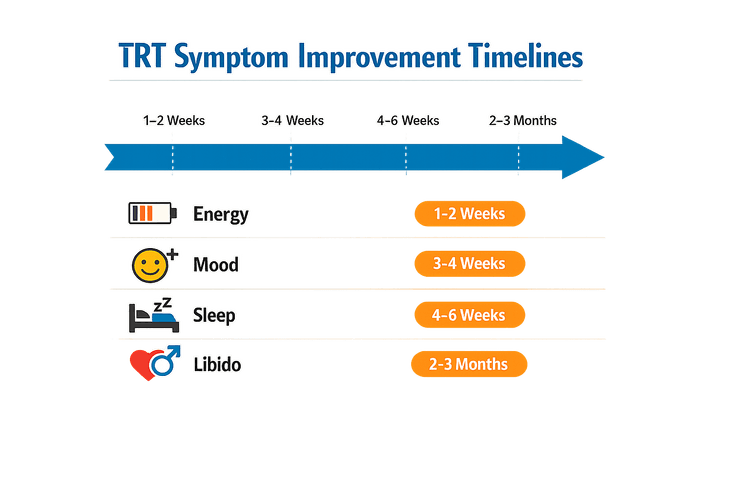
TRT does not flip a switch. Different symptoms respond on different schedules, and the published timelines come from trials that measured specific endpoints at set intervals. Here is what those trials found, symptom by symptom.
Sexual Interest: 3 to 6 Weeks
Effects on sexual interest appear after 3 weeks, plateau at 6 weeks, and no further increments are expected beyond that point. This is the fastest measurable change in most trials. If you see no shift in libido by week six, the dose may need adjustment or the diagnosis may need revisiting.
Log sexual interest weekly during the first six weeks. If you see no change by week six, schedule a follow-up lab and discuss dose or formulation with your prescriber before waiting longer.
Erections and Ejaculations: Up to 6 Months
Changes in erections and ejaculations may require up to 6 months. This timeline is longer than libido because vascular and tissue remodeling takes time. A man who sees libido return at week four but no erectile improvement at week eight is still within the expected range.
Mood and Depression: 3 to 30 Weeks
Effects on depressive mood become detectable after 3 to 6 weeks, with maximum benefits observed after 18 to 30 weeks. Early mood shifts are real but partial. The full effect takes months, and trials that stopped at 12 weeks missed the peak.
Expect early mood improvement around week four to six, but reserve judgment on the full benefit until month five or six. If mood worsens or does not budge by week eight, loop in your prescriber.
Quality of Life: 3 to 4 Weeks for Initial Effects
Effects on quality of life manifest within 3 to 4 weeks, but maximum benefits take longer. Quality-of-life scales in trials capture energy, motivation and general well-being. The early bump is consistent; the ceiling varies by individual.
Body Composition and Strength: 12 Weeks to 12 Months
Changes in fat mass, lean body mass and muscle strength occur within 12 to 16 weeks, stabilizing at 6 to 12 months. This is the slowest timeline because tissue remodeling requires sustained anabolic signaling and training stimulus. A man who starts TRT and does not train will see smaller and slower composition changes than one who lifts.
Factors That Influence the Timeline
Dose, formulation, injection frequency, baseline testosterone level and adherence all shift the schedule. A man who starts at 150 ng/dL will usually see faster symptom relief than one who starts at 280 ng/dL. A man on weekly injections may see more stable mood than one on every-two-week injections, even at the same total dose.
Baseline health matters. Sleep apnea, obesity, uncontrolled diabetes and alcohol all blunt TRT response. Fixing those levers first accelerates the timeline and sometimes eliminates the need for TRT altogether. For more on non-medication options, see How to Increase Testosterone Naturally: What Actually Moves the Number.
The timeline in the trial is not a guarantee for the individual, but it is the best guide we have for setting realistic checkpoints.
Tips and Tricks for Monitoring Progress on TRT
Tracking TRT means watching the right numbers and symptoms at the right intervals. Most clinics test you at six to eight weeks, then again at three to six months. That schedule catches early problems — hematocrit climbing, estradiol spiking, PSA moving — before they turn into reasons to stop. If your clinic skips the second test or waits a year, ask why.
Keep a symptom log before you start
Write down your baseline: energy at 3 p.m., morning erections per week, gym performance, mood swings, brain fog. Use numbers or a simple scale. When you test again in eight weeks, you will have something concrete to compare against. Memory is unreliable; a log is not.
Test the full panel, not just total testosterone
Total testosterone alone tells you almost nothing about how you are responding. You need free testosterone, estradiol, hematocrit, and PSA at minimum. SHBG helps explain why your total looks good but you feel the same. LH and FSH tell you if your natural production has shut down. Clinics that skip these are cutting corners.
Know what moves fast and what moves slow
Libido and mood can shift in two to four weeks, sometimes earlier. Strength and body composition take three to six months. Bone density takes a year or more. If you expect everything to change in a month, you will quit too early. If you wait a year to check labs, you might miss a problem that needed attention at month two.
The number that matters most in the first eight weeks is hematocrit — it climbs faster than anything else, and it is the one that makes clinics pause treatment.
Do not chase a feeling; chase stable levels
Some men feel a surge in week two, then a dip in week four. That is not the treatment failing; that is your body adjusting and your dose schedule catching up. Stable symptom relief comes after stable blood levels, and stable blood levels take two to three months to establish. If you are on injections twice a week, your peaks and troughs flatten out by week eight.
Ask your clinic what they monitor and how often
Before you sign up, ask: What do you test at baseline? What do you test at follow-up? How often? What triggers a dose change or a pause? If the answer is vague or if they only test total testosterone once, that is a red flag. Monitoring is not optional; it is how you stay safe on TRT. For a breakdown of what to look for in a clinic, see Best Online TRT Clinic: How to Choose and What to Avoid.
Conclusion
TRT timelines are not one-size-fits-all. Some men feel energy changes in the first two weeks; others need three months before they notice anything. Sexual function, muscle mass and bone density follow different arcs, and mood improvements often lag behind the testosterone number itself. The research shows that short-term TRT is safe and does not promote prostate cancer development, but long-term data with defined endpoints are still needed.
Before you start, test twice. After you start, track symptoms and labs on a schedule you agree on with your prescriber. If you are shopping for a clinic, read how to choose an online TRT provider and check what the membership actually costs in money, monitoring and flexibility. One morning result is not a diagnosis, and one month of injections is not a verdict on whether the treatment works for you.
If your numbers are borderline or your symptoms are vague, ask your doctor about non-medication levers first: weight, sleep apnea screening, alcohol intake and training volume. If those do not move the number and your labs confirm hypogonadism, then you have a timeline to work with. Expect the first changes in weeks, the full picture in months, and adjustments along the way. For additional context on natural approaches before starting therapy, see testosterone supplements for men or enclomiphene as an alternative.
Sources(26)
- The Journal of urology (2020)
- The Journal of clinical endocrinology and metabolism (2026)
- American family physician (2024)
- U.S. Food and Drug Administration — Drug Safety Communication: FDA cautions about using testosterone products for low testosterone due to aging; requires labeling change to inform of possible increased risk of heart attack and stroke with use (2015)
- Journal of Clinical Endocrinology & Metabolism — Testosterone Therapy in Men With Hypogonadism: An Endocrine Society Clinical Practice Guideline (2018)
- International journal of general medicine (2022)
- American Urological Association — Evaluation and Management of Testosterone Deficiency (AUA Guideline) (2018)
- International journal of impotence research (2023)
- The Journal of urology (2015)
- The aging male : the official journal of the International Society for the Study of the Aging Male (2015)
- The aging male : the official journal of the International Society for the Study of the Aging Male (2024)
- International journal of pharmaceutical compounding (2015)
- European journal of endocrinology (2024)
- F&S reviews (2020)
- Annals of internal medicine (2020)
- Andrology (2025)
- Arthroscopy : the journal of arthroscopic & related surgery : official publication of the Arthroscopy Association of North America and the International Arthroscopy Association (2024)
- Phytotherapy research : PTR (2013)
- Therapeutics and clinical risk management (2009)
- Frontiers in endocrinology (2026)
- European journal of endocrinology (2011)
- The aging male : the official journal of the International Society for the Study of the Aging Male (2009)
- The journal of sexual medicine (2025)
- The Journal of clinical endocrinology and metabolism (2025)
- Health technology assessment (Winchester, England) (2024)
- Translational andrology and urology (2020)