Testosterone Enanthate vs Cypionate: Key Differences

Updated
Top takeaways
- Testosterone cypionate and enanthate are both injectable testosterone esters used for treating low testosterone
- The two formulations share nearly identical pharmacology, with cypionate having a half-life of approximately eight days
- Choosing between them often comes down to availability, cost, and individual clinic or pharmacy preference rather than clinical superiority
- Both require diagnosis confirmation with two morning testosterone measurements below normal range before starting treatment
- Understanding the minor differences helps you evaluate what your provider offers and what you actually pay for
Introduction
Testosterone cypionate vs enanthate is a common comparison when your lab results come back low and a provider recommends testosterone replacement therapy. The prescription will almost always specify one of these two injectable testosterone esters, and patients frequently ask which one is better. The published pharmacology does not support a meaningful clinical difference between the two.
Both are oil-based intramuscular injections. Both release testosterone slowly from the injection site. Both are dosed on similar schedules, typically every one to two weeks, though some patients inject more frequently to smooth out peaks and troughs. The structural difference between the two esters is a single carbon atom in the ester chain, and that translates to a half-life difference measured in hours, not days. For most patients, the two are interchangeable.
What matters more than the ester is how the therapy is monitored, what it costs, and whether the clinic ordering it actually confirmed low testosterone with two separate morning tests. The choice between cypionate and enanthate rarely changes your outcome, but the quality of the clinic prescribing it does. Before you commit to any provider, read Best Online TRT Clinic: How to Choose and What to Avoid to understand what separates a compliant, transparent provider from one that skips diagnostic steps or locks you into expensive recurring billing.
The remainder of this article walks through the pharmacokinetics, administration differences, side-effect profiles, and cost considerations for both esters. If you are deciding between the two, the short answer is that clinical evidence does not favor one over the other. If your provider insists one is superior without citing a head-to-head trial, ask why.
Testosterone Cypionate vs Enanthate: Which Should You Choose?
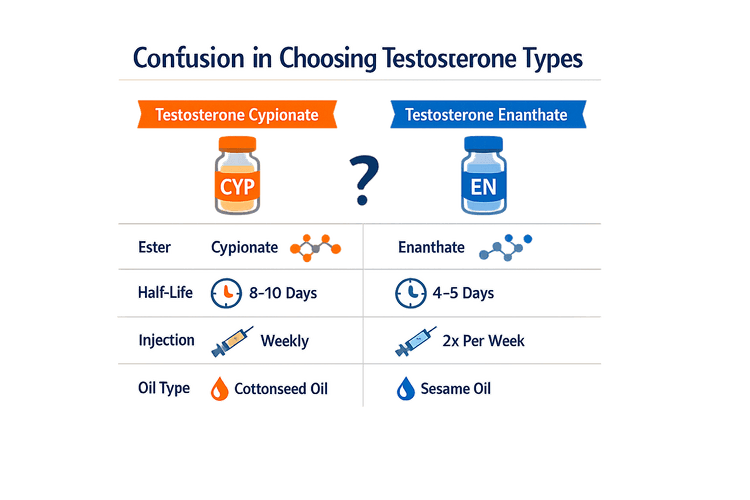
You walk into a clinic or open a telehealth portal, and the prescription reads either testosterone cypionate or testosterone enanthate. The doctor says they are interchangeable. The pharmacist says one might be in stock when the other is not. The internet says one is better for this, the other for that. You are left choosing between two drugs you cannot tell apart.
The confusion is not your fault. Both are long-acting testosterone esters, both require injections every one to four weeks, and both raise serum testosterone to similar levels when dosed correctly. The published trials rarely compare them head-to-head in the same study population, and when they do, the differences in efficacy, side effects, or patient preference are too small to call one superior. A trial of 136 men using testosterone cypionate at 100 mg weekly showed increased sexual activity and no biochemical recurrence events, but it did not test enanthate in parallel, so you cannot extract a direct comparison from that result.
The Real Question You Are Trying to Answer
What you actually need to know is whether one formulation will cost you less, require fewer injections, cause fewer injection-site reactions, or fit better into your insurance formulary. The clinical difference between cypionate and enanthate is narrow. The practical difference—what you pay, how often you inject, and whether your pharmacy stocks it—is where the choice gets made.
Most prescribers choose based on what they learned in training, what the clinic stocks, or what the compounding pharmacy offers. That leaves you comparing two options without a clear rubric. Before you can decide, you need to know what actually differs: half-life, injection frequency, carrier oil, cost, and availability. The trials do not settle those questions because they were not designed to. The label information does, and so does your insurance formulary.
If you are evaluating online TRT clinics, ask which ester they prescribe and why. If the answer is "they are the same," ask what the price difference is and whether you can switch if one causes injection pain or is harder to source. The choice is less about pharmacology and more about logistics.
How to Choose Between Testosterone Cypionate and Enanthate
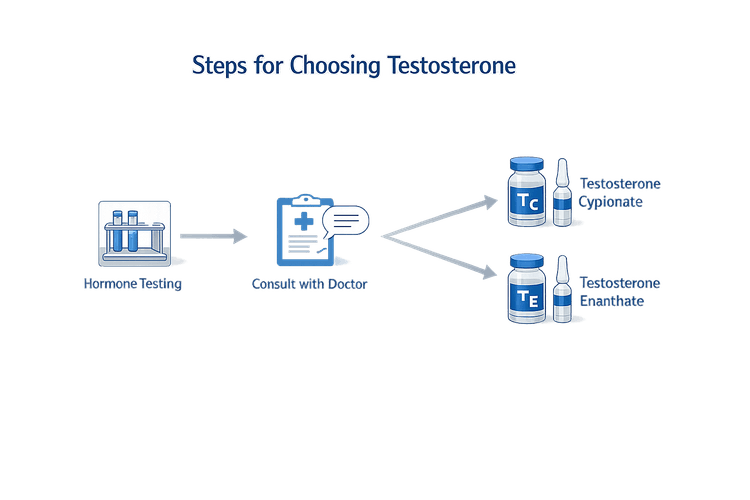
Before you compare formulations, you need a confirmed diagnosis. Two morning blood draws, taken on separate days, with testosterone below the normal range. That is the standard. One result is not enough.
Step 1
Test twice, early morning
Serum testosterone concentrations must be measured in the morning on at least two separate days and must be below the normal range to confirm hypogonadism before starting treatment. A single low result does not establish a diagnosis. Sleep, stress and recent illness all move the number temporarily.
Step 2
Review the full panel
Ask for total testosterone, free testosterone, SHBG, LH and FSH. The pattern tells you whether the problem is in the testes or the pituitary. If LH is low or low-normal, your body is not signaling for more testosterone. If LH is high, your testes are not responding. That distinction matters for treatment choice and monitoring later.
Step 3
Understand what both esters do
Testosterone cypionate and enanthate are both long-acting esters dissolved in oil. After intramuscular injection, serum testosterone rises into the supraphysiological range, then declines gradually into the hypogonadal range by the end of the dosing interval. Typical starting doses are 150–200 mg IM every two weeks or 75–100 mg per week. The half-life of cypionate is approximately eight days. Enanthate is similar.
The two esters are functionally interchangeable in clinical practice. Cypionate is more common in the United States; enanthate is more common elsewhere. Neither has a proven advantage in efficacy, side effects or cost when dosed equivalently.
Step 4
Decide on injection frequency
Weekly injections produce a narrower peak-to-trough swing than injections every two weeks. If you notice mood or energy swings in the second week of a two-week protocol, splitting the dose into weekly or twice-weekly injections often smooths the curve. The total weekly dose stays the same.
Step 5
Choose a clinic or prescriber
Telehealth and in-person clinics both prescribe testosterone, but their pricing, monitoring and membership structures differ. Before signing up, ask what the monthly cost includes: medication, labs, follow-up visits and shipping. Some clinics bill separately for each; others bundle everything. Best Online TRT Clinic: How to Choose and What to Avoid walks through what to check before you commit.
Monitoring After You Start
Once treatment begins, recheck testosterone, hematocrit, PSA and estradiol at three months, then annually if stable. The goal is a mid-normal total testosterone level measured at trough—right before your next injection. If your trough is still low, the dose goes up. If it is high and you have side effects, the dose goes down or the interval shortens.
In many tissues, testosterone activity depends on reduction to dihydrotestosterone, which binds to cytosol receptor proteins. The steroid-receptor complex is transported to the nucleus where it initiates transcription events and cellular changes related to androgen action. That is the mechanism, but it does not change how you dose or monitor.
Tips and Tricks
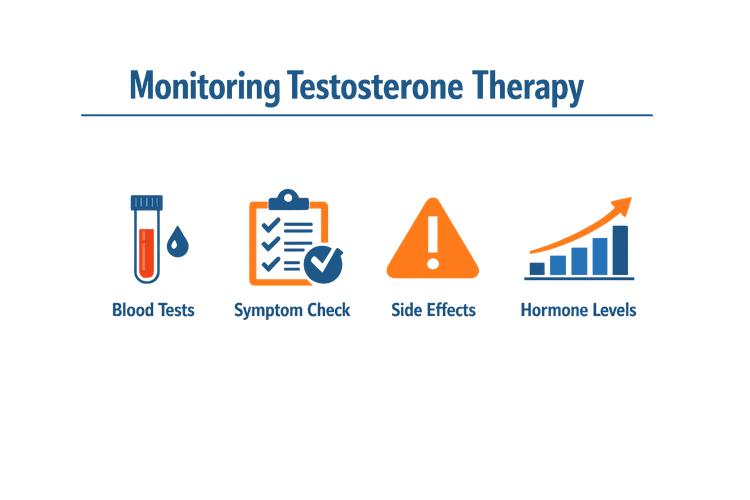
Before you pick one ester over the other, know what to ask for and what to track. The formulation matters less than whether your clinic monitors properly and whether you can stick to the schedule.
Ask for the Full Panel, Not Just Total Testosterone
Many clinics run total testosterone only. That number alone does not tell you if the treatment is working or if you are developing side effects. Ask for free testosterone, SHBG, estradiol, hematocrit and PSA at baseline and at follow-up. These numbers show whether the dose is right, whether your blood is thickening and whether estrogen conversion is climbing.
If a clinic resists ordering the full panel, that is a signal. Monitoring costs money; skipping it saves the clinic overhead but leaves you flying blind.
Test Timing Matters for Injectable Esters
Both cypionate and enanthate produce peaks and valleys. If you inject every two weeks, your testosterone level will be highest a day or two after the shot and lowest right before the next one. Testing at the wrong time can make a working protocol look like a failure or a too-high dose look fine.
Clinics that do not specify test timing are guessing. You want a protocol that accounts for pharmacokinetics, not one that treats every sample as equivalent.
Track Symptoms Alongside Numbers
Lab results tell you what is happening in your blood. Symptoms tell you what is happening in your body. If your total testosterone is in range but you still feel low energy, poor sleep or mood swings around injection day, the peaks and valleys may be too wide. Switching from twice-monthly to weekly dosing smooths the curve without changing the total amount of testosterone you get per month.
Some men feel better on a stable level; others tolerate the fluctuation fine. The only way to know is to track both the labs and how you feel across the full dosing interval.
Know What Monitoring Costs You
Follow-up labs typically run two to four times per year on TRT. If your clinic bundles labs into the membership fee, confirm what is included and what triggers an extra charge. If labs are billed separately, ask for the CPT codes and check what your insurance covers before you commit.
Some telehealth platforms include labs in the subscription; others charge per panel. The cheaper monthly fee is not always the cheaper total cost. For a detailed breakdown of what different TRT providers include and exclude, see our guide on how to choose an online TRT clinic.
Injection Frequency Is Negotiable
The label dosing for both cypionate and enanthate is typically every two weeks, but many providers now prescribe weekly or even twice-weekly injections to reduce peak-to-trough swings. Smaller, more frequent doses produce a steadier blood level and often reduce side effects like mood swings or acne that spike with high peaks.
If your clinic insists on a rigid two-week schedule and you are experiencing symptoms that correlate with injection timing, ask about splitting the dose. If they refuse without a clinical reason, that is another signal about how they approach individualization.
Self-Administration Saves Money and Time
Both formulations can be self-injected at home after training. Clinics that require in-office injections are adding cost and inconvenience without a medical benefit for most patients. Intramuscular injection is straightforward; most men are comfortable with it after the first few supervised attempts.
If you are paying per visit for an injection you could do at home, you are paying for access, not for a service that requires clinical skill. Confirm upfront whether your provider allows and trains for self-administration.
Conclusion
Testosterone cypionate vs enanthate: the two esters are nearly interchangeable for most men on TRT. Both deliver reliable testosterone elevation, both require injection, and both carry the same monitoring requirements for hematocrit, PSA and estradiol. The ester difference — cypionate's slightly longer half-life — rarely changes outcomes in the published trials.
The practical differences appear in administration and side-effect profiles. Intramuscular testosterone cypionate causes significant rises in estradiol, hematocrit and PSA due to supraphysiological peaks. Subcutaneous enanthate formulations reduce peak-to-trough swings and may lower those risks, but the data comparing them head-to-head is thin. If your clinic offers both routes, ask what they monitor and how often — that tells you more than the ester name.
Neither ester preserves fertility reliably. If sperm production matters to you now or later, enclomiphene or hCG belong in the conversation before you start any testosterone injection. Most telehealth platforms lead with the injection because it is simpler to prescribe and bill, not because it fits every patient. Test first, test twice, and know what you are trading before you sign the subscription.
For a structured comparison of how online TRT clinics price and monitor these options, see the clinic evaluation framework. The formulation you choose matters less than the lab work behind it and the transparency of the provider writing the script.
Frequently asked questions
What is the main difference between testosterone cypionate and enanthate?
Testosterone cypionate and enanthate differ by a single carbon atom in the ester chain. Cypionate has a half-life of approximately eight days; enanthate is similar. Both are oil-based intramuscular injections dosed every one to four weeks, and clinical trials show no meaningful difference in efficacy or side effects.
Is testosterone cypionate better than enanthate for TRT?
No published head-to-head trial shows testosterone cypionate is superior to enanthate for testosterone replacement therapy. The two esters are functionally interchangeable. Choice typically depends on availability, cost, and individual clinic preference rather than clinical advantage.
How often do you inject testosterone cypionate vs enanthate?
Both testosterone cypionate and enanthate are typically injected every one to two weeks. Some patients inject weekly or twice weekly to reduce peak-to-trough swings and minimize side effects like mood changes or acne. The total weekly dose remains the same regardless of injection frequency.
Does testosterone enanthate have fewer side effects than cypionate?
No evidence shows testosterone enanthate has fewer side effects than cypionate when dosed equivalently. Both can raise estradiol, hematocrit and PSA due to supraphysiological peaks after injection. Subcutaneous administration of either ester may reduce these peaks compared to intramuscular injection.
Which testosterone ester is cheaper: cypionate or enanthate?
Cost varies by pharmacy, insurance formulary, and whether you use a brand-name or compounded product. Neither ester is consistently cheaper. Check your insurance coverage and ask your clinic for pricing on both before deciding.
Related reading
Sources(27)
- The Journal of urology (2020)
- The Journal of clinical endocrinology and metabolism (2026)
- American family physician (2024)
- U.S. Food and Drug Administration — Drug Safety Communication: FDA cautions about using testosterone products for low testosterone due to aging; requires labeling change to inform of possible increased risk of heart attack and stroke with use (2015)
- Journal of Clinical Endocrinology & Metabolism — Testosterone Therapy in Men With Hypogonadism: An Endocrine Society Clinical Practice Guideline (2018)
- International journal of general medicine (2022)
- American Urological Association — Evaluation and Management of Testosterone Deficiency (AUA Guideline) (2018)
- International journal of impotence research (2023)
- International journal of impotence research (2023)
- The Journal of urology (2015)
- Sexual medicine reviews (2017)
- European journal of endocrinology (2024)
- U.S. Food and Drug Administration — Enclomiphene Citrate: FDA presentation to the Pharmacy Compounding Advisory Committee, June 8, 2022 (Madeline Wolfert, MD, CDER)
- International journal of obesity (2005) (2016)
- F&S reviews (2020)
- Andrologia (2014)
- Annals of internal medicine (2020)
- Expert opinion on pharmacotherapy (2005)
- DailyMed (U.S. National Library of Medicine) — FDA prescribing information: Depo-Testosterone (testosterone cypionate) injection, solution [Pharmacia & Upjohn Company LLC] (2026)
- The Journal of clinical endocrinology and metabolism (2022)
- Drug testing and analysis (2021)
- European journal of clinical pharmacology (1979)
- World journal of urology (2003)
- DailyMed (U.S. National Library of Medicine) — FDA prescribing information: Aveed (testosterone undecanoate) injection [Endo USA, Inc.] (2025)
- The aging male : the official journal of the International Society for the Study of the Aging Male (2015)
- Andrology (2025)
- European journal of endocrinology (2011)