How to Test Testosterone Levels: Testosterone Free vs Total

Updated
Top takeaways
- Total testosterone measures both bound and free hormone; free testosterone measures only the bioavailable portion that affects your cells
- One morning result is not a diagnosis—guidelines require at least two tests taken before 10 AM
- The full panel includes total and free testosterone, SHBG, LH, FSH, and sometimes estradiol and hematocrit
- Testing correctly means fasting, early morning timing, and avoiding workouts the day before
- Misreading the difference between testosterone free vs total leads to wrong treatment decisions and wasted money
Introduction
Before choosing between TRT, enclomiphene or nothing, you need two morning results and an understanding of what each number means. A single total testosterone reading tells you less than you think, and many men start treatment based on incomplete information.
Most online clinics will sell you treatment after one test. The published guidelines say otherwise. This guide walks through what each test measures, how to read the reference ranges, when free testosterone matters more than total, and what the rest of the panel tells you about whether your body is making enough hormone or needs help.
You will also learn the common timing and preparation mistakes that produce unreliable results, how to spot a clinic that skips the diagnostic steps, and what questions to ask before signing up for a subscription. For a detailed comparison of treatment options once you have accurate test results, see Best Online TRT Clinic: How to Choose and What to Avoid.
The number that matters depends on your SHBG level, your symptoms, and what the rest of the panel shows. Here is how to test first, test twice, and read the full picture.
Learn how to test testosterone levels accurately before making decisions about treatment options. Get the insights you need.
What is Testosterone Testing?
Testosterone testing measures the amount of testosterone in your blood. Your body carries testosterone in two forms: bound to proteins and unattached. A total testosterone test measures both. A free testosterone test measures only the unattached portion.
Most clinics order total testosterone first. It is the most common test and gives a starting number. The reference range printed on your lab report usually runs from around 300 to 1,000 ng/dL for adult men, though ranges vary by lab and age.
Testosterone Free vs Total: The Difference
Total testosterone includes hormone bound to sex hormone-binding globulin (SHBG) and albumin, plus the small fraction that floats unattached. Free testosterone is the unattached portion—typically 1 to 3 percent of the total. The bound hormone cannot enter cells easily. The free fraction is what your tissues use.
A free testosterone test is less common. Providers order it when total testosterone sits near the low end of normal but symptoms suggest deficiency, or when SHBG is abnormally high or low. High SHBG can make total testosterone look normal while free testosterone is low. Low SHBG can do the reverse.
What the Test Measures
The blood draw happens in the morning, ideally between 7 and 10 a.m., because testosterone peaks early and drops through the day. You fast beforehand—no food or drink except water for eight to twelve hours. The lab draws a vial, spins it down, and runs an immunoassay or mass spectrometry.
Total testosterone tells you the sum. Free testosterone tells you the bioavailable portion. Some labs calculate free testosterone from total testosterone, SHBG, and albumin using a formula. Direct measurement by equilibrium dialysis or ultrafiltration is more accurate but costs more and takes longer.
Understanding how to increase testosterone naturally starts with knowing which number you are working from. Without a baseline, you cannot measure change.
Why Testosterone Testing Matters
Testosterone testing tells you whether your symptoms have a hormonal cause and which treatment options fit your situation. Without accurate numbers, you are guessing. With them, you can tell whether low testosterone is primary (the testes), secondary (the pituitary), or neither.
Total testosterone measures all the hormone in your blood, bound and unbound. Free testosterone measures only the fraction available to tissues. Free testosterone correlates better with clinical and biochemical parameters of androgen deficiency than total testosterone does, especially in men with sexual symptoms. Routine assessment of free testosterone allows a more accurate diagnosis of functional hypogonadism.
What the Numbers Affect
Testosterone levels influence sex drive, muscle mass, bone density, fat distribution, red blood cell production, and sperm count. Measuring total testosterone can help identify factors that interfere with these functions. When total testosterone is borderline or normal but symptoms persist, free testosterone often explains the gap.
A single low result does not confirm hypogonadism. Guidelines require two morning samples taken on different days, plus measurement of luteinizing hormone (LH) to distinguish primary from secondary causes. LH tells you whether the pituitary is signaling the testes correctly. If LH is high and testosterone is low, the testes are not responding. If both are low, the pituitary is the issue. That distinction determines which treatments preserve fertility and which do not.
Why Free Testosterone Matters More for Some Men
Men with obesity, metabolic syndrome, or aging often have elevated sex hormone-binding globulin (SHBG), which binds testosterone and reduces the free fraction. In these cases, total testosterone may appear normal while free testosterone is low. Testing only total testosterone misses the diagnosis. Choosing the right online TRT clinic starts with knowing which numbers matter for your situation.
Fertility is another reason to test before treatment. Testosterone replacement therapy (TRT) suppresses sperm production in most men. Enclomiphene and human chorionic gonadotropin (hCG) raise testosterone without suppressing LH and FSH, preserving fertility in many cases. You cannot make that choice without knowing your baseline LH, FSH, and sperm parameters.
The number that matters is the one that explains your symptoms and guides treatment selection, not the one that sells the subscription.
Cost and monitoring differ by option. TRT requires regular hematocrit checks to monitor red blood cell production and prostate-specific antigen (PSA) monitoring in men over 40. Enclomiphene and hCG require LH and estradiol monitoring. Testing first tells you what monitoring you will need and what it will cost you in money and time.
How to Test Testosterone Levels Correctly
Before you test, you need two things: the right time of day and the right panel. One result tells you almost nothing. Two morning results, drawn before 10 a.m., give you a baseline. Add the supporting markers—SHBG, LH, FSH—and you can see whether your testosterone is low because your body isn't making enough or because something is binding it up.
Get Two Morning Draws Before 10 a.m.
Testosterone peaks in the early morning and drops through the day. A result drawn at 3 p.m. can be 30% lower than the same man's 8 a.m. number. One morning result is not a diagnosis. The Endocrine Society guideline says two separate morning samples, each drawn before 10 a.m., at least a week apart. If both come back low, you have a data point. If one is low and one is normal, you test again.
Fasting is not required for testosterone, but many clinics bundle it with a lipid panel or glucose test that does require fasting. Ask when you schedule.
Order the Full Panel, Not Just Total Testosterone
Total testosterone is the number most clinics advertise, but it is not the number that matters most. You need:
- Total testosterone — the sum of bound and unbound hormone
- Free testosterone — the unbound fraction that enters cells
- SHBG — the binding protein that holds most of your testosterone out of circulation
- LH and FSH — the pituitary signals that tell you whether your testicles are responding or your brain has stopped asking
Without SHBG, you cannot calculate free testosterone accurately. Without LH, you cannot tell whether low testosterone is primary (testicular failure) or secondary (pituitary suppression). The difference determines which treatment works.
Some labs report calculated free testosterone using total testosterone and SHBG. That is acceptable. Equilibrium dialysis is more accurate but costs more and is rarely necessary for initial screening.
Understand the Reference Range on Your Lab Report
Every lab report prints a reference range beside each number. That range is built from a population sample, often men aged 20 to 80, and it is wide. A total testosterone of 300 ng/dL is technically "normal" because it falls inside the range, but it is at the bottom. A 25-year-old man with a total testosterone of 300 ng/dL and symptoms is not the same as a 70-year-old man with the same number and no symptoms.
The reference range tells you whether you are an outlier. It does not tell you whether you need treatment. That decision comes from symptoms, age, and the full panel.
What About At-Home Kits?
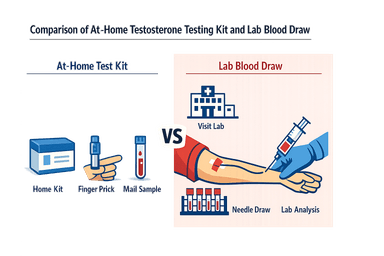
You may be able to test your testosterone levels with an at-home kit that collects a blood or saliva sample. Talk to your provider if you think an at-home test is right for you. If you do a home test, be sure to follow your provider's instructions for collecting the sample and for returning the kit for testing.
At-home kits vary in what they measure. Some report only total testosterone. Some use saliva, which correlates poorly with serum levels. Some do not include SHBG or LH. Before you order, check what the kit measures and whether the lab is CLIA-certified. A cheap kit that measures the wrong thing costs more than a proper draw.
If you are considering treatment, most clinics and insurance plans require a serum draw from a certified lab. The at-home result may prompt you to test, but it will not replace the diagnostic standard. For more on evaluating clinics, see Best Online TRT Clinic: How to Choose and What to Avoid.
Best Practices for Testing Testosterone Levels
Test twice before making any decision. One morning result is not a diagnosis. The Endocrine Society guidelines call for two separate fasting morning draws, ideally seven to thirty days apart. Both results should fall below the lower limit of normal before you start treatment conversations.
Test Testosterone Free vs Total with the Right Methods
Total testosterone is the standard first test. Most labs run an immunoassay, which is acceptable for screening. If your total testosterone sits near the lower reference limit or you carry extra body fat, add a free testosterone measurement. The accurate method is equilibrium dialysis, but most labs don't offer it. The next-best option is a calculated free testosterone using total testosterone, SHBG, and albumin in a validated formula. Direct immunoassay for free testosterone is unreliable — avoid it.
Reference ranges vary by lab and age. The CDC-harmonized lower limit for total testosterone in healthy nonobese young men is 264 ng/dL. Labs that are CDC-certified use this standard. If your lab isn't certified, confirm they participate in an accuracy-based quality control program. Age-adjusted ranges exist, but they reflect population averages that include men with obesity and chronic disease — not necessarily what is optimal for you.
Order the Full Panel
Total and free testosterone tell you the hormone level. LH and FSH tell you whether your hypothalamus and pituitary are trying to raise it. SHBG affects how much testosterone is bound and unavailable. Estradiol, hematocrit, and PSA matter for monitoring safety if you start treatment. Order all of them in the first round. Skipping any of these means guessing later.
Measure free testosterone by equilibrium dialysis or calculate it from total testosterone, SHBG, and albumin using a formula that accurately reflects the free fraction.
For men considering treatment, how to choose an online TRT clinic includes verifying that the provider orders the full panel and interprets it correctly before prescribing.
Timing and Preparation
Draw blood between 7 and 11 a.m. Testosterone peaks in the early morning and declines through the day. An afternoon test can read 20 to 30 percent lower than a morning draw from the same person. Fast for eight hours before the blood draw — water is fine, food is not. Sleep at least seven hours the night before. One night of poor sleep can drop testosterone by 10 to 15 percent.
Avoid intense training the day before testing. A hard session can suppress testosterone for 24 to 48 hours. If you lift regularly, test on a rest day or after light activity only.
Confirm Lab Certification
Ask whether the lab is CDC-certified for testosterone measurement or participates in an external accuracy program. Standardization remains a challenge across labs. The same sample can return different results depending on the assay and calibration. CDC certification reduces that variability. If your lab can't confirm certification, consider retesting at a certified facility before making treatment decisions.
Common Mistakes in Testosterone Testing
Most testing errors happen before the blood draw. A single afternoon result, no fasting, or skipping the free testosterone calculation will send you down the wrong path. These mistakes are common because the standard lab order does not prevent them.
Testing Once and Deciding
One morning result is not a diagnosis. Testosterone fluctuates day to day and week to week. A study of 16 men found week-to-week variability in both total and bioavailable testosterone, meaning a single number tells you less than you think. Guidelines recommend two separate morning draws before making any treatment decision. If the first result is borderline, the second often lands in a different category.
Ordering Total Testosterone Alone
Total testosterone measures everything bound and unbound. It does not tell you how much is available to cells. Free testosterone is the fraction that matters for symptoms, and it does not always move in the same direction as total. Correlations of various testosterone assays to increasing age were significant for all assays except total testosterone, which showed no relationship (r = -.126). That means total testosterone can stay normal while free testosterone drops.
Order the full panel: total testosterone, free testosterone (calculated or measured), SHBG, and LH. Without SHBG, you cannot calculate free testosterone. Without LH, you cannot tell whether low testosterone is primary (testicular) or secondary (pituitary). Skipping these means guessing.
Testing at the Wrong Time of Day
Testosterone peaks in the early morning and declines through the day. An afternoon draw can read 20–25% lower than the same person's morning level. Clinics that offer convenience draws at any time of day are selling convenience, not accuracy. The number that matters is the one taken before 10 a.m., fasting, after a normal night of sleep.
If your schedule makes morning draws difficult, test on a day when you can do it right. One properly timed test beats three convenient ones.
Trusting a Single Assay Without Verification
Not all testosterone assays are equivalent. A meta-analysis downgraded total testosterone evidence for risk of bias, indirectness, imprecision, and suspected publication bias. Different labs use different methods, and results can vary by 10–15% for the same sample. If your result is borderline and you are switching labs or retesting months later, expect the reference range and the method to differ.
Ask the lab which assay they use. Liquid chromatography–mass spectrometry (LC-MS) is the gold standard for accuracy. Immunoassays are faster and cheaper but less precise, especially at low levels. If your first test used an immunoassay and the result was borderline, consider retesting with LC-MS before deciding.
Ignoring the Rest of the Panel
Testosterone does not work in isolation. Elevated hematocrit, low LH, high estradiol, or rising PSA all change what the testosterone number means and what you can safely do next. A low total testosterone with high LH points to primary hypogonadism; the same total with low LH points to secondary hypogonadism, and the treatments differ. Elevated estradiol may explain symptoms even when testosterone is normal.
Order the full panel on the first draw. Adding tests later means another needle stick and another week of waiting. The best online TRT clinic will require a complete panel before discussing options; if a clinic diagnoses you on total testosterone alone, that is a red flag.
Frequently Asked Questions about Testosterone Testing
What is the difference between testosterone free vs total?
Total testosterone measures all the testosterone in your blood — bound and unbound. Free testosterone measures only the fraction not stuck to proteins, the portion that can enter cells and signal. Most of your testosterone (roughly 98 percent) is bound to SHBG or albumin. The free portion is what drives symptoms, which is why the number that matters is often the one not highlighted on the lab report.
Free testosterone levels associate with clinical and biochemical parameters of androgen deficiency better than total testosterone levels, especially in men with sexual symptoms. Routine assessment of free testosterone allows for a more accurate diagnosis of functional hypogonadism.
Do I need both tests?
Yes. Total testosterone alone can miss low-androgen states when SHBG is high — you see a normal total but too little free hormone. Free testosterone calculated from total testosterone and SHBG is the standard approach; direct immunoassays for free testosterone are less reliable. A complete panel includes total testosterone, SHBG, and calculated free testosterone. LH and FSH tell you whether the signal from the pituitary is intact.
Can free testosterone be normal when total testosterone is low?
Rarely, and usually only when SHBG is unusually low. The more common scenario is the reverse: normal total testosterone with low free testosterone because SHBG is elevated. That pattern appears in obesity, metabolic syndrome, and aging. It is one reason total testosterone alone is not a diagnosis.
Which test should I ask my doctor for?
Ask for total testosterone, SHBG, and calculated free testosterone, drawn fasting between 7 and 10 a.m. If the first result is low or borderline, repeat it on a different morning before making treatment decisions. One morning result is not a diagnosis. For a complete workup, add LH, FSH, estradiol, hematocrit, and PSA if you are over 40.
Why do some studies show free testosterone as unstable?
In supplement trials, free testosterone often shows wide confidence intervals and crosses the null even when total testosterone moves slightly. Five studies pooling 334 participants found a pooled estimate for free testosterone that crossed the null with substantial heterogeneity (SMD: 0.08, 95% CI: −0.48, 0.63). The free-testosterone analysis does not support a stable pooled benefit and cannot serve as biological confirmation of the small increase observed for total testosterone. Sensitivity analyses support that free testosterone remained weak and unstable compared to total testosterone.
This instability reflects measurement noise, small sample sizes, and the fact that free testosterone is a calculated value in most trials — errors in total testosterone or SHBG compound when you derive free testosterone from them.
How accurate are at-home testosterone tests?
At-home finger-prick kits measure total testosterone and sometimes SHBG. They are convenient but introduce pre-analytic variables: time of collection, sample handling, shipping delays. Lab-based venous draws remain the reference standard. If you use an at-home test, confirm any abnormal result with a morning venous sample at a certified lab before starting treatment.
For more context on selecting a testing provider, see Best Online TRT Clinic: How to Choose and What to Avoid.
Conclusion
Before you choose a treatment, test first and test twice. Two morning results separated by at least a week, with a full panel that includes total testosterone, free testosterone, SHBG, LH and FSH, give you the numbers that matter. One result on one day is not a diagnosis.
Understanding testosterone free vs total is not optional. Total testosterone tells you how much is in your blood; free testosterone tells you how much is available to your cells. SHBG explains the gap between the two. LH and FSH tell you whether your body is trying to make more testosterone or has stopped trying. Without all of these, nobody can tell you whether you need treatment, which treatment fits you, or whether a treatment is working.
The difference between a correct test and a wrong one is timing, lab method and which numbers you asked for. Most men who test in the afternoon, or who test only total testosterone, walk away with incomplete information. Most men who test once and act on that result are guessing.
Treatment decisions—whether TRT, enclomiphene, hCG or no medication at all—depend on what the full panel shows and what you are willing to trade. Measuring total testosterone can help identify factors that interfere with sex drive, bone mass, fat distribution, muscle mass, and the production of red blood cells and sperm. Testosterone replacement therapy is crucial for restoring testosterone levels and alleviating symptoms of low testosterone, but selecting the right treatment can be challenging. The short answer is that the evidence starts with the right test, done the right way, read in full.
If you are evaluating clinics or considering treatment options, choosing the right online TRT provider starts with verifying that they order the complete panel before they sell you anything. Worth knowing before you sign up.
Sources(21)
- MedlinePlus (U.S. National Library of Medicine) (2025)
- Labcorp OnDemand (2026)
- Quest Diagnostics (questhealth.com) (2026)
- American family physician (2024)
- Clinical biochemistry (2019)
- JAMA (2017)
- American Urological Association — Evaluation and Management of Testosterone Deficiency (AUA Guideline) (2018)
- JAMA (2017)
- The Urologic clinics of North America (2022)
- The Journal of steroid biochemistry and molecular biology (2019)
- Nutrients (2026)
- Clinics in laboratory medicine (2004)
- Metabolism: clinical and experimental (2002)
- The aging male : the official journal of the International Society for the Study of the Aging Male (2022)
- Molecular and cellular endocrinology (2014)
- BJU international (2021)
- The journal of applied laboratory medicine (2016)
- The Journal of clinical endocrinology and metabolism (2021)
- Clinical endocrinology (2015)
- Journal of Clinical Endocrinology & Metabolism — Testosterone Therapy in Men With Hypogonadism: An Endocrine Society Clinical Practice Guideline (2018)
- PloS one (2016)