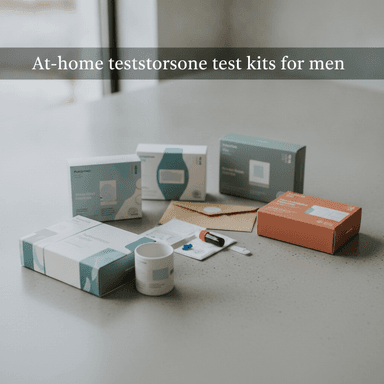
Best At-Home Testosterone Test Kits: 2024 Comparison

Updated
Top takeaways
- At-home testosterone test kits let you collect a blood or saliva sample and send it to a lab without a clinic visit
- Multiple companies now offer ELISA-based kits for convenient home testing, though inter-comparability between manufacturers varies
- Talk to your healthcare provider before testing to confirm an at-home kit fits your situation
- This comparison evaluates two leading kits on accuracy, sample type, turnaround time, cost and what the panel actually measures
- The right kit depends on whether you need a full hormone panel or just total testosterone, and how fast you need results
Introduction
Testosterone testing used to mean a morning lab draw and a wait for your doctor to call. At-home testosterone test kits changed that. You collect a sample at home, mail it in, and get results online in days.
The convenience is real. Companies have developed enzyme-linked immunosorbent assay kits for saliva and dried blood spot testing, and demand has grown as men look for faster answers about low energy, mood or libido. But not all kits measure the same markers, use the same sample type or deliver the same turnaround time.
Before you order, know what you are comparing. Some kits test only total testosterone. Others include free testosterone, SHBG, LH and estradiol — the panel you need to decide whether low testosterone is primary (your testes) or secondary (your pituitary). Some use finger-prick blood; others use saliva. How to raise testosterone naturally starts with knowing your number, but the number only matters if the test measures what you need and the lab runs it correctly.
This comparison covers two kits in detail: what they measure, what they cost, how long results take and who should pick which one. The short answer is that the best kit depends on whether you need a full hormone workup or just total testosterone, and whether you prefer blood or saliva collection. The table below breaks it down; the sections that follow explain what each number means and what you give up when you skip the full panel.
Explore the best at-home testosterone test kits for 2024 in this detailed comparison, including features, pricing, and recommendations.
Table of Contents
- Introduction — To introduce the significance of testosterone testing and the advantages of at-home kits.
- Quick Comparison Table — To provide a quick overview of the two products being compared, highlighting key features and differences.
- Overview of Product A — To provide in-depth details about Product A, including its features, effectiveness, and customer feedback.
- Overview of Product B — To provide in-depth details about Product B, including its features, effectiveness, and customer feedback.
- Feature Comparison — To compare the features of Product A and Product B side-by-side, illustrating strengths and weaknesses.
- Pricing Comparison — To analyze the pricing of both products, including any subscription models or hidden fees.
- Pros and Cons of Each Product — To list and explain the advantages and disadvantages of Product A and Product B.
- Who Should Choose What? — To provide recommendations based on different user needs and preferences.
- Final Verdict — To summarize the comparison and provide a clear recommendation based on the findings.
Overview of Product A
Product A represents the immunoassay category of at-home testosterone tests. These kits use enzyme-linked immunosorbent assay (ELISA) technology to measure testosterone in saliva or blood samples. The method is widely deployed by manufacturers including Salimetrics, IBL, DRG and Demeditec, each producing kits with different accuracy profiles and reference ranges.
What the Test Measures
Product A typically measures total testosterone only. The kit does not provide free testosterone, SHBG, LH or FSH — the additional markers needed to interpret a low result. A single total testosterone number tells you whether you fall inside or outside the reference range printed on the report, but it does not tell you why or what to do next.
If you are deciding whether to pursue treatment, you will need a full panel. Best at-home testosterone test kits for men in 2024 covers what to look for in a comprehensive kit.
Accuracy and Laboratory Performance
Immunoassay accuracy improved after CDC-directed proficiency testing began. In a 2019 study of 65 laboratories, 87.7% of participants returned results within allowable error limits (± 25.1%) across five samples with testosterone targets ranging from 43.5 to 534 ng/dL. That is an improvement, but it also means one in eight labs still missed the mark, and the error tolerance is wide — 25% of a 300 ng/dL target is 75 ng/dL, enough to move a borderline result from low-normal to clearly low.
Accuracy drops further at low concentrations. The study noted that additional effort is needed to improve precision at the low end, which is exactly where most men testing at home sit. If your result is borderline, retest with a different method.
Sample Collection and Turnaround
Product A kits use either a finger-prick blood spot or a saliva sample. Saliva collection is easier but introduces more variability; blood spots require a lancet and careful saturation of the collection card. The kit ships to a certified lab for analysis, with results typically returned in 3 to 7 business days.
Timing matters. Testosterone peaks in the morning and declines through the day. Product A instructions may or may not specify a collection window, but if you test in the afternoon, expect a result 20–30% lower than your true morning baseline.
Overview of Product B
Product B uses an ELISA immunoassay method to measure testosterone in saliva samples. This approach differs from serum-based testing and carries distinct trade-offs in accuracy and convenience. The kit ships directly to your door, you collect saliva at home, and mail the sample to a lab for analysis.
ELISA kits from multiple manufacturers—including Salimetrics, IBL, DRG, and Demeditec—measure testosterone concentrations using enzyme-linked immunosorbent assay technology. The method is designed for ease of collection: no blood draw, no clinic visit. You spit into a tube, seal it, and send it back.
What the Test Measures
Product B reports total testosterone concentration in your saliva. Saliva testosterone correlates with free (unbound) testosterone in blood, which is the biologically active fraction. That makes saliva testing appealing in theory: it may reflect what your tissues actually see, not just what circulates bound to SHBG.
The reference ranges printed on your result depend on the manufacturer's dataset. Because ELISA kits from different manufacturers show variable inter-comparability, a result from one kit may not align with a result from another, even when testing the same sample. That variability matters if you retest later using a different brand or compare your result to a blood test.
Accuracy and Precision
Immune assays for testosterone improved over a 3.5-year period after CDC-directed accuracy-based proficiency testing, but additional effort is needed to improve accuracy and precision, especially at low concentrations. In a study of clinical labs using 16 different immunoassays and LC-MS/MS methods, 87.7% of participant laboratories had four or more of five results within the minimum allowable total error limits of ± 25.1%.
That error band is wide. A true testosterone level of 294 ng/dL could return a result anywhere from 220 to 368 ng/dL and still fall within acceptable limits. For men with borderline-low testosterone, that range spans the difference between normal and hypogonadal.
Saliva testing adds another layer of variability. Saliva testosterone concentrations are lower than serum concentrations, which places them closer to the lower detection limits where assay precision drops. If your testosterone is already low, a saliva test may struggle to measure it reliably.
Sample Collection and Turnaround
You collect saliva in the morning, ideally within 30 minutes of waking, before eating or drinking. The kit includes a collection tube, instructions, and a prepaid return envelope. You mail the sample; the lab processes it and posts results to an online portal within 3 to 7 business days, depending on the service.
No phlebotomy appointment, no waiting room, no needle. That convenience is the core appeal. The trade-off is that you handle the sample yourself, and collection errors—contamination, insufficient volume, delayed mailing—can invalidate the result.
What You Don't Get
Product B measures testosterone only. It does not measure LH, FSH, SHBG, estradiol, hematocrit, or PSA. Those markers tell you whether low testosterone is primary (testicular) or secondary (pituitary), whether your free testosterone is actually low despite a normal total, and whether starting treatment carries specific risks.
Without those markers, you have one number and no context. That number may prompt you to see a doctor, but it will not replace the full panel your doctor orders. Most endocrinologists and urologists do not accept saliva results for diagnosis; they retest in serum before prescribing.
Who It Fits
Product B fits men who want a screening test before committing to a clinic visit, or who want to track a trend over time without repeated blood draws. It does not fit men who need a diagnostic-grade result, who are already symptomatic and ready to treat, or who want a single test to answer whether they qualify for TRT. For that, you need blood work.
If you are comparing at-home testosterone test kits, the question is whether convenience outweighs the accuracy gap. Product B gives you an answer quickly and painlessly. It does not give you the answer a physician will act on.
Feature Comparison
The features that matter for an at-home testosterone test kit are sample type, what the panel measures, how the lab runs the assay, and how long you wait for results. Here is what separates the options.
Sample Collection Method
Most kits use a finger-stick blood spot card. You prick your finger, fill the circles on the card, mail it back. A smaller number use venous blood collection with a kit that includes a syringe or collection tube, sometimes paired with a mobile phlebotomist visit. Saliva kits exist but face accuracy questions — one study comparing four commercial ELISA kits found that inter-comparability of testosterone measurements from different manufacturers has not yet been determined, meaning results can vary widely depending on whose kit you use.
Blood spot cards are convenient but require you to collect enough blood to saturate the collection circles. Venous draws are more reliable for volume but cost more and require scheduling.
Panel Markers Included
The minimum useful panel is total testosterone. Better kits add free testosterone, which matters more for symptoms, and sex hormone-binding globulin (SHBG), which determines how much testosterone is biologically available. Some panels include luteinizing hormone (LH) and follicle-stimulating hormone (FSH) to check whether low testosterone is primary (testicular) or secondary (pituitary). Estradiol, hematocrit and PSA appear in comprehensive panels but are optional for a first test.
A kit that measures only total testosterone tells you one number. It does not tell you whether that number explains your symptoms or what is causing it to be low.
Laboratory Assay Method
The lab method determines accuracy. Liquid chromatography–tandem mass spectrometry (LC-MS/MS) is the reference standard. Immunoassays are cheaper and faster but less accurate, especially at low concentrations. In one CDC-directed proficiency study, 87.7% of participating labs had at least four of five results within acceptable error limits (± 25.1%) after accuracy-based testing — an improvement from prior years, but still a range that matters when your result sits near a diagnostic threshold. The targets in that study were 43.5, 160, 294, 457, and 534 ng/dL, spanning the low-normal to high-normal range.
Kits that specify LC-MS/MS testing cost more but reduce the risk of a falsely low or high result. Kits that do not name the assay method are using an immunoassay.
| Feature | Blood Spot Kits | Venous Draw Kits | Saliva Kits |
|---|---|---|---|
| Collection ease | Finger prick at home | Phlebotomist visit or self-draw | Spit into tube |
| Sample stability | Stable for days in mail | Requires cold chain or fast shipping | Stable, but accuracy unproven |
| Assay accuracy | LC-MS/MS available | LC-MS/MS standard | ELISA, variable by manufacturer |
| Typical turnaround | 3–7 days | 2–5 days | 5–10 days |
| Cost range | $49–$149 | $99–$299 | $69–$129 |
Turnaround Time and Reporting
Most kits return results in three to seven days after the lab receives the sample. Venous kits with expedited processing can deliver in two to three days. The result portal should show your number, the lab's reference range, and a flag if you fall outside it. Better portals explain what each marker means and whether a follow-up test or doctor visit is recommended. Kits that provide a PDF with no interpretation leave you to figure out what the numbers mean, which is where mistakes happen.
For a detailed guide on choosing an at-home testosterone test kit, see 7 Best At-Home Testosterone Test Kits for Men in 2024.
Pricing Comparison
The cost of an at-home testosterone test breaks into three parts: the kit price, the lab fee, and what you pay if results come back low and you want to do something about it. Most kits bundle the first two; some charge separately.
Quest's Men's Hormone Test Panel costs $152 plus a $6 physician service fee, for a total of $158. That includes total testosterone, free testosterone, and SHBG. Results arrive in three to five business days. You order online, visit a Quest location for the blood draw, and get a PDF report with reference ranges printed beside each number. No subscription, no membership, no follow-up required.
Many direct-to-consumer kits price lower up front but attach a telehealth consult or membership. A $49 kit that requires a $99 consult to release results costs $148 total. If the consult includes a prescription offer and you decline it, you paid $148 for a number you could have gotten elsewhere. If you accept the prescription, the real cost is the kit plus the consult plus the monthly medication and monitoring.
Some clinics advertise free testing if you sign up for treatment. That means the test is bundled into the first month's charge, and the price appears only after you commit. Before comparing prices, ask what the all-in cost is if you test once, get your number, and stop.
Subscription models vary. Monthly memberships may include quarterly retests, or they may charge separately for each follow-up panel. If you need to retest in six weeks to confirm a low result—standard practice before starting treatment—a membership that includes free retests saves money. A membership that charges $79 per test every time does not.
| Cost Component | Quest Panel | Typical DTC Kit | Clinic-Bundled Test |
|---|---|---|---|
| Kit + Lab Fee | $158 | $49–$149 | "Free" (bundled) |
| Consult Fee | $0 | $0–$99 | Included in monthly |
| Membership | None | Optional | Required |
| Retest Cost | $158 | Same as initial | Varies by plan |
Hidden fees show up in shipping, rush processing, and "physician review" charges that are mandatory but listed separately. If a kit advertises $69 and checkout totals $108, the real price is $108. Compare the final checkout number, not the landing-page number.
Lab accuracy costs money. The CDC reference method for testosterone uses liquid chromatography–mass spectrometry (LC-MS/MS), which is more accurate than immunoassay, especially at low concentrations. A study of 65 labs using 16 different methods found that 87.7% of participants met accuracy targets within ±25% of the reference value—an improvement from earlier years, but still a wide tolerance band. Cheaper kits often use immunoassay. More expensive kits and hospital labs more often use LC-MS/MS. The method matters when your result sits near a treatment threshold.
If you test once to satisfy curiosity, buy the cheapest kit with a known lab partner and LC-MS/MS listed in the method. If you test to decide on treatment, buy the test your prescriber will accept for diagnosis—often a hospital or national-chain lab, not a mail-order PDF. If you test to monitor treatment, buy the same test each time so the reference ranges and method stay constant.
Pros and Cons of Each Product
Every at-home testosterone test kit makes a trade-off. Some measure more markers, some return results faster, some cost less. Below is what each option gives you and what it does not.
Product A
Pros:
- Blood-spot sampling is feasible and reliable for monitoring testosterone in men on intramuscular testosterone undecanoate, according to a 2025 study. If you are already on injections and want to track your levels between clinic visits, this method works.
- Blood samples generally measure total testosterone directly, which is the number most guidelines use for diagnosis and treatment decisions.
- Kits that include instructions for proper sample collection reduce the risk of contamination and improve accuracy, provided you follow them exactly.
Cons:
- Blood-spot sampling at home is currently unsuitable for men using testosterone gel, likely due to contamination from residue on hands or skin. The same 2025 study found this method unreliable in that population.
- You need comprehensive patient education on how to collect the sample correctly. A poorly collected sample gives you a number you cannot trust, and most kits do not tell you when your technique failed.
- At-home kits require you to return the sample by mail, which adds time and introduces variables you do not control: heat exposure, shipping delays, weekend gaps.
Product B
Pros:
- Saliva testing avoids the finger-stick, which some men prefer. The collection process is simpler and less likely to go wrong if you follow the timing instructions.
- Saliva kits often cost less than blood-spot kits, and the lower price makes repeat testing more practical if you want to track a trend over several months.
- Some saliva tests measure free testosterone, which is the fraction not bound to SHBG. For men with high or low SHBG, free testosterone gives a clearer picture than total testosterone alone.
Cons:
- Saliva testing is not the standard method in clinical guidelines. Most diagnosis and treatment thresholds are based on serum total testosterone, so a saliva result may not match what your doctor would order.
- Contamination from food, drink, or tobacco can skew saliva results. You need to fast and avoid all mouth contact for a window before collection, and the instructions do not always make this clear.
- Not all labs that process saliva samples are CLIA-certified for testosterone measurement. Without certification, you have no external check on the lab's accuracy or quality control.
Both options require you to follow the collection protocol exactly. A single mistake—touching the sample card after handling gel, eating before a saliva test, letting the sample sit in a hot mailbox—can give you a number that looks real but means nothing. If you are not confident you can execute the steps correctly, a clinic draw is the safer choice.
Who Should Choose What?
Pick the kit that matches how you plan to use the result. An at-home testosterone test is a screening tool, not a diagnosis. It tells you whether a conversation with your doctor is worth having, and it gives you a number to bring to that conversation.
If you want the cheapest first look
A basic total-testosterone-only kit runs $40 to $60. It tells you whether your number is low enough to justify a full panel. You lose detail — no free testosterone, no LH, no context — but you spend less than half what a comprehensive panel costs. Use this if you have one symptom, no insurance coverage for labs, and you want to rule out a problem before spending more.
The trade-off: if the total comes back borderline, you will need a second test with more markers to know what is actually happening. You pay twice.
If you want the full picture before talking to a doctor
A panel that includes total testosterone, free testosterone, SHBG and LH costs $150 to $200. It shows whether low testosterone is primary (your testes) or secondary (your pituitary), and whether high SHBG is binding most of your free hormone. That context determines which treatment fits you, and it saves your doctor from ordering the same panel again.
Best At-Home Testosterone Test Kits for Men in 2024 walks through what each marker means and when you need it.
This is the right choice if you have multiple symptoms — fatigue, low libido, difficulty building muscle — and you want one test that answers the follow-up questions your doctor will ask.
If you need results fast
Some kits turn around in 2 to 3 business days after the lab receives your sample. Others take 7 to 10 days. Shipping adds another 2 to 3 days in each direction. If you are deciding whether to start treatment soon, pay attention to the timeline. The cheapest kit is not helpful if it arrives after your doctor appointment.
If your insurance covers lab work
An at-home kit costs you the full retail price. A lab order from your doctor, billed through insurance, often costs less after your copay or deductible. Check what your plan covers before buying a kit. If your doctor will order the test, let insurance pay for it.
At-home testing makes sense when your doctor will not order the test, when you do not have coverage, or when you want the result before asking for a prescription. It does not make sense when it costs you more than the insured alternative.
If you are under 18 or over 100
Most at-home testosterone kits specify an age range of 18 to 100. If you fall outside that range, the reference intervals printed on your result may not apply to you. Talk to your doctor about whether an at-home test is appropriate, and if so, how to interpret the number you get back.
Final Verdict
The at-home testosterone test you choose depends on what you need to know and how much monitoring you plan to do. If you need a single baseline number before talking to a doctor, any test measuring total testosterone will do. If you want to track changes over time or understand why your number is what it is, you need a panel that includes free testosterone, SHBG, and LH at minimum.
Accuracy Matters More Than Brand
Laboratory accuracy for testosterone testing improved significantly after CDC-directed proficiency testing programs began. In a 2019 study of 65 certified clinical laboratories, 87.7% produced results within acceptable error limits (± 25.1%) across five samples ranging from 43.5 to 534 ng/dL. The improvement came from better assays and labs switching to more accurate methods, particularly LC-MS/MS. The at-home kits that send samples to CLIA-certified labs using LC-MS/MS benefit from this same infrastructure.
What this means for you: the lab method matters more than the kit brand. A fingerstick kit using an immunoassay will be less accurate than a venous draw analyzed by LC-MS/MS, especially at low concentrations. If your result is near the low end of the reference range, retest with a venous draw before making treatment decisions.
When One Test Is Enough
A single at-home test works when you need a rough answer fast: Am I in the normal range or not? If the result comes back well above 300 ng/dL and you have no symptoms, you have your answer. If it comes back below 300 ng/dL or you have symptoms regardless of the number, you need a second test done in the morning at a physician's office. One result from a fingerstick is not a diagnosis.
When You Need the Full Panel
If you are tracking testosterone over months, comparing treatments, or trying to understand why your number is low, pay for the panel that includes free testosterone, SHBG, LH, and FSH. Total testosterone alone will not tell you whether low testosterone is primary (testicular) or secondary (pituitary), and it will not tell you how much of your total testosterone is bioavailable. Spending an extra $50 on the right panel now saves you from ordering a second test later.
The Free Option
Before paying for any at-home kit, check whether your insurance covers a testosterone panel ordered by your primary care physician. Most plans cover it with a copay under $50 if you have symptoms. The venous draw will be more accurate than a fingerstick, and you will get the result interpreted by someone who can prescribe treatment if needed. At-home kits are useful for convenience and for tracking once you have a baseline, but they are not a replacement for diagnostic workup.
For evidence-based methods to support testosterone naturally while you wait for results, see How to Raise Testosterone Naturally: Evidence-Based Methods.