SHBG Explained: Why Normal Testosterone Levels Can Mislead

Updated
Top takeaways
- SHBG binds to testosterone in your blood, making it unavailable to your tissues
- A normal total testosterone result can mask low free testosterone when SHBG is high
- Measuring SHBG alongside total testosterone shows how much hormone is actually working in your body
- High SHBG is linked to age, low body weight, and certain health conditions; low SHBG tracks with obesity and insulin resistance
- Without an SHBG measurement, a single total testosterone number tells you less than half the story
Introduction
Your lab report shows total testosterone in the normal range, but you still have the symptoms: low energy, poor recovery, brain fog. The number looks fine, so your doctor says you're fine. That conclusion skips a step.
Total testosterone measures everything in your blood—both the hormone bound to carrier proteins and the small fraction that's free to enter cells and do the work. Sex hormone-binding globulin, or SHBG, is the protein that binds most of it. When SHBG is high, it locks up more testosterone. Your total can look normal while your free testosterone sits below the reference range. The reverse is also true: low SHBG can give you normal free testosterone even when total is low.
Measuring SHBG levels helps providers understand how much testosterone is active in your tissues, especially in men with symptoms that may be caused by too little testosterone. SHBG is also a potential predictor in men with hypogonadism, meaning it adds information that total testosterone alone does not provide. Research shows that SHBG is a mixture of at least two functionally different hormone-binding globulins, affected by obesity, age, and gender, each with different affinities for testosterone and estradiol (source: PubMed).
Before you accept a diagnosis based on one morning total testosterone result, ask for the full panel. That means total and free testosterone, SHBG, LH, and estradiol at minimum. The combination tells you whether your testosterone production is low, whether the hormone is available to your cells, and whether your pituitary is responding appropriately. One number by itself answers none of those questions.
This article walks through what SHBG is, why it matters, how to read it alongside testosterone, and what drives it up or down. If you are evaluating testosterone supplements for men or considering treatment, understanding SHBG is the step that comes first.
Problem Statement
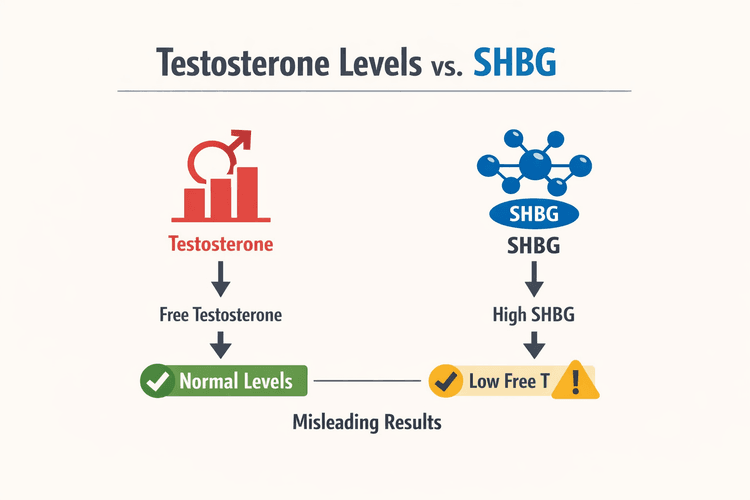
A total testosterone result inside the reference range does not tell you how much testosterone your tissues can actually use. SHBG binds testosterone in the bloodstream, and when SHBG is high, less of that total testosterone is free to enter cells. You can have a number that looks normal on paper and still have low-testosterone symptoms because the bioavailable fraction is too small.
Most lab panels measure total testosterone only. That number includes testosterone bound to SHBG, which cannot activate androgen receptors. High SHBG means that less of your total testosterone is available for your tissues to use, so your tissues may not be getting enough testosterone even when the total looks fine. Conditions like liver disease, hyperthyroidism, and certain medications raise SHBG and create this gap between the lab result and what your body experiences.
Why SHBG Levels Vary
SHBG is influenced by obesity, gender, and hormone balance. Obesity typically lowers SHBG, which can raise free testosterone but also complicates interpretation when total testosterone is borderline. Gender differences mean men and women have different baseline SHBG ranges, and these ranges shift with age. Research suggests that SHBG may be a mixture of at least two functionally different binding proteins, each with different affinities for testosterone and estradiol, adding another layer of complexity to how a single SHBG number translates into hormone availability.
The Gap Between the Number and the Symptom
When SHBG is elevated, the bound testosterone cannot reach receptors. You may see a total testosterone of 450 ng/dL—well within the 300–1000 ng/dL reference range—but if SHBG is high, your free testosterone might be in the bottom quartile. That mismatch explains why some men with "normal" labs still report fatigue, low libido, and difficulty building muscle. Before you choose between natural interventions or prescription options, you need to know whether the problem is total production or binding.
The confusion is compounded by the fact that many clinics and patient portals report only total testosterone. Without SHBG or a calculated free testosterone, neither you nor your doctor can tell whether the total is misleading. That is where the next step—ordering the right panel—becomes the only way to see the full picture.
Solution Steps
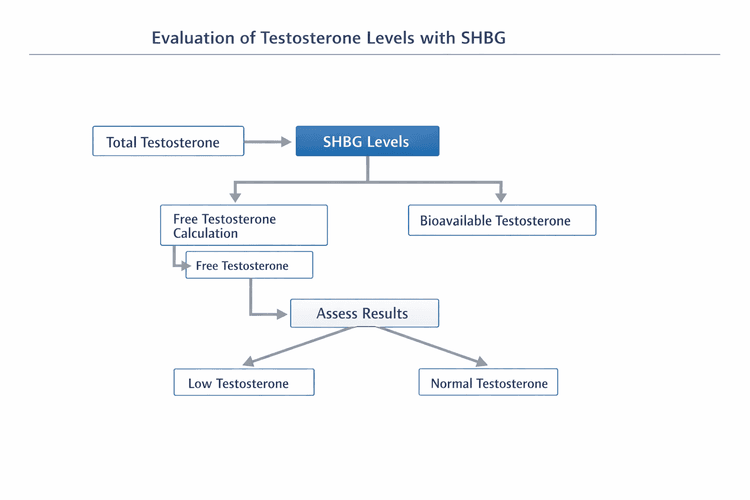
When total testosterone looks normal but symptoms persist, the next step is to measure what your tissues actually see.
Step One: Request the Full Panel
Ask your doctor for total testosterone, free testosterone, and SHBG in the same draw. Many labs run total testosterone alone, which leaves you guessing. The SHBG number tells you how much of that total is bound and unavailable. Free testosterone tells you what is left for your cells to use.
An SHBG test is often ordered when signs or symptoms suggest abnormal testosterone levels, even if total testosterone falls inside the reference range.
Step Two: Time the Test Correctly
Test in the morning, ideally between 7 and 10 a.m., when testosterone peaks. One result is not a diagnosis. If the first test shows low free testosterone or high SHBG, test again a week or two later at the same time of day. Testosterone fluctuates; two morning results give you a pattern.
Step Three: Interpret SHBG in Context
High SHBG means less testosterone reaches your tissues, even when total testosterone is normal. The reference range for SHBG varies by lab, but levels above the upper limit often correlate with symptoms of low testosterone. Conditions that raise SHBG include liver disease, hyperthyroidism, and use of estrogen-containing medications.
Low SHBG can inflate total testosterone readings on some older immunoassays, making it harder to spot a real deficiency. Laboratory specialists and clinicians should be aware that first-generation testosterone assays are influenced by SHBG concentrations, which can lead to inaccurate results.
Step Four: Check for Underlying Causes
Before treating low free testosterone, look for what is driving SHBG up or down. Weight gain, insulin resistance, and thyroid dysfunction all shift SHBG. Correcting those may normalize free testosterone without medication. For more on non-medication approaches, see How to Increase Testosterone Naturally: What Actually Moves the Number.
Step Five: Decide Whether to Treat
If free testosterone is low after addressing reversible causes, treatment options include enclomiphene, hCG, or testosterone replacement. Each has trade-offs in cost, monitoring, and fertility. The choice depends on your age, fertility goals, and how your body responded to the initial tests. Your provider may order additional hormone tests to confirm that your hormones are in balance with each other before prescribing.
Tips and Tricks
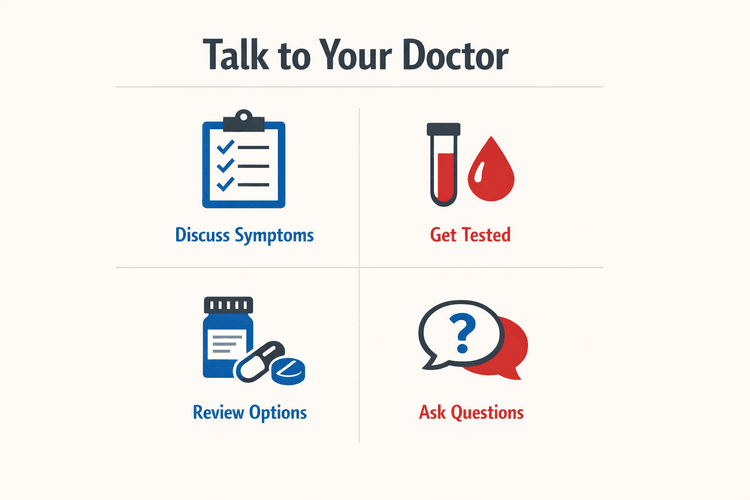
Once you know your SHBG level, you can make better decisions about what to ask your doctor and what to track. Here are the practical steps that matter.
Ask for the full panel, not just total testosterone
Most clinics order total testosterone alone. That number tells you nothing about SHBG or free testosterone. Ask your doctor for total testosterone, SHBG, and either calculated free testosterone or a direct free testosterone measurement. Without SHBG, you are reading one number out of context.
If your doctor orders only total testosterone, ask why. Some insurance plans cover the full panel when symptoms are documented. If cost is the barrier, know what you are missing before you interpret the result.
Retest under the same conditions
SHBG and testosterone vary with time of day, fasting status, recent exercise, alcohol intake, and weight change. If your first result shows high SHBG and borderline total testosterone, retest the same way: morning draw, fasting, no heavy training the day before. One morning result is not a diagnosis.
If SHBG is high on both tests, the pattern is real. If it jumps around, look at what changed between draws.
Know what moves SHBG before you treat testosterone
SHBG responds to body composition, liver health, insulin sensitivity, thyroid status, and alcohol intake. If your SHBG is low and you are overweight, losing fat will raise SHBG and may raise total testosterone without medication. If SHBG is high and you drink heavily, cutting alcohol may lower it.
First-generation testosterone immunoassays can yield inaccurate results due to the influence of SHBG concentrations, particularly in patients with abnormal SHBG levels. If your SHBG is very high or very low, ask your doctor whether the lab used an immunoassay or a liquid chromatography–mass spectrometry method. The latter is more accurate when SHBG is out of range.
For evidence-based guidance on weight, sleep, and alcohol as levers for testosterone, see How to Increase Testosterone Naturally: What Actually Moves the Number.
Understand what your clinic is testing and why
Some telehealth clinics order only total testosterone and skip SHBG to keep the initial visit cheap. Others include SHBG but use calculated free testosterone, which is accurate only when SHBG is in the normal range. If you are paying out of pocket, know what you are buying before you sign up.
Adult males experiencing symptoms that may be linked to insufficient testosterone can benefit from SHBG level testing to assess their hormonal health. Ask the clinic which lab they use, which assay method, and whether they will share the full report with reference ranges. If they will not, that is worth knowing before you commit.
Without SHBG, total testosterone is half the picture — and sometimes the wrong half.
Conclusion
Your testosterone number is not one number. Total testosterone tells you how much is circulating; SHBG tells you how much of it is locked up. A normal total with high SHBG can leave you with low free testosterone — the fraction that actually reaches tissue. That is why a single morning result, even one inside the reference range, is not a diagnosis.
The clearest signal comes from testing twice, both before 10 a.m., and ordering the full panel: total testosterone, free testosterone (calculated or measured by equilibrium dialysis), SHBG, LH and estradiol. Those five numbers together show whether your pituitary is signaling correctly, whether SHBG is binding too much, and whether your symptoms map to the lab work. Age, weight, insulin resistance and some medications all move SHBG; knowing that helps you and your doctor separate a primary testosterone problem from a binding problem.
If you are evaluating treatment options — whether lifestyle changes, enclomiphene, hCG or TRT — understanding SHBG tells you which intervention fits your physiology and what monitoring you will need afterward. For a detailed comparison of those options and how telehealth clinics structure their programs, see our guide on choosing an online TRT clinic.
Test first, test twice, and ask your doctor for the numbers that matter. SHBG is one of them.
Sources(9)
- The Journal of clinical endocrinology and metabolism (2021)
- MedlinePlus (U.S. National Library of Medicine) (2026)
- Biology of sex differences (2026)
- Endocrine connections (2020)
- Clinical endocrinology (2015)
- European journal of endocrinology (2017)
- Molecular and cellular endocrinology (2014)
- Metabolism: clinical and experimental (2013)
- Journal of Clinical Endocrinology & Metabolism — Testosterone Therapy in Men With Hypogonadism: An Endocrine Society Clinical Practice Guideline (2018)