High SHBG in Men: Causes and Questions to Ask Your Doctor

Updated
Top takeaways
- Sex hormone-binding globulin (SHBG) is a protein that binds testosterone and estradiol in the blood, controlling how much is free and active in your tissues.
- High SHBG can lower the amount of testosterone available to your cells, even when total testosterone looks normal on a lab report.
- Testing SHBG alongside total testosterone shows whether a low-symptom picture matches the lab numbers or whether something else is binding the hormone.
- Certain conditions and medications raise SHBG; knowing which ones apply to you changes the conversation with your doctor.
- The right questions turn a single number into a plan: what is causing it, what it means for your symptoms, and whether treatment targets the SHBG or the underlying cause.
Introduction
High SHBG in men means less testosterone circulates in the free, unbound form that enters cells and drives the effects you feel. Sex hormone-binding globulin binds and transports testosterone and estradiol in plasma. When SHBG goes up, a man can have total testosterone in the reference range and still experience low-testosterone symptoms if SHBG is high enough to lock most of it away.
Measuring SHBG levels shows how much of your testosterone is active in the tissues of your body. Without that number, a total testosterone result tells an incomplete story. Men who have conditions that alter SHBG—or whose total testosterone sits near the lower limit of normal—need a free testosterone measurement, either from equilibrium dialysis or calculated from total testosterone, SHBG and albumin. One morning result of total testosterone alone is not a diagnosis when SHBG is part of the picture.
Before you can address high SHBG, you need to know what drives it in your case. Age, liver function, thyroid status, alcohol intake, certain medications and body composition all move the number. Some causes respond to lifestyle changes that increase testosterone naturally; others require medical treatment of an underlying condition. The short answer is that high SHBG is a signal, not a disease, and the next step is identifying the source.
This guide walks through what high SHBG means, what causes it, and the questions to ask your doctor so you leave the appointment with a clear plan. The goal is not to self-diagnose but to arrive prepared, with the context that turns a lab slip into actionable information.
What Causes High SHBG in Men?
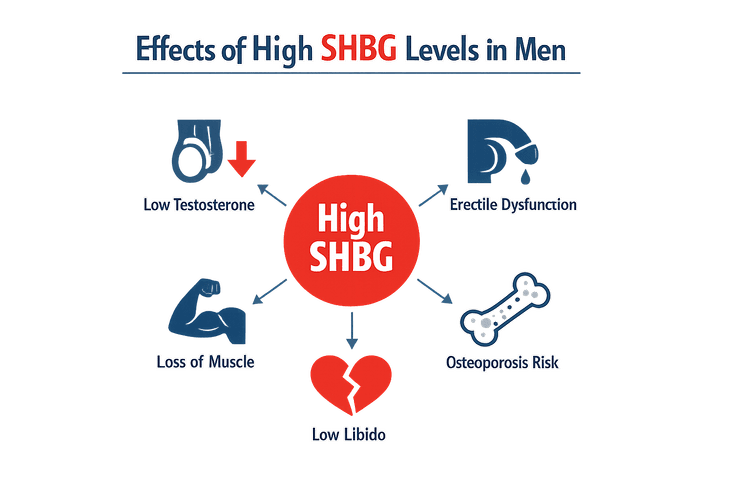
High SHBG in men reduces the amount of free testosterone available to reach your tissues. The number on your lab report may look normal, but if SHBG is elevated, your cells may not be getting enough usable hormone. That gap between total and free testosterone is where symptoms live.
What High SHBG Does to Testosterone Availability
SHBG binds tightly to testosterone in your bloodstream. When SHBG goes up, more testosterone is locked in that binding protein and unavailable for cellular uptake. You can have a total testosterone reading in the reference range and still experience low-testosterone symptoms if SHBG is high enough. Free testosterone — the fraction that matters for muscle, mood, energy and libido — drops as SHBG climbs.
Conditions Linked to Elevated SHBG in Men
Several medical conditions and medications raise SHBG. Liver disease and hyperthyroidism are common culprits. Certain eating disorders, estrogen-containing medications, and aging all push SHBG higher. HIV disease, cirrhosis, hepatitis, and some anticonvulsants also elevate levels. If you are on any of these medications or have one of these diagnoses, high SHBG is not surprising — it is a predictable response.
Older men tend to have higher SHBG than younger men, even when controlling for other risk factors. This age-related rise is one reason total testosterone alone is a poor diagnostic tool in men over fifty. The number that matters is free testosterone, and SHBG is the variable that determines how much of your total pool is actually free.
When SHBG climbs, total testosterone can stay normal while free testosterone drops — and symptoms follow the free fraction, not the total.
Why This Matters for Diagnosis and Treatment
If you test total testosterone without measuring SHBG, you are missing half the picture. A result in the middle of the reference range may look reassuring, but if SHBG is elevated, your free testosterone could be low enough to cause symptoms. That is why the full panel — total testosterone, free testosterone, SHBG, LH, FSH — is the starting point. One number is not a diagnosis.
Treatment decisions also hinge on SHBG. If high SHBG is driven by hyperthyroidism or liver disease, addressing the underlying condition may bring SHBG down and restore free testosterone without hormone therapy. If the cause is a medication, switching drugs may be an option. Before adding testosterone or any other intervention, you need to know what is driving SHBG up and whether that driver is modifiable. For more on evaluating treatment options and clinic quality, see Best Online TRT Clinic: How to Choose and What to Avoid.
How Do You Manage High SHBG in Men?
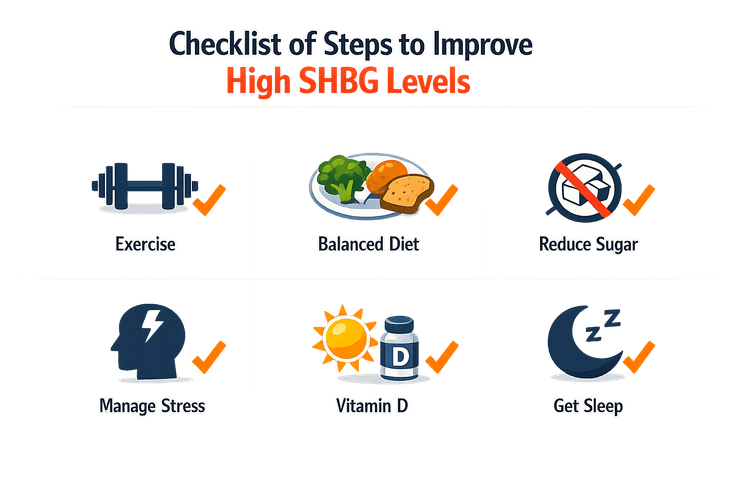
High SHBG in men means less testosterone reaches your tissues, even when total testosterone looks normal. The number that matters is free testosterone — what is actually available to work. Here is how to clarify the picture and decide what comes next.
Step 1: Get the Full Panel
A single total testosterone result does not tell you what is bioavailable. Ask your doctor for total testosterone, SHBG and calculated free testosterone on the same draw. Men with high SHBG often have low total testosterone but normal free testosterone, and no symptoms. Without the free testosterone number, you are guessing.
Measuring SHBG levels can provide information about how much of your testosterone is active in the tissues of your body, especially for men who have symptoms that may be caused by too little testosterone.
Step 2: Rule Out the Common Causes
High SHBG is often secondary to hyperthyroidism or liver disease. Your doctor should order TSH, free T4 and a basic metabolic panel with liver enzymes. If either is abnormal, treat the underlying condition first — SHBG usually falls when the primary problem resolves.
High levels of SHBG may be related to liver disease, hyperthyroidism, certain eating disorders or use of estrogen-containing medicines.
Step 3: Assess Symptoms Against Free Testosterone
If free testosterone is normal and you have no symptoms — low libido, fatigue, difficulty building muscle — you do not need treatment. How to Increase Testosterone Naturally: What Actually Moves the Number covers the non-medication levers that can shift total and free testosterone without raising SHBG further.
Step 4: Discuss Retesting and Monitoring
If free testosterone is borderline low or symptoms are mild, retest in three to six months. SHBG can shift with weight changes, thyroid status and age. Two results separated by time give you a clearer baseline than one.
Clinicians should measure free testosterone in men who have conditions that alter SHBG levels to better understand testosterone dynamics.
Tips and Tricks

You cannot lower SHBG directly, but you can change some of the inputs that raise it. Weight and insulin sensitivity matter most. Men carrying extra body fat—especially visceral fat—tend to have lower SHBG, while very lean men or those with insulin resistance sometimes see higher levels. Modest weight loss in overweight men often brings SHBG down toward the middle of the reference range.
Questions to Ask Your Doctor
Before adjusting anything, ask for a full hormone panel: total testosterone, free testosterone, LH, FSH, and estradiol alongside SHBG. One elevated SHBG result without context tells you little. Ask what your free testosterone level is—that number matters more than total testosterone when SHBG is high. If your doctor ordered only total testosterone, request the additional tests.
Ask about thyroid function. Hyperthyroidism raises SHBG, and treating the thyroid condition usually brings SHBG back down. If you take levothyroxine, ask whether your dose needs adjustment based on recent TSH results. High SHBG can be the first clue that thyroid hormone is running too high.
Lifestyle Levers Worth Checking
Alcohol intake raises SHBG in a dose-dependent way. Heavy drinkers often show elevated SHBG even when liver enzymes look normal. Cutting back or stopping for a few weeks and retesting can clarify whether alcohol is driving the number.
Resistance training and adequate protein intake help maintain insulin sensitivity, which indirectly influences SHBG. Very low-calorie diets or prolonged fasting can raise SHBG temporarily. If you are dieting hard or training for endurance events, consider whether your energy balance is chronically negative—that pattern raises SHBG and lowers free testosterone.
The number that matters is free testosterone, not total testosterone, when SHBG is high.
What to Monitor Over Time
Retest SHBG and the full panel after making changes. A single result is a snapshot. If SHBG stays high but free testosterone is normal and you feel fine, no intervention may be needed. If free testosterone is low and symptoms persist, that is when treatment discussions—such as testosterone replacement or alternatives—become relevant.
Ask your doctor about retesting intervals. Most clinicians recheck labs every three to six months when monitoring hormone changes. Avoid testing during illness, after a poor night of sleep, or immediately after a major diet or training change—those variables can shift results temporarily.
Conclusion
High SHBG in men is not a diagnosis you treat directly. It is a lab result that points to a question: why is the binding protein elevated, and what does that mean for the testosterone that is actually free to act? The number matters because it changes how you read total testosterone. A man with total testosterone at 600 ng/dL and high SHBG may have less free hormone available than a man at 450 ng/dL with normal SHBG. That is why the panel includes SHBG, free testosterone, and LH together.
The causes range from the controllable to the structural. Hyperthyroidism, liver disease, low androgens, aging, certain medications, and genetic variants all raise SHBG. Some of those you address by treating the underlying condition. Others you monitor. The research shows higher SHBG levels were associated with increased risk of all-cause mortality in men and women, and lower total and free testosterone levels in men carried similar associations. That does not mean SHBG itself is the problem—it means the pattern warrants attention.
Before you sign up for a telehealth subscription or buy a supplement stack, test first and test twice. Get a morning draw that includes total testosterone, free testosterone, SHBG, LH, and TSH at minimum. If SHBG is high, ask your doctor what is driving it. Ask whether the free testosterone level is actually low once SHBG is factored in. Ask whether thyroid, liver, or medication changes explain the pattern. Those questions cost you nothing and they clarify whether you need treatment at all.
If free testosterone is low and no reversible cause is found, the next conversation is about enclomiphene, hCG, or TRT—and that depends on your age, fertility goals, and willingness to monitor. Each option has trade-offs in cost, convenience, and long-term effects. The evidence for supplements that claim to lower SHBG or raise free testosterone is thin at best. The free option is weight loss if you are overweight, better sleep if you have untreated apnea, and cutting alcohol if you drink heavily. Those move the number more reliably than anything sold in a bottle.
Understanding high SHBG starts with reading the full panel, not fixating on one line. The number is a clue, not a verdict. For a structured look at how to choose between treatment options when free testosterone is confirmed low, see Best Online TRT Clinic: How to Choose and What to Avoid. The short answer is this: test properly, ask the right questions, and treat the cause when one is found. Everything else is noise.
Sources(24)
- The Journal of urology (2020)
- The Journal of clinical endocrinology and metabolism (2026)
- American family physician (2024)
- U.S. Food and Drug Administration — Drug Safety Communication: FDA cautions about using testosterone products for low testosterone due to aging; requires labeling change to inform of possible increased risk of heart attack and stroke with use (2015)
- Journal of Clinical Endocrinology & Metabolism — Testosterone Therapy in Men With Hypogonadism: An Endocrine Society Clinical Practice Guideline (2018)
- International journal of general medicine (2022)
- American Urological Association — Evaluation and Management of Testosterone Deficiency (AUA Guideline) (2018)
- International journal of impotence research (2023)
- The journal of sexual medicine (2019)
- RSC advances (2026)
- Journal of human kinetics (2014)
- The Journal of urology (2015)
- F&S reviews (2020)
- The world journal of men's health (2026)
- U.S. Food and Drug Administration — Enclomiphene Citrate: FDA presentation to the Pharmacy Compounding Advisory Committee, June 8, 2022 (Madeline Wolfert, MD, CDER)
- European journal of endocrinology (2024)
- Annals of internal medicine (2020)
- The Cochrane database of systematic reviews (2024)
- MedlinePlus (U.S. National Library of Medicine) (2026)
- The Journal of clinical endocrinology and metabolism (2021)
- The journal of applied laboratory medicine (2016)
- FP essentials (2023)
- The Journal of urology (2019)
- Urology (2025)