Testosterone Free vs Total: Which Number Matters Most?

Updated
Top takeaways
- Free testosterone measures the hormone available for immediate use by your cells; total testosterone measures everything in your blood, including what is bound and inactive
- Both numbers matter, but free testosterone often correlates better with symptoms when total testosterone sits in the normal range
- SHBG, the protein that binds testosterone, determines how much of your total becomes free — and SHBG varies widely between people
- Calculated free testosterone is the standard method; the Endocrine Society recommends it over direct immunoassay measurements
- A single test on a single morning does not give you the full picture — you need two morning draws and the full panel
Introduction
Free vs Total Testosterone: your lab report prints both numbers, but most men look at total first because it sits at the top of the page. Free testosterone is often the number that explains what you feel. Free testosterone is the fraction not stuck to binding proteins. It moves into cells and activates androgen receptors. Total testosterone includes free testosterone plus everything bound to sex hormone-binding globulin (SHBG) and albumin. The bound fraction is a reserve; it does not activate receptors until it unbinds. When SHBG is high, total testosterone can look normal while free testosterone sits low, and symptoms follow the free number.
The Endocrine Society recommends calculated free testosterone for clinical use because direct immunoassays are unreliable. The calculation uses total testosterone, SHBG and albumin. Variability in how labs measure SHBG affects the final free testosterone number, which is why testing twice at the same lab matters. For a detailed breakdown of how to order and interpret the full testosterone panel, see How to Test Testosterone Levels: Testosterone Free vs Total.
This article walks through what each number measures, when each one matters, how to test them correctly, and what the research says about using them to guide treatment decisions.
What Makes Free vs Total Testosterone Confusing?
You get a lab report with two testosterone numbers. One says total, one says free. The reference ranges sit beside each number, and both might be in range, out of range, or one of each. Nobody explained which one to read first, and the clinic that ordered the test sells the treatment either way.
The short answer: total testosterone is what most labs measure because the equipment is standardized and the cost is predictable. Free testosterone is harder to measure accurately, costs more, and comes in five different methods that do not agree with each other. That is the technical problem. The clinical problem is that total testosterone is tied directly to a protein called SHBG, and SHBG varies with age, weight, insulin resistance, liver function and thyroid status. When SHBG is high, total testosterone can look normal while free testosterone is low. When SHBG is low, total testosterone can look low while free testosterone is adequate. One number without the other is incomplete.
When Total Testosterone Misleads
Total testosterone measures everything in circulation: the roughly 2 percent that is unbound and biologically active, the 40 to 50 percent loosely bound to albumin, and the 50 to 60 percent tightly bound to SHBG. The SHBG-bound fraction does not enter cells and does not activate androgen receptors. If your SHBG is elevated—common in older men, men on certain medications, or men with hyperthyroidism—your total testosterone can sit comfortably in the reference range while your free testosterone is below it. The reverse happens in obesity and insulin resistance, where SHBG drops and total testosterone falls even though free testosterone remains normal or high.
This is not a rare edge case. It is common enough that guidelines recommend measuring free testosterone or calculating it when total testosterone sits near the lower boundary of the reference range. The problem is that "free testosterone" on a lab report can mean five different things: equilibrium dialysis (the reference method), direct immunoassay (fast and cheap but inaccurate), calculated free testosterone using total testosterone and SHBG (widely used, reasonably accurate if the assays are good), bioavailable testosterone (free plus albumin-bound), or the free androgen index (a ratio that does not convert to a concentration). These methods do not produce interchangeable results.
Why Free Testosterone Is Hard to Measure
Equilibrium dialysis is the gold standard for free testosterone. It physically separates the unbound fraction from the protein-bound fraction and measures it directly. It is also slow, expensive, and unavailable in most commercial labs. The alternative most labs use is a direct immunoassay, which is fast and fits on automated platforms but systematically overestimates free testosterone, especially at low levels. A 2004 review of five free testosterone methods found that direct immunoassays showed poor agreement with equilibrium dialysis and should not be used for clinical decisions in men with borderline low testosterone.
Calculated free testosterone—derived from total testosterone, SHBG, and albumin using a validated equation—performs nearly as well as equilibrium dialysis when the assays are standardized, and it costs nothing beyond the two input tests. That makes it the practical choice for most clinical settings. The catch is that total testosterone assays are not perfectly standardized either, and small measurement errors in total testosterone or SHBG propagate into the calculated free testosterone. A 2022 review noted that challenges to accurate testosterone measurement include deficiencies in standardization, variable reference ranges, and expenses related to gold standard equipment. Total testosterone remains the most accessible test; free testosterone and bioavailable testosterone are useful adjuncts, particularly in men with low borderline testosterone.
Total testosterone remains the most accessible for standard laboratories, while free testosterone may be useful in men with low borderline values.
What This Means for You
Before you interpret any testosterone result, you need to know which free testosterone method the lab used. If the report says "free testosterone" with no method listed, assume it is a direct immunoassay and do not trust it at face value. If the lab used calculated free testosterone and provides the reference range for the equation they used, that number is defensible. If you have only total testosterone and it sits near the lower boundary of the reference range, ask for SHBG and albumin so free testosterone can be calculated. If your total testosterone is clearly low or clearly normal and your symptoms match, free testosterone adds less—but if the numbers and symptoms do not line up, free testosterone is where the explanation usually lives.
For men considering treatment, this matters because some clinics diagnose low testosterone using total testosterone alone, others require free testosterone below a threshold, and still others use symptom scores with no hard cutoff. The method the clinic uses determines whether you qualify, what the baseline looks like, and whether follow-up testing will show a response. That is worth knowing before you sign up. For more on how to test testosterone levels correctly and interpret the full panel, see the linked guide.
How Do You Test Free vs Total Testosterone Correctly?
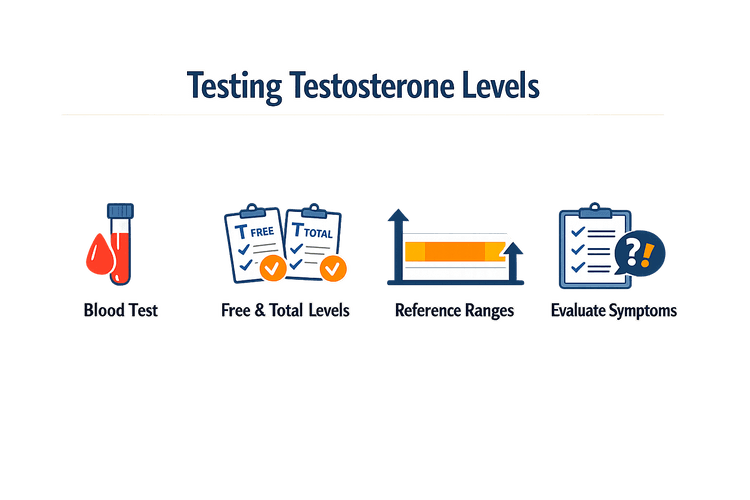
Before you can interpret a testosterone result, you need the right panel and the right timing. Most men walk into a clinic, get one number, and make decisions on it. That is backwards. Here is how to test correctly and read what you get.
Step 1: Order the Full Panel, Not Just Total Testosterone
Step 1
Order the full panel
Ask your doctor for total testosterone, SHBG, and either calculated free testosterone or bioavailable testosterone. Total testosterone alone does not tell you how much is active in your body. SHBG binds testosterone and makes it unavailable; when SHBG is high, total testosterone can look normal while free testosterone is low. Calculated free testosterone or bioavailable testosterone are the preferred tests to assess biologically-active testosterone.
Most standard labs report total testosterone by default. You have to request SHBG and free testosterone explicitly. If your lab does not calculate free testosterone, you can calculate it yourself using total testosterone, SHBG, and albumin with a validated formula. Do not rely on direct immunoassay free testosterone tests — they are less accurate than calculated values.
Step 2: Test in the Morning, Twice
Step 2
Test in the morning, twice
Testosterone peaks in the early morning and drops through the day. Draw blood between 7 AM and 10 AM, fasting. One morning result is not a diagnosis. Guidelines recommend two separate morning tests to confirm low testosterone before starting treatment. If the first test is borderline, the second test may come back normal.
Reference ranges vary by lab and by age. Some labs report a single range for all adult men; others use age-adjusted ranges. A result in the low-normal range for a 70-year-old may be low for a 30-year-old. Reference ranges for testosterone measurements may vary, and there are efforts to adapt these ranges to different populations, including age-adjusted values.
Step 3: Interpret Free Testosterone in Context with SHBG
Step 3
Interpret free testosterone with SHBG
If total testosterone is low-normal and SHBG is high, free testosterone is likely low. If total testosterone is low-normal and SHBG is low, free testosterone may be normal or even high. SHBG is the number that tells you whether total testosterone is a useful measure. Variability in SHBG measurements may affect reported SHBG levels and consequently free testosterone calculations, so retesting is important when results do not match symptoms.
| Scenario | Total T | SHBG | Free T | Interpretation |
|---|---|---|---|---|
| 1 | Low-normal | High | Low | Free T is the problem |
| 2 | Low-normal | Normal | Low-normal | Both may be low |
| 3 | Low-normal | Low | Normal | Total T may be misleading |
When SHBG is outside the normal range, calculated free testosterone or bioavailable testosterone becomes the number that matters. Total testosterone remains the most accessible test for standard laboratories, but free testosterone and bioavailable testosterone may be useful adjuncts, particularly in men with borderline total testosterone.
Step 4: Look at LH and FSH to Understand the Cause
Once you know your free testosterone is low, the next question is why. LH and FSH tell you whether the problem is in the testes or in the brain. Low testosterone with low or low-normal LH suggests the pituitary is not signaling the testes. Low testosterone with high LH suggests the testes are not responding. This distinction changes which treatments work. For a deeper look at how to test testosterone levels and interpret the full panel, including LH and FSH, see the linked guide.
Tips and Tricks for Accurate Testosterone Testing
Getting a number you can trust starts with timing and handling. Total testosterone is stable enough that most labs can measure it without special protocols. Free testosterone is not. It degrades quickly, the calculation methods vary, and the difference between a good result and a useless one often comes down to how the sample was collected and when.
Test in the morning, twice
Testosterone peaks in the early morning and drops through the day. A single afternoon draw can look low when your morning level is normal. The standard is two fasting samples, drawn between 7 and 10 a.m., at least a week apart. One morning result is not a diagnosis. If the first test is borderline, the second one tells you whether that number is real or noise.
Ask for the full panel, not just total testosterone
A total testosterone number by itself does not tell you what is bioavailable or what is driving the level. The panel you want includes total testosterone, free testosterone (calculated or measured by equilibrium dialysis), SHBG, LH, and albumin. SHBG binds most of your testosterone and makes it unavailable to tissues. When SHBG is high, total testosterone can look normal while free testosterone is low. LH tells you whether your pituitary is trying to raise testosterone or whether the signal is already maxed out.
Mass spectrometry is the gold standard for total testosterone measurement, and equilibrium dialysis followed by direct assessment is the gold standard for free testosterone. Most standard labs use immunoassays for total testosterone, which are less precise but adequate for screening. For free testosterone, many labs report a calculated value based on total testosterone, SHBG, and albumin rather than a direct measurement. Calculated free testosterone is cheaper and more widely available, but directly measured free testosterone requires strict handling and is not interchangeable with the calculated version.
Know what the reference range actually means
The reference range printed on your lab report is a population average, usually for men aged 19 to 39 or sometimes wider. It does not tell you what is optimal for you, and it does not account for age-related decline. A 50-year-old man with total testosterone at 350 ng/dL is technically in range, but that is the bottom quartile for his age and may explain symptoms. Compare your result to age-stratified norms, not the generic range, and track the trend across multiple tests rather than treating one number as definitive.
Verify the lab uses a validated method
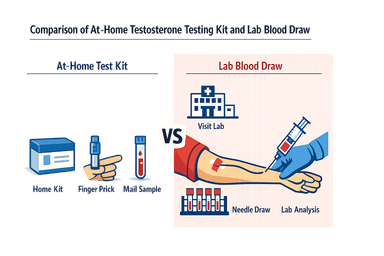
Not all labs measure testosterone the same way. Immunoassays are common and inexpensive, but they can cross-react with other steroids and produce falsely high or low results. Liquid chromatography–mass spectrometry (LC-MS/MS) is more accurate and is the preferred method when precision matters. If your result does not match your symptoms or if you are borderline, ask which assay the lab used. Some telehealth clinics use finger-stick tests that are less reliable than venous draws; if the result is unexpected, confirm it with a standard venous sample at a certified lab.
For a detailed breakdown of how to interpret your full testosterone panel and decide between treatment options, see understanding your testosterone results. If you are comparing treatment paths, Enclomiphene-First vs Injection-First Clinics explains how each approach affects Free vs Total Testosterone and fertility. For symptom timelines once you start treatment, How Long Does TRT Take to Work covers what to expect.
Conclusion
You need both numbers. Total testosterone tells you how much hormone your body carries; free testosterone tells you how much is available to use. A low total with normal free is different from a normal total with low free, and each pattern points to a different next step.
The short answer: free testosterone matters more for symptoms, but you cannot interpret it without the total. SHBG connects the two. A clinic that orders only one test or skips SHBG is guessing, and you are the one paying for the guess. Test first, test twice, and ask for the full panel before anyone hands you a prescription.
Some trials show free testosterone rising while total stays flat; others show the reverse. The pattern depends on what changed SHBG. That is why the number that matters is whichever one explains your symptoms and your binding protein. If you are choosing between treatment options, compare how each affects both measurements and fertility—the trade-offs are not the same.
Before you sign up for monthly billing, confirm that the clinic will test free testosterone by equilibrium dialysis or calculate it with total, SHBG and albumin. If the report shows only total or uses a direct immunoassay for free, the result is not reliable enough to dose on. Worth knowing before the first charge posts.
FAQ
What is Free vs Total Testosterone?Free vs Total Testosterone refers to two different measurements: free testosterone is the unbound hormone available to activate androgen receptors in your cells, while total testosterone includes all testosterone in your blood—both free and bound to proteins like SHBG and albumin.
Which matters more, Free vs Total Testosterone?Free testosterone often correlates better with symptoms, especially when total testosterone sits in the normal range but SHBG is elevated. Both numbers matter, but free testosterone tells you what is biologically active.
How does SHBG affect Free vs Total Testosterone?SHBG binds 50-60% of testosterone and makes it unavailable. When SHBG is high, total testosterone can appear normal while free testosterone is low. When SHBG is low, the reverse can occur. SHBG is the bridge between the two numbers.
Should I test Free vs Total Testosterone together?Yes. Testing both Free vs Total Testosterone, along with SHBG, gives you the full picture. Total testosterone alone can mislead when SHBG is abnormal, and free testosterone without total lacks context.
How is free testosterone measured when comparing Free vs Total Testosterone?Calculated free testosterone (using total testosterone, SHBG, and albumin) is the standard method. Direct immunoassays are less accurate. Equilibrium dialysis is the gold standard but rarely available.
Sources(26)
- The Journal of urology (2020)
- The Journal of clinical endocrinology and metabolism (2026)
- American family physician (2024)
- U.S. Food and Drug Administration — Drug Safety Communication: FDA cautions about using testosterone products for low testosterone due to aging; requires labeling change to inform of possible increased risk of heart attack and stroke with use (2015)
- Journal of Clinical Endocrinology & Metabolism — Testosterone Therapy in Men With Hypogonadism: An Endocrine Society Clinical Practice Guideline (2018)
- International journal of general medicine (2022)
- American Urological Association — Evaluation and Management of Testosterone Deficiency (AUA Guideline) (2018)
- The aging male : the official journal of the International Society for the Study of the Aging Male (2015)
- Public health reports (Washington, D.C. : 1974) (2015)
- European journal of endocrinology (2024)
- The aging male : the official journal of the International Society for the Study of the Aging Male (2026)
- Quest Diagnostics (questhealth.com) (2026)
- International journal of impotence research (2023)
- Centers for Disease Control and Prevention — Steroid Hormones Standardization Programs (HoSt) (2024)
- Asian journal of andrology (2014)
- The aging male : the official journal of the International Society for the Study of the Aging Male (2005)
- The Urologic clinics of North America (2022)
- The aging male : the official journal of the International Society for the Study of the Aging Male (2022)
- The Journal of steroid biochemistry and molecular biology (2019)
- Clinics in laboratory medicine (2004)
- Labcorp OnDemand (2026)
- BJU international (2014)
- Andrology (2025)
- European urology (2015)
- Annals of internal medicine (2020)
- International journal of pharmaceutical compounding (2015)