Tongkat Ali vs Ashwagandha for Testosterone: What Research Shows
Updated
Top takeaways
- Tongkat Ali and Ashwagandha are both marketed for testosterone support, but they come from different plant families and work through different mechanisms
- The published trials on each supplement vary in population, duration, and measured endpoints — comparing them requires reading past the marketing claims
- Neither supplement is a prescription drug; both are sold as dietary supplements with no FDA approval for raising testosterone
- The evidence for each is built on small studies, often industry-funded, with limited head-to-head comparison data
- Choosing between them means weighing what was actually measured in the trials against what you need and what you are willing to spend
Introduction
When comparing Tongkat Ali vs Ashwagandha for Testosterone, the choice depends on mechanism, trial population, and what your labs show. Two supplements dominate the conversation when men search for natural testosterone support: Tongkat Ali and Ashwagandha. Tongkat Ali, also known as Eurycoma longifolia or "Malaysian ginseng," is a root extract traditionally used as an "anti-aging" remedy. Ashwagandha, an adaptogenic herb from Ayurvedic medicine, is marketed for stress reduction and performance enhancement. Both appear in telehealth clinic stacks, retail supplement blends, and online forums — often with bold claims about testosterone, libido, and energy.
The research behind each is thin. Most trials are small, short, and funded by supplement companies. The populations studied are not always the men buying the products. Before choosing one over the other, you need to know what the trials actually measured, who they studied, and what they left unanswered. This article walks through the evidence for Tongkat Ali vs Ashwagandha for testosterone, the mechanisms proposed for each, and the trade-offs in cost, dosing, and what you can reasonably expect.
If you are already working with a clinic or considering prescription options, understanding how these supplements compare to tested and monitored treatments helps you make an informed choice. The short answer: both have some data, neither has the strength of evidence behind prescription therapies, and the decision comes down to what you prioritize — stress management, cost, or direct testosterone targeting.
Understanding the Testosterone Dilemma
Testosterone declines with age. The average man loses roughly 1% per year after thirty, and that number shows up in lab ranges, symptom surveys, and prescription volume. The question is not whether levels drop — they do — but what to do about it, and whether supplements move the needle before prescription options enter the conversation.
Two plants dominate the supplement aisle: Tongkat Ali (Eurycoma longifolia) from Southeast Asia and Ashwagandha (Withania somnifera) from India. Both have centuries of traditional use for fatigue, low libido, and stress-related complaints. Both appear in dozens of formulas marketed for testosterone support. The gap between traditional use and measured hormone change is where the evidence matters.
Why Do Testosterone Levels Matter?
Testosterone affects muscle mass, bone density, libido, mood, and energy. When levels fall below the reference range — typically 300 ng/dL total testosterone — symptoms can include persistent fatigue, reduced sexual interest, difficulty building or maintaining muscle, and low mood. The symptoms are real, but they are also nonspecific: low sleep, poor diet, and chronic stress produce the same picture without touching the hormone panel.
Before choosing a supplement, test first. Two morning results, drawn before 10 a.m., with total and free testosterone, SHBG, LH, and FSH. One result is not a diagnosis, and a supplement trial without baseline numbers is a guess.
Why Choose Natural Supplements Over Prescription Options?
Tongkat Ali and Ashwagandha are sold as natural alternatives to testosterone replacement therapy. They cost less, require no prescription, and carry none of the monitoring or fertility concerns that come with injections. The trade-off is magnitude: supplements that work at all tend to produce smaller changes than prescription options, and the evidence behind them is thinner.
The research on Tongkat Ali suggests it may restore hormone balance — particularly the cortisol-to-testosterone ratio — in men under physical or psychological stress. The mechanism appears to involve freeing testosterone from its binding proteins rather than increasing total production. Ashwagandha's effects center on cortisol reduction and stress adaptation, with secondary impacts on testosterone in some populations.
What we don't know yet: whether these supplements produce clinically meaningful changes in men with diagnosed low testosterone, and whether the effects persist beyond twelve weeks. The trials that exist are encouraging but not definitive.
Evaluating Tongkat Ali and Ashwagandha
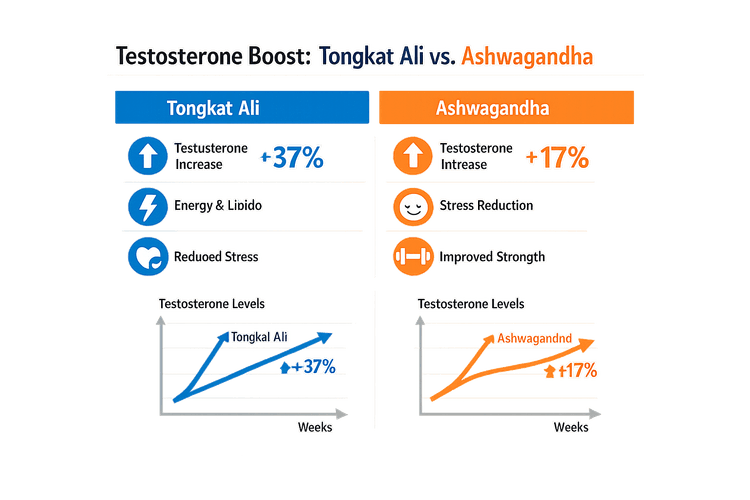
Both supplements have human trials. The numbers differ. Here is what each one measured, who was studied, and how long the trials ran.
What Does Ashwagandha Do for Testosterone?
One eight-week trial compared ashwagandha supplementation to placebo in men undergoing resistance training. The ashwagandha group saw testosterone increase by 96.19 ng/dL on average. The placebo group increased by 18.00 ng/dL. The difference was statistically significant (p = 0.004).
That is a measured change in total testosterone. The trial did not report free testosterone, SHBG, or LH. You get a number for total testosterone and a timeframe of eight weeks. The population was men already training, not sedentary men or men with diagnosed hypogonadism.
What Does Tongkat Ali Do for Testosterone?
One trial enrolled 76 men with late-onset hypogonadism. They received 200 mg of a standardized water-soluble extract daily for one month. Serum testosterone concentration improved significantly (P < 0.0001), and the Ageing Males' Symptoms score also improved.
Another body of research describes Tongkat ali as stimulating the release of free testosterone from binding proteins. The mechanism differs from ashwagandha: Tongkat ali appears to act on the binding proteins themselves, not on total production. That distinction matters when you read your lab results.
| Supplement | Population Studied | Duration | Testosterone Measure | Key Finding |
|---|---|---|---|---|
| Ashwagandha | Men in resistance training | 8 weeks | Total testosterone | +96.19 ng/dL vs placebo |
| Tongkat Ali | Men with late-onset hypogonadism | 1 month | Serum testosterone | Significant increase (P < 0.0001) |
How Do Their Mechanisms Differ?
Ashwagandha's effect appears to be on total testosterone production. Tongkat ali's effect appears to involve freeing testosterone from its binding proteins, which means free testosterone may rise more than total testosterone does. If you test only total testosterone, you may miss the effect Tongkat ali is known for.
Before choosing between them, test both total and free testosterone. SHBG and LH tell you whether the problem is production, binding, or signaling. Without those numbers, you are guessing which supplement fits your physiology.
Tongkat ali acts on binding proteins; ashwagandha acts on production. Your lab panel tells you which lever you need.
What the Trials Did Not Measure
Neither supplement has published data on long-term fertility outcomes, hematocrit changes, or estradiol shifts. The trials ran for one to two months. Nobody has published a 12-month safety and efficacy trial for either supplement in men with diagnosed hypogonadism.
If your testosterone is low enough to consider prescription treatment, these supplements are not a tested alternative. They are tested in men with borderline or age-related declines, not in men with primary or secondary hypogonadism who would qualify for TRT.
Cost and Monitoring
Both supplements are sold over the counter. Prices vary by brand and standardization. The trials used specific extracts at specific doses. A product with a different extraction method or dose may not produce the same result.
You still need lab work to know if the supplement worked. That means two tests: one before starting and one after eight weeks. If your insurance does not cover the labs, you pay out of pocket for both the supplement and the monitoring.
Tips for Choosing the Right Supplement
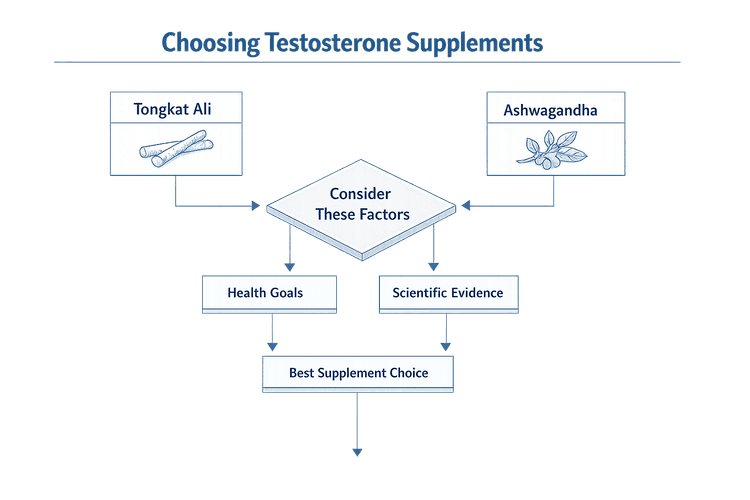
Before you buy, know what you are trying to fix. Tongkat Ali and Ashwagandha both have human trial data, but the populations studied and the endpoints measured differ. If your main complaint is stress and cortisol, the Tongkat Ali trials show restoration of cortisol-to-testosterone ratios in people exposed to modern stressors including aging, dieting and exercise stress. If you are untrained and looking for strength gains alongside hormone support, one Ashwagandha trial measured muscle strength and size in young, moderately trained men over eight weeks.
Match the Supplement to Your Baseline
The trial populations matter. Tongkat Ali studies included people dealing with lethargy, low libido, depression and fatigue — symptoms often tied to hormone imbalance. Ashwagandha's strength-training study enrolled untrained subjects with a small sample size and a short duration. If you fit the studied population, the results may apply to you. If you don't, the evidence is thin.
Understand What the Trials Actually Measured
Tongkat Ali trials measured hormone profiles and psychological mood state. Ashwagandha's strength study measured muscle strength, size and testosterone, but the findings come with caution due to the small sample and eight-week window. Neither supplement has large, long-duration trials in diverse populations. The evidence for females and older adults is limited.
If you want to know whether Ashwagandha increases testosterone in a way that holds up across populations, read the trials yourself. The headlines often overstate what the methods section supports.
Check the Dose and the Extract Standardization
Trials use specific extracts at specific doses. A bottle that lists the herb name without stating the extract ratio, the active compounds or the dose used in research is not comparable to the trial. Tongkat Ali trials used standardized root extract. Ashwagandha trials used specific withanolide concentrations. If the label does not match, the results may not either.
| Factor | Tongkat Ali | Ashwagandha |
|---|---|---|
| Primary evidence | Hormone balance, cortisol/testosterone ratio | Strength gains, limited testosterone data |
| Studied populations | Stressed, aging, dieting adults | Young, untrained men |
| Trial duration | Varies, some longer-term | Mostly short (8 weeks) |
| Dose standardization | Root extract, standardized | Withanolide concentration |
Do Not Expect Prescription-Level Results
No supplement replaces a prescription testosterone therapy or a SERM like enclomiphene when you have confirmed hypogonadism. Supplements work at the margins. They may improve your ratio of cortisol to testosterone or support recovery from training stress, but they will not double your total testosterone from 300 to 600 ng/dL. If your labs show true hypogonadism, ask your doctor for a prescription option, not a supplement. Learn more about enclomiphene cost and clinic approaches.
Monitor and Retest
If you choose one, retest your panel after eight to twelve weeks. Compare the numbers. If nothing moved, stop spending money on it. If cortisol dropped and testosterone rose modestly, you have your answer. The free option is fixing sleep, training and body composition first — those move the needle more than any supplement.
Frequently asked questions
Which is better for testosterone: Tongkat Ali or Ashwagandha?
Neither is definitively "better." Ashwagandha showed an 11% testosterone increase in stressed men over eight weeks. Tongkat Ali's trials focus on cortisol-testosterone balance rather than direct elevation. Your baseline labs — total testosterone, free testosterone, SHBG, and cortisol — determine which mechanism fits your physiology.
Can I take Tongkat Ali and Ashwagandha together?
No published trial has tested the combination for safety or synergy. Taking both increases cost and unknowns. Choose one, run it for eight weeks with before-and-after labs, and evaluate the result before adding a second supplement.
How long does it take to see results from these supplements?
Most trials measured changes at eight weeks. If you retest at eight to twelve weeks and see no movement in total testosterone, free testosterone, or cortisol, the supplement is not working for you.
Do these supplements work as well as TRT?
No. Testosterone replacement therapy produces larger, more consistent changes in men with diagnosed hypogonadism. Supplements may help men with borderline or stress-related declines, but they are not substitutes for prescription treatment when labs confirm low testosterone.
Are there side effects with Tongkat Ali or Ashwagandha?
Both are generally well-tolerated in trials. Ashwagandha can cause mild gastrointestinal upset in some users. Tongkat Ali may interact with blood-pressure or blood-sugar medications. Consult your doctor before starting either, especially if you take prescription drugs.
Conclusion
Tongkat Ali vs Ashwagandha for Testosterone is a question the research answers carefully. Ashwagandha showed an 11% testosterone increase in one trial of stressed men over eight weeks, while Tongkat Ali's human data focuses on hormone balance during stress rather than direct testosterone elevation. Neither supplement has the large, long-duration trials that would settle the comparison definitively.
The short answer: if you are choosing between these two, your decision hinges on what you are trying to fix. Ashwagandha has slightly more direct testosterone data in stressed populations. Tongkat Ali has a longer traditional use history and some evidence for cortisol-testosterone balance. Both have small sample sizes, short durations, and high variance across subjects — which means the effect you see in a trial average may not be the effect you see in your own labs.
What we don't know yet: which extract standardization matters, whether the effect persists past eight weeks, and whether either supplement changes outcomes that matter more than a single hormone number. The trials measured testosterone; they did not measure energy, libido, strength or mood with the rigor that would let you predict your own response.
If your labs show low testosterone and you want to try a supplement first, pick one, run it for eight weeks, and retest. If the number moves and you feel better, you have an answer. If it doesn't, you saved yourself months of guessing and you know it is time to talk to a doctor about treatment options that have larger effect sizes.
The free option is still the one nobody selling supplements will tell you: sleep seven hours, lose the spare weight, stop drinking every night, and retest in eight weeks. That combination moves testosterone more reliably than either herb, costs nothing, and the evidence is not thin.
Sources(21)
- Andrologia (2011)
- Journal of the International Society of Sports Nutrition (2013)
- Journal of the International Society of Sports Nutrition (2013)
- Phytotherapy research : PTR (2013)
- Chinese journal of natural medicines (2017)
- American journal of men's health (2019)
- International journal of molecular sciences (2023)
- Medicine (2019)
- Journal of ethnopharmacology (2020)
- The Journal of urology (2020)
- European urology focus (2017)
- International journal of general medicine (2022)
- The aging male : the official journal of the International Society for the Study of the Aging Male (2015)
- The journal of sexual medicine (2013)
- The Journal of clinical endocrinology and metabolism (2026)
- F&S reviews (2020)
- Journal of sex & marital therapy (2015)
- Urologia (2018)
- Reproductive biomedicine online (2017)
- Medicine (2019)
- Journal of the International Society of Sports Nutrition (2015)