Quest Testosterone Test: Comparison Guide with Labcorp
Updated
Top takeaways
- Quest and Labcorp are the two largest lab networks in the US, with thousands of draw sites each and similar panel offerings for testosterone testing.
- Both labs measure total testosterone, free testosterone, and supporting markers like SHBG, LH, and estradiol, but panel names and codes differ between the two.
- Pricing varies by insurance, location, and whether you order through a doctor or a direct-access service, with cash prices often ranging from $50 to $200 for a basic panel.
- Draw site density, hours, and wait times differ by region, so your zip code may favor one lab over the other for convenience.
- The lab you choose matters less than ordering the right panel twice, at the right time of day, before making any treatment decision.
Introduction
Quest vs Labcorp for a testosterone test is a decision most men face when their doctor orders hormone work or when symptoms like fatigue, low libido, or difficulty building muscle persist long enough to prompt testing. Quest Diagnostics and Labcorp process the majority of outpatient blood work in the United States. Both are accredited, both use automated immunoassays for most routine hormone testing, and both deliver results to your provider within a few days. The question is not which lab is objectively better—the question is which one fits your insurance network, your location, and the specific panel your situation requires.
Most men discover they need testosterone testing after symptoms persist long enough to prompt a conversation with a doctor. The first step is not choosing a lab. The first step is understanding what to test and when to test it. A single morning result tells you almost nothing. Two fasted morning draws, taken a week or more apart, give you a baseline. The panel should include total testosterone, free testosterone (or the inputs to calculate it), SHBG, LH, and estradiol at minimum. Some providers add FSH, prolactin, hematocrit, and PSA depending on age and history. Quest and Labcorp both offer these markers, but the ordering codes and panel bundles differ.
This guide walks through the practical differences between Quest vs Labcorp for a testosterone test: what each lab includes in its common panels, how pricing works with and without insurance, where to find draw sites, and what to ask your doctor before the order is written. The goal is to help you show up to the right lab, at the right time, with the right test ordered, so the results you get are actually useful. If you are comparing treatment options after diagnosis, Enclomiphene vs hCG: Compare Two Options for Testosterone Production covers two common alternatives to TRT and what the trials show about each.
What Makes Quest vs Labcorp for a Testosterone Test a Real Decision?
You need a testosterone test. Your doctor wrote the order or you bought one from a telehealth clinic. Now you have to pick a lab, and the two names that come up are Quest Diagnostics and Labcorp. They look the same on the surface—national chains, thousands of draw sites, insurance contracts with most carriers. The differences show up when you try to book the appointment, read the bill, or compare what each lab actually measures.
The first problem is the panel itself. Not every testosterone test is built the same way. Some labs run total testosterone only. Others add free testosterone, SHBG, LH, FSH, and estradiol in a bundle. If your order says "testosterone panel" without listing the components, you will not know what you are getting until the results come back. That matters because a single total testosterone number, taken once, is not enough to make a treatment decision. You need at least two morning draws, and ideally you need the supporting markers—LH tells you whether your pituitary is working, SHBG tells you how much testosterone is bound and unavailable, free testosterone tells you what is actually circulating. One lab may include these by default; the other may charge separately for each add-on.
The second problem is method and accuracy. Both Quest and Labcorp run immunoassays for most routine testosterone orders, and they run liquid chromatography–mass spectrometry (LC-MS/MS) for samples that fall below a threshold or when the order specifies it. Immunoassays are faster and cheaper, but they show more variability at low concentrations—the range where many men with symptoms actually fall. The CDC has run proficiency testing on clinical labs since 2012 to push accuracy up and bias down. In the 2016 round, 87.7% of participating labs had at least four out of five results within acceptable error limits, a 14.7% improvement from the earlier study. That still means some labs miss the target, and when your result sits near the low end of the reference range, a few percentage points of bias can flip your diagnosis.
The third problem is draw-site access and convenience. Quest and Labcorp each operate thousands of patient service centers, but they are not distributed evenly. In some cities, Quest has twice as many locations as Labcorp. In others, the reverse is true. If you need two fasting morning draws a week apart, and the nearest lab is a 40-minute drive, that becomes two 40-minute drives before 10 a.m. Some insurance plans steer you to one network or the other with lower copays, and some telehealth clinics have standing accounts with one lab and not the other, so your choice may already be narrowed before you look at the map.
The lab that is closer and takes your insurance is often the right lab, as long as the panel includes the markers you actually need.
The fourth problem is price transparency. If you are paying out of pocket, Quest and Labcorp both publish cash-pay menus, but the listed price for a "testosterone test" can range from under $50 to over $200 depending on what is bundled. If you are using insurance, the allowed amount and your responsibility depend on the contract between the lab and your carrier, and that number does not appear until the claim processes. You can call the lab or the insurer ahead of time and ask for an estimate, but estimates are not guarantees. The bill you get may include separate line items for the draw fee, the total testosterone assay, the free testosterone calculation, and each additional hormone, and each line item hits your deductible or coinsurance separately.
The last problem is turnaround time and reporting format. Most testosterone results come back in one to three business days. If the lab runs the sample twice or sends it out for LC-MS/MS confirmation, it can take longer. The format of the report—reference ranges, units, flags for high or low—varies between labs, and some formats are easier to read than others. If you are tracking results over time or sharing them with a doctor who uses a different lab, you will need to compare reference ranges carefully, because a 300 ng/dL result flagged as low at one lab may sit in the middle of the range at another.
These are the friction points. The next section walks through how to compare Quest vs Labcorp for a testosterone test on each of them so you can pick the one that fits your situation.
Solution Steps
Step 1: Understand What Each Lab Actually Measures
Both Quest and Labcorp use mass spectrometry methods for testosterone testing, which are considered the most accurate. Gas chromatography mass spectrometry (GC-MS) and liquid chromatography tandem mass spectrometry (LC-MS-MS) are the analytical methods both labs employ. These methods have run-to-run precision and accuracy generally less than 6% and are linear from 5 to 2000 ng/dL.
The test panels available at each lab vary by what your ordering physician requests. A basic panel measures total testosterone only. A comprehensive panel includes total testosterone, free testosterone (calculated or measured), sex hormone-binding globulin (SHBG), and sometimes luteinizing hormone (LH). Some panels add estradiol, follicle-stimulating hormone (FSH), hematocrit, and prostate-specific antigen (PSA).
Neither lab's basic testosterone test tells you enough. You need at least total testosterone, SHBG, and LH to make an informed decision about treatment. For more on how SHBG affects your results and what high levels mean, see High SHBG in Men: Causes and Questions to Ask Your Doctor.
Step 2: Compare Panel Availability
Quest offers test code 17985 for total testosterone by LC-MS-MS. Labcorp offers test code 004226 for the same. Both labs offer calculated free testosterone when you order total testosterone plus SHBG together. Both also offer direct free testosterone measurement by equilibrium dialysis, though this is less commonly ordered.
For a full hormone panel, both labs can run the same tests. The difference is in how your ordering provider bundles them. Telehealth clinics that use Quest or Labcorp typically create custom panels that include the markers they want to monitor. If you are ordering through your primary care physician, ask specifically for total testosterone, SHBG, and LH at minimum.
Neither lab is inherently better at running these tests. The method is standardized, and both participate in accuracy certification programs.
| Lab | Total Testosterone Method | Free Testosterone | Full Panel Availability |
|---|---|---|---|
| Quest | LC-MS-MS (test 17985) | Calculated or direct | Yes, via provider order |
| Labcorp | LC-MS-MS (test 004226) | Calculated or direct | Yes, via provider order |
Step 3: Check Draw Site Density in Your Area
Quest operates approximately 2,200 patient service centers across the United States. Labcorp operates roughly 2,000. In most metropolitan areas, you will find multiple locations for each lab within a short drive. In rural areas, one lab may have significantly better coverage than the other.
Before choosing a lab, search both networks using your ZIP code. Quest's site locator is at questdiagnostics.com/locations, and Labcorp's is at labcorp.com/labs-and-appointments. Look for early morning availability, because testosterone must be drawn before 10 a.m. for accurate results.
If one lab has a draw site within five minutes of your home and the other requires a 30-minute drive, that difference matters when you need to test fasting and before mid-morning.
Step 4: Verify Insurance Coverage and Out-of-Pocket Pricing
Your insurance plan designates one lab as in-network and the other as out-of-network, or it covers both. Call your insurer or check your member portal before you schedule. An in-network testosterone panel might cost you a $10 copay. The same panel out-of-network can run $200 to $400.
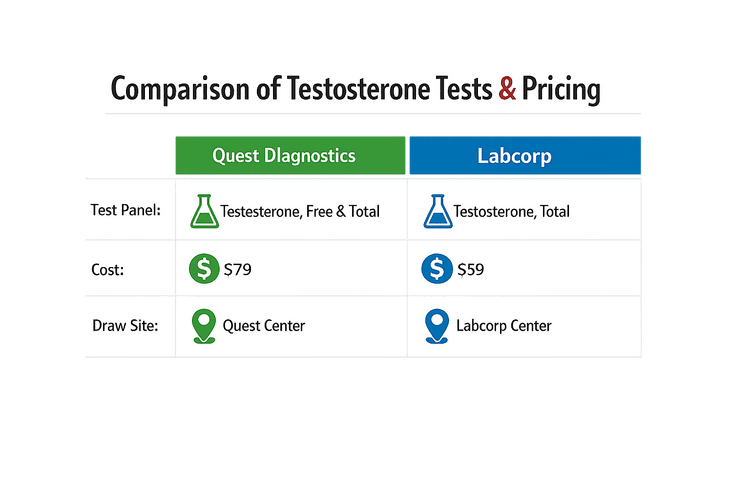
If you are paying cash, both labs publish self-pay rates. As of this writing, a basic total testosterone test at Quest costs approximately $69 to $99 without insurance. Labcorp charges a similar range. A comprehensive panel that includes SHBG, LH, estradiol, and other markers will cost $200 to $400 cash at either lab.
Telehealth clinics often bundle lab work into their membership fees. Some use Quest exclusively, others use Labcorp exclusively, and a few let you choose. If you are comparing clinics, ask which lab network they use and whether the lab fee is included or billed separately. For more on how insurance interacts with testosterone treatment, see Does Insurance Cover TRT? What You Need to Know.
Step 5: Schedule the Draw Correctly
Testosterone peaks in the early morning and declines throughout the day. To get a valid baseline, schedule your blood draw between 7 a.m. and 10 a.m. Both Quest and Labcorp allow online appointment scheduling, and most locations offer early morning slots.
Fast for at least 8 hours before the draw if your panel includes lipids or glucose. Water is fine. Avoid alcohol for 24 hours and heavy exercise for 48 hours before the test, as both can temporarily alter hormone levels.
Bring your lab order form if your provider gave you one. If the clinic sent the order electronically, bring a photo ID. Both labs will ask you to confirm your date of birth and the tests ordered before the draw.
Step 6: Understand Turnaround Time and How You Get Results
Both Quest and Labcorp typically return testosterone results within 24 to 48 hours. Complex panels that include less common markers may take 3 to 5 business days. Your ordering provider receives the results first. Most clinics and telehealth services will release them to you through a patient portal within a day of receiving them.
If you ordered the test yourself through a direct-to-consumer service, you will receive results by email or through the service's app. Both labs provide a reference range printed beside each number. The reference range for total testosterone in adult men is typically 264 to 916 ng/dL, though this varies slightly by lab and testing method.
Do not rely on the reference range alone. A result of 300 ng/dL is technically "normal" but may still warrant treatment if you have symptoms and a low LH, which suggests your pituitary is not trying to raise it.
Tips and Tricks
Before you walk into either lab, know that timing matters more than the name on the door. Most testosterone tests involve a blood draw between 7 and 10 AM, when your levels are highest. A sample taken at noon will read lower, and nobody will tell you to come back—the lab runs what you give them.
Schedule Your Draw Early
Book the earliest available slot. If the first opening is at 9:30, take it. If you can get 7 AM, better. The reference range on your report assumes a morning sample; an afternoon draw makes your result look artificially low and starts conversations you don't need.
Confirm the Panel Before You Pay
Both labs offer testosterone-only tests and broader panels that include free testosterone, SHBG, LH, FSH and estradiol. The single-marker test is cheaper and often useless—it tells you one number without context. If your doctor ordered "testosterone," call and ask whether the order includes free testosterone and SHBG. If it doesn't, ask them to add it before you go.
One morning result is not a diagnosis, and one marker is not a panel.
If you're paying out of pocket, compare the panel price at both labs before you choose a location. The draw site closest to you may not offer the best cash rate.
At-Home Kits: When They Work and When They Don't
Some vendors sell at-home testosterone kits that use a finger-stick blood sample or saliva. These skip the lab visit, but the trade-off is accuracy. Blood from a finger stick measures capillary levels, not venous, and saliva measures free testosterone only. If you're using the result to start or adjust treatment, your doctor will likely ask you to repeat it with a venous draw anyway.
Talk to your provider before you order an at-home test. If they say it's acceptable for your situation, follow the kit instructions exactly—timing, sample size and return shipping all matter. If they say they need a lab draw, don't spend money on a kit they won't accept.
Bring Your Insurance Card and ID
Both Quest and Labcorp require a photo ID and, if you're using insurance, your current card. If your insurance changed in the last 90 days, bring documentation. A rejected claim because of an old member number costs you time, and the lab will bill you directly while the insurer sorts it out.
Ask for a Copy of the Report
You are entitled to a copy of your lab results. Both labs offer patient portals where you can download the PDF. Set up your account before the draw or immediately after—you'll get the result faster than waiting for your doctor's office to call. The report includes reference ranges for every marker; read them before your follow-up appointment so you know what questions to ask.
For more on what those markers mean and how doctors use them, see High SHBG in Men: Causes and Questions to Ask Your Doctor.
Conclusion
Quest and Labcorp both run testosterone assays that meet CDC standardization targets when the lab uses LC-MS/MS. The analytical method matters more than the logo on the tube. A 2016 accuracy-based proficiency study found that 87.7 percent of participating laboratories delivered results within the minimum allowable total error limits when using calibrated methods, a 14.7 percent improvement from earlier testing. The gap narrows further when you specify LC-MS/MS on the order.
Neither chain guarantees the same method at every draw site. Before you book, confirm the assay type with the ordering provider or the lab directly. If the requisition says "immunoassay" and your total testosterone is under 300 ng/dL, ask for LC-MS/MS. Immunoassays lose precision at low concentrations, and that is where diagnostic decisions hinge.
Pricing and insurance networks differ by region and by the panel your provider orders. A single total testosterone test may cost you twenty dollars at one site and two hundred at another, even within the same chain. The bill depends on your plan's contracted rate, not the lab's list price. Call the number on your insurance card and ask for the allowed amount before you go.
If you need a full hormone panel—total and free testosterone, SHBG, LH, FSH, estradiol—make sure every marker is on the order. Partial panels leave gaps that delay diagnosis and add a second trip. Both Quest and Labcorp offer comprehensive panels; your provider picks which tests to include.
The lab that works for you is the one that runs the right assay, takes insurance, and sits close enough that you can walk in fasting before ten in the morning. Check the method, check the price, and test twice. That is how you get a number you can use.
For more on what to do after you have your results, see our guide on Enclomiphene vs hCG: Compare Two Options for Testosterone Production. If you are exploring alternatives to injections, Oral Testosterone: Kyzatrex, Jatenzo, and Tlando Explained covers FDA-approved oral formulations and what the trials show.
FAQ
Which lab is more accurate for testosterone testing, Quest or Labcorp?Both Quest and Labcorp use LC-MS/MS for testosterone measurement when specified, and both participate in CDC accuracy certification programs. A 2016 proficiency study found 87.7% of participating labs met acceptable error limits. The assay method matters more than the lab name—confirm your order specifies LC-MS/MS if your result is near the low end of the reference range.
Does insurance cover testosterone testing at Quest and Labcorp?Most insurance plans cover medically necessary testosterone testing at both Quest and Labcorp when ordered by a physician. Your out-of-pocket cost depends on whether the lab is in-network, your deductible, and your plan's coverage for lab services. Call your insurer before scheduling to confirm the allowed amount and your copay.
How much does a testosterone test cost at Quest vs Labcorp without insurance?Cash prices for a basic total testosterone test range from $69 to $99 at both Quest and Labcorp. A comprehensive panel that includes free testosterone, SHBG, LH, and estradiol typically costs $200 to $400. Prices vary by location and the specific tests ordered.
Can I choose between Quest and Labcorp if my doctor orders a testosterone test?Yes, unless your insurance plan restricts you to one lab network or your ordering provider has a standing account with only one lab. Ask your doctor which lab they use and whether you can request the other if it is more convenient or better covered by your insurance.
How long does it take to get testosterone test results from Quest or Labcorp?Most testosterone results are available within 24 to 48 hours. If the lab runs LC-MS/MS confirmation or includes less common markers like FSH or prolactin, turnaround may extend to 3 to 5 business days. Your provider receives results first; most release them to you through a patient portal within one day.
Sources(28)
- The Journal of urology (2020)
- The Journal of clinical endocrinology and metabolism (2026)
- American family physician (2024)
- U.S. Food and Drug Administration — Drug Safety Communication: FDA cautions about using testosterone products for low testosterone due to aging; requires labeling change to inform of possible increased risk of heart attack and stroke with use (2015)
- Journal of Clinical Endocrinology & Metabolism — Testosterone Therapy in Men With Hypogonadism: An Endocrine Society Clinical Practice Guideline (2018)
- International journal of general medicine (2022)
- American Urological Association — Evaluation and Management of Testosterone Deficiency (AUA Guideline) (2018)
- MedlinePlus (U.S. National Library of Medicine) (2025)
- Quest Diagnostics (questhealth.com) (2026)
- The Journal of clinical endocrinology and metabolism (2018)
- JAMA (2017)
- The Urologic clinics of North America (2022)
- The journal of sexual medicine (2022)
- Clinical biochemistry (2019)
- Clinical mass spectrometry (Del Mar, Calif.) (2019)
- Scandinavian journal of clinical and laboratory investigation (2017)
- RSC advances (2026)
- International journal of impotence research (2023)
- The journal of sexual medicine (2019)
- Journal of human kinetics (2014)
- American journal of men's health (2015)
- Advances in clinical and experimental medicine : official organ Wroclaw Medical University (2025)
- RSC advances (2026)
- Journal of applied physiology (Bethesda, Md. : 1985) (1994)
- Andrology (2025)
- European journal of endocrinology (2024)
- The journal of sexual medicine (2021)
- The journal of sexual medicine (2022)