Enclomiphene vs hCG: Compare Two Options for Testosterone Production
Updated
Top takeaways
- Enclomiphene and hCG both support testosterone production, but they work through different mechanisms and serve different use cases
- Enclomiphene blocks estrogen receptors to stimulate your own LH and FSH production; hCG mimics LH directly
- Both options can preserve sperm production, unlike traditional testosterone replacement therapy
- The choice between them depends on whether you are starting treatment for low testosterone or trying to maintain fertility during TRT
- Neither has FDA approval for treating low testosterone in men; both are used off-label or compounded
Introduction
What Enclomiphene vs hCG Actually Means
Enclomiphene citrate and human chorionic gonadotropin (hCG) are two medications used to maintain or restore testosterone production without shutting down the body's own hormone cascade. Enclomiphene is a selective estrogen receptor modulator (SERM) that blocks estrogenic suppression of the hypothalamic-pituitary-gonadal axis. hCG is a hormone that mimics luteinizing hormone and directly stimulates the testes to produce testosterone and maintain intratesticular testosterone levels.
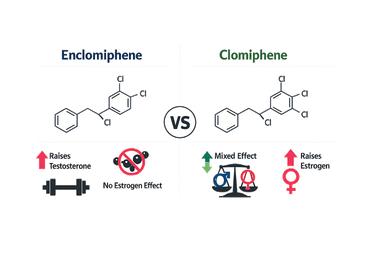
Clomiphene citrate, the mixture from which enclomiphene is derived, has been used off-label for male hypogonadism and infertility for years. Enclomiphene is the purified trans-isomer of that mixture. hCG is often used alongside testosterone replacement therapy to preserve sperm production, or as a standalone treatment for men who want to avoid exogenous testosterone entirely.
The comparison between enclomiphene vs hCG matters most when you are deciding how to address low testosterone while keeping fertility options open. For a broader look at how different treatments compare, see Enclomiphene Citrate: What the Research Actually Shows.
Why This Comparison Exists
Both medications are prescribed off-label or obtained through compounding pharmacies. Neither is FDA-approved specifically for treating low testosterone in men. Enclomiphene was evaluated by the FDA for inclusion on the 503A bulk drug substances list to increase serum testosterone, LH, and FSH to normal levels, but it was not added to that list. hCG is FDA-approved for female infertility and other indications, but its use in men for testosterone support is off-label.
The research shows that enclomiphene stimulates the hypothalamic-pituitary-gonadal axis, while hCG sustains intratesticular testosterone and spermatogenesis even when exogenous testosterone fully suppresses gonadotropins. Understanding how each works, what the trials measured, and what they cost in monitoring and fertility is the first step in choosing between them.
Problem Statement
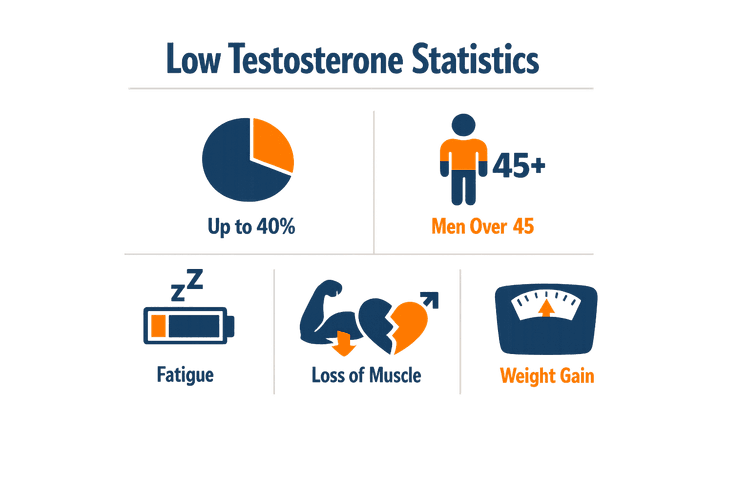
Low testosterone creates a decision tree with two branches. One path gives you a number that looks good on paper but shuts down your body's own production. The other path tries to restart what stopped working in the first place. Most men choosing between enclomiphene and hCG land here because they want the number to move without closing the fertility door.
Traditional testosterone replacement suppresses luteinizing hormone and follicle-stimulating hormone — the signals your pituitary sends to keep your testes producing testosterone and sperm. That suppression is reliable and dose-dependent. For men who are done building families or who never planned to, it is a non-issue. For men who want to preserve the option, it is the issue.
The Fertility Trade-Off
Exogenous testosterone reliably raises serum testosterone. It also reliably suppresses gonadotropins, which means testicular function declines over time. Sperm production drops, often to zero, within months. Intratesticular testosterone — the local concentration that drives spermatogenesis — falls by more than ninety percent on standard TRT protocols. Recovery is possible after stopping, but the timeline is unpredictable and not guaranteed.
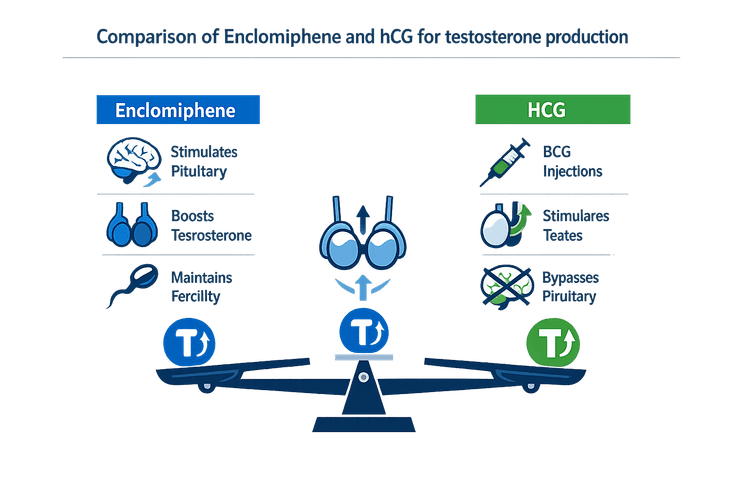
Enclomiphene and hCG take different mechanical approaches to the same goal: keeping gonadotropin signaling alive. Enclomiphene blocks estrogen receptors in the hypothalamus and pituitary, which removes the negative feedback loop that normally dampens LH and FSH secretion. The result is higher endogenous testosterone without direct suppression of the gonadal axis. Research shows that enclomiphene raises LH and FSH levels while increasing serum testosterone, and it does not negatively impact semen parameters in the trials conducted so far.
hCG mimics LH at the receptor level. It binds to the same testicular Leydig cells that respond to your own LH, stimulating local testosterone production even when your pituitary has been suppressed by exogenous testosterone. This is why hCG is often added to TRT protocols: concomitant administration of low-dose hCG with exogenous testosterone sustains intratesticular testosterone and spermatogenesis, even under full gonadotropin suppression.
What the Trials Actually Measured
The enclomiphene trials enrolled men with secondary hypogonadism — low testosterone with low or normal LH, meaning the problem starts upstream in the brain, not in the testes. These men had baseline total testosterone below 300 ng/dL and were not on any other hormone therapy. Trial durations ran twelve to sixteen weeks. Endpoints included changes in total and free testosterone, LH, FSH, estradiol, lipid panels, and semen parameters where measured. The populations were small — the largest published trial enrolled fewer than 150 men.
hCG studies in the fertility-preservation context typically involve men already on TRT who add hCG to prevent testicular atrophy and maintain sperm counts. Sample sizes are similarly modest, and follow-up periods range from three months to a year. The outcome measures focus on semen analysis, testicular volume, and intratesticular testosterone levels, not on whether hCG alone can normalize serum testosterone in hypogonadal men who are not taking exogenous testosterone.
That distinction matters. Enclomiphene is studied as monotherapy for men with secondary hypogonadism. hCG is studied as adjunctive therapy for men on TRT who want to preserve fertility. The evidence bases do not overlap cleanly, which is why comparing them requires knowing what you are trying to fix and what you are willing to monitor.
The number that matters is not just serum testosterone — it is whether your testes are still in the game.
For a deeper look at how enclomiphene works and what the trial data show, see Enclomiphene Citrate: What the Research Actually Shows.
Solution Steps: Enclomiphene vs hCG
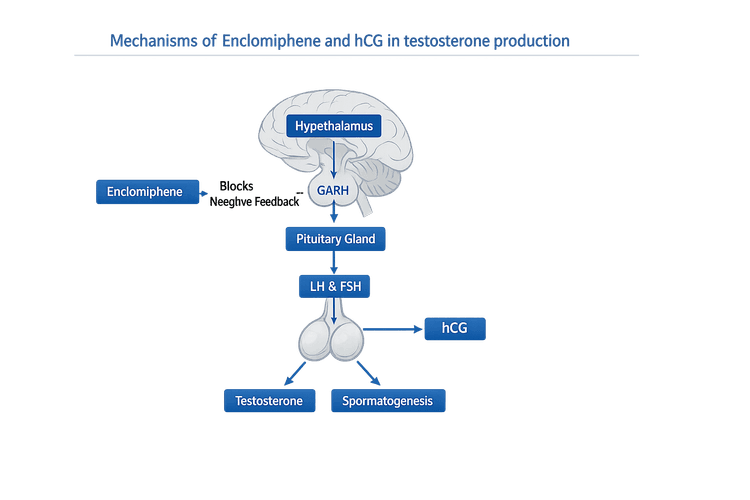
Enclomiphene and hCG take different routes to the same goal: raising testosterone without shutting down your own production. One blocks estrogen receptors in your brain. The other mimics the signal your pituitary normally sends to your testes. Here is what each does and what it costs you in monitoring, side effects and flexibility.
How Enclomiphene Works
Enclomiphene is the trans-isomer of clomiphene citrate, stripped of the cis-isomer that causes most of clomiphene's side effects. It blocks estrogen receptors in the hypothalamus and pituitary, which tricks your brain into releasing more luteinizing hormone and follicle-stimulating hormone. Those signals tell your testes to make more testosterone.
In clinical trials, enclomiphene demonstrated significant efficacy in restoring testosterone levels in men with secondary hypogonadism. The drug stimulates the hypothalamic-pituitary-gonadal axis, raising endogenous testosterone while maintaining spermatogenesis. You take it daily, usually 12.5 mg or 25 mg. Your LH and FSH rise. Your testosterone follows.
One comparative study found adverse effects in 13.8 percent of enclomiphene recipients, compared to 47 percent in the clomiphene group. Decreased libido occurred in 8.6 percent of enclomiphene users versus 33.3 percent in clomiphene users. The difference was statistically significant.
How hCG Works
Human chorionic gonadotropin mimics luteinizing hormone directly. You inject it subcutaneously, usually two to three times per week. It binds to LH receptors on Leydig cells in your testes and tells them to produce testosterone. It does not rely on your pituitary — it replaces the signal your pituitary would normally send.
Concomitant administration of low-dose hCG with exogenous testosterone sustains intratesticular testosterone and spermatogenesis, even when the pituitary is fully suppressed by TRT. Multiple studies demonstrate that hCG maintains sperm production under full gonadotropin suppression. This makes hCG the standard option for men on TRT who want to preserve fertility.
You can use hCG alone to raise testosterone, or you can use it alongside TRT to keep testicular function. Alone, it raises total testosterone but often less reliably than enclomiphene or TRT. Alongside TRT, it prevents testicular atrophy and keeps sperm counts viable.
Step-by-Step: Choosing Between Enclomiphene and hCG
Before choosing, get total testosterone, free testosterone, LH, FSH, estradiol and SHBG. Two morning results, drawn before 10 a.m., fasting. If your LH is already elevated, enclomiphene will not help. If your LH is low or normal, both options are on the table.
If you want to preserve sperm production while raising testosterone, both enclomiphene and hCG work. If you are already on TRT and want to add fertility support, hCG is the standard choice because it works even when your pituitary is suppressed. Enclomiphene alone will not restart a suppressed axis quickly.
Enclomiphene is a daily pill. hCG is an injection two to three times per week. Enclomiphene is often cheaper per month if you use a compounding pharmacy, but it is not FDA-approved for male hypogonadism — every prescription is off-label. hCG is also off-label for this use, but it has decades of prescribing history. Telehealth clinics price both widely; compare the monthly cost including labs and membership fees before signing up.
Retest at six to eight weeks. Check total and free testosterone, LH, FSH, estradiol, hematocrit and a lipid panel. If testosterone rises into the normal range and you feel better, continue. If it does not, adjust the dose or switch options. Neither drug works for everyone.
What the Evidence Shows About Enclomiphene vs hCG
Enclomiphene trials enrolled men with secondary hypogonadism — low testosterone with low or normal LH. The studies were short, twelve to sixteen weeks, and small, under two hundred participants. The drug raised testosterone reliably in that population. Long-term data and large controlled trials are still missing.
hCG has been studied for decades in fertility medicine and as an adjunct to TRT. The evidence for maintaining spermatogenesis during TRT is strong. The evidence for using hCG alone to treat hypogonadism is thinner — it works, but response varies more than with TRT or enclomiphene.
For more context on how these options fit into the broader landscape of testosterone treatment, see Enclomiphene Citrate: What the Research Actually Shows.
What We Don't Know Yet
Neither drug has long-term safety data in men using it for years. Enclomiphene trials stopped at sixteen weeks. hCG has longer prescribing history, but controlled trials in men using it solo for hypogonadism are small and short. We do not know how either affects cardiovascular risk, bone density or prostate health over decades. We do not know the optimal dose for every patient. We do not know how often men stop responding after the first year.
Before choosing, ask your doctor for the baseline labs that tell you whether your axis can respond to enclomiphene, and whether hCG is a better fit for your goals. Test first, test twice, then decide.
Tips and Tricks for Choosing Between Enclomiphene and hCG
Test First, Then Choose
Before you pick one of these, get a baseline testosterone panel that includes total testosterone, free testosterone, LH, FSH, SHBG and estradiol. Both enclomiphene and hCG work by raising LH or mimicking it — if your LH is already high and your testosterone is still low, neither one will help you. That pattern suggests primary testicular failure, and you need a different conversation with your doctor. Two morning results, drawn before 10 a.m. on separate days, give you a real baseline. One number is not a diagnosis.
Know What You Are Trading
Enclomiphene raises your own LH and FSH, which usually preserves sperm production and testicular volume. hCG mimics LH directly, so it raises testosterone and maintains testicular size, but it does not raise FSH — sperm production may decline over time in some men. If fertility is the priority right now, enclomiphene has the edge in the small studies we have. If you are already on TRT and want to preserve testicular function while staying on it, hCG is the add-on most clinics offer. Neither option is a guarantee — you monitor with labs, not assumptions.
Monitor With Numbers, Not Symptoms
Symptoms lag labs by weeks, and they are noisy. After starting either drug, recheck your testosterone panel at six to eight weeks, then every three to six months. Track total and free testosterone, estradiol, hematocrit and lipids. For enclomiphene, watch estradiol — some men see a rise, others see a drop. For hCG, watch hematocrit and estradiol; both can climb. If you are preserving fertility, add a semen analysis at six months. The number that matters is the one on the lab report, not how you feel that week.
Ask About Cost and Compounding
Enclomiphene is not FDA-approved for men, so most prescriptions come from compounding pharmacies. That means your insurance will not cover it, and prices vary widely — expect $50 to $150 per month depending on the clinic and the pharmacy. hCG is FDA-approved for other indications and available as a brand-name or compounded product; compounded hCG is cheaper but also not covered by insurance. Before you sign up with a telehealth clinic, ask what the drug costs you per month, what the membership or consultation fee is, and how often you pay for labs. The total cost is what you compare, not the drug price alone. For more on evaluating clinics before you commit, see Best Online TRT Clinic: How to Choose and What to Avoid.
Understand the Research Limits
The enclomiphene studies are small — often fewer than 100 men, followed for six to twelve months. The hCG-plus-TRT studies are also small and short. We do not have large, multi-year trials comparing these head-to-head for fertility outcomes, cardiovascular safety or cancer risk. That does not mean they are unsafe; it means the long-term data are thin, and nobody selling them will tell you that up front. Continued research with larger, long-term studies is essential to confirm safety, efficacy and fertility outcomes. If your doctor recommends one of these, ask what the monitoring plan is and what the exit strategy looks like if it stops working or causes side effects.
Conclusion
Enclomiphene and hCG both preserve fertility while raising testosterone, but they differ in side-effect profiles, cost, and administration. Enclomiphene is a daily pill that blocks estrogen receptors in the pituitary, prompting your body to produce more LH and FSH. hCG is an injection that mimics LH directly, signaling the testes to make testosterone and maintain sperm production. The choice between them depends on how much you value convenience over injectables, what your insurance covers, and how your body responds to each mechanism.
The trial data show enclomiphene raises testosterone with fewer reports of mood changes, low energy, and libido drops than clomiphene. One study of 66 men found adverse effects in 13.8% of the enclomiphene group versus 47% in the clomiphene group. Decreased libido appeared in 8.6% of enclomiphene users compared to 33.3% on clomiphene, and mood changes were absent in the enclomiphene arm but present in 9.1% of clomiphene recipients. Reduced energy affected 5.2% of enclomiphene users and 16.7% of clomiphene users. These numbers come from a single retrospective chart review, so larger trials are needed to confirm the pattern.
hCG has decades of use in fertility medicine and a well-documented side-effect profile: injection-site reactions, occasional gynecomastia from aromatization to estradiol, and the logistical burden of refrigeration and frequent dosing. Some men tolerate injections well; others find the routine unsustainable. Enclomiphene avoids needles but is compounded off-label in the United States, which means your prescription comes from a specialty pharmacy rather than a brand-name manufacturer, and insurance rarely covers it.
Making the Decision
Before you choose, test twice: two morning total and free testosterone results, plus LH, FSH, and estradiol. If your LH is already high, neither drug is likely to help—you have primary hypogonadism, and exogenous testosterone is the usual next step. If LH is low or normal and testosterone is low, both enclomiphene and hCG are on the table. Ask your prescriber what each costs per month in your insurance tier or through the clinic's pharmacy, what monitoring schedule they require, and whether they have experience titrating the dose based on follow-up labs.
For detailed guidance on evaluating telehealth providers and comparing clinic structures, see our guide to choosing an online TRT clinic. The cheapest advertised price is not the total cost—factor in labs, follow-up visits, and whether the clinic requires you to stay on their formulary or allows you to fill prescriptions elsewhere.
Neither drug is a permanent commitment. Many men try one, monitor the response over three months, and switch if the results or side effects do not fit. The goal is a testosterone level that relieves symptoms, labs that stay in range, and sperm parameters that preserve your options if fertility matters now or later. Test first, test twice, and make the call with numbers in front of you.
Sources(25)
- The Journal of urology (2020)
- F&S reviews (2020)
- Andrology (2025)
- European journal of endocrinology (2024)
- Sexual medicine reviews (2017)
- The Cochrane database of systematic reviews (2024)
- The Journal of arthroplasty (2025)
- American family physician (2024)
- International journal of pharmaceutical compounding (2015)
- European urology focus (2017)
- Prostate cancer and prostatic diseases (2014)
- The Journal of clinical endocrinology and metabolism (2026)
- UnitedHealthcare Commercial Medical Benefit Drug Policy 2026D0076J: Testosterone Replacement or Supplementation Therapy
- JAMA (2017)
- U.S. Food and Drug Administration — Enclomiphene Citrate: FDA presentation to the Pharmacy Compounding Advisory Committee, June 8, 2022 (Madeline Wolfert, MD, CDER)
- The world journal of men's health (2026)
- The Journal of clinical endocrinology and metabolism (2018)
- Journal of Clinical Endocrinology & Metabolism — Testosterone Therapy in Men With Hypogonadism: An Endocrine Society Clinical Practice Guideline (2018)
- The Journal of urology (2015)
- The aging male : the official journal of the International Society for the Study of the Aging Male (2015)
- Annals of internal medicine (2020)
- U.S. Food and Drug Administration — Testosterone Information (2026)
- The journal of sexual medicine (2021)
- International journal of impotence research (2023)
- International journal of general medicine (2022)