Enclomiphene Side Effects: Trial Results vs. Online Reports

Updated
Top takeaways
- Clinical trials report headache, hot flushes, nausea, and muscle spasms as the most frequent enclomiphene side effects
- Trial data shows enclomiphene produces fewer adverse effects than clomiphene, including lower rates of mood changes and decreased libido
- Online user reports vary widely and lack the controlled documentation of clinical studies
- The FDA label includes specific monitoring requirements often missing from clinic marketing materials
- Current evidence base is limited; larger long-term studies are needed to confirm safety patterns
Introduction
Enclomiphene citrate is a selective estrogen receptor modulator that blocks estrogenic suppression of the hypothalamic-pituitary-gonadal axis. It raises testosterone by increasing your own production rather than replacing it externally. Before choosing this option, you need to know what side effects the trials actually measured and how those compare to what men report online.
When examining enclomiphene side effects, it's essential to differentiate between what clinical trials have recorded and what users report online. Clinical trials provide a structured environment where side effects are systematically documented. For instance, the FDA label for enclomiphene includes specific monitoring requirements, such as hematocrit levels, which are often overlooked in marketing materials from clinics.
The published trial data comes from phase 2 and 3 studies where 499 men with secondary hypogonadism received either 12.5 mg or 25 mg doses for up to 26 weeks. The European Medicines Agency reviewed enclomiphene in 2018 and concluded the safety profile was not sufficiently demonstrated for marketing authorization. That review identified headache, hot flushes, nausea, and muscle spasms as the most frequent adverse events. A smaller comparative study of 66 patients found enclomiphene produced statistically lower rates of decreased libido, reduced energy, and mood changes than clomiphene.
Anecdotal reports from users online can vary widely, often influenced by individual expectations and baseline health. While these personal accounts can offer insights into potential effects not captured in trials, they should be approached with caution, as they lack the rigorous controls of a clinical study. The gap between trial protocols and real-world use matters: trials exclude men with certain cardiac, ophthalmic, or metabolic conditions, but telehealth clinics may not screen as strictly.
This article compares what the controlled studies measured against the patterns men describe in forums and reviews. You will see which side effects appear consistently across both sources, which ones emerge only in one setting, and where the evidence remains too thin to draw conclusions. Understanding both data sets helps you evaluate whether TRT or an alternative like enclomiphene fits your situation.
Problem Statement

Clinical trials report one set of numbers for enclomiphene side effects. Men posting online report another. The gap between them is wide enough to make you wonder if you are reading about the same drug.
In controlled trials comparing enclomiphene to clomiphene, adverse events appeared in 13.8% of enclomiphene patients versus 47% of clomiphene patients. Decreased libido showed up in 8.6% of enclomiphene users versus 33.3% of clomiphene users. Regression analysis put the odds of any adverse event at 0.18 for enclomiphene compared to clomiphene — meaning you were roughly five times less likely to report a problem on the isolated isomer.
Online forums tell a different story. Men describe visual disturbances, mood swings, anxiety spikes and libido crashes that do not map cleanly onto the trial tables. Some report feeling wired or emotionally flat. Others mention estradiol rebound when they stop. A few describe symptoms that sound like high estrogen despite normal labs.
The discrepancy has three sources. First, trial populations are screened and monitored; online posters are not. Second, trials define adverse events narrowly and record them systematically; forum posts describe anything that feels wrong. Third, trials compare enclomiphene to clomiphene or placebo, not to nothing — so the baseline rate of complaints is already higher than zero.
What this means: the trial data tells you enclomiphene is cleaner than clomiphene, not that it is free of side effects. The online reports tell you what can happen outside a controlled setting, but they do not tell you how often or in whom. Neither source alone gives you the full picture.
Before choosing enclomiphene, you need both. The trials show you the documented risks in a defined group. The forums show you the range of experiences men actually report. Weighing one against the other is how you decide if the trade-off fits you. For more context on how testosterone treatments compare, see Is TRT Safe? Testosterone Replacement Therapy for Men Over 40.
Understanding Enclomiphene Side Effects: A Comparative Analysis
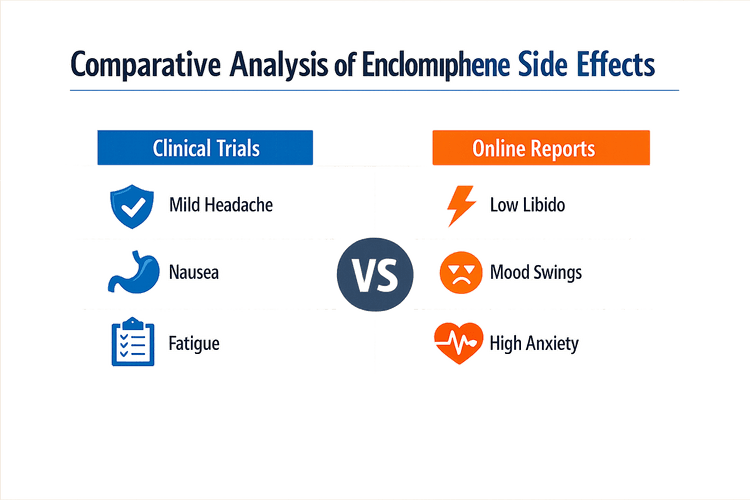
Clinical trials measure side effects in a controlled setting with defined endpoints and systematic reporting. Online reports capture what men notice and choose to post. The gap between these two sources tells you what the trials tracked, what they missed, and what men care about enough to write down.
What the Trial Data Shows
The published comparison between enclomiphene and clomiphene found that overall adverse effects occurred in 13.8% of enclomiphene recipients versus 47% of clomiphene recipients. Decreased libido appeared in 8.6% of the enclomiphene group compared to 33.3% in the clomiphene group — a statistically significant difference with an odds ratio of 0.18.
For erectile dysfunction, fatigue, and weakness, the trial found no statistically significant associations. The odds ratios were 0.42 for erectile dysfunction, 0.33 for fatigue, and 0.27 for weakness, but the confidence intervals crossed 1.0, meaning the data could not confirm a real difference. For depressive thoughts, gynecomastia, mood changes, and agitation, the trial did not collect enough reports to calculate odds ratios at all.
How Online Reports Differ
Men posting online describe side effects that trials may not track or may categorize differently. A trial endpoint called "fatigue" may miss what a user describes as "feeling flat in the gym" or "needing more coffee." A trial that records "mood changes" as a binary yes-or-no may not capture the specific pattern a man notices: irritability in week two, leveling out by week four.
Online reports also reflect selection bias. Men who feel nothing remarkable rarely post. Men who experience a strong effect — positive or negative — are more likely to write about it. That skew makes online reports useful for identifying what to watch for, but not for estimating how often it happens.
Evaluating Trial Data Against Enclomiphene Side Effects Reported Online
When you compare the two sources, start with the trial's documented endpoints. If the trial tracked libido and found a low rate, and online reports consistently mention libido changes, the trial data gives you the baseline rate in a controlled sample. If online reports mention a side effect the trial did not measure — joint pain, vivid dreams, changes in appetite — the trial cannot confirm or rule it out.
For more context on how enclomiphene compares to other testosterone interventions, see Testosterone Booster vs TRT: What Each Can Realistically Do.
The trial tells you what was measured; the online report tells you what was noticed.
What the Numbers Mean in Practice
An odds ratio of 0.18 for decreased libido means enclomiphene recipients were about five times less likely to report that side effect than clomiphene recipients in this trial. That is a large effect size. The 95% confidence interval of 0.06 to 0.53 means the true odds ratio is very likely somewhere in that range — all values well below 1.0, confirming the direction of the effect.
When a trial reports an odds ratio with a confidence interval that includes 1.0, the data cannot confirm a real difference. That does not mean the difference does not exist; it means the trial was underpowered to detect it. Smaller trials and rarer side effects produce wider confidence intervals and more "no significant difference" results, even when a real pattern may be present.
Tips and Tricks for Evaluating Enclomiphene Side Effects
Before signing up for enclomiphene, you need a filter for separating real risks from noise. Clinical trials track side effects systematically; online forums amplify whatever someone felt strongly enough to post. Both matter, but they measure different things.
Read the Discontinuation Rate, Not Just the Side Effect List
The most frequent side effects in enclomiphene trials were headache, hot flushes, nausea, and muscle spasms. That tells you what people reported. The discontinuation data tells you what people couldn't tolerate: blurred vision, muscle spasm, headache, and aggression led men to stop treatment. If a side effect appears in both lists, it crossed the threshold from annoying to deal-breaking for at least a few participants.
When a clinic's marketing material lists only the common side effects and skips the discontinuation data, you are missing the part that predicts whether you will finish the prescription.
Check Whether the Comparison Group Matters
Enclomiphene trials sometimes compared outcomes to testosterone replacement. The EMA review noted that cardiac events and thromboembolic events occurred slightly more often in the enclomiphene group than in men on testosterone. That is a narrow finding: it does not tell you the absolute risk, only the relative one against a specific alternative.
If you are choosing between enclomiphene and TRT, that comparison is useful. If you are choosing between enclomiphene and doing nothing, you need the placebo-controlled data instead. Most online discussions conflate the two.
Separate Mechanism-Based Risks from Reported Symptoms
Enclomiphene blocks estrogen receptors to raise LH and testosterone. That mechanism predicts hot flushes and some visual changes, because estrogen signaling affects thermoregulation and ocular tissue. The EMA reviewed cataract data from nonclinical studies and concluded that available evidence did not show enclomiphene caused or worsened cataracts in humans, but recommended ongoing ocular monitoring.
When someone online reports a side effect that fits the known mechanism—hot flushes, for example—it is consistent with what the drug does. When they report something unrelated to estrogen receptor blockade, check whether the trial data supports it before assuming causation.
The safety of enclomiphene was not sufficiently demonstrated to support broad marketing authorization, according to the 2018 EMA review.
Know What Enclomiphene Avoids
Enclomiphene is the isolated trans-isomer of clomiphene citrate. Early studies showed it maintains the testosterone-raising effect of clomiphene while avoiding the side effects tied to zuclomiphene, the cis-isomer. That separation matters if you previously tried clomiphene and stopped due to side effects: enclomiphene may behave differently.
If you have not tried either, the distinction is less relevant to you. The trial data for enclomiphene stands on its own.
Weight Online Reports by Specificity
A forum post that says "I felt terrible" tells you nothing actionable. A post that says "blurred vision two weeks in, resolved three days after stopping" gives you a timeframe, a specific symptom, and a reversibility signal. The second report is worth noting; the first is not.
When evaluating online experiences, look for posts that include dose, duration, symptom onset, and whether the effect persisted after stopping. Vague complaints and testimonials that read like marketing both fail the specificity test.
Compare Your Baseline Risk Profile to the Trial Population
Enclomiphene trials enrolled men with secondary hypogonadism—low testosterone with normal or low LH. If your labs show primary hypogonadism (low testosterone, high LH), the drug's mechanism does not fit your condition, and the trial safety data does not apply to you.
Similarly, if you have a history of thromboembolic events or significant cardiovascular disease, the slightly elevated event rate in the enclomiphene group becomes more relevant to your decision than it would be for someone with no cardiac history. For guidance on evaluating safety in the context of TRT and related therapies, see Is TRT Safe? Testosterone Replacement Therapy for Men Over 40.
Conclusion
Enclomiphene raises testosterone while producing fewer documented side effects than its parent compound, clomiphene citrate. The 66-patient comparison showed statistically significant reductions in decreased libido, reduced energy, and mood changes with enclomiphene, alongside a lower estradiol response. These are trial results, not marketing claims—small sample, real differences.
Clinical trials provide a structured environment where side effects are systematically documented, but they capture only what investigators choose to measure. Online reports add texture: individual responses, timing, context. Neither source tells the full story alone. The FDA label includes specific monitoring requirements, such as hematocrit levels, which are often overlooked in marketing materials from clinics—this discrepancy highlights the importance of consulting primary sources when evaluating treatment options.
Before you choose enclomiphene or any testosterone treatment, test twice in the morning and get the full panel: total and free testosterone, LH, FSH, estradiol, hematocrit. Without baseline numbers, nobody can tell you which option fits you or what to monitor. The trial data says enclomiphene improves testosterone with a lower rate of adverse events compared to clomiphene, but "lower rate" is not "no rate," and a 66-patient study is not a final answer.
For personalized advice—dosing, monitoring intervals, contraindications, interactions with your specific health history—consult a healthcare professional. The evidence supports enclomiphene as a comparable treatment option for hypogonadal men while minimizing the risk of adverse effects, but the decision to start, the choice of agent, and the follow-up protocol belong to a clinician who has seen your labs and knows your goals. That is the reading you cannot skip.
Related reading
Sources(29)
- The Journal of urology (2020)
- American family physician (2024)
- U.S. Food and Drug Administration — Drug Safety Communication: FDA cautions about using testosterone products for low testosterone due to aging; requires labeling change to inform of possible increased risk of heart attack and stroke with use (2015)
- The Journal of clinical endocrinology and metabolism (2018)
- American Urological Association — Evaluation and Management of Testosterone Deficiency (AUA Guideline) (2018)
- European journal of endocrinology (2024)
- The Journal of clinical endocrinology and metabolism (2026)
- International journal of pharmaceutical compounding (2015)
- The Journal of arthroplasty (2025)
- European urology focus (2017)
- UnitedHealthcare Commercial Medical Benefit Drug Policy 2026D0076J: Testosterone Replacement or Supplementation Therapy
- Current sexual health reports (2014)
- The journal of sexual medicine (2013)
- Prostate cancer and prostatic diseases (2014)
- F&S reviews (2020)
- The aging male : the official journal of the International Society for the Study of the Aging Male (2015)
- Sexual medicine reviews (2017)
- International journal of general medicine (2022)
- Medicines (Basel, Switzerland) (2025)
- DailyMed (U.S. National Library of Medicine) — FDA prescribing information: AZMIRO (testosterone cypionate) injection, solution [Azurity Pharmaceuticals, Inc.] (2025)
- DailyMed (U.S. National Library of Medicine) — FDA prescribing information: Natesto (testosterone) gel, metered [Acerus Pharmaceuticals Corporation] (2025)
- DailyMed (U.S. National Library of Medicine) — FDA prescribing information: Jatenzo (testosterone undecanoate) capsule, liquid filled [TOLMAR Inc.] (2025)
- DailyMed (U.S. National Library of Medicine) — FDA prescribing information: Kyzatrex (testosterone undecanoate) capsule, liquid filled [Marius Pharmaceuticals] (2026)
- DailyMed (U.S. National Library of Medicine) — FDA prescribing information: Tlando (testosterone undecanoate) capsule, liquid filled [Verity Pharmaceuticals Inc.] (2026)
- DailyMed (U.S. National Library of Medicine) — FDA prescribing information: Testopel (testosterone) pellet [Endo USA, Inc.] (2025)
- Health technology assessment (Winchester, England) (2024)
- Journal of Clinical Endocrinology & Metabolism — Testosterone Therapy in Men With Hypogonadism: An Endocrine Society Clinical Practice Guideline (2018)
- The Journal of urology (2021)
- American journal of cardiovascular drugs : drugs, devices, and other interventions (2025)