hCG vs Clomid for Men: Fertility and Testosterone Effects

Updated
Introduction
hCG vs Clomid for Men is a question men with low testosterone and fertility concerns face when choosing treatment. Both are prescription options used to manage hypogonadism and male infertility, but they work differently and fit different situations. hCG mimics luteinizing hormone and directly stimulates the testes. Clomid blocks estrogen receptors in the brain, which increases the body's own production of LH and FSH.
The short answer: if you are not on testosterone replacement therapy (TRT) and want to raise testosterone while maintaining sperm production, Clomid monotherapy is the studied option. If you are already on TRT and need to preserve or restore fertility, hCG is typically added to the protocol. The research shows these are not interchangeable choices — the hormonal effects differ, and so do the trade-offs.
Before choosing between these, you need two morning results and an LH level. Without them, nobody can tell you which one works for you. For a broader look at how to test and interpret your testosterone panel correctly, see Best Online TRT Clinic: How to Choose and What to Avoid.
Understanding the Fertility Challenge
Male hypogonadism has a prevalence of about 6%. That number tells you how many men have clinically low testosterone by the two-morning-test standard. It does not tell you how many men are on testosterone therapy, how many of them want children later, or how many knew what TRT does to sperm production before they started.
About 3 million men take testosterone in the United States. Many reproductive-age men are unaware of the negative impact of testosterone supplementation on fertility. TRT suppresses luteinizing hormone (LH) and follicle-stimulating hormone (FSH), the two signals that tell the testes to make sperm. Without those signals, sperm counts drop — sometimes to zero.
The Problem TRT Creates
When you add testosterone from outside, your body reads the higher level and turns off its own production. The pituitary stops releasing LH and FSH. The testes shrink their output of both testosterone and sperm. For men who want to preserve fertility, this creates a direct conflict: the treatment that raises testosterone is the same treatment that shuts down sperm production.
In a study of 6,999 adult men, 6,364 (91%) were prescribed hCG combined with TRT, and 552 (8%) were prescribed clomiphene citrate (Clomid) combined with TRT. The remaining 83 men (1%) were on clomiphene monotherapy. The distribution shows how clinicians try to work around the fertility problem: hCG and clomiphene are both used to keep LH and FSH signaling alive while men are on TRT, or to raise testosterone without TRT at all.
Why Men Need Alternatives
The need for effective treatment options comes down to this: not every man with low testosterone wants to trade fertility for symptom relief. Some men want children now. Others want the option later. Some are already on TRT and discover the fertility cost only when they try to conceive.
For these men, hCG and clomiphene represent two different strategies. hCG replaces the LH signal directly, so the testes keep working even while TRT suppresses the pituitary. Clomiphene works upstream: it blocks estrogen receptors in the brain, tricking the pituitary into releasing more LH and FSH, which raises both testosterone and sperm production without adding testosterone from outside.
The question is not whether these options exist. The question is which one fits the man in front of you, what the trade-offs are, and what the evidence actually shows. For more on evaluating testosterone supplements and alternatives, the evidence standard is the same: trial size, duration, and endpoints matter more than the marketing.
Evaluating hCG and Clomid for Male Fertility
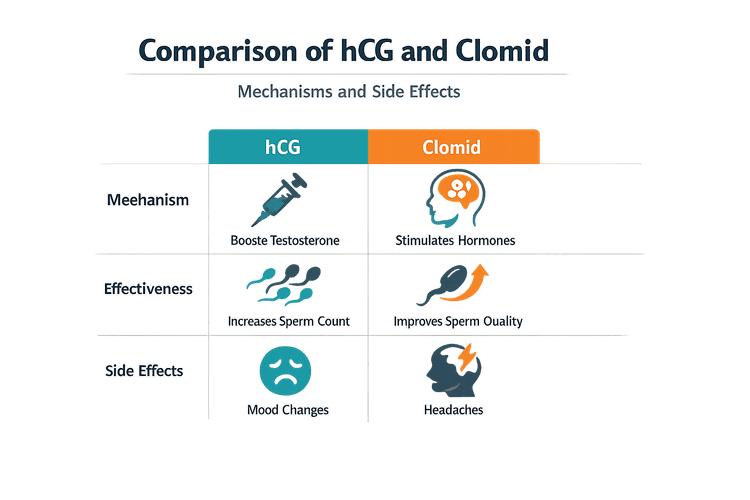
The question is which option preserves fertility while raising testosterone, and what the numbers actually say. Both hCG and clomiphene citrate (Clomid) work differently from testosterone replacement therapy (TRT), and the trials show distinct hormonal signatures.
How Do hCG and Clomid Work Differently?
hCG mimics luteinizing hormone (LH), directly stimulating the testes to produce testosterone and maintain sperm production. Clomid blocks estrogen receptors in the brain, which prompts the pituitary to release more LH and follicle-stimulating hormone (FSH) naturally. The mechanism matters because it determines what happens to your fertility markers.
In a study of 6,999 men, hCG combined with TRT suppressed both LH and FSH (p<0.05), while Clomid combined with TRT reduced FSH only (p=0.02). When Clomid was used alone as monotherapy, it significantly increased both LH and FSH at six months (p<0.001). That difference is the trade-off: hCG gives you direct testicular stimulation but shuts down your own pituitary signal; Clomid keeps the pituitary active but relies on your body's response.
| Treatment | LH Effect | FSH Effect | Mechanism |
|---|---|---|---|
| hCG + TRT | Suppressed | Suppressed | Direct testicular stimulation |
| Clomid + TRT | Maintained | Reduced | Pituitary stimulation via estrogen blockade |
| Clomid alone | Increased | Increased | Full pituitary activation |
Testosterone Response
All three approaches raised total and free testosterone to physiological levels between 23.58 nmol/L and 26.52 nmol/L. In a smaller trial of men with chronic renal failure, Clomid at 100 mg daily increased circulating testosterone from a mean of 223 ng/dL to 879 ng/dL, a 290% increase. A separate study found that Clomid 50 mg daily normalized testosterone in 9 of 10 men with hypogonadism and oligospermia.
The short answer: both drugs raise testosterone reliably. The difference is not in the final number but in what happens to your fertility hormones and sperm production along the way.
Effects on Sperm Production
The evidence on sperm is less clean. In the oligospermia study, sperm concentration increased in most men on Clomid, but nearly one-third worsened. Another trial noted that the effect of Clomid on spermatogenesis was inconclusive, with both improvement and deterioration observed. The clinical relevance was modest even when counts went up.
hCG combined with TRT suppresses FSH, which drives sperm production, so the combination is not a fertility-preserving strategy in the way Clomid monotherapy is. If fertility is the primary goal, Clomid alone or hCG alone (not combined with TRT) are the options that keep the pituitary-testicular axis active.
What Do the Trials Show for hCG vs Clomid for Men?
The trials compared hormonal effects, not head-to-head fertility outcomes. What we know:
- Clomid monotherapy raises LH, FSH and testosterone without suppressing your own production. Sperm results are variable.
- hCG + TRT raises testosterone but suppresses LH and FSH, making it a poor choice if you need sperm production.
- Clomid + TRT is a middle ground that reduces FSH but not LH, though its fertility benefit over TRT alone is unclear.
For a deeper look at how these options compare to other testosterone-raising strategies, see Enclomiphene Citrate: What the Research Actually Shows.
The number that matters is not just total testosterone — it is whether LH and FSH stay active or shut down.
Side Effects and Monitoring
Clomid's most common side effects are visual disturbances, mood changes and hot flashes, though these are uncommon at the doses used in men. hCG can raise estradiol, which may require monitoring and occasionally an aromatase inhibitor. Both drugs require periodic labs: total and free testosterone, LH, FSH, estradiol and hematocrit at minimum.
Neither drug is FDA-approved for male hypogonadism or fertility preservation. Both are used off-label, and insurance coverage is inconsistent. Cost varies widely depending on whether you use a telehealth clinic, a compounding pharmacy or a branded product.
How Should You Choose Between hCG and Clomid?
Before choosing between these, you need two morning results and an LH level. Without them, nobody can tell you which one works for you.
Start with Your Fertility Timeline
If you want to preserve sperm production, both options keep the machinery running. Clomiphene citrate is a therapy for men who desire to maintain fertility. hCG mimics the signal that drives sperm production directly. The question is when you need it and how long you plan to stay on treatment.
Short-term need — six months to a year while you try to conceive — tilts toward oral Clomid. Longer timelines or existing testicular atrophy tilt toward hCG injections. Ask your doctor for a baseline semen analysis before starting either one, then recheck at three months.
Consider Your Baseline Labs
LH tells you whether your pituitary is already working. If LH is low and total testosterone is low, Clomid has a target to stimulate. If LH is already elevated and testosterone is still low, your testes are not responding to the signal — adding more signal with Clomid will not fix that. hCG bypasses the pituitary and hits the Leydig cells directly.
Ideal candidates for Clomiphene treatment rely on a patient's interest in preserving testicular volume and spermatogenesis, but also on having a responsive hypothalamic-pituitary axis. If your LH is above the reference range, Clomid is the wrong tool.
Weigh Administration and Cost
Clomid is a pill. hCG is a subcutaneous injection two to three times per week. For some men, swallowing a tablet daily is simpler. For others, twice-weekly injections are manageable and worth it if the results are better. Neither option is expensive compared to branded TRT, but hCG requires refrigeration and needle disposal.
Cost varies by source. Compounded Clomid runs $30 to $60 per month through telehealth clinics. hCG ranges from $50 to $150 per month depending on dose and supplier. Insurance rarely covers either for this indication. Factor in lab monitoring every three months — testosterone, estradiol, hematocrit — which adds another $100 to $200 per draw if you pay out of pocket.
| Factor | Clomid | hCG |
|---|---|---|
| Administration | Daily oral tablet | Injection 2-3×/week |
| Typical monthly cost | $30–$60 | $50–$150 |
| Preserves fertility | Yes | Yes |
| Requires responsive LH axis | Yes | No |
| Storage | Room temperature | Refrigerated |
Monitor Response, Not Marketing
Every clinic ranking for this question sells the drug. The trials say something more careful, and it starts with who was actually studied. Recheck labs at six to eight weeks. If total testosterone has not moved or if estradiol has climbed above 50 pg/mL, the dose or the drug may need adjustment.
Subjective improvement in erectile dysfunction was reported in 86% of patients in one small hCG study, but that is a small study with no placebo arm. Symptoms matter, but the number that matters for long-term safety is whether testosterone normalized and hematocrit stayed below 52%. If either drug gets you there, it works. If it does not, switching to the other option or moving to TRT is the next conversation.
For a deeper look at how to evaluate telehealth providers before signing up, see Best Online TRT Clinic: How to Choose and What to Avoid. If you want to explore baseline testosterone optimization before prescription options, How to Increase Testosterone Naturally: What Actually Moves the Number covers the lifestyle interventions with trial evidence.
Conclusion
Both hCG and clomiphene citrate raise testosterone by different mechanisms, and both carry evidence for preserving sperm production while on therapy. hCG mimics LH and directly stimulates the testes; clomiphene blocks estrogen feedback and tells your pituitary to produce more of its own LH and FSH. The choice between them depends on your baseline labs, your fertility timeline, cost tolerance, and whether you can handle injections versus pills.
Clomiphene citrate is a therapy for men who desire to maintain fertility, according to review literature. It raises testosterone and gonadotropins reliably in most men with secondary hypogonadism. At the same time, a controlled trial in oligospermic men concluded that clomiphene is not a useful drug in the treatment of male infertility — the hormone changes did not translate into pregnancy rates above placebo. That gap between hormone response and fertility outcome is worth knowing before you commit to either drug for fertility alone.
Neither drug is a fertility guarantee, and neither replaces a semen analysis if conception is the goal. If you are already on TRT and want to preserve or restore sperm production, hCG added to your protocol or a switch to clomiphene are both options discussed in the literature. If you are starting from untreated low testosterone and fertility matters now, clomiphene is typically the first-line choice because it keeps your own axis running. If clomiphene fails or side effects are intolerable, hCG becomes the next step.
Cost, convenience, and monitoring frequency differ. Clomiphene is an inexpensive daily pill; hCG requires refrigerated vials, syringes, and subcutaneous injections two to three times per week. Both require follow-up labs every few months. Neither is a set-it-and-forget-it therapy. Best Online TRT Clinic: How to Choose and What to Avoid walks through what to check before signing up with a telehealth provider that prescribes either drug.
The short answer: clomiphene for most men who want to keep making sperm and raise testosterone without injections. hCG when clomiphene does not work, when you are already on TRT and adding fertility support, or when your LH is high and your testes need direct stimulation rather than more pituitary signal. Ask your doctor for the labs that tell you which category you fall into, and retest after three months to confirm the drug is doing what you need it to do.
FAQ
Which is better for fertility preservation: hCG or Clomid?Clomid monotherapy preserves fertility by raising both LH and FSH naturally. hCG combined with TRT suppresses FSH, so it is less effective for sperm production unless used alone without TRT.
Can hCG and Clomid be used together?They work through different mechanisms and are rarely combined. Most protocols use one or the other, depending on whether you are on TRT and your baseline LH level.
How long does it take for hCG or Clomid to raise testosterone?Both drugs typically show testosterone increases within 6-8 weeks. Recheck labs at that point to confirm response and adjust dosing if needed.
What are the main side effects of hCG vs Clomid for men?Clomid may cause visual disturbances, mood changes, or hot flashes. hCG can raise estradiol, sometimes requiring an aromatase inhibitor. Both are generally well-tolerated at standard doses.
Do insurance plans cover hCG or Clomid for male fertility?Coverage is inconsistent. Both drugs are used off-label for male hypogonadism and fertility preservation, so many plans deny claims. Expect to pay out of pocket.