hCG vs Clomid for Men: Which is Better for Fertility?

Updated
Top takeaways
- hCG and Clomid work through different mechanisms to preserve fertility while addressing low testosterone
- hCG mimics luteinizing hormone directly, while Clomid blocks estrogen receptors to increase your own hormone production
- Most men prescribed these treatments receive them alongside TRT, not as standalone options
- The choice between hCG vs Clomid for men depends on your baseline hormone levels, fertility goals, and how your body responds
- Both require monitoring through blood work to confirm they are working as intended
Introduction
Male hypogonadism affects roughly 6% of men and is defined by two morning testosterone readings below 300 ng/dl paired with symptoms. When fertility matters—whether you are planning a family now or want to preserve the option—the standard testosterone replacement therapy creates a problem. TRT suppresses your own hormone production and typically shuts down sperm production within months.
That is where hCG and Clomid enter the conversation. Both are used to maintain or restore fertility in men with low testosterone, but they work in fundamentally different ways. In a large study of nearly 7,000 men, 91% received hCG combined with TRT, while 8% received Clomid with TRT. Only 1% used Clomid alone. The pattern tells you something: most clinics pair these drugs with TRT rather than using them as replacements.
Before choosing between hCG and Clomid, you need a full hormone panel—not just total testosterone. That means LH, FSH, estradiol, and SHBG alongside your testosterone numbers. Without those, nobody can tell you which option fits your biology. The short answer is that hCG usually works faster and more predictably for fertility preservation, while Clomid costs less and avoids injections. The longer answer depends on what your labs show and what you are willing to monitor. For context on how these options compare to standard testosterone therapy, see Is TRT Safe? Testosterone Replacement Therapy for Men Over 40.
This guide walks through how hCG and Clomid work, what the trials measured, what each costs in money and monitoring, and how to decide which one matches your situation. We start with the biology of male fertility and why preserving it requires a different approach than simply raising testosterone.
Understanding Male Infertility
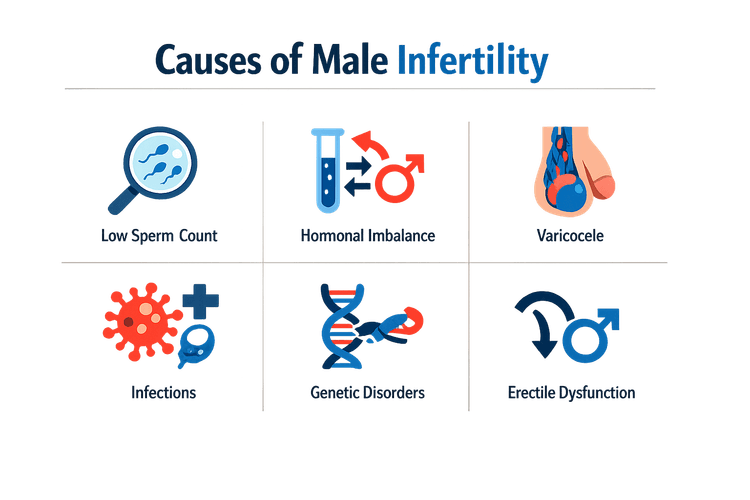
Male hypogonadism affects about 6% of men and is defined by two morning testosterone levels below 300 ng/dL combined with symptoms. That is the textbook case. The harder problem is men who have symptoms — fatigue, low libido, difficulty building muscle — but whose testosterone sits just above or just below the cutoff. They want treatment, but standard testosterone replacement shuts down sperm production.
Exogenous testosterone disrupts the hormonal cascade necessary for spermatogenesis. When you inject testosterone, your brain stops signaling the testes to make their own. Luteinizing hormone and follicle-stimulating hormone drop, and sperm counts often follow. For men who want to preserve fertility or who plan to have children, that trade-off is a problem.
Why Fertility Preservation Matters
Sperm production requires a working feedback loop. The hypothalamus releases GnRH, which tells the pituitary to release LH and FSH, which tell the testes to make testosterone and sperm. Break any link in that chain and counts drop. Testosterone replacement breaks the first link — it suppresses GnRH release because the brain reads high testosterone and assumes the job is done.
This is where hCG and Clomid come in. Both drugs attempt to raise testosterone without shutting down the testes. hCG mimics LH and directly stimulates testicular testosterone production. Clomid blocks estrogen receptors in the brain, tricking the hypothalamus into releasing more GnRH, which raises LH and FSH. In theory, both preserve the feedback loop. In practice, the details matter.
Who Needs to Think About This
Men under 40 who want children in the next few years. Men already on TRT who are planning a family. Men with borderline testosterone who want symptom relief without closing the door on fertility. These are the cases where the choice between hCG, Clomid and standard testosterone replacement has real consequences.
The short answer is that hCG and Clomid work differently, cost differently, and preserve fertility to different degrees. Neither is a perfect substitute for TRT in raising testosterone, and neither works for everyone. The next section walks through what each drug actually does and what the trials measured.
Evaluating hCG vs Clomid for Male Fertility
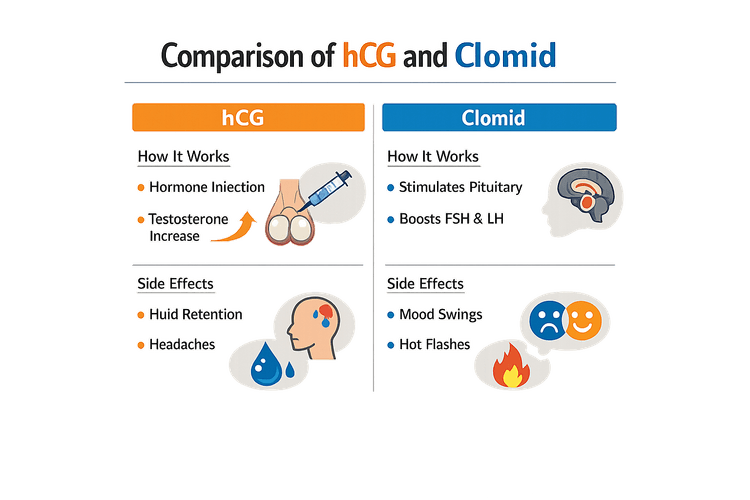
Both hCG and clomiphene citrate (Clomid) raise testosterone without shutting down the pituitary, which is why men interested in preserving fertility consider them. The mechanisms differ, the evidence differs, and the trade-offs differ.
How Each Drug Works
Clomiphene citrate blocks estrogen receptors in the brain. The pituitary reads that as low estrogen and responds by raising LH and FSH. Higher LH tells the testicles to make more testosterone. Higher FSH supports sperm production. You are using your own hardware.
hCG mimics LH directly. It binds to the same testicular receptors that natural LH uses, stimulating testosterone production without involving the pituitary. Because hCG does not raise FSH, it supports testosterone but does less for spermatogenesis on its own.
Testosterone Response
Clomid raises testosterone reliably in men with intact pituitary function. In one study of men with hypogonadism and oligospermia, 50 mg daily normalized testosterone in 9 of 10 participants. Another trial in men with chronic renal failure showed testosterone rising from a mean of 223 ng/dL to 879 ng/dL — a 290% increase — on 100 mg daily over 5 to 12 months.
hCG monotherapy also raises testosterone, though the magnitude varies. Men previously on TRT who switched to hCG saw mean testosterone increase from 307 ng/dL to 422 ng/dL. The response depends on baseline testicular function; if the testicles are atrophied or damaged, hCG has less to work with.
Effects on LH and FSH
This is where the drugs diverge sharply. Clomid monotherapy raises both LH and FSH significantly. At six months, men on Clomid alone showed substantial increases in both hormones. When Clomid is combined with TRT, FSH drops but LH remains detectable.
hCG suppresses both LH and FSH when combined with TRT. In a large cohort of nearly 7,000 men, hCG plus TRT reduced LH and FSH below baseline. The pituitary sees the testosterone rise and shuts down its own signaling. If you are taking hCG to preserve fertility while on TRT, you are relying on the hCG dose to do the work — your own LH production is offline.
Fertility Preservation in Practice
Clomid's ability to raise FSH makes it the stronger option for men prioritizing sperm production. Sperm concentration improved in most men treated with 50 mg daily, though the clinical relevance was modest and nearly one-third saw counts worsen. The drug works best in men with lower baseline sperm counts.
hCG supports testosterone production and testicular volume but does not raise FSH. For men on TRT who want to maintain some fertility potential, clinicians sometimes add hCG to the protocol. The evidence for this combination preserving fertility is thinner than for Clomid monotherapy.
Side Effects and Tolerability
Clomid's estrogen-blocking action can cause mood changes, visual disturbances, and hot flashes in some men. The visual side effects — blurred vision, light sensitivity — are rare but require stopping the drug. Most men tolerate 25 to 50 mg daily without major issues.
hCG is generally well tolerated. The most common complaints are related to injection site reactions and, occasionally, increased estradiol conversion because hCG stimulates aromatase activity in the testicles. Some men on hCG need an aromatase inhibitor to manage estrogen levels.
Cost and Access
Clomid is an off-label use for male hypogonadism. It is inexpensive as a generic — often under $20 per month without insurance. Most telehealth clinics and urologists will prescribe it if you meet the criteria.
hCG is more expensive. Brand-name hCG costs $100 to $300 per month depending on dose and pharmacy. Compounded hCG is cheaper but subject to FDA restrictions on compounding. Some clinics bundle hCG into TRT protocols at a premium.
For a detailed comparison of testosterone treatment options and their regulatory status, see Testosterone Booster vs TRT: What Each Can Realistically Do.
What the Numbers Show
Raises testosterone, LH, and FSH. Preserves or improves sperm production in men with intact pituitary function. Best for men who want fertility and are not on TRT.
Raises testosterone without shutting down LH or FSH. Maintains testicular size and some fertility potential. Best for men who cannot tolerate Clomid or need direct testicular stimulation.
Reduces FSH but keeps LH detectable. Partial fertility preservation. Used when TRT alone causes unacceptable testicular atrophy.
Suppresses LH and FSH. Relies entirely on the hCG dose to maintain testicular function. Fertility preservation is possible but less reliable than Clomid monotherapy.
The short answer: if fertility is the priority and you are not on TRT, Clomid has the stronger evidence. If you are already on TRT and want to add fertility support, hCG is the standard addition, though the data are less robust.
Tips for Choosing Between hCG and Clomid
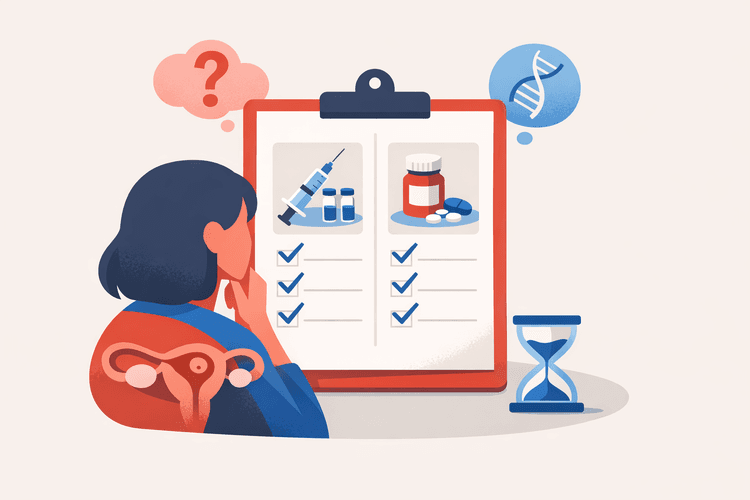
Choosing between hCG and Clomid depends on your starting point, your fertility goals, and what your baseline labs show. Neither is universally better — each fits specific situations.
Start with Your Current Treatment Status
If you are already on testosterone replacement therapy and need to restore fertility, hCG-based combination therapy addresses testosterone-related azoospermia or severe oligospermia. The evidence shows it works for men coming off exogenous testosterone who need sperm production restarted.
If you have never taken testosterone and want to preserve testicular volume and spermatogenesis while treating low testosterone, Clomid is the typical first choice. The ideal candidate for Clomid is interested in maintaining fertility from the start.
Consider What Each Drug Requires
hCG mimics LH directly, so it works even when your pituitary signal is low or shut down. That makes it the go-to option for men whose natural LH production has been suppressed by prior testosterone use. It requires injections, typically two to three times per week.
Clomid blocks estrogen receptors in the pituitary, which raises LH and FSH if your pituitary can respond. It works best when your baseline LH is low or normal and your pituitary is intact. It comes as a pill, usually taken daily.
Ask About Cost and Access
Both drugs are used off-label for male fertility preservation. Clomid is typically less expensive and easier to obtain. hCG costs more and may require specialty compounding pharmacies depending on your location and insurance.
Before signing up with a telehealth clinic, ask what the monthly cost includes: medication, labs, follow-up visits, and shipping. The cheapest advertised price often excludes monitoring labs, which you need every few months to track testosterone, estradiol, and hematocrit.
Match the Drug to Your Timeline
If you need fertility preserved quickly or are already experiencing azoospermia from prior testosterone use, hCG-based therapy is the documented approach for that scenario. Recovery timelines vary, but the goal is measurable sperm production within months.
If you are starting treatment for the first time and want to avoid shutting down natural production, Clomid preserves spermatogenesis from day one. You stay on it as long as it maintains your testosterone in range and your fertility markers stay normal.
The drug that fits you is the one that matches your baseline labs, your current treatment status, and whether you need to restart production or prevent shutdown in the first place.
Work with a Provider Who Monitors Both Hormones and Fertility
Neither hCG nor Clomid should be prescribed without baseline labs and regular follow-up. You need total and free testosterone, LH, FSH, estradiol, and a semen analysis if fertility is the primary goal.
For a detailed breakdown of how to interpret your testosterone panel before choosing any treatment, see How to Test Testosterone Levels: Testosterone Free vs Total.
Ask your provider how often they recheck labs, what thresholds trigger a dose adjustment, and what happens if your estradiol climbs or your hematocrit rises. Both drugs can raise estradiol; hCG does it more predictably. Monitoring is not optional.
Conclusion
Before choosing between hCG and Clomid for fertility preservation, you need two morning testosterone results, an LH level, and a clear picture of whether you are already on TRT or considering it. Without those numbers, nobody can tell you which option fits you.
Clomiphene citrate is a therapy for men who want to maintain fertility while raising testosterone. It works by blocking estrogen feedback in the brain, which prompts your pituitary to release more LH and FSH — the signals that tell your testes to produce both testosterone and sperm. The published trials show it improves both clinical symptoms and biochemical markers of male hypogonadism with few side effects and good long-term safety. hCG therapy, with or without testosterone, delivers LH-like signaling directly to the testes and is used less frequently in the general population but can be effective when Clomid is not tolerated or when a man is already on TRT and needs to preserve testicular function.
Many reproductive-age men are unaware of the negative impact of testosterone supplementation on fertility. Exogenous testosterone shuts down the pituitary signals that drive sperm production, often leading to azoospermia or severe oligospermia. If fertility is a priority now or in the near future, starting TRT without a fertility-preservation plan is a costly mistake.
The short answer: Clomid is typically the first-line option for men not yet on TRT who want to raise testosterone and preserve sperm production. hCG is typically reserved for men already on TRT who need to maintain testicular function, or for those who do not respond to or tolerate Clomid. Neither option is a one-size-fits-all solution, and both require monitoring with repeat labs — testosterone, LH, FSH, estradiol, and a semen analysis if fertility is the primary goal.
What we don't know yet: long-term head-to-head trials comparing Clomid and hCG in the same population, with endpoints that include live birth rates and cost per successful pregnancy. The evidence base is built on small studies, case series, and clinical experience rather than large randomized controlled trials.
Before signing up with a telehealth clinic or filling a prescription, ask your doctor for the full panel and a semen analysis if you have not had one recently. How to Test Testosterone Levels: Testosterone Free vs Total walks through what each number means and how to read the reference ranges. The number that matters is not just total testosterone — it is the combination of total and free testosterone, LH, FSH, and sperm parameters that tells you which treatment preserves what you need.
Nobody selling it will tell you this: both Clomid and hCG are off-label for male hypogonadism in the United States, and compounded formulations are not FDA-approved. That does not mean they do not work — it means the regulatory status, insurance coverage, and cost structure vary widely. Worth knowing before you sign up.
Sources(27)
- The Journal of urology (2020)
- F&S reviews (2020)
- Andrology (2025)
- European journal of endocrinology (2024)
- Sexual medicine reviews (2017)
- The Cochrane database of systematic reviews (2024)
- The Journal of arthroplasty (2025)
- American family physician (2024)
- International journal of pharmaceutical compounding (2015)
- European urology focus (2017)
- Prostate cancer and prostatic diseases (2014)
- The Journal of clinical endocrinology and metabolism (2026)
- UnitedHealthcare Commercial Medical Benefit Drug Policy 2026D0076J: Testosterone Replacement or Supplementation Therapy
- JAMA (2017)
- The world journal of men's health (2026)
- U.S. Food and Drug Administration — Enclomiphene Citrate: FDA presentation to the Pharmacy Compounding Advisory Committee, June 8, 2022 (Madeline Wolfert, MD, CDER)
- American journal of cardiovascular drugs : drugs, devices, and other interventions (2025)
- Journal of Clinical Endocrinology & Metabolism — Testosterone Therapy in Men With Hypogonadism: An Endocrine Society Clinical Practice Guideline (2018)
- American Urological Association — Evaluation and Management of Testosterone Deficiency (AUA Guideline) (2018)
- Translational andrology and urology (2025)
- Fertility and sterility (2024)
- Asian journal of andrology (2025)
- The journal of sexual medicine (2015)
- The Urologic clinics of North America (2016)
- Health technology assessment (Winchester, England) (2024)
- The aging male : the official journal of the International Society for the Study of the Aging Male (2015)
- The Journal of urology (2021)