Testosterone Booster vs TRT: What Each Can Realistically Do

Updated
Top takeaways
- Testosterone boosters are supplements marketed to raise testosterone, but most lack verification of their claimed benefits due to minimal industry oversight
- TRT is prescription testosterone that reliably raises blood levels but comes with monitoring requirements, cost and fertility trade-offs
- The choice between boosters and TRT depends on your baseline testosterone, what you need the number to do, and what you are willing to trade for it
- Before choosing either option, you need two morning testosterone results, an LH level, and a clear picture of what the evidence actually shows
- Understanding the realistic capabilities of each option helps you avoid expensive mistakes and set appropriate expectations
Introduction
When comparing testosterone boosters vs TRT, the first question is not which option is better in the abstract — it is what each can realistically do for you, what it costs in money and monitoring, and whether the trade-offs fit your situation. Testosterone supplementation in the United States has grown substantially in recent years, driven by direct-to-consumer advertising and telehealth clinics that promise convenience and fast results. At the same time, supplement marketplaces overflow with testosterone boosters — pills and powders that claim to raise your levels naturally, often with testimonials that look more convincing than the trial data behind them. The gap between marketing and evidence is wide for both categories, and it costs men money, time and sometimes fertility.
That requires looking past the sales page and into the published trials — their populations, sample sizes, endpoints and funding sources. It also requires knowing what your own testosterone panel says before anyone sells you a solution.
This article walks through what testosterone boosters and TRT can and cannot do, based on the evidence published in the last two decades. You will see what the trials measured, how large the effects were, and where the data stops. You will also see what to test first, what each option costs you in practical terms, and how to evaluate a clinic or supplement before signing up. The goal is to give you the numbers and the context so you can make an informed decision rather than an expensive guess.
Understanding the Challenge
Most men shopping for testosterone solutions face the same problem: every seller claims their product works, and nobody selling it will tell you what the trials actually measured. Testosterone-boosting supplements dominate Amazon and social media with promises to "naturally" raise levels, while telehealth clinics advertise prescription TRT as the reliable fix. The gap between marketing and evidence is wide, and it costs you money and time if you guess wrong.
The Marketing vs. the Measurements
Testosterone boosters are sold with minimal regulatory oversight. A systematic review of the published data from the last two decades found that most multi-ingredient supplements fail to increase total testosterone at all. The exceptions—β-hydroxy β-methylbutyrate and betaine—showed effects only in male athletes under training conditions, not in the general population of men with low testosterone. The rest of the ingredients you see on the label have thin evidence or none.
TRT, by contrast, is a prescription drug with decades of clinical data. It raises testosterone reliably because you are adding exogenous hormone. The challenge here is different: understanding the trade-offs in fertility, cost, monitoring requirements, and whether your low testosterone is primary (testicular) or secondary (pituitary). Many men start TRT without knowing their baseline LH and FSH, which means they cannot tell whether a non-suppressive option like enclomiphene would have worked first.
What Men Get Wrong Before They Start
The most common misconception is that one morning testosterone result below the reference range means you need treatment. It does not. Guidelines call for two separate morning measurements, plus symptoms, before diagnosing hypogonadism. A single low reading can reflect poor sleep, recent illness, stress, or the natural day-to-day variation in hormone levels.
The second mistake is assuming all low testosterone has the same cause. If your LH is low or normal alongside low testosterone, the problem is likely central (pituitary or hypothalamus), and medications that stimulate your own production—enclomiphene, clomiphene, or hCG—may restore levels without shutting down sperm production. If your LH is high and testosterone is low, the testes are not responding, and TRT is usually the only reliable option. Skipping this step means choosing a treatment without knowing whether it fits your biology.
The third error is treating supplements and TRT as equivalent categories. They are not. Supplements are unregulated products with ingredient lists that rarely match what human trials tested, if trials exist at all. TRT is a controlled medication with known pharmacokinetics, side effects, and monitoring protocols. Comparing them as if they occupy the same tier of evidence ignores the asymmetry in what we actually know.
How Do Testosterone Boosters vs TRT Compare?
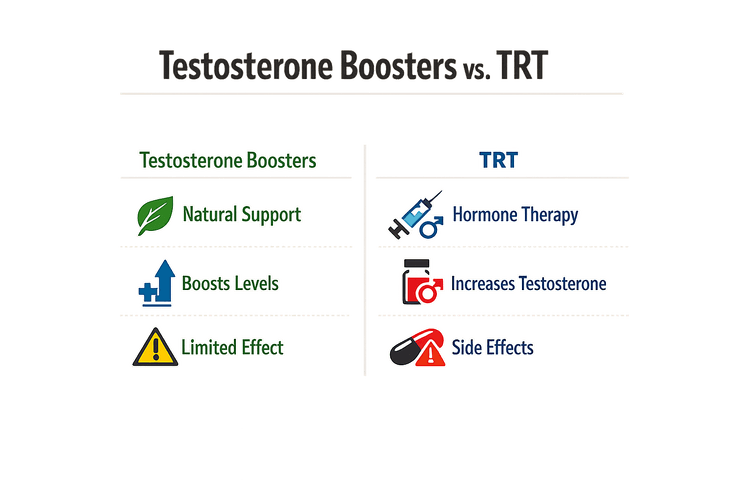
Testosterone boosters vs TRT is not a fair comparison on evidence. Testosterone boosters are supplements sold over the counter. TRT is a prescription treatment for diagnosed hypogonadism. The first raises questions; the second raises your testosterone reliably when the diagnosis is correct.
What Are Testosterone Boosters?
Testosterone boosters are multi-ingredient supplements marketed to increase testosterone levels. They appear on social media and in marketplaces with claims to significantly raise your numbers. Lax industry regulation allows sales to thrive without verification of the purported benefits.
The ingredients vary. Common ones include D-aspartic acid, fenugreek, ashwagandha, zinc, and vitamin D. Some have small human trials behind them; most do not. The evidence is thin, and the magnitude of effect—when measured—is modest.
No prescription is required. You buy them, you take them, and you hope. There is no lab work, no diagnosis, and no monitoring. If your testosterone is low because of a pituitary issue, sleep apnea, or obesity, a supplement will not address the cause.
What Is TRT and How Does It Work?
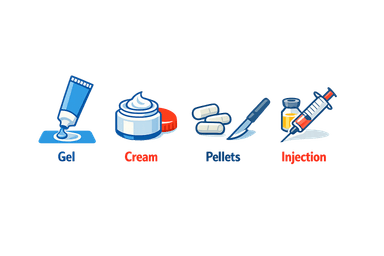
Testosterone replacement therapy is a prescription treatment for male hypogonadism. It delivers exogenous testosterone—either through injections, gels, creams, patches, or subcutaneous pellets—to bring your levels into the normal range when your body no longer produces enough.
TRT works by directly supplementing what your testes are not making. It raises total and free testosterone reliably. The increase is dose-dependent and measurable. When managed correctly, it brings levels into the mid-normal range and holds them there.
The trade-off: exogenous testosterone suppresses your body's own production. LH and FSH drop, and sperm production usually declines or stops. For men who want to preserve fertility, this matters. For men past that concern, it may not. To understand when symptoms improve, see How Long Does TRT Take to Work?
What Are the Benefits and Drawbacks of Each Approach?
Testosterone boosters cost less upfront and require no doctor visit. They appeal to men who want to avoid prescriptions or who assume their testosterone is low without testing. The drawback: you are spending money on products with unverified claims, no monitoring, and no certainty that the ingredient list will move your numbers.
TRT delivers a measurable increase in testosterone. Symptoms tied to genuine hypogonadism—low energy, reduced libido, difficulty building muscle—often improve when levels normalize. The drawbacks: cost, ongoing monitoring for hematocrit and PSA, and the near-certain suppression of natural production and fertility. Prescriptions for TRT have increased substantially in the United States over the past several years, reflecting both greater awareness and, in some cases, looser prescribing standards.
If your testosterone is genuinely low and verified by lab work, TRT is the option with evidence behind it. If your levels are normal or borderline, a supplement will not change the outcome, and TRT is not indicated. For a detailed comparison of different TRT formulations, see Testosterone Enanthate vs Cypionate: Key Differences.
What We Don't Know Yet
Long-term safety data for many testosterone boosters is absent. The trials that exist are small, short, and often funded by the companies selling the products. We do not know how sustained use affects cardiovascular risk, prostate health, or hormone feedback loops over decades.
For TRT, the cardiovascular risk picture remains debated. Some studies suggest increased risk; others do not. The TRAVERSE trial provided some reassurance, but questions remain for men with pre-existing heart disease. What we do know: both options require honesty about what the evidence shows and what it does not.
Tips and Tricks for Making an Informed Decision
Before you buy a supplement or sign up for a clinic, get two morning testosterone readings and a full panel. Without them, nobody can tell you which path fits you — not an ad, not a review, not a sales call. The number that matters is total testosterone drawn before 10 AM on separate days, plus free testosterone, LH, FSH, SHBG, estradiol, hematocrit and PSA. One result is not a diagnosis. For guidance on interpreting results, see Testosterone Free vs Total.
What Should You Discuss with Your Doctor?
Bring your lab results and ask three questions. First: do these numbers explain my symptoms, or is something else going on? Low testosterone overlaps with sleep apnea, depression, thyroid disease and a dozen other conditions that a supplement will not fix. Second: if my testosterone is low, what caused it — primary testicular failure, pituitary suppression, obesity, medication, or aging? The cause changes the answer. Third: what are the trade-offs of each option in money, monitoring, fertility and reversibility?
The physician should discuss the potential benefits and risks of TRT with you, and the conversation should include what the evidence does and does not show. TRT raises testosterone predictably; most supplements do not. TRT usually suppresses sperm production; most supplements do not, because most do not work. TRT requires ongoing monitoring; supplements do not, because most do not work. If a clinic skips this conversation and moves straight to billing, that is worth knowing before you sign up.
How Do You Evaluate Supplement Claims?
T-Boosters are prominently featured online with claims they "naturally" increase testosterone. Limited human studies have evaluated these products, resulting in no definitive findings of efficacy. When you see a supplement with five-star reviews and a bold promise, ask: where is the human trial, how many people were in it, how long did it run, and what did it actually measure? Most products cite animal studies, in-vitro data, or trials on elderly men with deficiencies, not healthy adults.
If the label lists ten ingredients, check each one separately. A study showing that 600 mg of ashwagandha raised testosterone in stressed men does not mean the 50 mg in a blend will do the same. The dose, population, duration and outcome all matter. Does Ashwagandha Increase Testosterone? Reading the Trials covers how to read those studies and what the numbers actually show. Similarly, Does Creatine Increase Testosterone? examines another commonly discussed supplement.
What Should You Know Before Signing Up for a Telehealth Clinic?
Read the membership terms, the refund policy, and the monitoring protocol before you give a credit card. Some clinics bill monthly whether you refill or not. Some require a minimum commitment. Some include labs; others charge separately for each draw. Ask: what happens if my hematocrit goes high, my PSA rises, or I want to stop? What does the clinic do if I become infertile on TRT and want to preserve sperm? For cost breakdowns, see Enclomiphene Cost: Monthly Expenses Explained.
Check the regulatory status of what you are buying. Compounded enclomiphene is not FDA-approved; it is made by a compounding pharmacy under state oversight, and the quality, dose and purity vary. If a clinic offers it, ask where it is compounded, whether they test each batch, and what recourse you have if the product is contaminated or underdosed. The cheapest option is not always the one you want when the product is going into your body for months.
The Free Lever: Weight, Sleep and Alcohol
If you are overweight, losing 10–15% of your body weight can raise testosterone more than most supplements. If you have untreated sleep apnea, CPAP can do the same. If you drink heavily, cutting back to moderate intake or stopping entirely often raises testosterone without a prescription. These levers cost nothing, require no monitoring, and do not suppress fertility. They are also harder to sell, so nobody marketing a product will lead with them.
The number that matters is total testosterone drawn before 10 AM on separate days, plus a full panel — one result is not a diagnosis.
Test first, test twice, and bring the results to someone who will explain what they mean and what the options cost you in money, time, monitoring and fertility. That is the informed decision.
Conclusion
The choice between testosterone boosters vs TRT starts with two morning testosterone tests and a conversation with a doctor who will read the full panel. Boosters are unregulated, carry thin human evidence, and rarely move the needle on lab results. TRT is FDA-approved, raises testosterone reliably, and comes with known trade-offs in fertility, monitoring and cost.
If your numbers confirm low testosterone and symptoms match, TRT and heart risk is worth understanding before you start. If your levels are borderline or normal, no supplement will deliver what the marketing promises, and TRT is not indicated. The gap between what a product page says and what the trial actually measured is wide—reading the fine print protects your money and your health.
Test first, test twice, and ask your doctor for the evidence behind any recommendation. That is the informed approach, and it is the only one that holds up when the results come back.
Sources(25)
- The Journal of urology (2020)
- The Journal of clinical endocrinology and metabolism (2026)
- American family physician (2024)
- U.S. Food and Drug Administration — Drug Safety Communication: FDA cautions about using testosterone products for low testosterone due to aging; requires labeling change to inform of possible increased risk of heart attack and stroke with use (2015)
- Journal of Clinical Endocrinology & Metabolism — Testosterone Therapy in Men With Hypogonadism: An Endocrine Society Clinical Practice Guideline (2018)
- International journal of general medicine (2022)
- American Urological Association — Evaluation and Management of Testosterone Deficiency (AUA Guideline) (2018)
- International journal of impotence research (2023)
- The journal of sexual medicine (2019)
- RSC advances (2026)
- Journal of human kinetics (2014)
- RSC advances (2026)
- European journal of endocrinology (2024)
- F&S reviews (2020)
- Andrology (2025)
- The aging male : the official journal of the International Society for the Study of the Aging Male (2015)
- The world journal of men's health (2026)
- Annals of internal medicine (2020)
- The Journal of urology (2015)
- The Journal of clinical endocrinology and metabolism (2023)
- The journal of sexual medicine (2022)
- International journal of pharmaceutical compounding (2015)
- The journal of sexual medicine (2021)
- The Journal of steroid biochemistry and molecular biology (2021)
- Reproductive biology and endocrinology : RB&E (2024)