Testosterone Injections vs Gel: Testosterone Gel, Cream, Pellets
Updated
Introduction
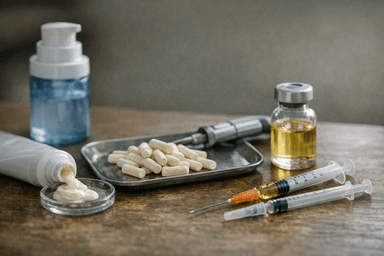
Testosterone replacement therapy comes in multiple delivery methods, each with distinct trade-offs in convenience, cost, and monitoring requirements. Testosterone injections vs gel is a common consideration for those exploring treatment options.
Testosterone replacement therapy has evolved significantly over the past sixty years. What began with crude injection protocols has expanded into a range of patient-friendly delivery methods, each designed to restore testosterone levels in men with confirmed deficiency. The formulations available today include transdermal gels and creams, intramuscular and subcutaneous injections, subdermal pellets, buccal tablets, intranasal gels, and oral capsules.
The expansion of options creates a new problem: how to choose. Each delivery method carries its own set of trade-offs in convenience, cost, absorption variability, and monitoring burden. Some require daily application, others require office visits every few months. Some are covered by insurance, others are not. Some produce stable blood levels, others produce peaks and troughs that patients feel.
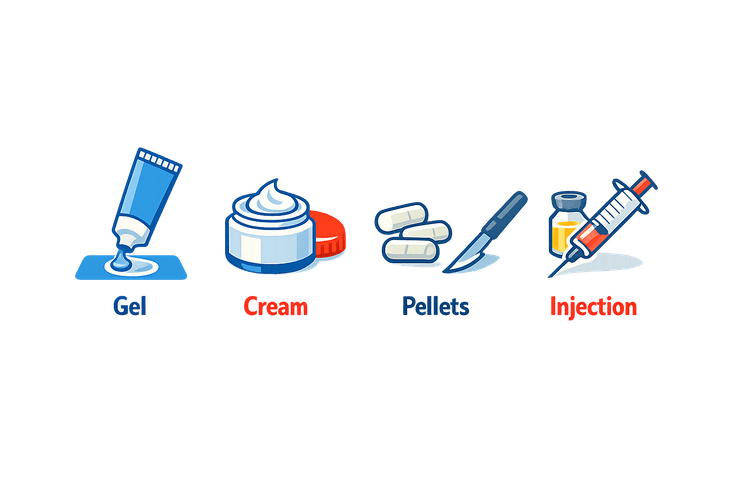
This article compares the four most commonly prescribed delivery methods — gel, cream, pellets, and injections — using the criteria that matter in practice: how often you dose, what it costs, how stable your levels stay, what monitoring looks like, and what the evidence says about each option. If you are evaluating testosterone replacement therapy options, understanding these differences helps you ask the right questions before committing to a protocol.
Understanding the Problem
The majority of testosterone prescriptions in the United States and Canada are now written by primary care physicians, and the range of available formulations has widened to include gels, creams, injections, pellets, buccal tablets and intranasal preparations. That expansion creates a decision point most patients are not prepared for: which delivery method fits your life, your budget, your monitoring tolerance and your fertility plans.
The problem is not a lack of options. It is that every option comes with trade-offs, and the clinic writing your prescription rarely explains them in full. Gels and creams require daily application and carry transfer risk to partners and children. Injections require needles and create peaks and troughs in blood levels. Pellets require a minor surgical procedure every few months. Each method works, but each works differently, and the choice depends on factors the initial consultation often skips.
What the Trials Show and What They Do Not
Clinical trials demonstrate that testosterone replacement therapy raises testosterone levels and improves symptoms of deficiency across all delivery methods. A 2016 meta-analysis of 156 randomized controlled trials involving 5,464 men found that testosterone therapy increased total testosterone by an average of 297 ng/dL (95% CI: 265–329) across formulations. What the trials also show is that concerns exist about impact on fertility, risk of polycythemia, cardiovascular events and prostate cancer. These risks do not vary by delivery method in a way that makes one universally safer than another. They vary by dose, by monitoring frequency and by the patient's baseline health.
The short answer: no single delivery method is best for everyone. The correct method is the one you will use consistently, that fits your monitoring plan, that you can afford without interruption, and that aligns with your fertility goals. Choosing it requires understanding what each method actually demands from you in time, money and lifestyle adjustment.
The next section walks through how to match each method to your situation, step by step, using the numbers that matter and the questions most clinics do not ask up front.
What Delivery Method Fits Your Routine and Monitoring Tolerance?
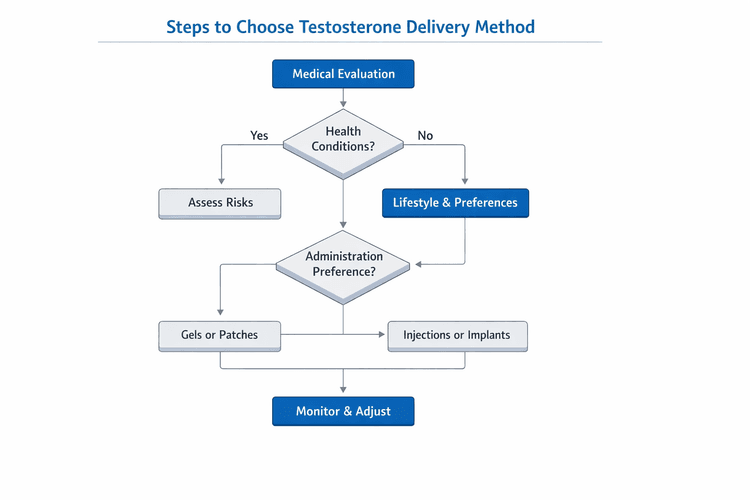
Choosing a delivery method starts with your baseline labs, your schedule, and what you can afford in time and money. The trials and clinical experience show that all four methods—gel, cream, pellets, and injections—can normalize testosterone levels when dosed correctly. The question is which one fits your life and monitoring tolerance.
Step 1
Get two morning testosterone readings and a full panel
Before you pick a method, confirm low testosterone with two separate fasted morning draws. The panel should include total testosterone, free testosterone, SHBG, LH, FSH, estradiol, hematocrit, and PSA. One low result is not a diagnosis. Two results below 300 ng/dL, taken on different days before 10 a.m., establish the baseline. The LH and FSH numbers tell you whether the problem is primary (testicular) or secondary (pituitary). That distinction does not change which delivery method works, but it matters for prognosis and monitoring.
Step 2
Decide whether you can apply something daily
Gels and creams require once-daily application to clean, dry skin—usually shoulders, upper arms, or abdomen. They deliver steady levels when applied consistently at the same time each day. If your schedule is erratic, if you travel frequently without access to your medication, or if you share a bed with a partner or children who might contact the application site, transdermal methods add friction. The transfer risk is real: skin-to-skin contact within hours of application can transfer testosterone to others. Covering the site with clothing reduces but does not eliminate that risk. If daily application and transfer precautions do not fit your routine, move to step 3.
Step 3
Compare injection frequency and self-administration comfort
Intramuscular testosterone enanthate or cypionate is typically injected every one to two weeks, though some protocols use smaller doses twice weekly to reduce peak-trough swings. Many men with hypogonadism still receive intramuscular testosterone esters, with testosterone enanthate being the most commonly prescribed. You can learn to self-inject at home, or you can visit a clinic for each dose. Self-injection requires comfort with needles, proper disposal, and rotating injection sites. Clinic visits add time and cost. Weekly or twice-weekly schedules produce more stable levels than every-two-week dosing, but they also mean more injections. If you prefer infrequent dosing and can tolerate wider level swings, every-two-week injections work. If you want steadier levels and are comfortable with needles, twice-weekly self-injection is the standard.
Step 4
Evaluate pellet insertion logistics and cost
Testosterone pellets are a highly effective subdermal depot administered at regular intervals, tailored to the patient's androgen deficiency symptoms. A clinician inserts pellets under the skin of the hip or buttock in an office procedure that takes about ten minutes. The pellets release testosterone over three to six months. The timing of the next insertion is individualized based on the return of your characteristic androgen deficiency symptoms—when levels drop, symptoms return, and you schedule the next procedure. Pellets eliminate daily or weekly tasks, but each insertion is a minor surgical procedure with a small risk of infection, extrusion, or scarring. Pellet therapy is often the most expensive option upfront, and insurance coverage varies. If you want the longest interval between interventions and are willing to pay more and accept procedural risk, pellets fit. If cost or procedure aversion is high, choose another method.
Step 5
Match the method to your monitoring and adjustment tolerance
All methods require periodic blood work—typically at six weeks, three months, and then every six to twelve months. Gels and creams allow easy dose adjustment by changing the amount applied. Injections allow dose or frequency changes at each visit or self-injection. Pellets lock you into a dose for months; if your levels run too high or too low, you wait until the next insertion to adjust. If you are starting testosterone replacement therapy for the first time, a method that allows frequent titration—gel, cream, or injection—gives you faster feedback. Once stable, some men switch to pellets for convenience. If you want control and the ability to adjust quickly, start with a daily or weekly method. If you are already stable on another form and want to reduce intervention frequency, pellets become an option.
Choosing Between Testosterone Replacement Therapy Delivery Methods
The step-by-step process narrows the field by ruling out what does not fit your routine, risk tolerance, and budget. After that, the choice often comes down to personal preference. Gels and creams suit men who prefer daily rituals and want steady levels without needles. Injections suit men who want low daily burden, are comfortable with self-administration, and prefer predictable dosing every few days or weeks. Pellets suit men who want the longest possible interval between interventions and are willing to pay more and accept a minor procedure every few months. There is no single best method—only the method that you will use consistently and monitor correctly. Before signing up with any clinic, confirm what the method costs you per month, what monitoring is included, and whether your insurance covers the drug and the visits. For more on evaluating telehealth providers, see Best Online TRT Clinic: How to Choose and What to Avoid.
Tips and Tricks for Choosing Testosterone Delivery
Before you commit to a delivery method, ask your doctor for two morning testosterone results taken a week apart. One number is not a diagnosis, and the method you choose depends on where you start and what you need to reach.
Test First, Then Choose
Every delivery method raises testosterone, but they differ in how fast, how steady, and how much monitoring you need. Gels and creams give daily control — if your level runs high, you adjust the dose that day. Injections and pellets lock you in for weeks or months. If you are new to testosterone replacement therapy and unsure how you will respond, starting with a method you can adjust daily makes sense.
Know What You Are Signing Up For
Fixed-dosage patches and depot injections have known drawbacks: patches stick poorly and cause skin irritation, and depot injections produce nonphysiologic hormone levels that swing high right after the shot and drop before the next one. Gels avoid the peaks and valleys but require daily application and transfer precautions around partners and children.
Pellets deliver steady levels for months, but insertion is a minor surgical procedure, and if your dose is wrong, you wait it out. Injections give you weekly or biweekly control, but you need to be comfortable with needles or have someone administer them.
Match the Method to Your Life
If you travel frequently or work irregular hours, a method that does not require refrigeration or daily timing fits better. Gels and creams are portable; pellets require no daily action once inserted. If you have young children or a partner who might absorb testosterone from skin contact, gels require careful handwashing and covered application sites — injections and pellets eliminate that risk.
Cost and insurance coverage vary widely. A month of gel can cost more than a vial of injectable testosterone that lasts two months. Pellets often run higher out-of-pocket but require fewer clinic visits. Check what your insurance covers and what a telehealth clinic charges before you sign up.
The cheapest method is the one you will actually use consistently — missed doses cost you more than a higher monthly price.
Plan for Monitoring
All methods require follow-up labs: testosterone, hematocrit, PSA, and sometimes estradiol. Gels and creams let you adjust the dose quickly when a lab comes back high or low. Injections require a dosing change and a wait for the next cycle. Pellets mean waiting months or adding a short-acting method on top.
Ask your clinic how often they retest and what they charge for follow-up labs. Some telehealth services bundle labs into the membership; others bill separately, and that is where costs add up.
What We Don't Know Yet
Long-term head-to-head trials comparing gels, injections, and pellets on hard outcomes — cardiovascular events, fractures, quality of life — are thin. Most studies measure testosterone levels and short-term symptoms, not what happens over ten or twenty years. The method that gets your level into range with the fewest side effects and the highest adherence is the one that works for you, and that is a question the trials have not answered.
Conclusion
Choosing between testosterone gel, cream, pellets or injections comes down to what you can sustain. Daily gels and creams require routine and caution around transfer. Pellets remove daily hassle but lock you into a dose for months and cost more up front. Injections every week or two give you control over timing and usually cost less, but some men dislike needles and the learning curve.
The majority of testosterone prescriptions in the United States and Canada are now written by primary care physicians, which means access is easier than it used to be — but it also means the choice of delivery method often defaults to what the clinic stocks or what the telehealth platform promotes. Before you sign up, ask what formulations they offer, what the monthly cost is after insurance or membership fees, and whether you can switch if the first method doesn't fit.
No delivery method fixes poor sleep, excess weight or undiagnosed sleep apnea, and none of them work if you stop using them. The best option is the one you will actually use for the long term, with monitoring you can afford and side effects you can manage. Test first, choose based on your schedule and budget, and plan to check labs every three to six months once you start. For more guidance on selecting a provider and understanding what to watch for during treatment, see our guide on how to choose an online TRT clinic.
For men seeking alternatives to pharmaceutical testosterone replacement therapy, natural testosterone optimization strategies and evidence-based supplements may offer modest benefits when combined with lifestyle changes.
Frequently asked questions
How do I choose between testosterone injections and gel?
The choice depends on your daily routine and tolerance for procedures. Gels require daily application and precautions around skin contact with others, but they provide steady levels and easy dose adjustment. Injections require comfort with needles and produce some peak-trough variation, but they eliminate daily tasks and transfer risk. Start with your insurance coverage, then consider whether you prefer daily application or weekly self-injection.
What is the most cost-effective testosterone replacement therapy method?
Injectable testosterone (enanthate or cypionate) is typically the least expensive option, especially when self-administered at home. A 10 mL vial costs $50–150 and lasts two to three months. Gels run $200–500 per month without insurance. Pellets cost $500–1,500 per insertion every three to six months. Insurance coverage changes the equation—if your plan covers gels but not injections, the covered option becomes most cost-effective.
How often do I need blood work on testosterone replacement therapy?
All delivery methods require labs at six weeks after starting, then at three months, then every six to twelve months once stable. The six-week check confirms your dose is moving levels into the target range (400–700 ng/dL for most men). The three-month check looks for hematocrit elevation, PSA changes, and estradiol. Annual monitoring tracks the same markers plus lipids and liver function.
Can I switch between testosterone delivery methods?
Yes. Many men start with gels or injections for easier dose titration, then switch to pellets once stable. Switching requires a washout period—typically two to four weeks off the old method before starting the new one—and new baseline labs to guide the initial dose. Discuss the switch with your prescriber; do not change methods without medical supervision.