Testosterone Injections vs Gel: Testosterone Gel, Cream, Pellets
Updated
Top takeaways
- Testosterone replacement therapy now includes buccal tablets, intramuscular injections, transdermal gels, intranasal gel, subcutaneous injections, oral capsules, and subdermal pellets — each with different dosing schedules, monitoring requirements, and cost structures.
- Transdermal preparations like gels and patches deliver physiological testosterone levels and are convenient, but require daily application and carry transfer risk to others.
- Injections, pellets, and oral options differ in how often you dose, how stable your levels stay, and what blood work your doctor will order — the choice depends on your tolerance for needles, your schedule, and what your insurance covers.
- No single delivery method is universally superior; the right option balances your lifestyle, your willingness to self-administer, and the monitoring burden your clinic requires.
Introduction
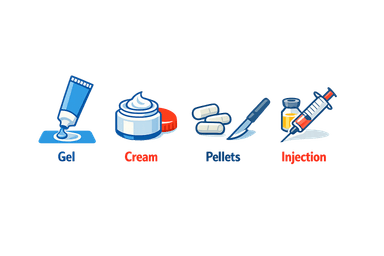
Testosterone delivery methods — injections, gels, creams, and pellets — differ in dosing frequency, cost, level stability, and what they demand from your daily routine. Choosing a testosterone delivery method means weighing convenience against cost, dosing frequency against level stability, and self-administration against clinic visits. Over the last six decades, testosterone replacement therapy has expanded from a handful of injectable esters to a menu that includes gels, creams, patches, pellets, nasal sprays, buccal tablets, and oral capsules. Each option delivers testosterone, but the pharmacokinetics — how fast it enters your bloodstream, how long it stays, and how much ends up as active hormone — differ enough that two men on the same total weekly dose can experience different symptom relief and different side effects.
The range of formulations has widened, and the majority of testosterone prescriptions in the United States and Canada are now written by primary care physicians rather than endocrinologists. That shift means more men have access to treatment, but it also means the conversation about which delivery method fits you often happens in a fifteen-minute appointment, with limited time to compare the trade-offs. Transdermal gels and patches are convenient and deliver a steady physiological amount of testosterone, but they require daily application and carry a transfer risk to partners and children. Injections — whether intramuscular or subcutaneous — produce higher peak levels and cost less per month, but they require needles and can create a roller-coaster pattern of highs and lows. Pellets eliminate the need for daily dosing but involve a minor surgical procedure every few months and leave you locked into a dose until the pellets dissolve.
Before you sign up for a telehealth clinic or fill a prescription, you need to understand what each method asks of you in time, money, and monitoring. The choice is not just about what raises your testosterone number on a lab report — it is about what you will actually use consistently, what your insurance will cover, and what fits the way you live. Enclomiphene-first vs injection-first clinics offer different starting points, but once you are on exogenous testosterone, the delivery method becomes the variable you control.
This article walks through the most common testosterone delivery methods, compares their dosing schedules and cost structures, and lays out the monitoring and lifestyle trade-offs that determine which one works for you. The goal is not to pick a winner — it is to give you the facts you need to choose the option that you will stick with.
What Makes Choosing Between Testosterone Delivery Methods Difficult?
Every testosterone delivery method trades one problem for another. You pick the schedule, the application ritual, the blood-level pattern and the cost structure that fits your life, but you do not get to escape the trade-offs.
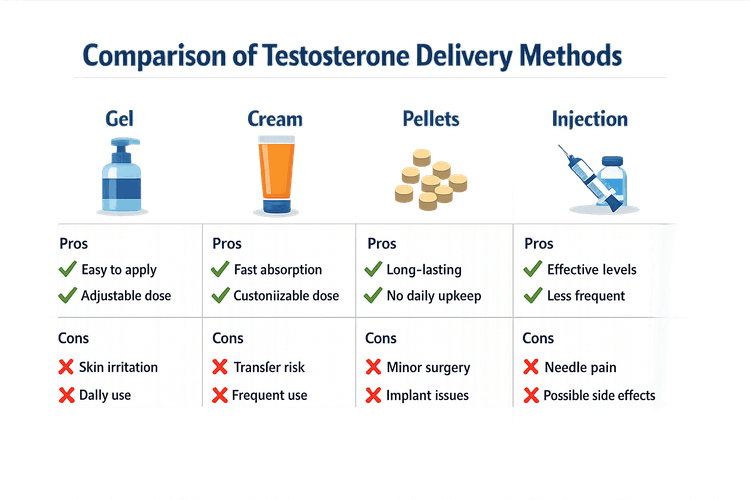
The clinic ad shows four options as if they are equal. They are not. Injections deliver the highest peak levels and cost the least per month, but they also produce the widest swings between doses. Gels and creams hold levels steadier and let you stop faster if something goes wrong, but they cost more, transfer to others on contact, and demand daily discipline. Pellets remove the daily decision entirely and last months, but they require a minor surgical procedure, cannot be reversed once implanted, and sometimes migrate or extrude. Oral testosterone avoids needles and skin contact, but older formulations carried liver risk and newer ones cost significantly more.
What the Trials Measured
Most testosterone trials compare delivery methods on two endpoints: whether they raise total and free testosterone into the normal range, and whether patients stay on them. The trials do not usually compare mood, energy, libido or body composition between methods—those outcomes depend more on reaching your target level than on how the testosterone arrived.
Intramuscular testosterone esters such as enanthate and cypionate remain the most commonly prescribed form despite pharmacokinetics that produce mood and energy fluctuations. These esters require injections every two to four weeks, and levels peak within days then decline steadily until the next dose. Patients report feeling best in the first week and worst in the last few days before the next injection.
Gels and creams were developed to solve the fluctuation problem. They deliver testosterone through the skin daily, producing steadier levels without the peaks and valleys of injections. The trade-off is transfer risk: anyone who touches the application site within hours can absorb testosterone, including partners and children. The label warns about this explicitly, and case reports document unintended exposure.
Pellets avoid both needles and daily application. A clinician implants several pellets under the skin, usually in the hip or buttock, and they release testosterone steadily for three to six months. Levels stay stable, but the procedure is minor surgery with infection risk, the pellets sometimes extrude, and if your dose is wrong or you develop a side effect, you cannot remove them early.
The Decision Nobody Warns You About
The method you choose shapes your monitoring schedule, your out-of-pocket cost, your travel requirements if you use a telehealth clinic, and your flexibility if you need to stop or adjust. Injections let you skip a dose or change frequency easily. Gels let you stop today and clear your system within days. Pellets lock you in for months. Clinics do not always explain this up front, because they make the most margin on the method they prefer to dispense.
The cheapest method per month is not always the cheapest method per year once you add monitoring labs, follow-up visits, and the cost of fixing a dose that was wrong.
You also inherit the monitoring burden that comes with the method. Injections require trough and peak labs to confirm your dose is right. Gels require a steady-state level after two weeks, then periodic checks to confirm absorption has not changed. Pellets require a level check four to six weeks after implantation, then again before the next procedure. If your clinic does not explain the monitoring calendar before you sign up, ask for it in writing.
How Do You Choose the Right Testosterone Delivery Method?
Step 1: Test First, Then Choose the Method
Before selecting a delivery method, confirm that you need testosterone replacement at all. Two morning results showing total testosterone below the reference range, taken at least a week apart, plus symptoms that match low testosterone — fatigue, low libido, difficulty building muscle — give you a diagnosis worth treating. Without two tests and matching symptoms, you are choosing a delivery method for a problem you may not have. How to test testosterone levels explains the difference between total and free testosterone and when each matters.
Once diagnosed, the delivery method decision starts with understanding what each option actually does. Injections, gels, creams and pellets all raise testosterone, but they differ in how stable the levels stay, how often you dose, and what you pay in time and money.
Step 2: Compare Stability and Dosing Frequency
Injections deliver a large dose of testosterone that your body releases slowly over days or weeks, depending on the ester. Testosterone cypionate and enanthate, the two most common forms, peak within 24 to 48 hours and decline until the next injection. Weekly injections keep levels more stable than every-two-week protocols, which can produce noticeable peaks and troughs. How long TRT takes to work depends partly on the delivery method and partly on which symptoms you are tracking.
Gels and creams are applied daily, usually to the shoulders or upper arms. They absorb through the skin and produce steady levels throughout the day. Daily application means no peaks or troughs, but it also means remembering to apply every morning and avoiding skin-to-skin contact with partners or children for several hours after application.
Pellets are inserted under the skin every three to six months. They release testosterone continuously, with timing individualized based on when symptoms return. Pellet insertion requires a minor procedure, but once placed, you do not dose daily or weekly.
Step 3: Evaluate What Each Method Costs You
Cost includes both money and inconvenience. Injections are the cheapest option in raw drug cost — a 10 mL vial of testosterone cypionate runs $30 to $80 without insurance and lasts two to three months at typical doses. Gels cost more, often $200 to $400 per month without insurance, though some generics and manufacturer coupons bring that down. Pellets cost the most upfront, typically $400 to $800 per insertion, but spread over three to six months the monthly cost can be comparable to gels. Enclomiphene cost offers another comparison point for men considering alternatives to exogenous testosterone.
Inconvenience is harder to price but just as real. Daily gel application takes two minutes and requires planning around showers, swimming and physical contact. Weekly injections take five minutes, require learning to self-inject, and produce sharps waste. Pellets require a clinic visit and a small incision every few months, but nothing in between.
Step 4: Account for Transfer Risk and Monitoring
Gels and creams carry a transfer risk that injections and pellets do not. Testosterone absorbed through your skin can transfer to others through direct contact, which is why labels specify covering the application site and washing hands immediately. If you live with a partner or children, this risk shapes your routine — you apply in the morning, let it dry, cover it with a shirt, and avoid prolonged skin contact until you shower.
All testosterone delivery methods require monitoring. Expect labs every three to six months once stable, checking total and free testosterone, hematocrit, and PSA. Injections sometimes raise hematocrit more than gels, though individual response varies. Pellets require the same monitoring, plus attention to the insertion site for the first few days after each procedure.
Step 5: Match the Method to Your Priorities
If stable levels matter most and you do not mind daily dosing, gels and creams deliver that. If cost and simplicity matter most and you are comfortable with some level fluctuation, weekly injections fit. If you want the least frequent dosing and do not mind a minor procedure every few months, pellets are the option.
There is no single best method. The trials show that all four options raise testosterone into the normal range when dosed correctly. What differs is how they fit your life, your budget, and your tolerance for daily tasks versus occasional procedures. For a detailed comparison of the two most common injectable esters, see Testosterone Enanthate vs Cypionate: Key Differences.
The cheapest method is the one you will actually use consistently for years.
Tips and Tricks
Before you commit to a delivery method, run through these checks. They catch the gaps that clinic ads skip and the questions that surface only after you've signed the contract.
Ask About Application Requirements Before You Start
Gels and creams demand daily routines that clinics describe as simple but that add friction to real life. If you apply a gel in the morning, you cannot swim or shower for at least five hours afterward. That means no gym shower before work, no pool time with kids in the evening, and no spontaneous plans that involve water. If your schedule makes that wait impossible most days, you will miss doses or absorb less than the label expects. Ask the clinic how they handle patients who travel for work, who train twice a day, or who live in humid climates where five hours without washing feels unrealistic.
If the clinic prescribes a pump-style gel, confirm that you understand the priming step. The first time you use the canister, you must depress the actuator three times and discard that gel entirely. Only then does the pump deliver accurate doses. After priming, each full press delivers 12.5 mg of testosterone, so a 50 mg daily dose requires four presses. Clinics that hand you the canister without explaining this setup leave you underdosed on day one.
Compare What Monitoring Actually Costs You
Every method requires blood work, but the timing and the line items differ. Injections and pellets let you test at any point in the dosing cycle because levels stay stable. Gels require morning draws timed to your application schedule, and some clinics add a second draw later in the day to check for peaks. Pellets may require fewer total draws per year, but each insertion visit includes the procedure cost on top of the lab fee. Injections split the cost between the vial, the syringes, and the quarterly or semi-annual blood panel.
Ask the clinic for a twelve-month calendar that shows every expected lab draw, every follow-up visit, and every refill or procedure. Then ask for the price of each line item. Some clinics bundle labs into a monthly subscription; others bill separately and leave you with surprise invoices when your insurance denies the testosterone panel. If the clinic uses a third-party lab, confirm that the lab is in-network or get the out-of-pocket price in writing.
Check the Transfer Rules If You Move or Switch Providers
Pellets lock you into a single provider for three to six months. If you move cities, change insurance, or decide the clinic is not a fit, you cannot transfer an implanted pellet to a new doctor. You either wait for it to dissolve or you start a second treatment on top of it, which doubles your testosterone load and your risk. Injections and gels transfer easily—any provider can write a new script and adjust the dose based on your current labs. Creams from compounding pharmacies sometimes do not transfer because the next provider uses a different formulation or refuses to prescribe compounded drugs.
Before you sign up, ask the clinic what happens if you want to switch. Some telehealth platforms require you to stay enrolled for a minimum term or forfeit prepaid months. Others let you pause or cancel anytime but will not refund unused medication. If the clinic implants pellets, ask whether they remove them early if you have a bad reaction or if you are stuck riding it out.
A delivery method that works for twelve weeks but traps you for six months is not a good fit—it is a contract you did not read carefully enough.
Plan for Skin Contact and Household Transfer Risk
Gels and creams carry transfer risk that injections and pellets do not. If someone else touches the application site before the gel dries, they absorb testosterone. That includes children, partners, and anyone who shares your bed or your towels. The label says to cover the site with clothing once it dries, but sweat, friction, and close contact can still move residue. If you have young children at home or a partner who is pregnant or planning to become pregnant, ask the clinic how they mitigate transfer risk and what they recommend if accidental contact happens.
Some clinics suggest applying the gel at night and covering the site immediately. Others recommend switching to injections if your household setup makes transfer likely. Do not assume that washing your hands after application is enough—residue stays on skin, sheets, and clothing longer than most patients expect.
Understand What Happens If You Miss a Dose or a Visit
Missing one gel application drops your testosterone for that day but does not derail the treatment. Missing an injection by a few days extends the trough and may bring back symptoms until you catch up. Missing a pellet insertion appointment by a week or two means your levels fall to baseline and you restart from scratch. Ask the clinic what their policy is for missed doses, late refills, and rescheduled procedures. Some will not reinsert pellets if you are more than two weeks late. Others charge a reactivation fee if you let your prescription lapse.
If you travel frequently, work irregular hours, or know that you forget daily tasks, choose a method that tolerates missed doses. Gels are forgiving on a day-to-day basis but require discipline over months. Injections every week or two are easier to remember than daily applications. Pellets remove the adherence question entirely but only if you can commit to the insertion schedule.
For a comparison of injection formulations and how they differ in dosing frequency, see Testosterone Enanthate vs Cypionate: Key Differences.
Conclusion
Each testosterone delivery method trades one set of constraints for another. Injections give you stable levels and lower cost, but you manage the needle schedule yourself. Gels and creams offer daily dosing that feels less medical, but transfer risk and variable absorption mean more monitoring. Pellets remove the daily decision entirely, but you cannot adjust the dose once they are in, and the procedure itself is not minor.
The method that works is the one you will use correctly for months at a time. That means looking past the marketing and asking three questions: what does this cost in money, what does it cost in time, and what happens if I need to stop or adjust? The trials show similar satisfaction scores across injections, gels and clomiphene citrate — 35, 39 and 36 on the qADAM scale — which tells you that compliance matters more than the route.
Before choosing, test first and test twice. A single morning result is not a diagnosis, and no delivery method fixes a problem you have not confirmed. If you are comparing enclomiphene-first vs injection-first clinics, remember that one preserves your own production and the other replaces it — the delivery route is secondary to that mechanism.
Talk to your doctor about what you are willing to do every day or every week, what monitoring you can afford, and whether fertility matters now or later. The right method is the one that fits those answers, not the one with the cleanest ad copy.
Frequently asked questions
Which testosterone delivery method has the most stable levels?
Gels, creams, and pellets produce the most stable testosterone levels. Daily gels and creams maintain steady-state concentrations without peaks or troughs. Pellets release testosterone continuously over three to six months. Weekly injections create less fluctuation than biweekly or monthly schedules, but still produce measurable peaks and troughs.
How much do different testosterone delivery methods cost per month?
Injections cost $30–$80 per vial without insurance, lasting two to three months ($10–$40/month). Gels run $200–$400 monthly without insurance, though generics and coupons reduce this. Pellets cost $400–$800 per insertion every three to six months ($65–$265/month). Insurance coverage varies widely and significantly affects out-of-pocket expenses.
Can I switch between testosterone delivery methods?
Yes, you can switch between injections, gels, and creams at any time by adjusting your prescription. Pellets cannot be removed once implanted, so switching from pellets requires waiting three to six months for them to dissolve, or starting another method on top of them, which risks overdosing.
Do testosterone gels transfer to other people?
Yes, testosterone gels and creams transfer through skin-to-skin contact for several hours after application. Partners and children who touch the application site can absorb testosterone. Labels require covering the site with clothing, washing hands immediately after application, and avoiding prolonged contact until showering.
How often do I need blood work with each testosterone delivery method?
All testosterone delivery methods require blood work every three to six months once stable, checking total testosterone, free testosterone, hematocrit, and PSA. Injections may require both trough and peak measurements initially. Gels need steady-state levels after two weeks. Pellets require testing four to six weeks post-insertion and before the next procedure.
Sources(25)
- The Journal of urology (2020)
- Sexual medicine reviews (2017)
- F&S reviews (2020)
- International journal of pharmaceutical compounding (2015)
- The journal of sexual medicine (2013)
- International journal of general medicine (2022)
- The aging male : the official journal of the International Society for the Study of the Aging Male (2015)
- Quest Diagnostics (questhealth.com) (2026)
- The Journal of clinical endocrinology and metabolism (2026)
- The Journal of the American Board of Family Practice (2001)
- The journal of sexual medicine (2015)
- The world journal of men's health (2026)
- Clinical endocrinology (2004)
- Expert opinion on pharmacotherapy (2005)
- American Urological Association — Evaluation and Management of Testosterone Deficiency (AUA Guideline) (2018)
- The Journal of clinical endocrinology and metabolism (2022)
- European journal of endocrinology (2024)
- Journal of Clinical Endocrinology & Metabolism — Testosterone Therapy in Men With Hypogonadism: An Endocrine Society Clinical Practice Guideline (2018)
- Annals of internal medicine (2020)
- American family physician (2024)
- The Journal of urology (2015)
- The journal of sexual medicine (2021)
- Urology (2025)
- Andrology (2025)
- U.S. Food and Drug Administration — Drug Safety Communication: FDA cautions about using testosterone products for low testosterone due to aging; requires labeling change to inform of possible increased risk of heart attack and stroke with use (2015)