Is Enclomiphene FDA Approved? Current Regulatory Status

Updated
Top takeaways
- Enclomiphene is not FDA-approved as a standalone drug for any medical use
- It is a component of clomiphene, an FDA-approved fertility medication
- Under Section 503A, compounding pharmacies can legally prepare enclomiphene for patients with a valid prescription
- Development of enclomiphene as a standalone drug was discontinued in 2015 after FDA feedback
- The drug is available through compounding, not through traditional FDA-approved channels
Introduction
Is enclomiphene FDA approved? No. Enclomiphene citrate has never received FDA approval for any medical use. While enclomiphene FDA approved status is often misrepresented in telehealth clinic marketing, the regulatory reality is straightforward: enclomiphene exists only as a compounded preparation, not as an approved drug.
Enclomiphene citrate appears in telehealth clinic ads and online forums as a testosterone therapy option. The regulatory picture is more complicated than the marketing suggests. By itself, enclomiphene has not been approved by FDA for any use. What you can obtain legally is a compounded preparation — a category with different rules, different oversight and a different paper trail than an approved drug.
The confusion stems from enclomiphene's relationship to clomiphene, the approved medication. Clomiphene is a mixture of two geometric isomers: enclomiphene (the trans-isomer) and zuclomiphene (the cis-isomer). Because enclomiphene is a component of an FDA-approved product, compounding pharmacies are permitted to separate it and prepare it as a single-isomer drug under Section 503A of the Federal Food, Drug, and Cosmetic Act. That makes it legal to prescribe and dispense, but it does not make it FDA-approved.
Enclomiphene citrate is a selective estrogen receptor modulator (SERM) that blocks estrogenic suppression of the hypothalamic-pituitary-gonadal axis. In trials, it raised testosterone, LH and FSH in men with secondary hypogonadism. The manufacturer submitted a new drug application in 2014 for secondary hypogonadism in fertile men. In December 2015, FDA issued a Complete Response letter stating that the Phase 3 study design was no longer adequate to demonstrate clinical benefit and noting concerns about study conduct and data integrity. Development was discontinued for all medical purposes as of 2021.
What remains is access through compounding. That path has its own requirements: a licensed prescriber, a patient-specific medical need, and a pharmacy that follows state and federal compounding regulations. Understanding testosterone testing and treatment options starts with knowing what category of drug you are being offered and what oversight applies to it.
Is Enclomiphene FDA Approved for Testosterone Therapy?
Enclomiphene is sold by telehealth clinics, compounding pharmacies, and supplement sellers — yet none of them use the same language to describe what the FDA says about it. One site calls it "not yet approved," another says it's "pending review," a third markets it as a research compound, and a fourth lists it alongside approved testosterone treatments without clarifying the difference. The result is confusion about what you're actually buying and whether it has regulatory backing.
The core problem: enclomiphene has never been FDA-approved for any medical use. As of 2021, the manufacturer discontinued development of the drug for all medical purposes. That means no approval process is underway, no pending application exists, and no timeline for future approval has been announced. When a clinic prescribes enclomiphene, it is prescribing an unapproved drug.
Why Clinics Can Still Prescribe It
Unapproved does not mean illegal to prescribe. Doctors can prescribe unapproved drugs off-label if they judge the benefit outweighs the risk. Compounding pharmacies can prepare unapproved active ingredients under Section 503A of the Federal Food, Drug, and Cosmetic Act — but only if the ingredient appears on the FDA's Bulks List or meets specific criteria.
In 2022, the FDA Pharmacy Compounding Advisory Committee voted on whether to add enclomiphene citrate to the 503A Bulks List. The vote was 8 against, 4 in favor. Several committee members cited lack of clinical efficacy evidence. That vote means enclomiphene remains in regulatory limbo: it can be compounded under narrow conditions, but it does not have the same standing as ingredients the FDA has explicitly cleared for compounding.
What This Means for You
When you sign up for enclomiphene through a telehealth service, you are receiving a compounded, unapproved drug. The clinic may present it as equivalent to FDA-approved treatments, but the regulatory status is not equivalent. There is no manufacturer-approved labeling, no post-market surveillance, and no requirement that the compound match a reference standard the way an approved drug does. The evidence base is limited, the long-term safety data do not exist, and the FDA has declined to add it to the pathway that would normalize its use in compounding.
Before choosing enclomiphene, ask the clinic to clarify its regulatory status in writing. If they say it is FDA-approved, that is incorrect. If they say approval is pending, that is also incorrect — development was discontinued in 2021. What they can accurately say is that it is prescribed off-label and compounded under the same legal framework that allows other unapproved treatments, but without the FDA committee endorsement that would place it on the Bulks List.
How Enclomiphene FDA Approved Status Affects Your Treatment
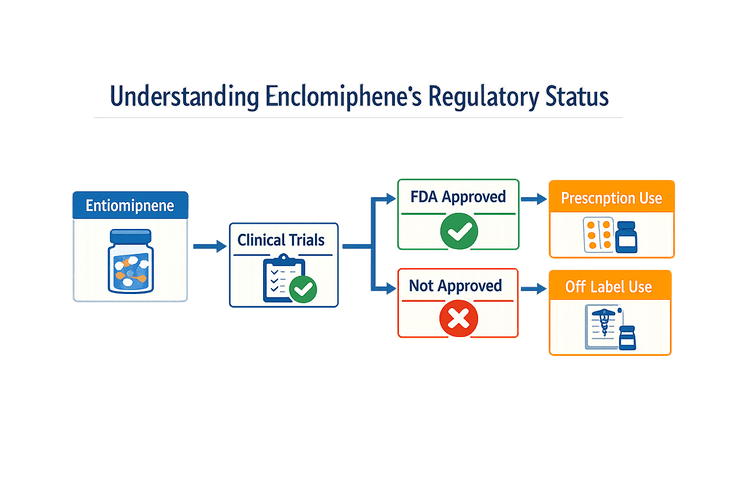
Understanding whether enclomiphene FDA approved status exists requires looking at the regulatory framework that governs how it can be prescribed and dispensed. The short answer is no — enclomiphene as a standalone drug does not have FDA approval. What it does have is eligibility for legal compounding under specific federal provisions, which is a different pathway entirely.
Step 1: Understand the Compounding Pathway
Enclomiphene is not an FDA-approved drug on its own. However, it is a component of clomiphene citrate, which is FDA-approved for ovulation induction in women. Under Section 503A of the Federal Food, Drug, and Cosmetic Act, drug substances that are components of FDA-approved products are eligible for use in compounding. This means a licensed compounding pharmacy can legally prepare enclomiphene for patients who have a valid prescription and a documented medical need.
This distinction matters when evaluating what you are actually getting. A compounded enclomiphene prescription is legal and can be filled by a licensed pharmacy, but it has not gone through the full FDA approval process for the indication you are using it for — typically secondary hypogonadism or low testosterone in men.
Step 2: Check What the Prescription Label Says
When you receive enclomiphene from a compounding pharmacy, the label will not say "FDA-approved." It will typically include the pharmacy name, the prescribing physician, dosage instructions, and a statement that the medication is compounded. Ask your provider or pharmacist to confirm the source and the compounding facility's credentials. Legitimate compounding pharmacies are licensed and inspected, but they operate under different regulations than manufacturers of FDA-approved drugs.
Step 1
Verify the compounding pharmacy
Before filling a prescription, confirm that the pharmacy is licensed in your state and follows USP (United States Pharmacopeia) compounding standards. Ask your clinic which pharmacy they use and check its accreditation status.
Step 3: Understand How This Affects Your Treatment Options
The regulatory status of enclomiphene shapes what you pay, how it is monitored, and what recourse you have if something goes wrong. Compounded drugs are not covered by most insurance plans, so you will pay out of pocket. Prices vary widely depending on the clinic and pharmacy; expect to see monthly costs ranging from $50 to over $200.
Because enclomiphene is used off-label for male hypogonadism, your doctor is prescribing it based on clinical judgment and available research, not on an FDA-approved indication. Clinical trials have shown that enclomiphene raises testosterone in men with secondary hypogonadism and generally preserves fertility, but the studies are smaller and shorter than those required for full FDA approval. One study found that enclomiphene provided comparable testosterone increases to other treatments with a lower rate of documented adverse events, supporting its use as a treatment option while further research is warranted.
The number that matters is not whether the FDA stamped it, but whether the trial data and your lab results support using it for your situation.
If you are comparing enclomiphene to FDA-approved testosterone replacement options like testosterone gel, cream, or injections, the regulatory difference is one factor among several. FDA approval provides a standardized product with known dosing, but it does not mean the drug is better for your specific case. Enclomiphene's advantage is that it stimulates your own testosterone production and usually preserves sperm production, which TRT typically does not. For a detailed comparison of testosterone therapy approaches, see our guide on testosterone replacement therapy safety for men over 40.
Step 4: Know What You Are Signing Up For
Before starting enclomiphene, ask your provider these questions:
- Which compounding pharmacy will fill this, and is it licensed and accredited?
- What is the total monthly cost, including the medication, lab monitoring, and clinic fees?
- How often will I need follow-up labs, and what will you be tracking?
- What happens if the medication does not raise my testosterone or if I have side effects?
Many telehealth clinics offer enclomiphene as part of a membership model. Read the terms carefully. Some require multi-month commitments, and not all include the cost of labs or follow-up consultations in the advertised price. The cheapest advertised rate often does not include monitoring, and monitoring is not optional — you need repeat testosterone panels to know if the drug is working and to watch for adverse changes in hematocrit, estradiol, or lipid levels.
Tips and Tricks
Before you sign up for enclomiphene through a telehealth clinic, here is what to ask and what to know.
Ask About the Pharmacy
Every compounded enclomiphene prescription comes from a 503A or 503B pharmacy. Ask the clinic which one they use. 503A pharmacies compound patient-specific prescriptions; 503B outsourcing facilities make larger batches under stricter FDA oversight. Both are legal for compounding enclomiphene, but 503B facilities face more frequent inspection. If the clinic cannot or will not name the pharmacy, that is a warning sign.
Get the Full Panel First
Enclomiphene works by blocking estrogen receptors in the hypothalamus and pituitary, which raises LH and FSH. If your LH is already high and your testosterone is still low, enclomiphene will not fix that — your testes are not responding. Before starting any treatment, get total testosterone, free testosterone, LH, FSH, SHBG, estradiol, and hematocrit. Two morning draws, taken a week apart, give a clearer picture than one. Without LH and FSH, you are guessing whether the problem is upstream or downstream. Learn more about free vs total testosterone testing to understand which markers matter most.
Understand What the Clinic Charges
Some telehealth platforms charge a monthly membership fee, some charge per consultation, and some bundle the drug cost into a flat rate. Ask for the all-in monthly cost: membership, consultation, prescription, and shipping. Compare that to what you would pay if you got the prescription from your primary-care doctor and filled it at a local compounding pharmacy. The convenience of telehealth is real, but so is the markup. Worth knowing before you sign up.
Know What Monitoring Looks Like
Enclomiphene raises testosterone by raising LH, and LH-driven testosterone can also raise estradiol and hematocrit. Responsible prescribers recheck labs at 6 to 12 weeks, then every 6 months. If the clinic does not mention follow-up labs, ask. If they say labs are optional, that is another warning sign. Short-term clinical safety data for enclomiphene have been satisfactory and equivalent to safety data for testosterone gels and placebo, but those trials included regular monitoring. You should too.
Compare It to Other Options
Enclomiphene is one lever. Testosterone gel, cream, pellets or injections are others. Enclomiphene usually preserves sperm production; TRT usually does not. Enclomiphene depends on your testes still working; TRT does not. If fertility matters now or might later, enclomiphene or hCG are the first-line options. If your LH is already high or you have tried enclomiphene and it did not work, TRT is the fallback. Ask your doctor for the trade-offs in money, monitoring, and fertility before choosing.
FAQ
Is enclomiphene FDA approved for testosterone replacement?No. Enclomiphene has never received FDA approval for testosterone replacement or any other medical use. It is available only as a compounded medication prescribed off-label.
Can I legally get enclomiphene with a prescription?Yes. Licensed compounding pharmacies can legally prepare enclomiphene under Section 503A if you have a valid prescription and documented medical need. Legal does not mean FDA-approved.
Why did the FDA reject enclomiphene?In December 2015, the FDA issued a Complete Response letter citing inadequate Phase 3 study design and concerns about study conduct and data integrity. The manufacturer discontinued development in 2021.
Is compounded enclomiphene safe?Short-term safety data from clinical trials are comparable to testosterone gels and placebo. Long-term safety data do not exist. Compounded drugs lack the post-market surveillance of FDA-approved products.
How does enclomiphene compare to TRT?Enclomiphene stimulates your body's own testosterone production and usually preserves fertility. TRT replaces testosterone directly but typically suppresses sperm production. For a detailed comparison, see our guide on testosterone boosters vs TRT.
Conclusion
Enclomiphene citrate is not FDA approved for any indication. In December 2015, the FDA issued a Complete Response to the manufacturer's application, stating that the Phase 3 trial design was no longer adequate to demonstrate clinical benefit and raising concerns about study design. In 2022, an FDA advisory committee voted 8–4 against placing enclomiphene on the 503A Bulks List — the roster of ingredients that compounding pharmacies can legally use. Several committee members cited lack of clinical efficacy evidence.
That means every enclomiphene prescription written today is compounded off-label. The drug has no USP monograph, no approved labeling and no post-market surveillance system. Clinics that offer it are using a substance that FDA reviewers have twice declined to endorse. Animal studies suggest it raises testosterone by blocking estrogen feedback at the pituitary, but the human trials that reached FDA review did not meet the agency's threshold for approval.
If you are considering enclomiphene, ask your doctor for the full panel — total and free testosterone, LH, FSH and estradiol — before starting and again at follow-up. Ask what the monitoring schedule will be, what the cost is compared to FDA-approved options like testosterone replacement therapy, and what happens if the compounding pharmacy stops carrying it. Worth knowing before you sign up: the regulatory status is unsettled, the evidence base is incomplete, and the committee that reviewed it in 2022 said more studies are needed.
Sources(26)
- The Journal of urology (2020)
- The Journal of clinical endocrinology and metabolism (2026)
- American family physician (2024)
- U.S. Food and Drug Administration — Drug Safety Communication: FDA cautions about using testosterone products for low testosterone due to aging; requires labeling change to inform of possible increased risk of heart attack and stroke with use (2015)
- Journal of Clinical Endocrinology & Metabolism — Testosterone Therapy in Men With Hypogonadism: An Endocrine Society Clinical Practice Guideline (2018)
- International journal of general medicine (2022)
- American Urological Association — Evaluation and Management of Testosterone Deficiency (AUA Guideline) (2018)
- F&S reviews (2020)
- The Journal of arthroplasty (2025)
- International journal of pharmaceutical compounding (2015)
- The journal of sexual medicine (2013)
- Sexual medicine reviews (2023)
- The Journal of the American Board of Family Practice (2001)
- European urology focus (2017)
- International journal of impotence research (2023)
- The journal of sexual medicine (2019)
- RSC advances (2026)
- Journal of human kinetics (2014)
- American journal of men's health (2015)
- U.S. Food and Drug Administration — Testosterone Information (2026)
- Andrology (2025)
- U.S. Food and Drug Administration — FDA issues class-wide labeling changes for testosterone products (2025)
- Public health reports (Washington, D.C. : 1974) (2015)
- Health technology assessment (Winchester, England) (2024)
- The aging male : the official journal of the International Society for the Study of the Aging Male (2015)
- Expert opinion on pharmacotherapy (2005)