Enclomiphene vs Clomiphene: Key Differences Explained
Updated
Top takeaways
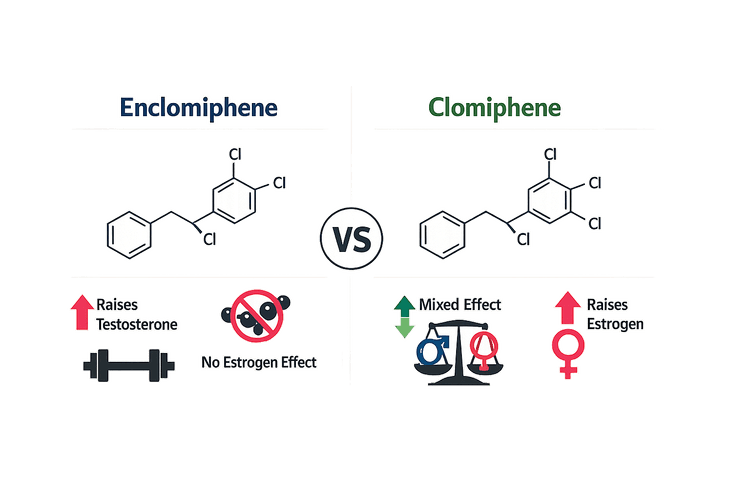
- Enclomiphene and clomiphene are both used to raise testosterone, but enclomiphene is the isolated active isomer with fewer documented adverse effects
- Clomiphene contains both enclomiphene and zuclomiphene; the zuclomiphene portion drives most of the estrogen-related side effects
- In a 66-patient study, enclomiphene raised testosterone with lower estradiol change and significantly fewer reports of decreased libido, reduced energy, and mood changes
- Understanding the difference matters because the side-effect profile changes how long you can stay on treatment
- The regulatory status differs: clomiphene is FDA-approved for female infertility; enclomiphene and clomiphene-for-men are both off-label or compounded
Introduction
When comparing enclomiphene vs clomiphene for testosterone therapy, the structural difference between these two medications determines their side-effect profiles and tolerability. Clomiphene citrate has been prescribed off-label to men with low testosterone for years. It raises your own production instead of replacing it, which usually preserves fertility. Enclomiphene citrate is the purified active half of that molecule, and the trials show it does the same job with a cleaner side-effect profile.
The difference is not academic. Clomiphene is a 50/50 mix of two isomers: enclomiphene, which blocks estrogen receptors in the hypothalamus and raises LH and testosterone, and zuclomiphene, which has a longer half-life and estrogenic activity that accumulates over time. That zuclomiphene portion is what drives the mood changes, low libido, and fatigue that make men stop clomiphene after a few months.
A 2024 study compared 66 patients on enclomiphene versus clomiphene. Enclomiphene produced a median testosterone increase of 166 ng/dL versus 98 ng/dL for clomiphene, though that difference was not statistically significant. The estradiol change was: enclomiphene dropped it by 5.92 pg/mL on average, clomiphene raised it by 17.50 pg/mL. That difference was significant, and so was the adverse-event rate. Decreased libido, reduced energy, and mood changes were all statistically less frequent with enclomiphene.
Before choosing between them, you need two morning testosterone results, an LH level, and a conversation with a prescriber about cost, availability, and monitoring. Most telehealth clinics now offer enclomiphene; some still dispense clomiphene because it is cheaper to compound. The Enclomiphene Citrate: What the Research Actually Shows article covers the trial data in detail, including who was studied and what the endpoints actually measured.
This article walks through what each drug does, how they differ in mechanism and side effects, and what those differences mean when you are deciding which one fits your situation.
The Problem with Clomiphene
Clomiphene citrate is a racemic mixture — half enclomiphene, half zuclomiphene. Both isomers block estrogen receptors, but they do it differently and for different lengths of time. That split creates the problem.
Enclomiphene clears your system in days. Zuclomiphene stays for weeks, building up with each dose. Over time, zuclomiphene's prolonged estrogen-receptor blockade drives the side effects that make men stop treatment.
What the Adverse-Event Data Shows
In a head-to-head comparison, 47 percent of men on clomiphene reported adverse effects. On enclomiphene alone, that number dropped to 13.8 percent. The difference was statistically significant.
Decreased libido was the most common complaint: 33.3 percent of clomiphene users versus 8.6 percent on enclomiphene. Both drugs raised testosterone by similar amounts, but the zuclomiphene half of clomiphene produced side effects that the enclomiphene half did not.
That is the core trade-off: clomiphene works, and it has decades of off-label use behind it, but a significant fraction of men quit because of how it makes them feel. The zuclomiphene component is the reason.
Why It Matters for Treatment Decisions
If you are choosing between clomiphene and enclomiphene, the side-effect profile is the main differentiator. Both raise testosterone and preserve fertility. Both work through the same mechanism — blocking estrogen feedback at the pituitary to increase LH and FSH. The difference is tolerability.
Clomiphene is widely available and inexpensive. Enclomiphene is harder to find, often compounded, and costs more. But if the goal is to stay on treatment long enough to see results, enclomiphene's lower adverse-event rate is worth knowing before you sign up.
Both drugs raise testosterone by similar amounts, but zuclomiphene produces side effects that enclomiphene does not.
The short answer: clomiphene works, but roughly half of men report side effects. Enclomiphene isolates the active isomer and cuts that rate by two-thirds.
How Does Enclomiphene vs Clomiphene Compare Mechanically?
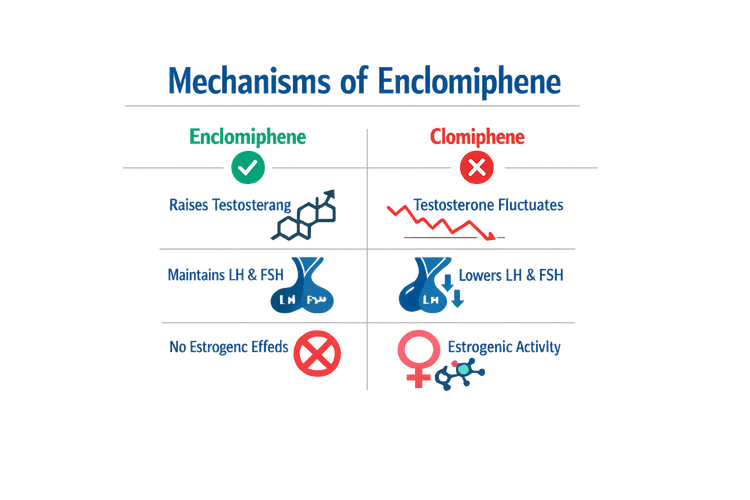
Enclomiphene is the trans-isomer of clomiphene citrate. Clomiphene sold for decades as a mixture of two geometric isomers: trans-clomiphene (enclomiphene) and cis-clomiphene (zuclomiphene). The trans form does most of the work you want. The cis form stays in your system longer and causes most of the side effects you don't.
Enclomiphene citrate is a selective estrogen receptor modulator that blocks estrogenic suppression of the hypothalamic-pituitary-gonadal axis. That means it prevents estrogen from telling your brain to stop making luteinizing hormone. LH signals the testes to produce testosterone. More LH, more testosterone—without shutting down your own production.
What Is the Mechanical Difference?
Clomiphene citrate has a USP monograph and is FDA-approved for ovarian dysfunction in women. Enclomiphene citrate is a small molecule with no USP compendial monograph. It can be made by separating the trans-isomer from the cis-isomer mixture. The separation matters because zuclomiphene has a half-life measured in weeks, not days. It builds up. Enclomiphene clears faster, so the estrogen-blocking effect is cleaner and the rebound is predictable.
Animal studies suggest enclomiphene can treat secondary hypogonadism by increasing circulating testosterone levels. Early human trials showed the same pattern: testosterone rises, LH rises, sperm production usually stays intact. The literature examining efficacy and safety in androgen deficiency is still thin—most studies are small and short—but the mechanism is straightforward.
What Enclomiphene Does for Testosterone and Fertility
Enclomiphene raises total and free testosterone by stimulating your own production. It does not replace your axis; it amplifies it. That matters for fertility. Men on TRT typically see sperm counts drop to zero or near-zero within months. Men on enclomiphene usually maintain or improve sperm parameters because LH and FSH stay active.
The trade-off is reliability. Enclomiphene works when your testes can still respond to LH. If your primary problem is testicular failure—low LH response, prior damage, age-related decline in Leydig cell function—enclomiphene will not raise testosterone as much as exogenous testosterone will. Enclomiphene Citrate: What the Research Actually Shows covers the trial data in detail.
Enclomiphene blocks estrogenic suppression of the HPG axis, allowing endogenous testosterone production to rise without the tissue accumulation seen with the cis-isomer.
Regulatory and Formulation Considerations
Enclomiphene citrate is slightly soluble in water, so particle size and polymorphism matter for oral dosage forms. The impurity profile is expected to be similar to clomiphene citrate as outlined in the USP monograph, with the addition of residual cis-clomiphene and binaphthyl byproducts from the separation process. Controlling these impurities is part of ensuring the product is unlikely to be toxic.
Enclomiphene is not FDA-approved for male hypogonadism. It is available from compounding pharmacies and some telehealth clinics as an off-label treatment. That means no standardized dosing, no long-term safety data in men, and variable quality control depending on the compounder. Before you sign up, ask what the source is, what the purity testing shows, and whether the clinic monitors LH and estradiol alongside testosterone.
Tips for Choosing Between Enclomiphene and Clomiphene
Before choosing between these drugs, you need two morning results and an LH level. Without them, nobody can tell you which one works for you. Both drugs raise testosterone by blocking estrogen receptors in the brain, but the side-effect profiles diverge because clomiphene is a racemic mixture and enclomiphene is the isolated trans-isomer.
What to Ask Your Doctor For
Ask your doctor for baseline labs: total testosterone, free testosterone, LH, FSH, estradiol, and SHBG. These tell you if your testes still respond to LH and whether you have primary or secondary hypogonadism. If LH is already high and testosterone is low, neither drug will help — you need exogenous testosterone. If LH is low or normal and testosterone is low, a SERM like enclomiphene or clomiphene may work.
Request a trial period with defined endpoints. A reasonable protocol is 12 weeks on the drug, then recheck the full panel. The number that matters is free testosterone, not just total. If free testosterone normalizes and you feel better, the drug is working. If estradiol climbs or side effects appear, that is information for the next decision.
Monitoring and Side Effects
In a 66-patient comparison, adverse effects were reported in 47% of clomiphene recipients and 13.8% of enclomiphene recipients. Decreased libido occurred in 33.3% on clomiphene versus 8.6% on enclomiphene. Mood changes and reduced energy were also statistically more frequent with clomiphene. Enclomiphene lowered estradiol by a median of 5.92 pg/mL, while clomiphene raised it by 17.50 pg/mL.
If you start clomiphene and notice libido drop or mood flatten, check estradiol. The cis-isomer (zuclomiphene) has estrogenic activity in some tissues, which may explain the profile. Switching to enclomiphene often resolves these complaints, though the evidence base is still small.
Cost and Availability
Clomiphene citrate has a USP monograph and is FDA-approved for ovulation induction. When prescribed off-label for male hypogonadism, it is often available as a generic and costs less than $50 per month. Enclomiphene citrate has no USP monograph and is not FDA-approved for any indication. It is compounded by specialty pharmacies and typically costs $100 to $200 per month, depending on the clinic and dosing.
This is where it gets expensive: telehealth clinics that offer enclomiphene usually require a monthly membership, monthly labs, and sometimes an enrollment fee. Read the fine print of the subscription before you sign up. Ask whether the membership includes labs, physician consultations, and prescription refills, or whether each is billed separately.
For more on evaluating telehealth providers, see Best Online TRT Clinic: How to Choose and What to Avoid.
When to Choose Clomiphene
Choose clomiphene if cost is the deciding factor and you tolerate it well. It raises testosterone reliably in men with secondary hypogonadism, and decades of off-label use have established a safety record. If you trial it and experience no mood or libido side effects, there is no reason to switch to a more expensive compounded drug.
When to Choose Enclomiphene
Choose enclomiphene if you tried clomiphene and had estrogenic side effects, or if you want to minimize estradiol rise from the start. The evidence suggests lower adverse-effect rates, though the studies are smaller and shorter than the clomiphene literature. Enclomiphene provides the same magnitude of testosterone increase with fewer documented complaints.
| Criterion | Clomiphene | Enclomiphene |
|---|---|---|
| FDA approval for male hypogonadism | No (off-label) | No (compounded) |
| Typical monthly cost | $30–$50 | $100–$200 |
| Estradiol change (median) | +17.50 pg/mL | –5.92 pg/mL |
| Adverse effects (66-patient study) | 47% | 13.8% |
| Decreased libido | 33.3% | 8.6% |
What We Don't Know Yet
The longest published trial of enclomiphene in men ran 12 weeks. We have no multi-year safety data, no head-to-head trials larger than 66 patients, and no data on fertility outcomes compared to clomiphene. The FDA has not approved enclomiphene for any indication, so all use is compounded and off-label. That does not make it unsafe, but it does mean the evidence is thin here.
Further research and more extensive studies are warranted to validate these conclusions and explore additional long-term effects.
Conclusion
Enclomiphene vs clomiphene: both raise testosterone by blocking estrogen receptors in the brain. The difference is that clomiphene is a 50/50 mix of two isomers — enclomiphene and zuclomiphene — while enclomiphene is the isolated active half. That structural difference shows up in the side-effect profile: in a 66-patient comparison, enclomiphene produced statistically fewer reports of decreased libido, reduced energy, and mood changes, and it raised estradiol less. The testosterone increase was numerically larger with enclomiphene (median +166 ng/dL vs. +98 ng/dL), though that difference did not reach statistical significance in this study.
The practical takeaway is straightforward. If you are choosing between the two, enclomiphene offers a cleaner estrogen profile and fewer documented adverse events. Both drugs preserve fertility and both are used off-label for hypogonadism in men, but enclomiphene's single-isomer formulation removes the zuclomiphene component that lingers and drives many of the unwanted effects. The evidence base is still small — the study cited here had 66 patients — but the direction is consistent.
Before starting either drug, test twice in the morning and get a full panel: total and free testosterone, LH, FSH, estradiol, SHBG. Without baseline numbers, nobody can tell you if a selective estrogen receptor modulator is the right tool or if you need a different approach. If you are working with a telehealth clinic, ask what monitoring schedule they use, what the drug costs you per month, and whether they prescribe the compounded or branded version. Worth knowing before you sign up.
For readers comparing these options to TRT or hCG, the Enclomiphene Citrate: What the Research Actually Shows article covers mechanism, trial data, and trade-offs in detail. For broader testosterone optimization, see How to Increase Testosterone Naturally: What Actually Moves the Number.
Frequently asked questions
What is the main difference between enclomiphene vs clomiphene?
Enclomiphene vs clomiphene differs in composition: clomiphene is a 50/50 mixture of enclomiphene (active isomer) and zuclomiphene (inactive isomer with estrogenic effects), while enclomiphene is the purified active component. This structural difference means enclomiphene produces fewer side effects—13.8% adverse event rate versus 47% for clomiphene in a 66-patient study.
Which one raises testosterone more effectively?
Both enclomiphene and clomiphene raise testosterone through the same mechanism. In a 2024 study, enclomiphene produced a median increase of 166 ng/dL versus 98 ng/dL for clomiphene, though this difference was not statistically significant. The key difference is tolerability, not efficacy.
Does enclomiphene vs clomiphene affect estradiol differently?
Yes. Enclomiphene lowered estradiol by a median of 5.92 pg/mL, while clomiphene raised it by 17.50 pg/mL. This difference was statistically significant and explains much of the side-effect divergence between the two drugs.
Which has fewer side effects for testosterone therapy?
Enclomiphene has a significantly lower side-effect rate. Decreased libido occurred in 8.6% of enclomiphene users versus 33.3% on clomiphene. Mood changes and reduced energy were also less frequent with enclomiphene.
Is enclomiphene or clomiphene FDA-approved for men?
Neither drug is FDA-approved for male hypogonadism. Clomiphene is FDA-approved for female infertility and used off-label in men. Enclomiphene has no FDA approval for any indication and is available only through compounding pharmacies.
Sources(23)
- F&S reviews (2020)
- International journal of pharmaceutical compounding (2015)
- Sexual medicine reviews (2017)
- The Journal of urology (2020)
- The journal of sexual medicine (2013)
- Medicines (Basel, Switzerland) (2025)
- International journal of general medicine (2022)
- International journal of impotence research (2023)
- The journal of sexual medicine (2019)
- RSC advances (2026)
- Journal of human kinetics (2014)
- RSC advances (2026)
- Journal of Clinical Endocrinology & Metabolism — Testosterone Therapy in Men With Hypogonadism: An Endocrine Society Clinical Practice Guideline (2018)
- The Cochrane database of systematic reviews (2024)
- The Journal of clinical endocrinology and metabolism (2018)
- Mayo Clinic proceedings (2007)
- BMJ open (2017)
- European journal of endocrinology (2024)
- Andrology (2025)
- Current opinion in endocrinology, diabetes, and obesity (2014)
- Therapeutics and clinical risk management (2009)
- BMJ open (2017)
- American Urological Association — Evaluation and Management of Testosterone Deficiency (AUA Guideline) (2018)