Oral Testosterone: Kyzatrex, Jatenzo, and Tlando Explained

Updated
Top takeaways
- Oral testosterone undecanoate (TU) is a long-term treatment option for men with hypogonadism, available in formulations like Kyzatrex, Jatenzo, and Tlando
- Research shows oral administration is as effective as other testosterone replacement modalities for male hypogonadism
- These FDA-approved oral options eliminate the need for injections or topical applications
- Understanding the evidence behind each formulation helps you make informed treatment decisions
Introduction to Oral Testosterone
Oral testosterone has changed the landscape of testosterone replacement therapy. For decades, men with hypogonadism faced a choice between weekly or bi-weekly injections, daily topical gels, or implanted pellets. Each option carried trade-offs in convenience, cost, and side effects.
The FDA approval of oral testosterone undecanoate formulations introduced a different path. Kyzatrex, Jatenzo, and Tlando use specialized delivery systems that allow testosterone to be absorbed through the lymphatic system rather than passing directly through the liver, which historically destroyed oral testosterone before it could reach therapeutic levels.
Many hypogonadal men prefer oral testosterone treatment when given the option. The appeal is straightforward: swallow a capsule with food, twice daily in most cases, and avoid needles or the transfer risk that comes with gels. For some, that convenience matters more than the higher per-dose cost or the need to take it with meals. For others, the twice-daily schedule and food requirement make injections or gels the better fit.
Research shows oral administration has proven as effective as other modalities for male hypogonadism. A two-year analysis of one oral TU formulation found it offered long-term treatment, with measurable impact on testosterone levels and psychosexual function. The trials that led to FDA approval measured total and free testosterone levels, symptom improvement, and safety markers including liver function and cardiovascular risk factors.
Before choosing between oral testosterone and other replacement options, you need two morning testosterone results, an LH level, and a clear diagnosis of hypogonadism from a clinician who reviewed your full panel. Without that baseline, no formulation—oral, injectable, or topical—can be matched to your specific case. If you're comparing online TRT clinics, ask what diagnostic workup they require before prescribing and what monitoring schedule they follow once treatment starts.
The sections that follow break down what each oral testosterone formulation does, what the trials measured, what it costs in money and monitoring, and what you need to know before signing up.
Understanding the Need for Oral Testosterone
Male hypogonadism affects 10-30% of the male population and is often under-recognized and under-treated. The number that matters is your morning testosterone level measured twice, not once, because a single low result does not make a diagnosis. When both results come back below range and symptoms match—fatigue, low libido, difficulty building muscle, mood changes—you and your doctor can talk about treatment.
Traditional testosterone replacement includes gels, patches, and short- or long-acting injectables. Each has limitations. Gels transfer to partners and children through skin contact. Patches irritate the skin. Injections create peaks and troughs: testosterone spikes in the days after an injection and drops before the next one, and some men feel the swing. Injections also require either clinic visits or learning to self-inject, and they suppress sperm production reliably, which matters if you want to preserve fertility.
Why Men Look for Alternatives
The rising prevalence of testosterone deficiency has led to increased use of exogenous testosterone therapy, including among men desiring fertility. Conventional testosterone replacement therapies restore serum testosterone but suppress gonadotropins—the pituitary signals that tell your testicles to make sperm. For men who want children now or later, that trade-off is a problem. For men who dislike needles, daily gel application, or explaining a patch, the existing options feel limiting.
Oral testosterone formulations aim to solve some of these problems. They do not require injections or skin contact with others, and they clear the body faster, which gives you more control if side effects appear. The trade-off is cost, insurance coverage, and the need to take them with food multiple times per day. If you are evaluating whether an online TRT clinic offers oral options, ask about the specific brand, the dosing schedule, and what it costs you after insurance.
Exploring Kyzatrex, Jatenzo, and Tlando
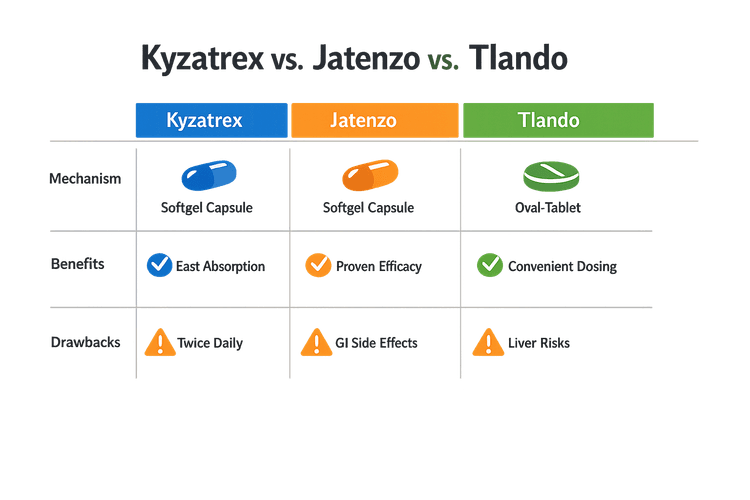
Three oral testosterone formulations are FDA-approved in the United States: Kyzatrex, Jatenzo, and Tlando. All three use testosterone undecanoate, a form of testosterone attached to a fatty acid chain that allows absorption through the lymphatic system rather than the liver. That design sidesteps the hepatotoxicity that sank earlier oral testosterone drugs.
Each product uses a self-emulsifying drug delivery system that mixes with dietary fat in the intestine. You take them with food — specifically, food containing fat — or they do not absorb reliably. Without fat in the meal, blood levels drop and dosing becomes unpredictable.
How Kyzatrex Works
Kyzatrex comes in capsules dosed twice daily with meals. The manufacturer designed it for flexible titration: your doctor adjusts the dose based on blood levels drawn a few hours after the morning dose. Starting doses are typically lower, and the range allows individualized dosing up or down depending on how your body absorbs and clears testosterone.
The twice-daily schedule mimics the natural rise and fall of testosterone more closely than weekly injections, but it requires consistency. Miss a dose or take it without enough fat, and your levels dip. Some men prefer the control; others find the routine inconvenient.
How Jatenzo Works
Jatenzo also uses testosterone undecanoate with lymphatic absorption. It is dosed twice daily with food, similar to Kyzatrex. The formulation and dosing increments differ slightly, but the mechanism is the same: fat in the meal triggers emulsification and absorption.
Jatenzo was the first oral testosterone undecanoate approved by the FDA in 2019. Clinical trials showed it raised testosterone into the normal range in most men, with levels checked in the morning before the first dose. The label warns that it can raise blood pressure and hematocrit, so monitoring those is part of the protocol.
How Tlando Works
Tlando is dosed twice daily, but the capsules come in a fixed-dose regimen rather than a wide titration range. That makes it simpler to prescribe but less flexible if your absorption is unusually high or low. Blood levels are checked similarly — morning draws before the first dose — and adjusted by changing the number of capsules rather than switching to intermediate strengths.
The fixed-dose approach works well for men whose levels land in the target range on standard dosing. For those who need fine-tuning, the lack of intermediate steps can be limiting.
What the Trials Measured
The approval trials for these drugs measured whether they could raise total testosterone into the normal range — typically 300 to 1,000 ng/dL — without causing liver toxicity. Most men in the trials reached target levels, but the trials excluded men with severe obesity, uncontrolled hypertension, or hematocrit above 50%. If you fall outside those parameters, the drugs may not work as predictably.
The trials also required men to take the medication with a standardized meal containing a specified amount of fat. Real-world adherence is harder. If your breakfast is black coffee and toast, your levels will not match the trial results.
For a broader look at how online TRT clinics structure their prescribing and monitoring, including which formulations they offer and what follow-up testing they require, the research desk has a separate breakdown.
Cost and Access
None of these drugs are available as generics. List prices run several hundred dollars per month, and insurance coverage varies. Some plans cover one but not the others; some require prior authorization showing that injections or gels failed or are not tolerated. If you are paying out of pocket, Kyzatrex offers a self-pay program with a set monthly fee, which can be cheaper than the cash price at a retail pharmacy.
Telehealth clinics that prescribe oral testosterone typically charge a monthly membership on top of the drug cost. That membership covers the prescribing visit, follow-up labs, and dosing adjustments. Read the fine print on what labs are included and whether the membership renews automatically.
What Oral Testosterone Does Not Fix
Oral testosterone raises your testosterone level. It does not restore fertility — these drugs suppress your body's own production the same way injections and gels do, shutting down LH and FSH and reducing sperm production. If fertility matters now or in the near future, oral testosterone is the wrong choice. The drugs also do not address the underlying cause of low testosterone. If the cause is obesity, sleep apnea, or alcohol use, treating those directly often raises testosterone without medication.
Oral testosterone also requires consistent meal timing and fat intake. If your schedule or diet is erratic, the twice-daily dosing with food becomes a problem. Injections or gels may fit better.
Tips for Considering Oral Testosterone Treatment
Before starting oral testosterone, you need two morning blood draws showing low testosterone and symptoms that match the lab result. One test is not a diagnosis. Ask your doctor for total testosterone, free testosterone, LH, FSH, and hematocrit. Without LH and FSH, nobody can tell you whether your pituitary is working or whether you have primary testicular failure. Those numbers change what treatment fits you.
Oral testosterone requires dosing with food — specifically with fat. The formulations absorb through the lymphatic system, not the stomach. If you take them on an empty stomach, the blood level drops and the dose fails. The label specifies a meal; follow it. This is not optional.
Dosing and Titration
Most oral testosterone starts at a fixed dose and adjusts based on a single blood draw taken three to five hours after the morning dose. That timing matters. Too early and the level is still climbing; too late and it is falling. Your doctor will check the result at around day 28 and again at day 56, then adjust the dose up or down within the approved range. The goal is a testosterone level in the normal range for your age, not the top of the reference range.
If the first dose does not bring your level into range, the next step is a higher dose, not a different drug. The approved formulations allow titration from a minimum morning-only dose to a maximum twice-daily dose. Expect at least two months of dose adjustment before you know whether the drug works for you.
What to Discuss with Your Doctor
Ask about monitoring frequency. Oral testosterone requires blood work at baseline, during titration, and then every six to twelve months. The panel should include testosterone, hematocrit, PSA if you are over 40, and liver function tests. Oral formulations bypass first-pass liver metabolism, but your doctor will still check liver enzymes periodically.
Ask about cost and insurance coverage. Oral testosterone is newer than injections and gels, and not all plans cover it. If your plan does not, the out-of-pocket price can run several hundred dollars per month. Some manufacturers offer co-pay cards; ask your pharmacy or check the drug's website. If cost is a barrier, compare online TRT clinics that may offer different pricing structures or alternative formulations.
Ask whether oral testosterone preserves fertility. The short answer: it does not. Exogenous testosterone suppresses LH and FSH, which shuts down sperm production in most men. If fertility matters to you now or in the next few years, ask about enclomiphene or hCG instead. Those drugs raise testosterone without suppressing the pituitary.
Monitoring and Adjustments
Once your dose is stable, expect blood work every six months for the first year, then annually if everything stays in range. Your doctor will track hematocrit — oral testosterone raises red blood cell production, and a hematocrit above 54% requires dose reduction or blood donation. PSA monitoring starts at age 40 or earlier if you have risk factors. A rising PSA does not mean cancer, but it does mean more testing.
If your symptoms do not improve after three months at a stable dose, the problem may not be testosterone. Low testosterone overlaps with sleep apnea, depression, thyroid disease, and obesity. Treating the number without addressing the underlying cause leaves you on a drug that does not help. Ask your doctor to rule out those conditions before assuming the dose is too low.
Conclusion: Making Informed Choices
Oral testosterone therapy has increased in use in recent years, and the FDA has approved new formulations that avoid the liver toxicity of older oral options. Kyzatrex, Jatenzo and Tlando each deliver testosterone undecanoate with meals, but they differ in dosing schedules, cost and the number of pills you take daily. Before choosing one, you need a confirmed diagnosis — two morning tests showing low total testosterone, plus symptoms.
The evidence shows concerns about efficacy and safety persist despite approval. These are not pills you take once and forget. Each requires blood work at intervals to confirm your testosterone level is in range, your hematocrit is not climbing and your PSA is stable. The monitoring schedule is the same as for injections or gels, and the cost is often higher unless your insurance covers the brand.
If you are deciding between oral testosterone and other routes, the short answer is this: orals work for some men, but they are not inherently safer or more convenient than injections or gels once you account for the pill count, the meal timing and the monitoring. Best Online TRT Clinic: How to Choose and What to Avoid walks through what to check before signing up with any provider, including how they handle lab work and prescription refills.
The majority of testosterone prescriptions in the United States are now written by primary care physicians, not specialists. That means you are responsible for knowing what questions to ask and what numbers matter on your lab report. Test first, test twice, and ask your doctor for the full panel — not just total testosterone. If a clinic is pushing oral testosterone without explaining the monitoring, the meal requirement or the fertility trade-off, that is a red flag.
Oral testosterone is one option in a wider range of formulations. It is not a guaranteed solution, and it is not without risks. The research shows it works for hypogonadism when dosed correctly and monitored carefully. What it does not show is that it is easier, cheaper or better tolerated than the alternatives for most men. Make your choice based on your schedule, your budget, your lab results and your willingness to take pills with food twice or three times a day — not on marketing.
Related reading
Sources(25)
- F&S reviews (2020)
- International journal of pharmaceutical compounding (2015)
- The aging male : the official journal of the International Society for the Study of the Aging Male (2015)
- The journal of sexual medicine (2013)
- Sexual medicine reviews (2017)
- International journal of general medicine (2022)
- Medicines (Basel, Switzerland) (2025)
- International journal of impotence research (2023)
- The journal of sexual medicine (2019)
- RSC advances (2026)
- U.S. Food and Drug Administration — Drug Safety Communication: FDA cautions about using testosterone products for low testosterone due to aging; requires labeling change to inform of possible increased risk of heart attack and stroke with use (2015)
- Journal of human kinetics (2014)
- U.S. Food and Drug Administration — FDA issues class-wide labeling changes for testosterone products (2025)
- TouchREVIEWS in endocrinology (2022)
- U.S. Food and Drug Administration — Testosterone Information (2026)
- American Urological Association — Evaluation and Management of Testosterone Deficiency (AUA Guideline) (2018)
- Journal of Clinical Endocrinology & Metabolism — Testosterone Therapy in Men With Hypogonadism: An Endocrine Society Clinical Practice Guideline (2018)
- U.S. Food and Drug Administration — Enclomiphene Citrate: FDA presentation to the Pharmacy Compounding Advisory Committee, June 8, 2022 (Madeline Wolfert, MD, CDER)
- FP essentials (2023)
- The Journal of clinical endocrinology and metabolism (2026)
- The Cochrane database of systematic reviews (2024)
- Federal practitioner : for the health care professionals of the VA, DoD, and PHS (2025)
- The Journal of urology (2020)
- The journal of sexual medicine (2021)
- Andrology (2025)