Subcutaneous vs Intramuscular Testosterone Injections
Updated
Top takeaways
- Intramuscular injections have been the standard for testosterone therapy for decades, but subcutaneous administration is gaining traction as a self-administered alternative
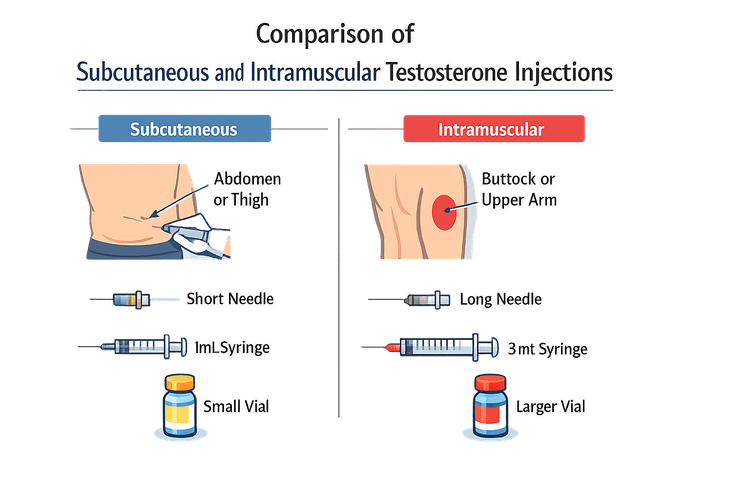
- IM injections deliver testosterone deep into muscle tissue; SC injections place it just under the skin with a shorter needle
- The choice between routes affects injection comfort, ease of self-administration, and adherence — not just the testosterone level you reach
- Direct head-to-head safety studies are limited, so the decision often comes down to practical trade-offs rather than clear superiority
- Understanding both methods before starting therapy helps you ask the right questions at your clinic visit
Introduction
Subcutaneous vs intramuscular testosterone injections represent the two primary delivery routes when you choose injectable testosterone replacement therapy. Testosterone replacement therapy comes in gels, patches, pellets and injections. When you land on injections — usually because of cost, insurance coverage or stable blood levels — the next fork is where the needle goes. Intramuscular injections have been the most common modality for testosterone therapy of male hypogonadism and gender transition for nearly 80 years. They deliver predictable serum testosterone levels and remain the least expensive option. Subcutaneous injections are newer to widespread clinical use, though the same testosterone esters work under the skin.
The practical difference is immediate: IM injections require a longer needle, deeper placement into muscle, and a technique many patients find difficult to self-administer. SC injections use a shorter needle, go into the fat layer just under the skin, and most patients can handle them at home after one demonstration. Pain and injection-site discomfort vary by individual, but studies characterizing subcutaneous administration position it as an effective and safe alternative when ease of self-administration matters.
Before choosing a route, it helps to know what each one does, what the published comparisons actually measured, and where the evidence is still thin. The decision is not just pharmacology — it is also about whether you will stick with the protocol six months in, whether your insurance covers the supplies for one route but not the other, and whether your clinic even offers both. For a broader look at what to evaluate when selecting a provider, see Best Online TRT Clinic: How to Choose and What to Avoid.
This guide walks through the mechanics of each injection route, the evidence comparing them, and the practical considerations that determine which one fits your situation. The goal is not to declare a winner — it is to give you the facts you need to make an informed choice with your prescriber.
What Makes Choosing Between Subcutaneous vs Intramuscular Testosterone Injections Difficult?
Choosing between subcutaneous and intramuscular testosterone injections is not a preference exercise. It is a decision shaped by pain tolerance, self-administration skill, insurance coverage and adherence patterns — and the published trials offer conflicting signals on which route causes more discomfort.
Intramuscular injections have been the standard for decades. They deliver predictable testosterone levels and cost less than most other modalities. The drawback: many patients cannot or will not inject into a large muscle themselves, which means clinic visits, co-pays and scheduling friction. One study notes that IM injections "are difficult to self-administer and associated with some discomfort," a barrier that quietly drives non-adherence when patients skip doses rather than return to the clinic.
Subcutaneous injections promise easier self-administration — a shallower needle, less tissue depth, simpler technique. Clinics marketing the subcutaneous route emphasize convenience and patient preference. But one comparative trial found that subcutaneous testosterone undecanoate "produces greater pain 24 hours after injection" than the intramuscular route, and that delayed pain "may contribute to the overall majority preference for the IM injection." The same trial reported no meaningful difference in testosterone, DHT or estradiol pharmacokinetics between the two routes, which means the choice hinges on tolerability and logistics rather than efficacy.
The Real Trade-Off
The problem is not which route works — both do. The problem is predicting which route a given patient will stick with long enough to matter. A method that hurts less in the moment but aches the next day may still lose to a method that requires a clinic visit but produces no delayed soreness. Insurance coverage, needle phobia, work schedules and the presence of a partner willing to inject all shift the calculation, and none of those variables appears in the trial endpoints.
Clinicians face the same uncertainty. Without a clear predictor of who will tolerate subcutaneous injections and who will prefer intramuscular, the default is often the route the prescriber learned first or the one the pharmacy stocks. That leaves patients to discover the answer by trial, which works only if the first attempt does not discourage them from continuing therapy at all. For more on evaluating clinics and treatment options before starting, see Best Online TRT Clinic: How to Choose and What to Avoid.
How to Choose Between Subcutaneous vs Intramuscular Testosterone Injections
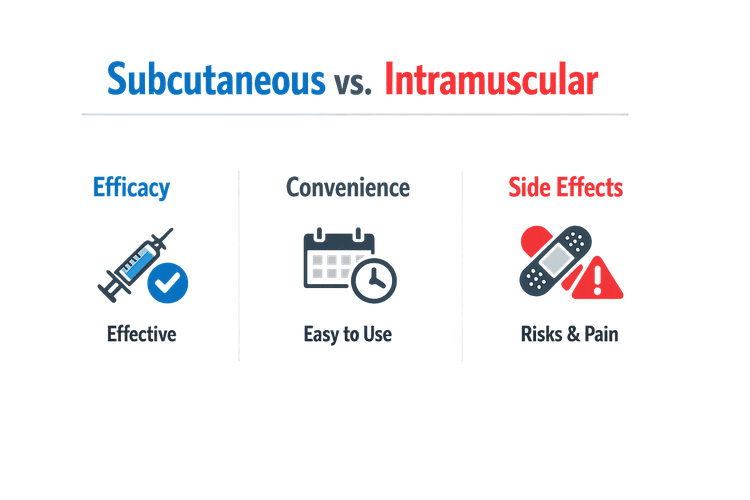
Choosing between subcutaneous and intramuscular testosterone injections starts with what the trials actually measured. The pharmacokinetics—how testosterone, DHT, and estradiol move through your blood—do not differ substantially between the two routes. That means the hormone levels you get from the same dose are comparable. The differences show up in how you administer it, how it feels, and whether you can do it yourself.
Step 1
Check if self-administration matters to you
Subcutaneous injections are easier to self-administer than intramuscular. You use a shorter needle, inject into fatty tissue rather than muscle, and the technique is simpler to learn. If you need to inject weekly or twice-weekly and prefer to do it at home without help, subcutaneous has a practical edge. Intramuscular requires a longer needle, deeper placement, and more confidence with technique—many patients ask a partner or visit a clinic for each dose.
Step 2
Compare pain and injection-site discomfort
One trial measured pain at injection and 24 hours later. Subcutaneous produced greater pain 24 hours after injection, and the majority of participants preferred intramuscular overall. The difference was not large, but it was consistent. If you are sensitive to lingering soreness, intramuscular may be the better fit despite the deeper needle stick.
Step 3
Confirm your dose does not need adjustment
The subcutaneous route does not require a dose change for most men. The same milligram amount delivers comparable testosterone levels whether you inject into fat or muscle. If your doctor has already dialed in your dose on intramuscular and you want to switch, you can usually keep the same dose and frequency. Recheck labs four to six weeks after switching to confirm.
Who fits each route
Subcutaneous works well if you inject at home, want a shorter needle, and can tolerate mild soreness the next day. It is also an option for men who cannot do intramuscular injections safely—those on anticoagulants, for example, where deep muscle injection carries more bleeding risk. Intramuscular remains the standard if you prefer less day-after discomfort, have a clinic or partner administering the injection, or if your insurance or formulary defaults to it. Neither route is inherently better; both deliver testosterone reliably when done correctly.
For a broader look at how to evaluate TRT options and what to ask before starting, see Best Online TRT Clinic: How to Choose and What to Avoid. If you are exploring non-injection options first, How to Increase Testosterone Naturally: What Actually Moves the Number covers lifestyle and supplement interventions.
What the evidence does not tell you yet
No large trial has directly compared long-term adherence, injection-site complications, or patient satisfaction across hundreds of men on both routes. The pharmacokinetic data come from crossover studies with small samples—enough to show equivalence in hormone levels, not enough to grade rare side effects or dropout rates. Clinicians should discuss the subcutaneous route with patients because it is easier to self-administer and may improve adherence, but the preference data favor intramuscular when pain at 24 hours is weighted.
Tips and Tricks
Before your first injection, read the label. The vial tells you concentration, dose volume and whether the ester is approved for subcutaneous use. Most testosterone cypionate and enanthate labels say intramuscular only, but clinicians prescribe subcutaneous off-label because it is easier to self-administer.
Self-Administration
Subcutaneous injections go into the fat layer of the abdomen or thigh. Use a 25–27 gauge needle, half-inch to five-eighths inch long. Pinch the skin, insert at a 45-degree angle, inject slowly. Rotate sites each time to avoid lumps.
Intramuscular injections go into the muscle of the thigh or glute. Use a 22–25 gauge needle, one to one-and-a-half inches long. Insert perpendicular to the skin, aspirate if your clinician instructs it, inject slowly. Rotate sites to reduce soreness.
Preparation Checklist
Before each injection:
- Wash hands with soap and water.
- Wipe the vial top with an alcohol pad.
- Draw air into the syringe equal to your dose, inject it into the vial, then draw the testosterone.
- Tap the syringe to move bubbles to the top, push them out.
- Wipe the injection site with a fresh alcohol pad, let it dry.
Store vials at room temperature, away from light. Check the expiration date. If the oil looks cloudy or contains particles, do not use it.
What to Expect
Subcutaneous injections may leave a small lump under the skin for a day or two. That is normal. Intramuscular injections may cause soreness for 24 to 48 hours. Ice the site before injection to reduce discomfort.
If you see redness, swelling or warmth that lasts more than two days, call your prescriber. If you develop a fever or the site becomes painful to touch, that is an infection risk and you need same-day evaluation.
Disposal
Needles and syringes go into a sharps container. Do not recap needles. When the container is three-quarters full, seal it and follow your local disposal rules. Many pharmacies and clinics accept sealed sharps containers.
Monitoring
Test testosterone levels six to eight weeks after starting or changing dose. Your clinician will also check hematocrit and estradiol. If your hematocrit climbs above 54 percent, you may need a lower dose or more frequent injections. For more on choosing a provider and what to ask before signing up, see Best Online TRT Clinic: How to Choose and What to Avoid.
Conclusion
Both subcutaneous and intramuscular testosterone injections deliver the hormone effectively. The pharmacokinetics of testosterone, DHT, and estradiol do not differ substantially between the two routes. What does differ is the needle, the injection site, the patient preference for pain and convenience, and the monitoring profile each route tends to produce.
Intramuscular testosterone cypionate causes significant rises in estradiol, hematocrit, and prostate-specific antigen due to supraphysiological peaks. Subcutaneous administration may produce a lower peak-to-trough ratio, which can mitigate some of those reactions. That difference matters if your hematocrit runs high or your estradiol swings wide on IM injections. It matters less if your levels stay stable and you tolerate the IM route without issue.
Injectables remain the modality of choice for testosterone replacement therapy. Within that category, the choice between subcutaneous and intramuscular comes down to your tolerance for injection-site pain, your willingness to self-administer with a shorter needle, and your lab response on each route. Test first, test twice, and ask your doctor which route fits your monitoring needs. If you are starting therapy or considering a change in administration, review the Best Online TRT Clinic: How to Choose and What to Avoid to understand how clinics structure prescriptions, monitoring, and support for both injection methods.
The short answer: subcutaneous offers convenience and potentially smoother peaks; intramuscular offers familiarity and decades of clinical use. Neither is universally superior. The number that matters is your testosterone level on the route you can sustain long-term, measured at trough, with monitoring that catches hematocrit and estradiol before they become problems.
Frequently asked questions
What is the difference between subcutaneous vs intramuscular testosterone injections?
Subcutaneous injections place testosterone into the fat layer just under the skin using a shorter needle, while intramuscular injections deliver it deep into muscle tissue with a longer needle. Both routes produce comparable testosterone levels, but differ in administration technique and pain profiles.
Which injection method is less painful?
One comparative trial found that subcutaneous injections produced greater pain 24 hours after injection than intramuscular, and most participants preferred intramuscular overall. Immediate injection pain was similar between routes.
Can I switch from intramuscular to subcutaneous testosterone?
Yes, most men can switch without changing dose or frequency. Recheck labs four to six weeks after switching to confirm your testosterone levels remain in range.
Do I need different needles for subcutaneous vs intramuscular injections?
Yes. Subcutaneous injections use 25–27 gauge needles, half-inch to five-eighths inch long. Intramuscular injections require 22–25 gauge needles, one to one-and-a-half inches long.
Which route is easier to self-administer?
Subcutaneous injections are easier to self-administer. The shorter needle, shallower depth, and simpler technique allow most patients to inject at home after one demonstration. Intramuscular injections require more confidence with technique, and many patients ask a partner or visit a clinic for each dose.
Related reading
Peptides vs TRT: Evidence-Based Insights vs Marketing Claims
Sources(26)
- The Journal of urology (2020)
- The Journal of clinical endocrinology and metabolism (2026)
- American family physician (2024)
- U.S. Food and Drug Administration — Drug Safety Communication: FDA cautions about using testosterone products for low testosterone due to aging; requires labeling change to inform of possible increased risk of heart attack and stroke with use (2015)
- Journal of Clinical Endocrinology & Metabolism — Testosterone Therapy in Men With Hypogonadism: An Endocrine Society Clinical Practice Guideline (2018)
- International journal of general medicine (2022)
- American Urological Association — Evaluation and Management of Testosterone Deficiency (AUA Guideline) (2018)
- The Journal of arthroplasty (2025)
- International journal of pharmaceutical compounding (2015)
- European urology focus (2017)
- The journal of sexual medicine (2013)
- The Journal of urology (2021)
- F&S reviews (2020)
- DailyMed (U.S. National Library of Medicine) — FDA prescribing information: Testopel (testosterone) pellet [Endo USA, Inc.] (2025)
- International journal of impotence research (2023)
- The journal of sexual medicine (2019)
- RSC advances (2026)
- Journal of human kinetics (2014)
- RSC advances (2026)
- Journal of the Endocrine Society (2017)
- The Journal of clinical endocrinology and metabolism (2022)
- Cureus (2022)
- Sexual medicine (2015)
- The journal of sexual medicine (2021)
- The aging male : the official journal of the International Society for the Study of the Aging Male (2015)
- Andrology (2025)