Testosterone Injections vs Gel: Testosterone Gel, Cream, Pellets
Updated
Introduction
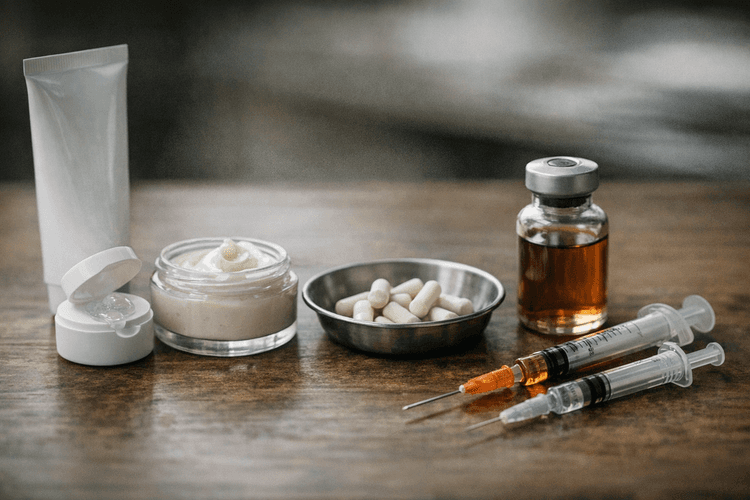
Testosterone gel cream pellets injections represent four distinct delivery methods for testosterone replacement therapy, each with different trade-offs in convenience, cost, and blood-level stability.
Testosterone replacement therapy is not one thing. It is a category with at least seven delivery methods, and the method you choose shapes everything that follows: how often you dose, what you pay, how stable your levels stay, and how much monitoring you need.
The available formulations include transdermal gels and creams, intramuscular and subcutaneous injections, subdermal pellets, oral capsules, buccal tablets, and intranasal gel. Each one delivers testosterone, but the pharmacokinetics — how fast it enters your blood, how long it stays, and how much variability you see day to day — differ enough that two men on different methods can have very different experiences even at the same average testosterone level.
This article walks through the mechanics, monitoring requirements, and cost structure of the four most commonly prescribed methods: testosterone gel, cream, pellets, and injections. It does not tell you which one to use. It gives you the information you need to ask your prescriber the right questions before you start.
Transdermal preparations — gels and creams — have gained popularity because they deliver a physiological amount of testosterone daily and avoid the peaks and troughs of weekly or biweekly injections. Pellets offer the longest dosing interval but require a minor surgical procedure every few months. Injections remain the most cost-effective option for many patients, though they require either clinic visits or self-administration.
What follows is a breakdown of how each method works, what it costs you in money and monitoring, and where the published evidence shows meaningful differences in outcomes and side effects.
Understanding the Challenges of Testosterone Therapy
Choosing between testosterone gel cream pellets injections is not just about convenience. Each option comes with a different set of trade-offs in stability, cost, monitoring burden and side-effect profile. The method that works for one person may fail for another, and the clinic that sells it may not tell you what changes when you switch.
The first challenge is pharmacokinetics. Intramuscular testosterone esters improve bone and muscle mass, but they create swings in blood levels that lead to mood and energy fluctuations between injections. Some men feel the drop in the second week of a two-week cycle; others tolerate it without noticing. Gels and creams deliver more stable daily levels, but absorption varies by skin type, application site and whether you shower or sweat soon after. Pellets release testosterone slowly over months, but the implantation procedure carries infection risk and the dose cannot be adjusted without another procedure.
What the Trials Measured
The published comparisons focus on whether each method raises testosterone into the normal range, not on which one feels best or costs least over a year. A trial that shows "efficacy" typically means the average participant reached a target level at a scheduled lab draw. It does not tell you how many participants had transfer incidents with gel, how many had injection-site reactions, or how many stopped because of insurance denials.
Intramuscular esters require injections every two to four weeks, which is manageable for some and a dealbreaker for others. Clinics that offer at-home injection kits assume you or a household member can handle the technique and the disposal. Gels require daily application and a wait before skin contact with others, especially children. One missed step—a hug before the gel dries, a shared towel—can transfer enough testosterone to cause virilization in a child. That risk is real, documented and not hypothetical.
Monitoring and Side Effects
All testosterone therapy suppresses natural production, which means sperm count usually drops. If fertility matters now or later, you need that conversation before starting any method. The degree of suppression varies, but the mechanism does not: exogenous testosterone shuts down the signal from the brain to the testes. Some men recover quickly after stopping; others do not.
There are also concerns regarding the development of prostate cancer and the risk of polycythemia and cardiovascular events associated with testosterone therapy. Polycythemia—a rise in red blood cell count—happens more often with injections than with gels, though both require regular hematocrit monitoring. Prostate-specific antigen (PSA) must be checked before starting and periodically after, especially in men over 40. Cardiovascular risk remains debated, but the trials were not designed to detect rare cardiac events, so the data are incomplete.
For practical guidance on what to ask before signing up with a provider, see Best Online TRT Clinic: How to Choose and What to Avoid.
Cost and Access
The sticker price is one thing; the out-of-pocket total after insurance, copays, lab fees and clinic membership charges is another. Injections are often the cheapest per dose, but if your insurance does not cover self-administration supplies, you pay for syringes, needles, alcohol wipes and a sharps container every month. Gels are convenient but expensive without insurance, and many plans apply a prior-authorization requirement or a high tier copay. Pellets involve a procedure fee every few months, and not all insurers cover the implantation.
Telehealth clinics bundle the prescription, labs and follow-up into a monthly fee, which simplifies billing but may cost more than a local endocrinologist if your insurance is good. The cheapest option depends on your insurance, your state's pharmacy laws and whether the clinic is in-network. Ask for the full annual cost—including labs, follow-up visits and any required membership—before choosing.
Steps to Choose the Right Testosterone Delivery Method
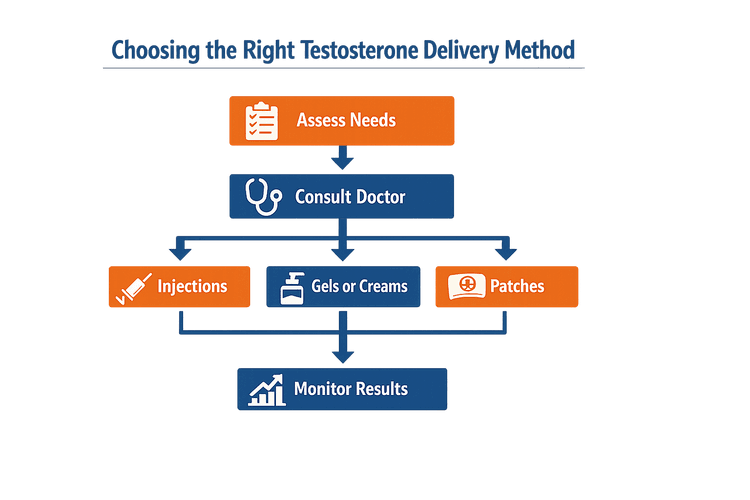
Choosing between testosterone gel cream pellets injections starts with numbers, not preferences. You need two morning testosterone results, taken a week apart, before you can evaluate which delivery method fits your physiology and schedule.
Step 1: Get Your Baseline Labs Right
Step 1
Test twice, same conditions
You need two fasting morning draws, 7–10 days apart, taken before 10 a.m. A single result does not establish a pattern. Ask for total testosterone, free testosterone, SHBG, LH, FSH, estradiol, hematocrit and PSA. Without the full panel, you cannot predict how your body will respond to any delivery method.
The reference range printed beside each number is population-wide. Your symptoms matter more than where you fall in that range, but the two-test average tells your doctor whether replacement is indicated and helps rule out secondary causes.
How Do You Match Delivery Method to Your Monitoring Tolerance?
Each delivery method imposes a different monitoring schedule and cost structure. Gels and creams require stable daily application and periodic labs to confirm absorption. Injections create peaks and troughs; your protocol and injection frequency determine how often you test. Pellets deliver steady levels for months but require a minor surgical procedure every insertion.
| Method | Dosing Frequency | Monitoring Frequency | Procedure Required |
|---|---|---|---|
| Gel/Cream | Daily | Every 3–6 months | No |
| Injections | Weekly to biweekly | Every 3–6 months | No |
| Pellets | Every 3–6 months | Before each insertion | Yes (subdermal) |
Fixed-dosage patches and depot injections have known limitations: inflexibility in dosing and nonphysiologic hormone levels that swing from supraphysiologic peaks to subtherapeutic troughs. Gels offer more flexibility, but absorption varies by skin type and application site.
What Are the Transfer Risks and Lifestyle Constraints?
Gels and creams transfer to others through skin contact. If you live with a partner, children or pets, you must cover the application site or time your application to minimize contact. Injections and pellets eliminate transfer risk entirely.
Pellet insertion timing is individualized based on the return of your characteristic androgen deficiency symptoms—fatigue, low libido, mood changes. That means you and your provider track symptom patterns, not just lab numbers. The release rate and effective duration of pellets are not well studied, so your experience guides the schedule.
What Does Each Method Cost in Money and Flexibility?
Telehealth clinics often bundle the drug, labs and consults into a monthly subscription. Before you sign up, ask what the total annual cost is, what happens if you need to adjust your dose, and whether the membership includes the monitoring labs or bills them separately. For a detailed breakdown of what to ask before choosing a clinic, see Best Online TRT Clinic: How to Choose and What to Avoid.
Step 5: Discuss Fertility Preservation Before You Start
All forms of exogenous testosterone suppress your natural production through negative feedback on LH and FSH. If fertility matters now or in the future, you need a plan before your first dose. Some men bank sperm. Others use hCG alongside testosterone or choose enclomiphene instead of TRT. The decision point is before you start, not after your LH drops to undetectable.
Your doctor should ask about fertility goals during the intake visit. If the conversation does not happen, bring it up yourself.
Tips and Tricks for Effective Testosterone Therapy
Once you start testosterone therapy, the delivery method matters less than what you do with it. Here is what actually moves the needle on results, side effects and cost.
Test twice before adjusting dose
One morning result is not a diagnosis, and one result after starting therapy is not a trend. Labs bounce — sleep, hydration and timing all shift the number. If your level comes back lower than expected, repeat it before changing dose. The second result tells you whether the first was real.
Most clinics run labs at six weeks, then every three to six months. That schedule catches problems early without overtesting. If you switch from gel to injections or vice versa, wait six weeks before the first follow-up. Steady state takes time.
Apply gel and cream correctly
Gels and creams work only if the skin absorbs them. Apply to clean, dry skin on the shoulders or upper arms — areas with good blood flow and low transfer risk. Let it dry completely before putting on a shirt. Showering or swimming within two hours washes off the dose you just paid for.
Cover the application site before skin-to-skin contact with a partner or child. Transfer is real. If someone else touches the gel before it dries, they absorb testosterone too. That includes pets — dogs lick, and the dose transfers.
Track injection timing and site rotation
If you inject every week or every two weeks, pick a day and stick to it. Missing by a day or two occasionally is fine; missing by a week drops your level and you feel it. Most men notice fatigue or mood shift three to five days after a missed dose.
Rotate injection sites — glutes, quads, delts. Injecting the same spot every time builds scar tissue, and scar tissue does not absorb well. Mark a calendar or use an app. After six months, patterns blur and you forget which side you used last.
Monitor hematocrit and donate blood if needed
Testosterone raises red blood cell production. That thickens the blood, measured as hematocrit. Most men see hematocrit climb 2 to 5 points in the first year. If it goes above 54%, your doctor will tell you to donate blood or lower the dose.
Donating blood every eight to twelve weeks keeps hematocrit in range without cutting testosterone. Blood banks take whole blood donations every 56 days. If your hematocrit stays high despite donations, the dose is too high.
Understand what testosterone does to fertility
Testosterone therapy usually lowers sperm production. LH and FSH drop, and the testes shrink. For some men, sperm count goes to zero within months. For others, it stays detectable but low. The trial data show wide variation, and nobody can predict your response before you start.
If you want to preserve fertility, ask your doctor about enclomiphene or hCG before starting testosterone. Both raise testosterone without suppressing LH. Switching from testosterone to enclomiphene after your sperm count drops works for some men, but recovery takes months and is not guaranteed. The free option is to test first — get a semen analysis before starting any therapy, so you know your baseline.
For more on how enclomiphene compares with testosterone therapy, see Enclomiphene Citrate: What the Research Actually Shows.
Ask what the membership actually includes
Telehealth clinics bundle labs, medication and doctor visits into a monthly price. That sounds simple until you read the fine print. Some memberships include labs; others charge separately. Some cover follow-up visits; others bill per call. Some ship medication monthly; others require you to pick up a prescription at a local pharmacy and pay the copay.
Before signing up, ask three questions: Does the monthly price include labs? Does it include shipping? What happens if I need to adjust dose between scheduled visits? The answers tell you whether the advertised price is the real price.
Store your medication correctly
Gels and creams stay stable at room temperature. Injections depend on the ester — testosterone cypionate and enanthate are fine at room temperature for months, but check the label. Pellets are implanted, so storage is not your problem.
If you travel, pack injections in checked luggage or carry a doctor's note. TSA does not usually question a vial and syringes, but the note avoids the conversation. Gels and creams go in a quart bag like any other liquid.
Know when to call your doctor
Most side effects are mild — oily skin, acne, mild ankle swelling. Those settle or respond to dose adjustment. Call your doctor if you develop chest pain, shortness of breath, severe headache, vision changes or leg swelling. Those are rare, but they require same-day evaluation.
If your mood worsens or you feel more irritable than usual, mention it at your next visit. Testosterone does not cause aggression in controlled trials, but dose and timing matter. A level that swings high and low between injections feels different than a steady level from daily gel.
Conclusion
Choosing between testosterone gel cream pellets injections comes down to what you can sustain. The formulation that delivers stable levels with the least friction in your routine is the one that works. Gels and creams require daily application and transfer precautions. Pellets mean steady levels for months but surgical placement every few cycles. Injections range from weekly self-administration to clinic visits every ten weeks, depending on the ester.
The majority of testosterone prescriptions in the United States and Canada are now written by primary care physicians, not specialists. That puts the responsibility on you to ask the right questions before signing up: what the monitoring schedule looks like, what the all-in cost is, and whether your insurance covers the formulation your doctor recommends. A clinic that sells convenience should also sell transparency about what happens when your levels drift or side effects appear.
Test first, test twice, and bring two morning results to the conversation. No single delivery method suits everyone, and the evidence does not rank them by efficacy—it ranks them by adherence, cost and the lifestyle trade-offs you are willing to make. The right option is the one you will actually use, with monitoring you will actually do, at a price that does not become a reason to stop six months in.
Frequently asked questions
Which testosterone delivery method is most cost-effective?
Injections are typically the cheapest per dose, but the total cost depends on your insurance coverage, whether you need clinic visits for administration, and the cost of supplies like syringes and sharps containers. Ask for the full annual cost including labs and follow-up visits before choosing.
How do testosterone gel cream pellets injections differ in blood-level stability?
Gels and creams deliver stable daily levels but absorption varies by individual. Injections create peaks and troughs depending on frequency and ester type. Pellets provide steady release over months. The pharmacokinetics differ enough that two men on different methods can have very different experiences at the same average testosterone level.
Can testosterone gel or cream transfer to family members?
Yes. The FDA requires a boxed warning for transfer risk. If someone touches the application site before the gel dries, they absorb testosterone. Case reports document virilization in children exposed through casual contact. Cover the site or wait two hours before skin-to-skin contact.
How often do I need lab monitoring with testosterone therapy?
Most protocols require labs at six weeks after starting, then every three to six months. All methods require monitoring for hematocrit, PSA, and testosterone levels. Pellets require labs before each insertion procedure. The monitoring schedule is similar across delivery methods.