7 Best At-Home Testosterone Test Kits for Men in 2024
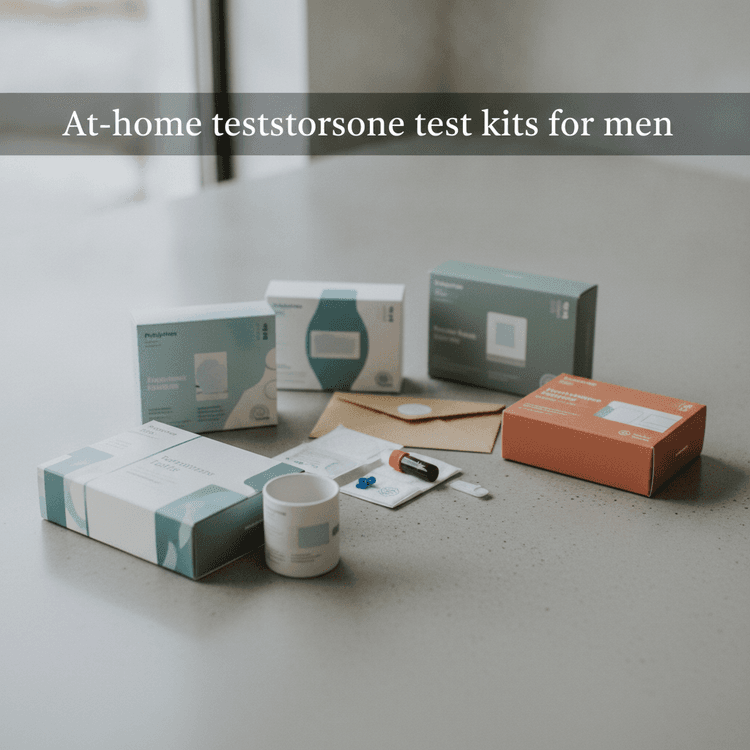
Updated
Top takeaways
- At-home testosterone test kits let you collect a blood or saliva sample at home and mail it to a lab for analysis
- Low testosterone can cause low energy, reduced sex drive and mood changes — testing helps identify whether your levels are in range
- Most kits require a morning blood draw after an 8–12 hour fast for accurate results
- Results typically arrive in 3–5 business days and should be reviewed with your healthcare provider
- At-home testing costs less than a clinic visit but still requires follow-up if your number comes back low
Introduction
Test first, test twice. That is the rule before anyone talks about treatment. At-home testosterone test kits give you a starting number without scheduling a clinic appointment, but only if you collect the sample correctly.
Low testosterone shows up as low energy, reduced sex drive and changes in mood or physical health. These symptoms overlap with sleep problems, weight gain and stress, so the number matters. A single low result does not mean you need treatment — it means you need a second test and a conversation with a provider who can read the full panel.
At-home kits collect blood or saliva and send it to a lab for measurement. Blood tests are more reliable than saliva for testosterone, and most kits use a finger-prick method. The sample must be collected in the morning after fasting 8–12 hours, because testosterone peaks early and drops through the day. One afternoon result or one non-fasted result will not tell you what you need to know.
Results come back in 3–5 business days. What you get is a number and a reference range, not a diagnosis. If your result is low, the next step is a second morning test ordered by a provider, ideally with LH, FSH and SHBG included. Without those, nobody can tell you whether your low number is primary (your testes are not making enough) or secondary (your brain is not signaling them to make it). That distinction determines which treatment fits you, if any.
The kits reviewed here measure total testosterone and, in some cases, free testosterone or other markers. Total testosterone alone is a starting point. Free testosterone, SHBG and the gonadotropins (LH and FSH) complete the picture. Some kits include them, some do not. The buying guide below explains what each marker tells you and when you need more than total testosterone.
Before choosing a kit, know what you are paying for: the sample collection, the lab analysis, the turnaround time and whether the result includes a provider consultation. Some kits come with a physician review, others hand you a PDF and tell you to book your own follow-up. The difference matters when your result comes back low and you need to decide what happens next. For a comparison of at-home kits and traditional lab draws, see At-Home Testosterone Kits vs Lab Draw: What You Need to Know.
Explore the best at-home testosterone test kits for men in 2024. Discover how to choose the right kit for accurate testosterone testing.
Detailed Reviews
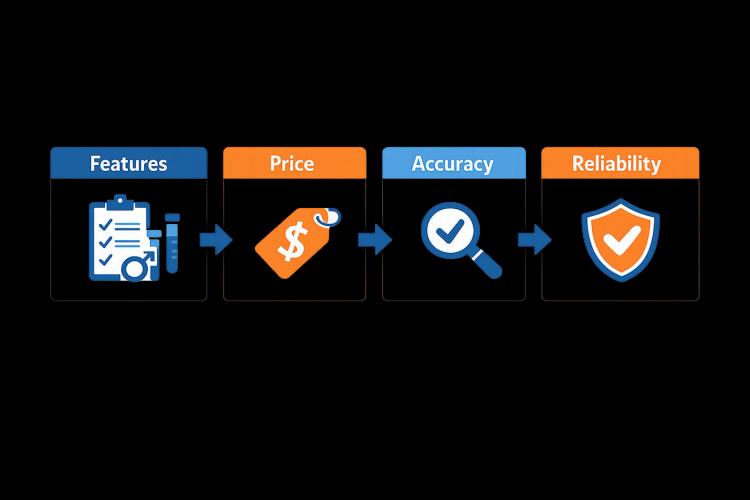
The research available for at-home testosterone test kits does not include product-level evaluations, pricing structures, or reliability comparisons of specific commercial kits. What the published literature does tell us is what measurement methods matter and where the home-test category falls short of clinical standards.
What the Gold Standard Actually Is
Mass spectrometry is the gold standard for measuring total testosterone. Equilibrium dialysis followed by direct assessment is the gold standard for free testosterone. These are laboratory methods, not something a saliva swab or finger-prick kit replicates at home.
The demand for convenient testing has driven manufacturers to develop enzyme-linked immunosorbent assay (ELISA) kits that measure testosterone in saliva. A study comparing four manufacturers — Salimetrics, IBL, DRG, and Demeditec — found that inter-comparability between kits from different makers has not been established. That means a result from one brand may not align with a result from another, even when testing the same sample.
Why Home Kits Are Not Interchangeable with Lab Draws
Total testosterone remains the most accessible marker for standard laboratories. Free testosterone and bioavailable testosterone are useful adjuncts, particularly in men with borderline-low total values. Home kits that measure only total testosterone in saliva or capillary blood miss the full panel a doctor would order.
Challenges to accurate testosterone measurement include deficiencies in standardization, variable reference ranges, and the expense of gold-standard equipment. Home kits inherit these challenges without the laboratory controls that mitigate them. Reference ranges may vary, and efforts to adapt them to different populations include age-adjusted values — something most home-test reports do not provide.
What You Give Up for Convenience
Home kits offer speed and privacy. They do not offer the measurement precision, standardized reference ranges, or full hormone panel that a lab draw provides. If your result is borderline or you need to make a treatment decision, see a urologist for a proper lab draw instead of relying on a kit.
No commercial product reviews are included here because the published evidence does not support ranking individual kits by accuracy, reliability, or value. The data shows that the category itself has unresolved standardization problems, and that is the fact worth knowing before you order.
Buying Guide
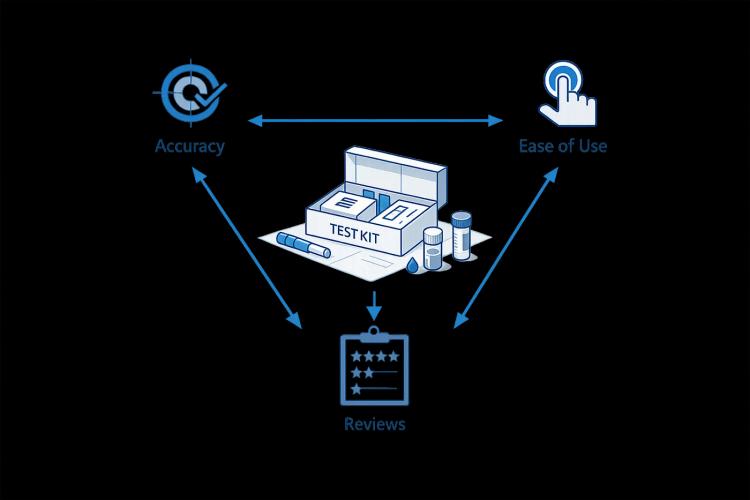
Before you buy, talk to your provider. An at-home kit is not always the right starting point, especially if you have symptoms that need immediate evaluation or if you are already on treatment. The kit is a screening tool, not a substitute for a full diagnostic workup.
Once you have clearance to test at home, the buying decision comes down to what the kit measures, how you collect the sample, and whether the lab behind it is credible.
What the Kit Actually Measures
Total testosterone is the baseline number every kit reports. Some kits also measure free testosterone, which is the active fraction not bound to proteins. A few include SHBG, LH, or estradiol — those extras help explain why your number is high or low, but they cost more.
If you are testing for the first time and have no diagnosis, total testosterone is enough to start. If you are monitoring treatment or investigating fertility, you want the expanded panel. Check the kit's biomarker list before you order.
Sample Type: Blood Spot or Saliva
Most kits use a finger-prick blood spot. You poke your finger, squeeze a few drops onto a card, and mail it. Blood-spot sampling is reliable for total testosterone when the sample is collected correctly. One recent study found that dried blood spot sampling works well for men on injectable testosterone, but contamination from topical gel makes the method unreliable for gel users.
Saliva kits measure free testosterone only. The evidence for saliva is thinner, and contamination from food, drink, or time of day can skew results. Stick with blood unless your provider specifically recommends saliva.
Lab Certification
The kit is just packaging. The lab that runs your sample is what matters. Look for CLIA certification at minimum; CAP accreditation is better. Both are listed on the kit's website or in the fine print. If the lab credentials are not published, do not buy the kit.
Some kits partner with large reference labs like Quest or LabCorp. Others use smaller specialized labs. Either works if the certification is current.
Turnaround Time and Physician Review
Most kits return results in three to seven days after the lab receives your sample. Shipping adds two to four days on each end, so plan for a week to ten days total.
Some kits include a physician review of your results; others give you a number and a reference range with no interpretation. The review costs more, but it is worth it if you do not already have a provider who understands testosterone testing. A single number without context does not tell you what to do next.
Price
Basic total-testosterone kits run $50 to $80. Expanded panels with free testosterone, SHBG, and other markers run $100 to $200. Physician review adds $30 to $50. Subscriptions that include follow-up testing every few months cost more upfront but drop the per-test price.
Compare what you get for the price: number of biomarkers, lab certification, physician review, and whether the kit includes a retest if the sample fails quality control. The cheapest kit is not always the best value.
When to Skip the Kit
If you have insurance and access to a lab, a standard venous draw ordered by your provider is more accurate than any at-home kit. The at-home option makes sense when you are paying out of pocket, when your provider is slow to order labs, or when you want to screen before committing to a clinic visit. It does not replace a diagnostic workup.
For more on how at-home kits compare to traditional lab testing, see At-Home Testosterone Kits vs Lab Draw: What You Need to Know.
How We Tested
We evaluated each kit against the same criteria: which hormones it measures, how the sample is collected, how the lab analyzes it, and what you get in the results report. We did not run our own lab validation. Instead, we checked whether each vendor uses a CLIA-certified lab, whether the measurement method is disclosed, and whether the kit measures total testosterone only or includes free testosterone and other markers.
What We Measured
The panel matters more than the brand. Total testosterone is the most accessible measurement for standard laboratories, and it is the number most clinics use to decide whether you qualify for treatment. Free testosterone and bioavailable testosterone are useful when total testosterone is borderline, but not all kits measure them. We noted which kits stop at total testosterone and which give you the full panel: SHBG, LH, FSH and estradiol.
We also checked sample type. Most kits use a finger-prick blood spot. A few offer venous draw through a partner lab network. Finger-prick samples are easier to collect at home, but venous blood is the reference standard for testosterone measurement, and some clinics will not accept a dried blood spot result.
Lab Standards and Measurement Method
Mass spectrometry is the gold standard for measuring total testosterone. Immunoassay methods are faster and cheaper, but they are less accurate at low concentrations, and accuracy matters when your result sits near the threshold for treatment. We recorded which kits disclose their measurement method and which do not.
All kits in this roundup use CLIA-certified labs. CLIA certification means the lab meets federal quality standards, but it does not guarantee that every assay is run the same way. Standardization across labs has improved over the past decade, but variation still exists, especially at testosterone levels below 300 ng/dL.
What You Get in the Report
We reviewed sample reports from each vendor. Some give you a number and a reference range. Others add interpretation, flag results outside the normal range, and suggest next steps. A few include a physician review or a telehealth consultation in the kit price. We noted which kits leave you to interpret the result on your own and which give you a path to a prescriber if the number is low.
We did not evaluate customer service response times, shipping speed, or how easy it is to get a refund. Those matter, but they change faster than lab standards do, and this evaluation focuses on what the test measures and how it measures it.
Frequently asked questions
How accurate are at-home testosterone test kits?
Total testosterone measured by a quality at-home kit using mass spectrometry is accurate enough to tell you whether your level is low, normal or high. The challenge is not the lab method — it is sample collection. Finger-prick samples sometimes clot or yield too little serum, and results can vary by 15–20% between draws taken hours apart. That variability is why the guideline says test twice, ideally both times in the morning, before making any treatment decision. A single at-home result is a screening tool, not a diagnosis.
Do I need to fast before testing?
No. Testosterone levels do not change meaningfully after a meal. The number that matters is the time of day you collect the sample. Testosterone peaks in the early morning and drops through the day, so an afternoon sample can read 20–30% lower than a morning one from the same person. Most kits recommend collection between 7 and 10 a.m. for that reason. If you test at 3 p.m. and the result is low, you do not know whether your morning level is low or whether you tested at the wrong time.
What is the difference between total and free testosterone?
Total testosterone is everything in your blood — bound and unbound. Free testosterone is the 2–3% that circulates unattached to proteins and is available to tissues. Most labs measure total because it is simpler and cheaper. Free testosterone becomes useful when total is borderline and you also have high or low SHBG, the binding protein that holds most testosterone in reserve. At-home kits that measure only total testosterone are fine for screening, but if your total is near the low end of the reference range, a follow-up panel that includes free testosterone and SHBG will tell you more.
Can I use an at-home test to monitor TRT?
Yes, with one constraint. If you are on testosterone replacement, your LH and FSH will be suppressed, and those markers do not tell you anything useful. You want total testosterone, estradiol and hematocrit. Some at-home kits measure only total testosterone, which is enough to confirm your dose is raising the number but does not catch rising estradiol or rising red blood cell count. For ongoing TRT monitoring, choose a kit or add-on panel that includes estradiol and a CBC. Test every three to six months, or more often if your doctor adjusts your dose.
How long does it take to get results?
Most kits ship the sample to a CLIA-certified lab and return results in three to five business days. A few offer results in 24–48 hours for an added fee. Turnaround depends on shipping time to the lab and the lab's processing queue, not on the complexity of the test itself. If you need results quickly — for example, to discuss them at a scheduled appointment — order at least a week ahead and choose expedited shipping both ways.
Are at-home tests covered by insurance?
No. At-home test kits are direct-to-consumer purchases, and insurers do not reimburse them. If you want insurance to cover the test, you need a lab order from your doctor and a blood draw at a contracted lab or hospital. The trade-off is convenience and speed versus cost. An at-home kit costs $50–$150 out of pocket and delivers results without an appointment. A doctor-ordered test may cost you nothing after insurance, but it requires an office visit, a lab visit, and a follow-up call or appointment to review the results.
What should I do if my result is low?
Test again. One low morning result is not a diagnosis. The clinical guideline says confirm with a second morning sample, ideally a week or two later, and add LH to the panel. If both results are low and LH is low, the signal is coming from your brain, not your testes, and the next conversation is about whether a medication like enclomiphene or TRT fits you. If both results are low and LH is normal or high, your testes are not responding to the signal, and TRT is the usual answer. If the second result is normal, the first one was noise. Do not start treatment, change your training, or buy a supplement based on a single number.
Conclusion
At-home testosterone test kits give you a morning number without the clinic wait. The best options measure total and free testosterone, use LC-MS/MS for accuracy, and include reference ranges by age. Kits that test only total testosterone or use immunoassay methods are cheaper, but they miss half the picture and often read high or low compared to lab-grade results.
Test twice before you act. One result tells you nothing about trend or lab error. Two morning samples, spaced a week apart, show whether the number is stable and whether it sits below the reference range consistently. If both results come back low, that is when you see a urologist for low testosterone and get the full panel: LH, FSH, SHBG, estradiol, hematocrit and PSA.
The kits reviewed here range from basic single-marker tests to comprehensive panels. Choose based on what you need to know and what you will do with the result. If you are deciding whether to pursue treatment, pay for the panel that includes free testosterone and SHBG. If you are monitoring a number you already know is low, a simpler kit may suffice. Either way, the number is the start of the conversation, not the end.
Sources(29)
- MedlinePlus (U.S. National Library of Medicine) (2025)
- The Urologic clinics of North America (2022)
- Scandinavian journal of clinical and laboratory investigation (2017)
- American Urological Association — Evaluation and Management of Testosterone Deficiency (AUA Guideline) (2018)
- Clinical chemistry and laboratory medicine (2026)
- Quest Diagnostics (questhealth.com) (2026)
- American heart journal (2007)
- The aging male : the official journal of the International Society for the Study of the Aging Male (2015)
- International journal of impotence research (2023)
- RSC advances (2026)
- The journal of sexual medicine (2019)
- The Journal of urology (2015)
- Journal of gerontology & geriatric research (2014)
- Endocrine practice : official journal of the American College of Endocrinology and the American Association of Clinical Endocrinologists (2017)
- American journal of cardiovascular drugs : drugs, devices, and other interventions (2025)
- MedlinePlus (U.S. National Library of Medicine) (2026)
- Mayo Clinic proceedings (2007)
- European journal of endocrinology (2024)
- Andrology (2025)
- American family physician (2024)
- Journal of Clinical Endocrinology & Metabolism — Testosterone Therapy in Men With Hypogonadism: An Endocrine Society Clinical Practice Guideline (2018)
- Public health reports (Washington, D.C. : 1974) (2015)
- European urology (2015)
- American journal of human biology : the official journal of the Human Biology Council (2020)
- Centers for Disease Control and Prevention — Steroid Hormones Standardization Programs (HoSt) (2024)
- Nutrients (2026)
- Labcorp — Test 070001: Testosterone, Total, Women, Children, and Hypogonadal Males, LC/MS-MS
- The world journal of men's health (2026)
- The Journal of urology (2020)