How to Boost Testosterone in Men: 7 Proven Strategies

Updated
Top takeaways
- Declining testosterone levels are linked to reduced muscle mass, fatigue, and reproductive challenges in men
- Low testosterone (low T) produces measurable symptoms after puberty, including low sex drive and erectile dysfunction
- Evidence-based strategies exist to support healthy testosterone levels without the risks associated with replacement therapy
- Testing is the starting point — two morning results tell you whether intervention is warranted
- The strategies below are graded by the quality of human trial data behind them
Introduction
Testosterone matters. When it declines, men notice: muscle shrinks, energy drops, and reproductive function suffers. The question is not whether testosterone is important — it is — but how to address low levels safely and effectively.
When discussing how to boost testosterone in men, it is crucial to differentiate between evidence-based strategies and those lacking scientific backing. In my work, I often encounter studies that headline impressive results but require careful scrutiny. For instance, a trial might enroll only a specific group, such as overweight men with secondary hypogonadism, which limits the applicability of its findings to the broader population.
The market sells many solutions. Some work. Most do not. This article covers seven strategies backed by human trials, with their trade-offs stated plainly. Before trying any of them, you need two morning testosterone measurements. One result is not a diagnosis. Two results, taken on separate days between 7 and 10 a.m., give you a baseline. Without that baseline, you are guessing.
For a deeper look at non-pharmaceutical approaches, see How to Raise Testosterone Naturally: Evidence-Based Methods.
The strategies below are not equal. Some require prescription monitoring. Some cost hundreds of dollars per month. Some preserve fertility; others do not. The evidence for each varies in quality, duration, and population studied. The goal here is to show you what the trials actually measured, what they did not measure, and what each option costs you in money, monitoring, and fertility.
Understanding the Problem: Low Testosterone Levels

Low testosterone shows up as reduced muscle mass, fatigue, and reproductive challenges. Those are the measurable outcomes that matter, not vague complaints about feeling off. The causes split into two groups: conditions affecting the testicles directly and conditions that interfere with the signals that tell them to produce testosterone.
What Causes Low Testosterone
Testicle problems include injury, benign tumors, and genetic conditions like Klinefelter syndrome. These conditions reduce the organ's ability to make testosterone, regardless of what the brain signals. Pituitary gland disorders disrupt the hormone signals that tell the testicles to produce testosterone in the first place. Chronic diseases — liver disease, kidney disease — create systemic metabolic problems that lower testosterone over time. Alcohol use disorder falls into the same category: long-term metabolic damage that shows up in the testosterone panel.
The difference between primary and secondary hypogonadism matters when you pick a treatment. Primary hypogonadism means the testicles cannot respond to normal signals. Secondary hypogonadism means the signals themselves are weak or absent. Treatments that work by boosting the signal — enclomiphene, clomiphene, hCG — do nothing for primary hypogonadism. TRT works for both, but it shuts down your own production entirely. That distinction is why starting TRT requires a full panel and a clear diagnosis, not a single morning number.
Why the Number Matters
Testosterone regulates muscle protein synthesis, red blood cell production, bone density, and sperm production. When the level drops, those processes slow. The fatigue is real, the muscle loss is measurable, and the reproductive impact is documented. The problem is not psychological, and the solution is not motivational. It is hormonal, and it requires either fixing the underlying cause or replacing the hormone.
What low testosterone does not cause: every vague complaint attributed to it by a clinic ad. If the symptom list includes brain fog, low motivation, poor sleep, and weight gain, you are reading marketing copy, not a diagnostic checklist. Those symptoms overlap with sleep apnea, depression, thyroid disease, and a dozen other conditions. Test first, test twice, then decide.
7 Proven Strategies to Boost Testosterone in Men
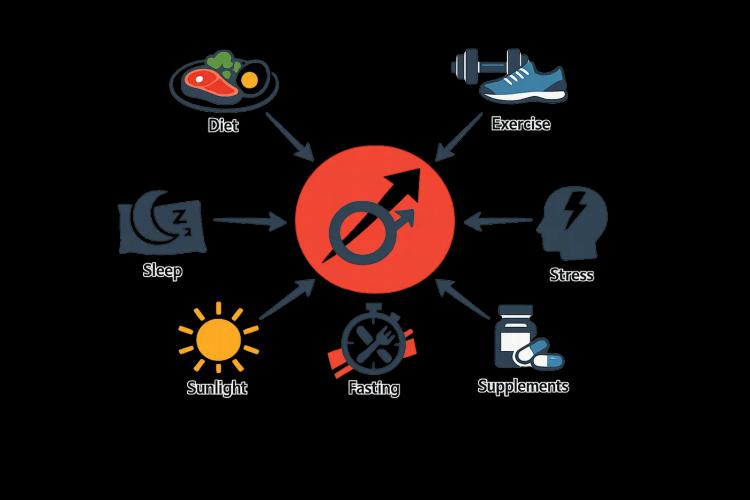
Most testosterone boosters sold online do not work. A systematic review of 52 studies on 27 different supplements found that nearly all fail to increase total testosterone. The exceptions are β-hydroxy β-methylbutyrate (HMB) and betaine, which showed benefit in male athletes only. That leaves seven evidence-based strategies, split between prescription options and lifestyle changes that actually move the number.
Strategy 1: Testosterone Replacement Therapy (TRT)
TRT raises testosterone reliably. It also shuts down your own production, and most men stay on it. The treatment comes in multiple forms: injections, gels, patches, pellets. A UK study tracked seven different delivery methods and found all raised testosterone when dosed correctly. The choice depends on your tolerance for injections, cost and insurance coverage.
TRT requires monitoring. The FDA label mandates hematocrit checks because testosterone thickens blood. You also need PSA screening if you are over 40. Most telehealth clinics include these labs in the membership fee, but verify what each clinic covers before signing up.
Strategy 2: Clomiphene Citrate (Off-Label)
Clomiphene citrate raises your own testosterone by blocking estrogen receptors in the brain, which signals the pituitary to produce more LH and FSH. Unlike TRT, it usually preserves sperm production. A recent study confirmed clomiphene as monotherapy for men with testosterone deficiency who want to maintain testicular function.
Clomiphene is off-label for men. The FDA approved it for female infertility, so insurance often denies coverage. Expect to pay out of pocket, and expect monitoring similar to TRT: testosterone, estradiol, LH and FSH every three to six months.
Strategy 3: Weight Loss (If Overweight)
Excess body fat lowers testosterone through aromatization—testosterone converts to estradiol in fat tissue. Losing weight reverses this. The effect is strongest in men with obesity and secondary hypogonadism, where the problem starts in the brain, not the testes.
No supplement or drug matches the testosterone increase from dropping 10 to 15 percent of body weight if you are overweight. It is the free option, and it improves insulin sensitivity and cardiovascular risk at the same time.
Most testosterone boosters fail to increase total testosterone; the exceptions are HMB and betaine, effective only in male athletes.
Strategy 4: Resistance Training
Heavy compound lifts—squats, deadlifts, presses—trigger acute testosterone spikes during and after training. The effect is temporary, but chronic resistance training over months raises baseline testosterone modestly in untrained men. The benefit plateaus once you are trained.
Training also builds muscle mass, which improves insulin sensitivity and body composition. Both matter more for metabolic health than the testosterone bump itself.
Strategy 5: Sleep Optimization
Testosterone production peaks during REM sleep. Chronic sleep restriction—less than five hours per night—drops testosterone by 10 to 15 percent in healthy young men. Fixing sleep apnea, if present, raises it back.
Test for sleep apnea if you snore, wake unrefreshed or have a neck circumference over 17 inches. CPAP therapy improves testosterone in men with obstructive sleep apnea and low testosterone at baseline.
Strategy 6: Limit Alcohol
Chronic heavy drinking suppresses the hypothalamic-pituitary-gonadal axis and damages Leydig cells in the testes. Moderate drinking—one to two drinks per day—shows inconsistent effects in the research. Heavy drinking consistently lowers testosterone.
If your total testosterone is low and you drink daily, cutting alcohol for three months and retesting is worth doing before starting medication.
Strategy 7: Zinc and Magnesium (If Deficient)
Zinc and magnesium supplementation raises testosterone only in men with documented deficiency or in athletes with high sweat losses. If you are not deficient, adding more does nothing. The systematic review found mixed results for zinc/magnesium supplements across five studies, with benefit limited to specific populations.
Test your zinc and magnesium levels before supplementing. If you are deficient, correct the deficiency. If you are not, save your money.
| Strategy | Evidence Strength | Fertility Impact | Cost |
|---|---|---|---|
| TRT | High | Suppresses | $$–$$$ |
| Clomiphene | Moderate | Preserves | $$–$$$ |
| Weight loss | High | Neutral | Free |
| Resistance training | Moderate | Neutral | Free–$ |
| Sleep optimization | Moderate | Neutral | Free–$$ |
| Limit alcohol | Moderate | Improves | Free |
| Zinc/magnesium | Low (if not deficient) | Neutral | $ |
Tips and Tricks for Success
Before spending money on supplements or treatments, test your testosterone. A single morning result is not a diagnosis. Test twice, in the morning, and ask for the full panel: total testosterone, free testosterone, LH, FSH, SHBG, estradiol, hematocrit and PSA. Without that panel, nobody can tell you whether a lifestyle change, a supplement or a prescription makes sense for you.
Track what actually changes the number
If you drop twenty pounds, fix your sleep apnea or quit drinking, retest at the three-month mark. The number that matters is your lab result, not how you feel or what the scale says. If your total testosterone moved from 280 ng/dL to 420 ng/dL, the intervention worked. If it stayed at 290 ng/dL, it didn't, and you know not to waste time repeating it.
Evaluate supplements by the human evidence, not the label
Most testosterone-boosting supplements sold online have no human trial data. A 2019 review of the highest-rated T-boosters on Amazon found limited human studies and no definitive findings of efficacy. The ingredients that did show effects in trials—like vitamin D in deficient men—work only when you are deficient. If your vitamin D level is already normal, adding more does nothing to testosterone.
When a supplement lists fadogia, tribulus or ashwagandha, ask for the trial: how many men, how long, what did their testosterone do. If the answer is a rat study or a twelve-person pilot, there is nothing to recommend. The FDA-approved therapies have decades of data; the supplement does not.
Understand what testosterone therapy actually requires
If lifestyle changes and weight loss do not move your number, and your symptoms persist, testosterone therapy is the next conversation. It is not a supplement you add to your routine. It is a prescription that shuts down your own production, requires regular monitoring of hematocrit and PSA, and most men stay on it. The Endocrine Society guideline says testosterone therapy should not be routinely prescribed to all men over 65 with low testosterone. Instead, it should be offered on an individualized basis after discussing the potential risks and benefits.
Before signing up with a telehealth clinic, ask what the monitoring schedule is, what it costs per month, and whether you can take the prescription to your local pharmacy. The cheapest option is often not the one that leads with the lowest price.
Conclusion
Boosting testosterone in men requires understanding what the evidence actually supports and what it doesn't. Weight loss, resistance training, adequate sleep, and vitamin D correction show measurable effects in controlled trials. Supplements marketed for testosterone often lack human data, and the few that have been studied show modest results in narrow populations. Testosterone therapy itself delivers reliable increases in the number, along with improvements in mood, sexual function, and muscle strength, but it comes with monitoring requirements and trade-offs in fertility that most men stay on long-term.
In my work evaluating these studies, I often encounter trials that headline impressive results but require careful scrutiny. A study might enroll only overweight men with secondary hypogonadism, which limits how broadly its findings apply. The regulatory landscape adds another layer: the FDA label for testosterone therapies mandates hematocrit monitoring, a detail frequently omitted in clinic marketing materials. This gap between what the label requires and what sellers emphasize underscores the importance of consulting primary sources before committing to treatment.
Before choosing any option, test twice in the morning and get a full panel: total and free testosterone, LH, FSH, SHBG, estradiol, hematocrit, and PSA. Two results separated by weeks tell you whether the number is stable or variable, and the supporting labs tell you whether the cause is primary or secondary. One morning result is not a diagnosis, and no treatment decision should rest on it.
Proactive health management means knowing the cost in money, monitoring, and fertility for each choice. Free options—losing weight, fixing sleep apnea, cutting alcohol—work for some men and cost nothing beyond effort. Prescription options work more reliably but require regular labs and, in the case of TRT, acceptance that most men do not come off. The right path depends on your labs, your priorities, and what you're willing to monitor. For a detailed look at evidence-based lifestyle strategies, see how to raise testosterone naturally.