Where to Get Testosterone: Clinic vs Online TRT Options

Updated
Top takeaways
- Testosterone replacement therapy (TRT) is FDA-approved only for classic hypogonadism, though off-label use has expanded prescriptions significantly
- Two main options exist: clinic-based TRT with in-person visits and online telehealth providers delivering treatment remotely
- Pricing structures differ between models — online providers often advertise monthly medication costs separately from labs and consultation fees
- The choice between clinic and online TRT depends on your testing needs, monitoring preferences, insurance coverage, and comfort with telehealth
- Both pathways require a prescription and proper diagnosis before treatment begins
Introduction
Testosterone replacement therapy is a treatment for male hypogonadism — the medical term for clinically low testosterone production. The FDA approves TRT only for this specific condition, though the number of prescriptions has grown substantially in recent years. If you are considering treatment, you face a practical question before any medical decision: where to get testosterone that is legal, monitored, and appropriate for your situation.
You have two primary pathways. The first is a traditional clinic: you visit a doctor's office, get labs drawn at a local facility, return for a consultation, and pick up a prescription at a pharmacy or receive injections in the office. The second is an online TRT provider: you order a test kit or visit a lab near you, consult with a clinician by video or phone, and receive medication by mail if you qualify. Both models require a prescription. Neither allows you to skip diagnosis or monitoring.
The advertised monthly price from online telehealth clinics often covers the medication itself, but if you check the terms page, you will find that labs and the first consultation are billed separately. This is standard practice and worth knowing before you compare headline numbers. Similarly, the FDA label for testosterone treatments lists hematocrit monitoring as a necessary component — a detail that marketing materials from many clinics do not emphasize. These gaps between what is advertised and what is required shape the real cost and commitment of each option.
This comparison walks through how clinic-based and online TRT differ in testing, prescribing, monitoring, cost, and convenience. It covers what each model includes, what it bills separately, and who fits each pathway. The goal is to give you the numbers and the trade-offs before you sign up. For context on alternative treatments that may preserve fertility, see Clomid for Men: How It Raises Testosterone and What It Costs You.
Explore the differences between clinic and online TRT options for testosterone replacement therapy.
Overview of Clinic-Based TRT
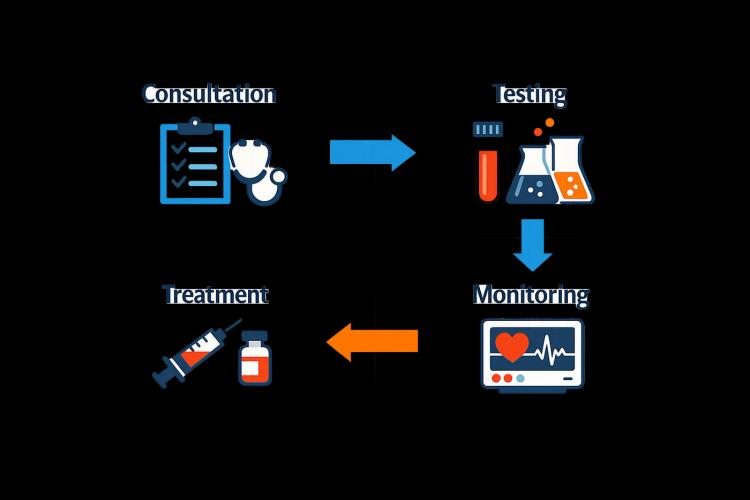
Clinic-based testosterone therapy means you walk into a doctor's office for diagnosis, prescription and monitoring. Currently, the majority of testosterone prescriptions in the United States and Canada are written by primary care physicians. You may also see an endocrinologist, urologist or men's health specialist depending on your insurance and referral network.
The process starts with a physical exam and at least two morning blood draws taken on separate days. Your doctor orders a full panel: total and free testosterone, SHBG, LH, FSH, estradiol, hematocrit and PSA. If both results show low testosterone and symptoms line up, you receive a prescription for one of the FDA-approved formulations.
Where to Get Testosterone: Clinic Formulation Options
Available testosterone therapy formulations include buccal tablets, intramuscular injections, transdermal gels, intranasal gel, subcutaneous injections, oral capsules and subdermal pellets. Your doctor chooses based on your preference, insurance coverage and how well you tolerate the delivery method. Injections are the cheapest and most reliable. Gels offer daily dosing with steadier levels but cost more and carry transfer risk to others. Pellets last three to six months but require an in-office procedure.
Clinic visits continue every three to six months for follow-up labs and dose adjustments. The FDA label for testosterone treatments lists hematocrit monitoring as a necessary component, along with PSA in men over 40. Your doctor tracks these numbers and adjusts or stops therapy if red blood cell count climbs too high or PSA rises.
What Clinic-Based Care Includes
You get face-to-face evaluation, a full diagnostic workup and a physician who knows your medical history. If you have sleep apnea, cardiovascular risk factors or a history of prostate issues, an in-person doctor can coordinate care with your other specialists. The clinic handles prior authorization with your insurance, though many insurers still deny coverage or require high copays.
Testosterone therapy prescriptions are predominantly for hypogonadism, but many are for less specific conditions. A clinic-based physician is more likely to investigate secondary causes — obesity, sleep disorders, medication side effects — before writing a prescription. That takes time and multiple visits, which is the trade-off for thoroughness.
For a deeper look at one alternative that preserves fertility, see Clomid for Men: How It Raises Testosterone and What It Costs You.
Overview of Online TRT Options
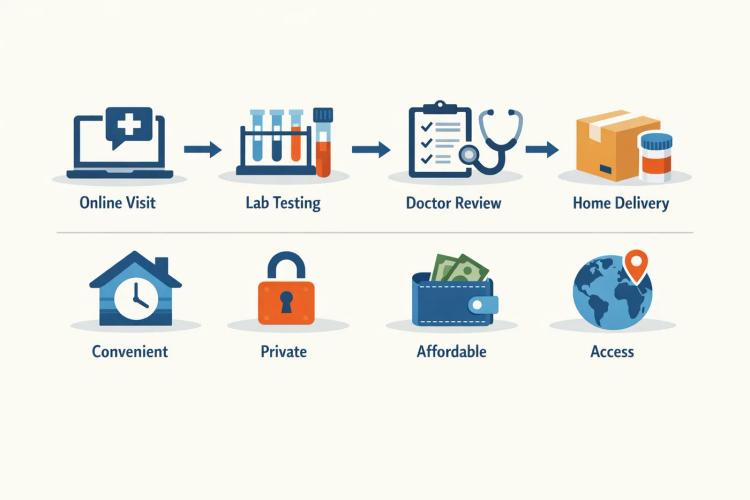
Online TRT providers operate through telehealth platforms. You fill out a medical questionnaire, upload or order labs, and consult with a clinician by video or phone. If approved, the prescription ships to your door. The entire process runs remotely — no waiting room, no in-person visits unless you choose to add them.
Most online platforms require a testosterone test before prescribing. Some sell at-home test kits that let you collect a blood or saliva sample and mail it to a lab. Others accept recent results from a local lab if they meet the platform's criteria. Either way, you need a number on file before a prescriber will write for testosterone.
How the Process Works
You create an account, answer health questions, and submit payment for the initial consultation. The platform reviews your labs and medical history, then schedules a call or video visit with a physician or nurse practitioner. If you qualify, the prescriber writes a prescription and the platform ships the medication — typically testosterone cypionate or enanthate for injection, sometimes gels or oral testosterone options.
Follow-up labs happen at intervals the platform sets, usually every three to six months. You order the test through the platform or use a local lab, upload the results, and the prescriber adjusts your dose if needed. Refills ship automatically on a subscription schedule unless you pause or cancel.
What Online Platforms Offer
Online providers stock the same FDA-approved testosterone formulations that clinics use. Injections dominate the online market because they cost less and dose more predictably than gels. A few platforms offer topical options, but the monthly price climbs and insurance rarely covers telehealth prescriptions.
Some platforms include ancillary medications — hCG to preserve fertility, anastrozole to manage estradiol, or enclomiphene as an alternative to full TRT. Others sell only testosterone and refer you elsewhere for add-ons. The included services vary: some bundle labs and consultations into one monthly fee, others bill them separately.
Advantages of the Online Route
Convenience leads the list. No commute, no waiting room, no scheduling around office hours. You handle everything from a phone or laptop, and the medication arrives by mail. For men in rural areas or states with few specialized clinics, online access removes a geographic barrier.
Speed comes next. Many platforms promise a prescription decision within 48 hours of your consult. Shipping takes two to five business days. Compare that to the weeks it can take to book a first appointment at a busy urology or endocrinology practice.
Price transparency is better online than in most brick-and-mortar settings. Platforms list their monthly fees, lab costs, and consultation charges up front. You know what you will pay before you start, and there are no surprise facility fees or billing codes to decode later.
Limitations to Keep in Mind
Online providers rely on asynchronous communication. If you have a question between visits, you message the platform and wait for a reply. That works for routine issues, but it is not the same as walking into a clinic and talking to someone face-to-face.
Lab monitoring happens on your schedule, which means it is easy to skip. Platforms send reminders, but enforcement is light. Miss a follow-up test and your prescription may auto-renew anyway. That creates gaps in oversight — hematocrit, PSA, and estradiol can drift out of range without anyone noticing until symptoms appear.
Some platforms use compounded testosterone instead of brand-name or generic FDA-approved products. Compounded formulations cost less, but they are not subject to the same batch testing and quality standards. If consistency matters to you, confirm what you are getting before you sign up.
Feature Comparison: Clinic vs Online TRT
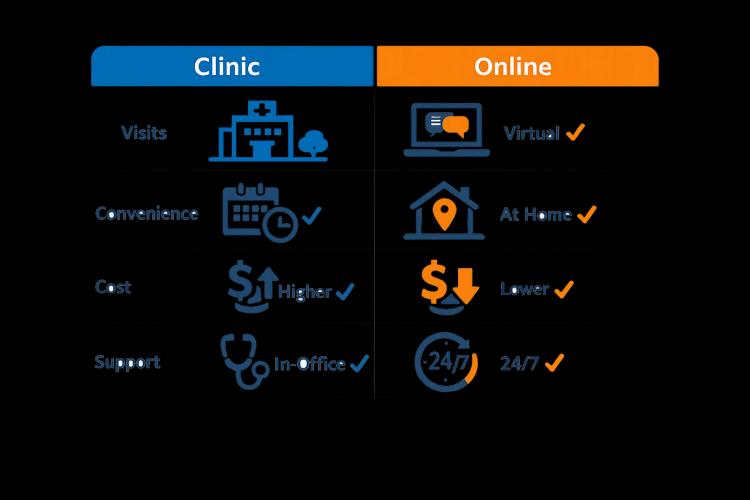
The advertised monthly price from online telehealth clinics often covers the medication itself, but if you delve into the terms page, you'll find that labs and the first consultation are billed separately. This is a common practice that can catch many off guard if they're not paying attention to the fine print.
Where to Get Testosterone: Core Service Differences
Clinic-based providers typically offer in-person consultations with a physician who reviews your full medical history, performs a physical exam, and orders comprehensive baseline labs. Online TRT options skip the physical exam and rely on questionnaires, video calls, and labs you complete at a local draw site or using a home kit.
Both routes can prescribe the same FDA-approved testosterone formulations: intramuscular injections, transdermal gels, subcutaneous injections, buccal tablets, intranasal gel, oral capsules, and subdermal pellets. The FDA label for testosterone treatments lists hematocrit monitoring as a necessary component, a detail that is often glossed over in the marketing materials of many clinics. Clinic providers usually handle this monitoring in-house. Online providers send you to a lab every three to six months and review the results remotely.
| Feature | Clinic-Based TRT | Online TRT |
|---|---|---|
| Initial consultation | In-person visit, physical exam | Video call or questionnaire |
| Lab testing | Drawn at clinic or affiliated lab | Local lab or home kit |
| Prescription access | Same-day or next-day | 1–3 days after approval |
| Monitoring frequency | Every 3–6 months in-person | Every 3–6 months, remote review |
| Formulation options | All FDA-approved types | Usually injections and gels |
| Follow-up visits | In-person or telehealth | Telehealth only |
Testing and Prescription Protocols
Clinic providers order a full testosterone panel before prescribing: total testosterone, free testosterone, SHBG, LH, FSH, estradiol, hematocrit, and PSA. Many also check thyroid and metabolic markers. Online clinics order the same panel but may not include PSA or thyroid unless you request it or meet age criteria.
Testosterone replacement therapy is approved by the FDA only for classic hypogonadism. Both clinic and online providers prescribe off-label for borderline-low results or symptoms without a clear diagnosis. The difference is documentation: clinic providers write detailed notes; online providers rely on templated charts.
Monitoring and Follow-Up Structure
Clinic-based care includes scheduled follow-up visits where a provider checks your blood pressure, reviews symptoms, and adjusts dosing based on lab trends. Online providers send you lab orders, review results asynchronously, and message dosing changes. If you need an in-person exam for a side effect, the online clinic refers you to a local provider.
Hematocrit monitoring matters. Elevated hematocrit increases stroke risk, and the FDA label requires regular checks. Clinic providers can draw blood and adjust treatment the same day. Online providers send you to a lab, review results remotely, and may delay adjustments by days or weeks.
For more on how different treatment options affect your monitoring burden, see Enclomiphene vs hCG: Compare Two Options for Testosterone Production.
Medication Delivery and Formulation Access
Clinic-based providers write prescriptions you fill at a local pharmacy or dispense medication directly. Online clinics ship medication to your door, usually from a compounding pharmacy. Compounded testosterone is not FDA-approved but is legal under state pharmacy boards. Some online clinics offer brand-name injectables; others use only compounded versions.
If you want a specific formulation—subcutaneous versus intramuscular injections, for example—clinic providers can prescribe either. Online clinics typically default to one protocol and charge extra to switch.
Pricing Comparison: Clinic vs Online TRT
The advertised monthly price from online telehealth clinics often covers the medication itself, but if you delve into the terms page, you'll find that labs and the first consultation are billed separately. This is a common practice that can catch many off guard if they're not paying attention to the fine print.
What Clinic-Based TRT Actually Costs You
Local clinics typically bundle the consultation, lab work, and medication into a single visit charge or monthly program fee. Expect an initial consultation between $150 and $300, followed by lab panels every three to six months at $100 to $250 per draw. Medication costs vary by formulation—injectable testosterone cypionate runs $30 to $80 per month when purchased through the clinic pharmacy, while compounded creams or pellets can reach $200 to $400 monthly.
Monitoring is usually billed separately. Hematocrit checks, lipid panels, and PSA tests add $50 to $150 per quarter. Some clinics roll these into a flat monthly membership, others itemize each service. Ask what the total annual cost looks like, including every required lab and follow-up visit, before signing up.
What Online TRT Providers Charge
Online platforms advertise monthly fees between $99 and $199, which typically cover the prescription and medication delivery. The initial consultation fee—often $50 to $150—appears as a separate line item. Required lab work is either billed directly to you by a third-party lab network or added to your first month's invoice at $150 to $300.
Some telehealth services include quarterly follow-up consultations in the monthly fee; others charge $30 to $75 per check-in. Shipping for injectable testosterone is usually free, but expedited delivery or specialty formulations like troches or nasal gels may add $20 to $50 per shipment. Read the membership terms to see which services are bundled and which are billed separately.
| Cost Component | Clinic-Based TRT | Online TRT |
|---|---|---|
| Initial consultation | $150–$300 | $50–$150 |
| Monthly medication | $30–$400 | Included in $99–$199 fee |
| Lab panels (quarterly) | $100–$250 | $150–$300 (billed separately or first month) |
| Follow-up visits | Bundled or $75–$150 each | Bundled or $30–$75 each |
| Monitoring labs | $50–$150 per quarter | Often billed separately |
Hidden Fees and Billing Surprises
Both clinic and online models can carry hidden costs. Clinic-based programs may charge facility fees, require you to purchase medication through their in-house pharmacy at marked-up prices, or bill for "care coordination" that amounts to a nurse sending your lab order. Online providers may auto-renew monthly subscriptions, charge restocking fees if you pause treatment, or require you to pay out-of-pocket for any lab your insurance won't cover.
Before committing, ask for a written breakdown of every charge you'll see in the first year. Include the initial visit, all required labs, medication refills, follow-up consultations, and any shipping or handling fees. The cheapest advertised price is rarely the total you'll pay.
Pros and Cons of Each Option
Clinic-Based TRT: Advantages
In-person clinics offer face-to-face evaluation. You sit across from a physician who can examine you, review your history, and order labs that day. If your insurance covers the visit and the prescription, the out-of-pocket cost can be lower than online options. The physician can also coordinate with your primary care provider, so your TRT monitoring appears in one medical record.
Clinics that specialize in men's health often stock multiple formulations — injections, gels, pellets — and can switch you between them without waiting for a new prescription to ship. If you have a reaction or your hematocrit climbs, you walk back in for a same-day adjustment.
Clinic-Based TRT: Disadvantages
Appointments mean time off work, travel, and waiting rooms. If the clinic is not in your insurance network, each visit and each lab panel is billed at the clinic's rate, and those rates vary widely. Some men's health clinics operate on a cash-pay model, and monthly costs can exceed online subscriptions once you add consultation fees and lab fees.
Not every city has a clinic that specializes in testosterone therapy. If you live outside a metro area, the nearest qualified provider may be an hour away, and follow-up visits every three to six months add up.
Online TRT: Advantages
Online providers eliminate the commute. You complete a health questionnaire, upload recent labs or order a kit, and consult with a clinician by video or phone. If you qualify, the prescription ships to your door. The advertised monthly price is often lower than a cash-pay clinic visit, and some platforms include the medication in that price.
For men who travel frequently or work irregular hours, asynchronous messaging with a provider is more practical than scheduling in-person appointments. The convenience is the selling point.
Online TRT: Disadvantages
The advertised monthly price often covers the medication itself, but if you read the terms page, labs and the first consultation are billed separately. Some platforms charge for follow-up labs, others bundle them; you need to compare the total annual cost, not just the subscription line.
Online clinics rely on self-reported symptoms and uploaded labs. They cannot perform a physical exam, and they may not have access to your full medical history. If a contraindication exists — elevated hematocrit, untreated sleep apnea, a history of prostate cancer — it is your responsibility to disclose it. The physician should discuss with the patient the potential benefits and risks of TRT, but a ten-minute video call is not the same depth of conversation you get in a specialist's office.
Some online platforms prescribe compounded testosterone or off-label combinations. Compounded drugs are not FDA-approved; they are mixed by a pharmacy to a physician's order. The quality control is different, and insurance rarely covers them. The balance of musculoskeletal benefits and harms of TRT remains uncertain, and choosing a treatment without in-person monitoring adds a layer of risk.
Weighing the Trade-Offs
If cost and convenience are your top priorities, and you have recent labs and no complex medical history, an online provider may fit. If you value in-person oversight, insurance coverage, or access to multiple formulations without shipping delays, a local clinic is the safer bet. Neither option is risk-free, and both require you to stay on top of monitoring. The choice depends on what you are willing to manage yourself and what you need a physician to manage for you.
Who Should Choose What?
Choosing between clinic-based and online TRT depends on what you need most: convenience, cost control, or hands-on medical oversight. Neither option is universally better. The right one fits your health profile, your schedule, and how much you want to manage yourself.
When a Local Clinic Fits
You live near a clinic that accepts your insurance and you want someone else to handle the logistics. You have complex health conditions—cardiovascular disease, sleep apnea, prostate concerns—that need regular in-person evaluation. You prefer face-to-face consultations and the ability to walk in when something feels wrong. You want a provider who coordinates with your primary care physician and sees your full chart. You are willing to trade convenience for the structure of scheduled visits and integrated care.
Local clinics work best when insurance covers most of the cost and when your health picture requires more than a quarterly lab review. If monitoring means more than checking a number on a portal, a clinic gives you that.
When Online TRT Fits
You have straightforward low testosterone—two morning results below 300 ng/dL, no major comorbidities, and you respond well to standard protocols. You live far from a specialist or your work schedule makes regular clinic visits difficult. You are comfortable reviewing your own labs, asking specific questions by message, and following a protocol without weekly check-ins. You want transparent pricing and you are willing to pay out-of-pocket to avoid insurance prior authorizations and formulary restrictions.
Online providers work when you value speed, price clarity, and the ability to handle routine monitoring yourself. They do not work if you need your TRT provider to also manage your blood pressure, your diabetes, or your prostate—most online platforms treat testosterone only and refer you back to local care for everything else.
When Neither Fits Yet
You have not tested twice in the morning. You do not know your LH, FSH, or SHBG. You have symptoms but no confirmed diagnosis. In that case, start with testing—either through your primary care physician or a local lab—before signing up anywhere. A single result, an afternoon draw, or a test ordered by a clinic that also sells the treatment does not give you the full picture. Test first, test twice, then choose a provider.
If your goal is fertility preservation, most online platforms offer enclomiphene or hCG, but the trials for those options are smaller and the monitoring is different. Clinic-based care gives you more flexibility to adjust protocols mid-treatment when fertility is part of the plan.
Final Verdict
Neither option wins across the board. Clinic-based TRT costs more and requires appointments you show up for. Online TRT costs less, ships to your door, and runs on your schedule. The trade-off is how much oversight you get and who owns the monitoring plan.
If you need hands-on care — someone who checks your injection technique, answers questions in real time, or coordinates with another specialist — a local clinic gives you that. If you travel frequently, work irregular hours, or live far from a men's health provider, online TRT removes the friction. Both can prescribe the same medications and order the same labs.
The advertised monthly price from online telehealth clinics often covers the medication itself, but if you delve into the terms page, you'll find that labs and the first consultation are billed separately. Add those line items before you compare. The FDA label for testosterone treatments lists hematocrit monitoring as a necessary component, and not every online provider builds that into the membership automatically — ask what the monitoring schedule includes and what it costs you.
Test first, test twice. A single morning result is not a diagnosis. Get two fasting morning testosterone levels, plus LH, FSH, and a hematocrit baseline, before you choose a provider. If the first clinic or online service tries to skip that step, find one that doesn't.
The short answer: choose based on what you value more — convenience and cost, or in-person access and integrated follow-up. Both can work. Neither is risk-free. The one that fits you is the one whose monitoring plan you will actually follow.
Related reading
Injection Sites and Technique: Where to Inject Testosterone Safely
Sources(23)
- The Journal of clinical endocrinology and metabolism (2026)
- The Journal of clinical endocrinology and metabolism (2018)
- The Journal of urology (2020)
- U.S. Food and Drug Administration — Drug Safety Communication: FDA cautions about using testosterone products for low testosterone due to aging; requires labeling change to inform of possible increased risk of heart attack and stroke with use (2015)
- JAMA (2017)
- American Urological Association — Evaluation and Management of Testosterone Deficiency (AUA Guideline) (2018)
- The journal of sexual medicine (2022)
- International journal of pharmaceutical compounding (2015)
- The world journal of men's health (2026)
- Journal of Clinical Endocrinology & Metabolism — Testosterone Therapy in Men With Hypogonadism: An Endocrine Society Clinical Practice Guideline (2018)
- The Journal of urology (2015)
- F&S reviews (2020)
- Sexual medicine reviews (2017)
- The aging male : the official journal of the International Society for the Study of the Aging Male (2015)
- The Cochrane database of systematic reviews (2024)
- American family physician (2024)
- Andrology (2025)
- European journal of endocrinology (2024)
- Public health reports (Washington, D.C. : 1974) (2015)
- Health technology assessment (Winchester, England) (2024)
- The journal of sexual medicine (2021)
- Translational andrology and urology (2025)
- International journal of general medicine (2022)