Testosterone Replacement Clinics: Finding the Right TRT Clinic

Updated
Top takeaways
- Testosterone replacement therapy (TRT) is a commonly utilized treatment for male hypogonadism, but choosing the right testosterone replacement clinics determines whether you get appropriate monitoring or just a prescription.
- TRT carries contraindications, adverse effects, and a lack of long-term safety data — meaning the clinic's monitoring protocol matters as much as the drug itself.
- Finding the right TRT clinic means evaluating how they test, what they monitor, what they cost, and whether they prioritize your fertility and long-term health over monthly revenue.
- The clinic you choose sets the baseline for everything: the labs you get before starting, the follow-up schedule, the cost structure, and whether you understand the trade-offs before you sign.
Introduction
Finding the right TRT clinic starts with understanding what separates clinics that test properly from those that prescribe after one questionnaire. Testosterone replacement therapy is a commonly utilized treatment for male hypogonadism. It raises total and free testosterone reliably when the diagnosis is correct and the monitoring is consistent. The problem is not whether TRT works — it does — but whether the clinic offering it will test you properly, monitor you closely, and tell you what it costs in money, fertility, and time before you start.
Every TRT clinic offers some version of the same drug, but the quality of care varies widely. Some require two fasting morning testosterone results, a full hormone panel, and a clear contraindication screen before prescribing. Others approve you after one questionnaire and a single blood draw. The difference is not cosmetic. TRT is limited by contraindications, adverse effects, and a lack of long-term safety data, which means patients receiving this therapy require close monitoring — not just at the start, but for as long as they stay on it.
The clinic you choose determines whether you get that monitoring or just a standing prescription. It determines whether you know your LH, FSH, hematocrit, and PSA before starting, or find out about them only when something goes wrong. It determines whether alternatives like Clomid are discussed as options that preserve fertility, or whether TRT is presented as the only solution. And it determines what you pay — not just the advertised monthly fee, but the hidden costs of labs, follow-ups, and add-ons that appear after you sign up.
This guide walks through the key factors to evaluate when finding the right TRT clinic: what to ask, what to check, and what to know before you commit.
Problem Statement
Most men searching for testosterone replacement therapy run into the same three obstacles: clinics that skip the full panel, clinics that sell one protocol regardless of your labs, and pricing structures that hide the real monthly cost until after you sign up.
The first problem is diagnostic. A single total testosterone result tells you almost nothing about whether TRT fits you. You need free testosterone, SHBG, LH, and often FSH to see whether your testes are the problem or your pituitary is. Many telehealth platforms order one morning draw, see a number below 300 ng/dL, and route you straight to a prescription. That skips the question of whether Clomid for men or another fertility-preserving option would work for you.
The second problem is protocol lock-in. Some clinics offer only injectable testosterone cypionate. Others push enclomiphene or hCG regardless of your LH level. If your labs say one thing and the clinic's menu says another, you either accept the mismatch or start over somewhere else. That costs time and another round of bloodwork.
The Hidden Cost Problem
The third obstacle is price transparency. A clinic advertises $99 per month, but that number rarely includes labs, follow-up panels, or the medication itself. By the time you add monitoring bloodwork every three to six months, shipping, and the actual drug, the real monthly average lands between $150 and $400. Nobody selling the service will tell you the all-in number up front.
Another friction point: regulatory status. Compounded enclomiphene, compounded hCG, and off-label clomiphene are common in telehealth TRT, but they carry different legal and insurance positions than FDA-approved testosterone products. Some men discover mid-treatment that their insurance won't cover a compounded drug or that the pharmacy changed formulations without notice. Knowing which drugs are approved, which are compounded, and what that means for your access matters before you start.
Finally, there is the follow-up gap. Testosterone therapy requires ongoing monitoring: hematocrit, PSA, estradiol, and symptom tracking. Clinics that sell you the first prescription but leave follow-up vague create a compliance problem. You need a clear schedule for labs, a process for dose adjustments, and a clinician who will actually review your results. Without that structure, you are managing a chronic treatment on your own.
How Do You Find the Right TRT Clinic?
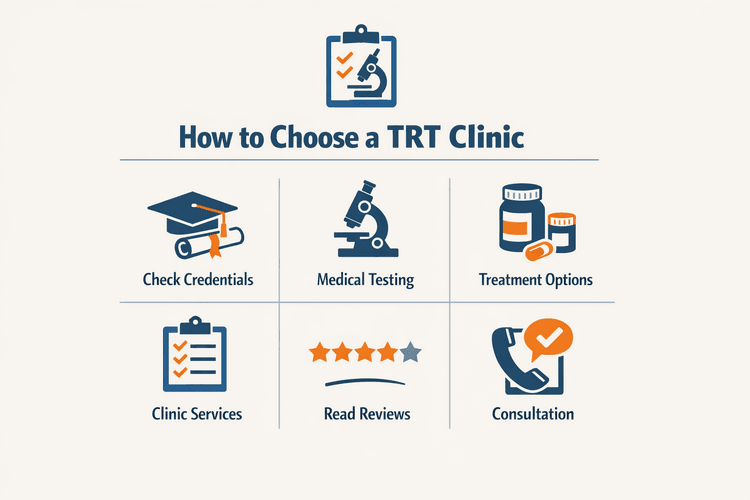
Finding the right TRT clinic requires a deliberate process. You need to evaluate more than marketing claims — you need to know what the clinic tests, what it monitors, and what it costs you in money and time.
Step 1: Confirm They Test the Full Panel Before Treatment
Ask what the clinic measures before prescribing. A proper baseline includes total testosterone, free testosterone, SHBG, LH, FSH, estradiol, hematocrit, and PSA. If the clinic offers treatment based on one total testosterone result and a symptom checklist, that is not enough. You need two morning results taken on separate days, and you need the supporting hormones to tell whether your own production is the problem or something else is suppressing it.
Some telehealth platforms skip LH and FSH entirely. Without them, nobody can distinguish primary hypogonadism from secondary, and that distinction determines whether enclomiphene or hCG might work for you instead of injections.
Before signing up or paying a consultation fee, ask the clinic to send you the list of labs they order at baseline. If they will not provide it, or if the list is shorter than seven markers, move to the next clinic.
Step 2: Verify Ongoing Monitoring and Follow-Up Protocols
TRT is not a prescription you fill once. Monitoring and management of adverse effects are critical to maximize benefit and minimize the risks of TRT. Ask the clinic how often they recheck labs, what markers they track, and who reviews the results with you.
Standard monitoring includes hematocrit every three to six months — elevated red blood cell counts are common and require dose adjustment or therapeutic phlebotomy. Estradiol and PSA also need periodic checks. If the clinic's follow-up is automated refills with no scheduled lab reviews, you are managing your own monitoring, and that is a risk you should know about before you start.
Step 3: Understand the Full Cost Structure
Telehealth TRT pricing varies widely. Monthly subscriptions may include medication, labs, and consultations, or they may charge each separately. Ask for a written breakdown: consultation fee, lab costs, medication cost per month, and any additional charges for follow-up visits or dose adjustments.
Compare that total to what insurance might cover if you go through a local provider. Some men pay less out-of-pocket with insurance and an in-network endocrinologist than they do with a cash-pay telehealth clinic, especially when labs and office visits are factored in.
Multiply the monthly fee by twelve, add the initial consultation and baseline labs, and add at least two follow-up lab panels per year. That number is what the clinic costs you annually, not the advertised monthly rate.
Step 4: Check the Clinic's Prescribing and Compounding Practices
Find out whether the clinic prescribes FDA-approved testosterone or compounded formulations. Compounded testosterone is legal and widely used, but it is not FDA-approved, which means potency and sterility are the responsibility of the compounding pharmacy, not a federal review process. Ask which pharmacy the clinic uses and whether that pharmacy is accredited by PCAB or a state board.
If the clinic offers oral testosterone options like Jatenzo or Kyzatrex, those are FDA-approved but expensive without insurance. If it offers compounded oral or troches, know that absorption is inconsistent and evidence is thin.
Step 5: Evaluate the Clinic's Approach to Fertility and Alternative Treatments
If fertility matters to you now or in the future, ask whether the clinic discusses hCG, enclomiphene, or clomiphene as alternatives to TRT. Traditional testosterone injections suppress sperm production in most men. Clinics that lead with injections and mention fertility only when you ask are not prioritizing that outcome.
Some clinics add hCG to a TRT protocol to preserve testicular function. That works for some men, but it is more expensive and requires more frequent injections. If the clinic does not offer it or explain the trade-offs, you are making that decision without full information.
The clinic that sells you the fastest path to higher testosterone is not always the one that protects what you need long-term.
What Should You Ask Before Choosing a TRT Clinic?
Before choosing between telehealth and in-person clinics, ask what happens when something goes wrong. A clinic that monitors closely will catch rising hematocrit or suppressed sperm production early. One that doesn't may leave you managing side effects alone.
Ask About Monitoring Frequency and Cost
TRT requires regular blood work. Ask upfront: how often do they test total testosterone, free testosterone, hematocrit, and PSA? What does each round of labs cost you if insurance doesn't cover it? Some clinics bundle monitoring into a monthly fee. Others bill separately, and the lab charges add up fast. Get the monitoring schedule and the out-of-pocket numbers before you commit.
Check What Happens If You Want to Stop
Some clinics lock you into multi-month subscriptions with auto-renewal. Others let you pause or cancel without penalty. Read the membership terms. If you need to stop TRT to preserve fertility or try a different approach, you want a clinic that makes the exit straightforward, not one that requires a phone call to cancel and bills you for another quarter.
Look for Clinics That Discuss Alternatives
A clinic focused only on TRT may not mention enclomiphene, clomiphene, or hCG — options that preserve your own testosterone production and usually maintain sperm count. If fertility matters to you now or later, ask whether they offer those alternatives and monitor LH and FSH to track how well your testes are still working. A clinic that discusses trade-offs is one that treats patient-centered decision making as more than a phrase.
For a detailed comparison of how these options differ, see Enclomiphene vs hCG: Compare Two Options for Testosterone Production.
Patients receiving TRT require close monitoring — contraindications and adverse effects are not hypothetical risks.
Verify Who Prescribes and Who Monitors
Telehealth clinics often use nurse practitioners or physician assistants. That's legal in most states, but you want to know who reviews your labs and adjusts your protocol when results drift. Ask: who reads my blood work, and how do I reach them if I have a question between visits? If the answer is vague or routed through a customer-service queue, keep looking.
Compare What You Actually Pay Per Month
Clinics advertise a medication price but bury the consultation fee, lab fee, and shipping. Add them all up. A clinic charging $99 per month for testosterone plus $150 per quarter for labs and $50 per visit costs you more than one charging $200 per month with labs and visits included. Build a twelve-month budget for each option before you sign up.
Conclusion
Finding the right TRT clinic starts with reading two morning testosterone results, knowing what your insurance covers, and checking whether the clinic tests and monitors the full panel. Most online rankings sell the drug they recommend. The research shows TRT improves quality of life, libido and depression symptoms when prescribed correctly, but those outcomes depend on accurate diagnosis, proper monitoring and a treatment plan that fits your goals.
Patient satisfaction is highest when the delivery method matches your routine and the clinic explains what to expect at each visit. In one survey, 62.7 percent of men were satisfied with their TRT regimen, with the highest satisfaction rates among those using auto-injectors, subcutaneous pellets and intramuscular injections. Efficacy mattered more to patients than cost when evaluating their regimen, but cost still determines whether you can sustain treatment long-term.
Before you sign up, ask for the full pricing sheet, the monitoring schedule and the clinic's policy on pausing or stopping treatment. Ask whether they prescribe compounded drugs and whether those are FDA-approved. Ask what happens to your fertility and whether they offer alternatives that preserve sperm production. If the clinic will not answer those questions in writing before you pay, that is the answer.
The right clinic is the one that tests first, monitors consistently, explains trade-offs without selling, and supports your decision whether you start, pause or stop. For more on alternatives that preserve fertility, see Enclomiphene vs hCG: Compare Two Options for Testosterone Production. To understand injection methods, see Subcutaneous vs Intramuscular Testosterone Injections.
FAQ
What labs should a TRT clinic order before prescribing?
A proper baseline includes total testosterone (two separate morning draws), free testosterone, SHBG, LH, FSH, estradiol, hematocrit, and PSA. Clinics that skip LH and FSH cannot distinguish primary from secondary hypogonadism, which determines whether fertility-preserving alternatives might work.
How often should a TRT clinic monitor bloodwork?
Standard monitoring includes hematocrit, PSA, and estradiol every three to six months. Clinics that schedule labs annually leave you responsible for recognizing polycythemia, gynecomastia, or prostate changes between check-ins.
What is the real monthly cost of TRT?
Advertised monthly fees often exclude labs, medication, and follow-up visits. The all-in cost typically ranges from $150 to $400 per month when you add consultation fees, baseline labs, quarterly monitoring panels, and the medication itself.
Does TRT affect fertility?
Traditional testosterone injections suppress sperm production in most men. Clinics that add hCG to the protocol or offer enclomiphene or clomiphene as alternatives help preserve testicular function and sperm count, but these options cost more and require more frequent dosing.
Sources(20)
- The Journal of urology (2020)
- The Journal of clinical endocrinology and metabolism (2026)
- American family physician (2024)
- U.S. Food and Drug Administration — Drug Safety Communication: FDA cautions about using testosterone products for low testosterone due to aging; requires labeling change to inform of possible increased risk of heart attack and stroke with use (2015)
- Journal of Clinical Endocrinology & Metabolism — Testosterone Therapy in Men With Hypogonadism: An Endocrine Society Clinical Practice Guideline (2018)
- International journal of general medicine (2022)
- American Urological Association — Evaluation and Management of Testosterone Deficiency (AUA Guideline) (2018)
- The aging male : the official journal of the International Society for the Study of the Aging Male (2015)
- Quest Diagnostics (questhealth.com) (2026)
- European journal of endocrinology (2024)
- Translational andrology and urology (2020)
- Saudi medical journal (2006)
- The Journal of the American Board of Family Practice (2001)
- BJU international (2018)
- The journal of sexual medicine (2022)
- Public health reports (Washington, D.C. : 1974) (2015)
- Federal practitioner : for the health care professionals of the VA, DoD, and PHS (2025)
- The journal of sexual medicine (2021)
- The journal of sexual medicine (2022)
- Therapeutic advances in urology (2022)