Clomid for Men: How It Raises Testosterone and What It Costs You

Updated
Top takeaways
- Clomiphene citrate is prescribed off-label to treat low testosterone in men by stimulating the pituitary gland to release LH and FSH.
- The drug is not FDA-approved for men, but clinical evidence shows it raises testosterone levels while typically preserving sperm production.
- Cost, insurance coverage and fertility preservation are the main trade-offs when comparing clomiphene for men to testosterone replacement therapy.
- Two morning testosterone tests and a full hormone panel are required before starting treatment.
- Clomiphene for men works only when the pituitary and testes can still respond to hormonal signals.
Introduction
Clomiphene for men—sold as Clomid—is FDA-approved to help women ovulate but not approved to treat any condition in men. Yet clinics prescribe it off-label for low testosterone, especially when a man wants to keep his sperm production intact. Testosterone replacement therapy shuts down sperm production in most men. Clomiphene usually does not.
The drug blocks estrogen receptors in the hypothalamus and pituitary. When those brain regions sense less estrogen, they release more luteinizing hormone and follicle-stimulating hormone. Those hormones tell the testes to make more testosterone and sperm. The result: your own testosterone goes up, and your fertility often stays online.
Research indicates that clomiphene for men raises total testosterone and improves symptoms of low testosterone over both short and long treatment periods. The evidence is not as large or as long as the evidence for testosterone replacement, but it is consistent across multiple trials. If you are choosing between clomiphene and testosterone injections, understanding how to increase testosterone naturally can help you see where medication fits in the bigger picture.
The short answer: clomiphene for men is one option when you want higher testosterone without shutting down your own production. It costs you in monitoring, in uncertainty about how much your number will rise, and in the fact that no version of the drug is FDA-approved for men. What it does not usually cost you is fertility—and that is why it exists in the treatment menu at all.
The Problem: Low Testosterone in Men
Hypogonadism is a worldwide problem among men causing sexual, physical and mental problems. The diagnosis requires two morning blood draws showing total testosterone below the reference range, plus symptoms. One result is not a diagnosis. The symptoms overlap with aging, poor sleep, obesity and depression, which means many men assume they need testosterone when the real problem is weight or a CPAP machine.
Testosterone therapy is the first-choice treatment for male hypogonadism, but it has several side effects, including subfertility. Exogenous testosterone shuts down the pituitary signal to the testes. That suppresses sperm production in most men, usually within weeks. If you want to preserve fertility or restart it later, you need a different approach—or you accept the trade-off and plan to add hCG or come off entirely when you want children.
The alternative is a medication that raises your own testosterone instead of replacing it. Clomiphene citrate is one option. It blocks estrogen receptors in the pituitary, which tricks the brain into releasing more LH and FSH. Those hormones tell the testes to make more testosterone and sperm. Low dose clomiphene citrate is effective in elevating serum testosterone levels in men with hypogonadism. The catch: it is FDA-approved for female infertility, not male hypogonadism. When prescribed to men, it is off-label.
Before choosing between these, you need two morning results and an LH level. Without them, nobody can tell you which one works for you. If your LH is already high and your testosterone is low, your testes are not responding—clomiphene will not help. If your LH is low or normal and your testosterone is low, clomiphene has a chance. Best online TRT clinics should order that panel before prescribing anything, but not all of them do.
How Does Clomiphene for Men Work?
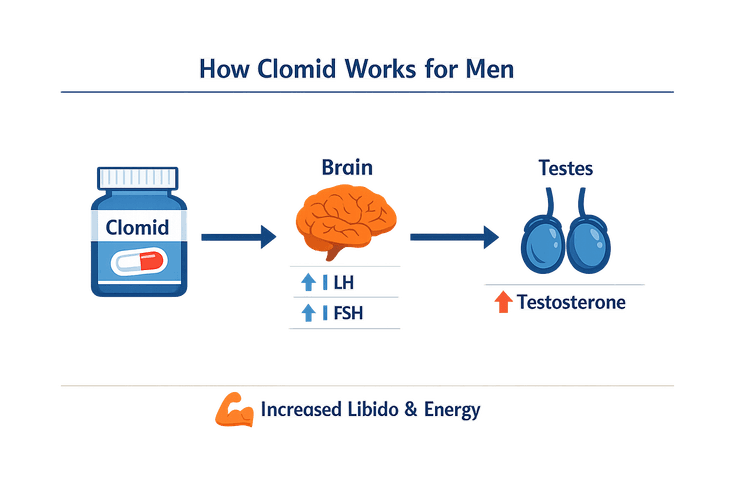
Clomiphene for men raises testosterone by blocking estrogen receptors in the brain. When the hypothalamus and pituitary can't detect circulating estrogen, they respond as though testosterone is low — even when it isn't — and release more luteinizing hormone (LH) and follicle-stimulating hormone (FSH). Those signals tell the testes to produce more testosterone and sperm.
This is fundamentally different from injecting testosterone. Clomiphene stimulates your own production pathway. TRT shuts it down.
The Numbers From the Trials
A small study of five men with chronic renal failure and low testosterone treated them with 100 mg clomiphene daily for five to twelve months. Mean testosterone rose from 223 ng/dL at baseline to 879 ng/dL — a 290% increase. All five reported improved libido, sexual function and general well-being.
Another trial using low-dose clomiphene in hypogonadal men confirmed that the drug elevates serum testosterone and improves the testosterone-to-estradiol ratio. A 2021 systematic review concluded that clomiphene is effective for both biochemical markers and clinical symptoms, with few reported side effects.
How Treatment Works in Practice
You take clomiphene as a daily oral tablet. Dosing typically starts at 25 to 50 mg per day; some studies used 100 mg. Your doctor orders baseline labs — total testosterone, free testosterone, LH, FSH, estradiol — then rechecks them after four to six weeks to see whether your levels rose and whether the dose needs adjustment.
Because clomiphene works through your own axis, response varies. Some men see a large increase; others see a modest one. If your pituitary or testes don't respond to the signal, clomiphene won't move the number much. That's why you test first, test twice, and adjust or switch treatments based on the result.
The label says clomiphene therapy should be supervised by physicians experienced in endocrine disorders. This is not a drug you trial on your own. If you're comparing clomiphene to other options like enclomiphene or TRT, the mechanism and monitoring requirements differ — understanding those trade-offs matters before you choose.
Order a full hormone panel: total testosterone, free testosterone, SHBG, LH, FSH, estradiol, hematocrit and PSA. Two morning fasting samples, taken on separate days, give you a reliable baseline.
Most protocols begin at 25 to 50 mg daily. Higher doses raise estradiol more, which can blunt the benefit or cause side effects.
Measure the same panel. If testosterone rose into the normal range and you feel better, the dose is working. If it didn't move or moved too much, adjust.
Recheck labs every three to six months. Track hematocrit, estradiol and PSA alongside testosterone. If any marker drifts out of range, adjust the dose or switch treatments.
What Does Clomiphene for Men Cost?
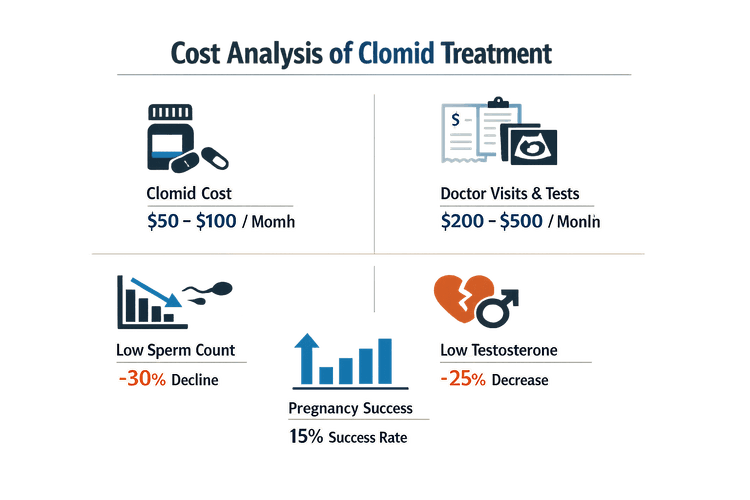
Clomiphene for men costs you in two currencies: money and fertility outcomes. The financial side is straightforward. The fertility side is more nuanced — most men see some improvement in sperm parameters, but the clinical relevance is modest and nearly one-third of men see counts worsen.
The Financial Cost
Clomiphene citrate is inexpensive compared to testosterone replacement. A month of 50 mg daily typically runs $30 to $100 out of pocket, depending on whether you use generic or brand-name and whether insurance covers it. Lab monitoring adds $100 to $300 per panel — you need a baseline testosterone and follow-up at 4 to 6 weeks, then every 3 to 6 months once stable.
Telehealth clinics bundle the drug and labs into monthly subscriptions. Compare the all-in price — drug, labs, and physician oversight — before signing up. Some clinics advertise a low drug price but charge separately for each consult and lab order. When evaluating options, choosing a reputable online TRT clinic requires looking at the total monthly cost, not just the sticker price.
The Fertility Trade-Off
Clomiphene preserves and often improves spermatogenesis — that is the reason men choose it over testosterone replacement. One study of men with hypogonadism and oligospermia found that 50 mg daily normalized testosterone in 9 of 10 men. Sperm concentration increased in most patients, but the clinical relevance was modest and nearly one-third worsened.
The ideal candidate for clomiphene is a man who wants to preserve testicular volume and spermatogenesis while raising testosterone. If fertility is not a concern, testosterone replacement raises levels more reliably and costs about the same.
What Predicts Response
Baseline estradiol predicts testosterone response to clomiphene. Men with higher estradiol at baseline tend to see larger increases in testosterone. Sperm improvements are more likely in men with lower baseline counts, but even then, the magnitude of improvement is often small.
Clomiphene may be considered for testosterone optimization, particularly in men with higher estradiol, but fertility expectations should be managed. If your baseline sperm count is very low, clomiphene is worth trying, but it is not a reliable rescue.
Tips and Tricks for Clomid Treatment
Before you start clomiphene, ask your doctor for two morning testosterone tests drawn before 10 a.m., at least a week apart. One low result is not a diagnosis, and the time of day matters — testosterone peaks in the morning and drops by afternoon. Without two consistent readings, nobody can tell you whether treatment makes sense.
Work with a physician experienced in hormone management
The label says clomiphene citrate therapy should be supervised by physicians experienced in endocrine disorders. That means someone who reads full panels — total and free testosterone, LH, FSH, estradiol — not just a single number. If a clinic offers treatment after one test and a questionnaire, that is a red flag.
Clomiphene raises LH, which tells your testes to make more testosterone. If your baseline LH is already high and testosterone is still low, clomiphene will not fix the problem — your testes are not responding to the signal they already have. That is primary hypogonadism, and it usually requires TRT instead. The pre-treatment LH level tells you which path fits.
Balance the goal with the risks
The therapeutic objective should be balanced with potential risks and discussed before you start. Clomiphene preserves fertility in most men, but it does not guarantee it, and some men report visual disturbances or mood changes on the drug. If fertility is your primary reason for choosing clomiphene over TRT, confirm that with a baseline semen analysis — do not assume your fertility is normal without testing it.
If you are working with a telehealth clinic, confirm what happens if you need to stop or switch treatments. Some memberships lock you into a subscription with penalties for early exit. Read the contract terms before you sign up, and make sure the clinic provides access to your full lab history if you leave.
One low morning result is not a diagnosis, and the clinic that treats it as one is selling convenience, not medicine.
Track your response with labs, not symptoms alone
Symptoms improve for many men on clomiphene, but symptom improvement does not always match testosterone levels. Some men feel better with modest rises; others see large increases and still report fatigue or low libido. The only way to know whether the drug is working biochemically is to retest total and free testosterone, LH, and estradiol after six to eight weeks on a stable dose.
If testosterone rises but estradiol rises sharply too, some clinicians adjust the dose or add an aromatase inhibitor. If LH climbs but testosterone stays flat, that suggests primary hypogonadism, and continuing clomiphene will not help. The follow-up labs tell you whether to stay the course, adjust, or switch treatments.
Conclusion
Clomiphene for men raises testosterone by blocking estrogen receptors in the brain, which signals the pituitary to produce more LH and FSH. That tells your testes to make more testosterone and usually preserves sperm production. The trials show it works for central hypogonadism — low testosterone caused by low pituitary signaling — but not for primary testicular failure.
The cost breaks down to drug price, lab monitoring and fertility trade-offs. Generic clomiphene runs $20 to $60 per month. You need baseline labs and follow-up panels every three to six months: total and free testosterone, LH, estradiol, hematocrit. That adds $100 to $300 per visit depending on where you order. The fertility upside is real for men who want to preserve or restore sperm counts, but the evidence on symptom relief is thinner than for TRT.
Before you sign up, get two morning testosterone measurements, an LH level, and a conversation with a provider who can read the full panel. If your LH is already high and your testosterone is low, clomiphene will not help you — your testes are the problem, not your pituitary. If your LH is low or normal and you want to avoid shutting down sperm production, clomiphene is worth discussing.
The long-term safety data are limited. Most published series run 12 to 24 months. The studies report few side effects, but "few" is not zero, and nobody tracked these men for five or ten years. If you choose clomiphene, plan to monitor and be ready to switch if it stops working or your estradiol climbs too high. For a detailed comparison of treatment options and what to look for in a provider, see our guide on choosing an online TRT clinic.
Clomiphene is a tool, not a cure. It raises the number, and for some men that improves symptoms. For others it does not. The only way to know is to test first, treat second, and retest at three months with the same lab and the same morning timing. If the number moves but the symptoms do not, you have your answer.
Sources(31)
- Endocrinology, diabetes & metabolism (2023)
- The journal of sexual medicine (2013)
- The Journal of urology (2019)
- The world journal of men's health (2026)
- Andrology (2022)
- The journal of sexual medicine (2005)
- The journal of sexual medicine (2014)
- The Journal of clinical endocrinology and metabolism (1976)
- International journal of urology : official journal of the Japanese Urological Association (2025)
- The Journal of urology (2020)
- The Journal of clinical endocrinology and metabolism (2026)
- American family physician (2024)
- U.S. Food and Drug Administration — Drug Safety Communication: FDA cautions about using testosterone products for low testosterone due to aging; requires labeling change to inform of possible increased risk of heart attack and stroke with use (2015)
- The Journal of clinical endocrinology and metabolism (2018)
- American Urological Association — Evaluation and Management of Testosterone Deficiency (AUA Guideline) (2018)
- European journal of endocrinology (2024)
- International journal of pharmaceutical compounding (2015)
- The Journal of arthroplasty (2025)
- Health technology assessment (Winchester, England) (2024)
- The journal of sexual medicine (2022)
- The journal of sexual medicine (2013)
- The Journal of urology (2021)
- International journal of impotence research (2023)
- The journal of sexual medicine (2019)
- Pediatrics (2017)
- Journal of human kinetics (2014)
- International journal of general medicine (2022)
- Public health reports (Washington, D.C. : 1974) (2015)
- The Cochrane database of systematic reviews (2024)
- Andrology (2025)
- Journal of Clinical Endocrinology & Metabolism — Testosterone Therapy in Men With Hypogonadism: An Endocrine Society Clinical Practice Guideline (2018)