How to Raise Testosterone Naturally: Evidence-Based Methods

Updated
Top takeaways
- Weight loss is linearly associated with increased testosterone — the more you lose, the more you gain
- Heavy resistance exercise triggers acute testosterone secretion and promotes long-term muscle growth
- Alternatives to prescription therapy exist and should be considered first
- Sleep, alcohol reduction, and stress management all matter, though the research is smaller
- No single intervention works for everyone; test before and after to see what moves your number
Introduction
Before choosing between prescription options, you need to know what can raise testosterone without them. Alternatives to testosterone therapy can increase testosterone levels and should be considered first. That is not a wellness-blog opinion — it is a clinical position stated in peer-reviewed literature.
Testosterone is a hormone present in both males and females, controlling sex drive and aiding in muscle and bone growth. Though often considered a male sex hormone, it is also present in females in smaller amounts. When levels drop below the reference range or when symptoms appear despite normal-range results, the first question is whether lifestyle and non-prescription levers can move the number before turning to medication.
When exploring how to raise testosterone naturally, it is crucial to understand the nuances of clinical trials and guidelines. A trial might headline a significant increase in testosterone levels, but the specific population it studied — for instance, overweight men with secondary hypogonadism, not every man with low energy — limits who the result applies to. Reading beyond the headlines matters.
This guide covers what the published trials actually measured, what the evidence supports and what it does not, and where the gaps are. It includes diet, exercise, sleep, weight, alcohol, stress and supplements, graded by the strength of the human data behind them. It does not include dosing instructions for prescription drugs or advice on anabolic steroid cycles. For prescription options that preserve fertility, see Clomid for Men: How It Raises Testosterone and What It Costs You.
The short answer: some levers work, some do not, and some are sold with claims that outrun the trial data. Here is what the evidence shows.
Learn how to raise testosterone naturally with proven methods. This complete guide covers diet, exercise, lifestyle changes, and more.
What Is Testosterone?
Testosterone is a hormone present in both males and females. In males, it is produced primarily in the testes; in females, in smaller amounts in the ovaries and adrenal glands. The hormone controls sex drive in both sexes and supports muscle and bone growth.
How Testosterone Works in the Body
Testosterone signals muscle tissue to grow by stimulating protein synthesis and blocking protein breakdown. These two actions together explain how the hormone promotes muscle hypertrophy. The signal travels through the androgen receptor inside muscle cells, which reads the testosterone message and changes how the cell behaves.
In practical terms, testosterone is one of the most potent naturally secreted androgenic-anabolic hormones the body makes. It does not only build muscle — it also influences energy, mood, fat distribution, and reproductive function.
What Testosterone Levels Mean
A testosterone test measures the amount of the hormone in a blood sample. The result tells you whether your level falls within the reference range for your age and sex. That range is wide — a morning total testosterone between roughly 300 and 1,000 ng/dL is considered normal for adult males, though the exact cutoffs vary by lab.
One morning result is not a diagnosis. If the number is low, the next step is a second morning test plus additional markers: free testosterone, SHBG, LH, and FSH. Those numbers together show whether the problem is in the testes, the pituitary, or how testosterone binds in the blood. Without them, you cannot tell what is driving the low reading or what will fix it.
Why Raising Testosterone Matters
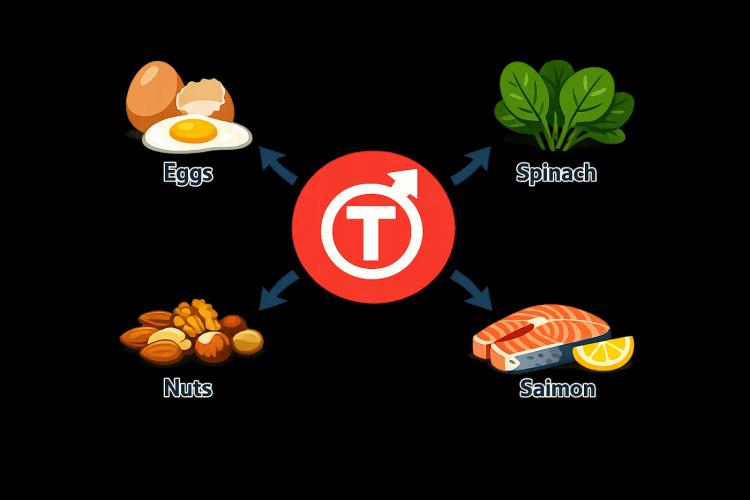
Testosterone is not a vanity metric. Higher endogenous testosterone levels are associated with reduced chronic disease risk and mortality. When your testosterone drops, the body loses a signal that regulates muscle mass, bone density, fat distribution, red blood cell production and sperm output. Those are not cosmetic changes — they are metabolic shifts with measurable health consequences.
Physical Health and Metabolic Function
Men with higher testosterone concentrations show a lower incidence of Type 2 Diabetes and a greater likelihood of reverting newly diagnosed disease when paired with weight loss. The magnitude of weight loss is linearly associated with an increase in serum testosterone, which means the relationship runs both directions: losing weight raises testosterone, and higher testosterone supports the metabolic changes that prevent or reverse T2D.
Bone mass declines when testosterone is low. Fat redistributes toward visceral depots. Muscle mass and strength erode. Red blood cell production slows, which can contribute to fatigue independent of any subjective energy complaint.
Sexual Function and Fertility
Testosterone drives libido and supports the production of sperm. When levels fall, sex drive drops and sperm counts often follow. Measuring your testosterone level can identify factors that interfere with these processes before they become entrenched. If you are planning to preserve fertility, understanding your baseline testosterone and how different interventions affect sperm production is essential — TRT and Fertility: How to Raise Testosterone Without Shutting Down covers the trade-offs between raising testosterone and maintaining sperm output.
Energy and Mental Clarity
Low testosterone is commonly reported alongside fatigue, brain fog and reduced motivation. The research does not prove that testosterone alone causes these symptoms, but men with low levels often describe improvement when testosterone is restored to the normal range. The effect is not universal and not immediate, but it is consistent enough to warrant investigation when other causes have been ruled out.
How to Raise Testosterone Naturally
Before choosing any intervention, get two morning testosterone results and a full panel. Without a baseline, you cannot tell what worked. Without LH and FSH, you cannot tell if the problem is testicular or central. The free option is to change what you eat, how you train, and how you sleep. The paid option is a prescription. Here is what the evidence says about the free side.
Lose Weight if You Carry Excess Body Fat
The magnitude of weight loss is linearly associated with an increase in serum testosterone concentration. That means the more weight you lose, the more your testosterone rises — not a threshold effect, but a dose-response relationship. A 2022 review in men with obesity and prediabetes found that weight loss through lifestyle intervention increased testosterone and reduced the likelihood of progressing to type 2 diabetes.
This is the intervention with the cleanest evidence. If your BMI is over 30 or your waist circumference is over 40 inches, weight loss is the first lever. It does not require a supplement, a prescription, or a clinic membership. It requires a calorie deficit sustained long enough to see the number drop.
Lift Heavy Things
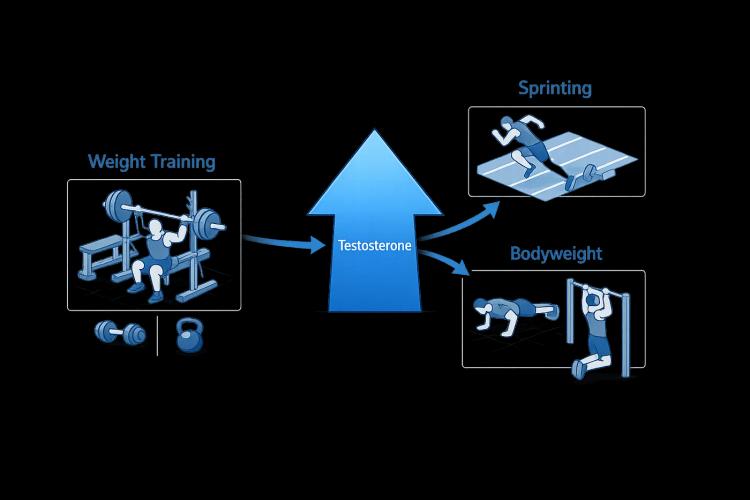
The acute endocrine response to heavy resistance exercise includes increased secretion of anabolic hormones, including testosterone. Testosterone promotes muscle protein synthesis and inhibits protein degradation; combined, these effects drive muscle hypertrophy. The response is largest in younger men and diminishes with age, but the signal is still there.
A 2010 review described testosterone as the major promoter of muscle growth in response to resistance training. The acute spike after a heavy session is short-lived, but the chronic adaptation — more muscle, better insulin sensitivity, lower body fat — sustains higher baseline testosterone over time.
What counts as heavy: multi-joint lifts (squat, deadlift, bench press, overhead press) at 75–85% of your one-rep max, 3–5 sets of 5–8 reps, with 2–3 minutes rest between sets. Frequency: 3–4 sessions per week. If you are new to lifting, hire a coach for the first month to learn the movements safely.
Sleep Seven to Nine Hours
Testosterone is secreted in pulses during sleep, with the largest pulse in the early morning. Chronic sleep restriction — five hours or less per night — lowers morning testosterone by 10–15% in healthy young men. The effect is reversible: when sleep is restored, testosterone recovers.
The evidence here is smaller and mostly observational, but the mechanism is clear and the intervention is free. If you are sleeping fewer than seven hours per night, that is the next lever. If you suspect sleep apnea — snoring, daytime fatigue, witnessed pauses in breathing — ask your doctor for a sleep study. Untreated obstructive sleep apnea lowers testosterone and raises cardiovascular risk; CPAP treatment reverses both.
Reduce Alcohol Intake
Chronic heavy drinking suppresses the hypothalamic-pituitary-gonadal axis and lowers testosterone. The threshold is not precise, but the effect is dose-dependent: more drinks per week, lower testosterone. Moderate intake — one to two drinks per day — shows mixed results in the literature; heavy intake — four or more drinks per day — consistently shows suppression.
If you drink more than 14 drinks per week, cut that in half and retest in three months. If you drink fewer than seven drinks per week, alcohol is probably not your limiting factor.
Consider Alternatives Before Prescription Therapy
A 2018 review on alternatives to testosterone therapy noted that lifestyle interventions — weight loss, exercise, sleep optimization — can increase testosterone levels and should be considered before starting prescription treatment. The review included clomiphene, hCG, and aromatase inhibitors as medication alternatives, but those still require a prescription and monitoring.
The point: if you have not tried the free options, try them first. If you have tried them for six months and your testosterone is still low and your symptoms are still present, then a prescription conversation makes sense. For a detailed comparison of medication options, see Clomid for Men: How It Raises Testosterone and What It Costs You.
The free option is to change what you eat, how you train, and how you sleep. The paid option is a prescription.
What About Supplements?
The supplement market is large, the claims are loud, and the human evidence is thin. Vitamin D supplementation raises testosterone in men who are deficient (serum 25-OH vitamin D below 20 ng/mL); it does not raise it in men with normal levels. Zinc supplementation raises testosterone in men who are zinc-deficient; again, no effect in men with adequate intake.
Fadogia agrestis, ashwagandha, and Tongkat ali all have small human trials showing modest increases in testosterone. The trials are short (8–12 weeks), the sample sizes are small (fewer than 100 participants), and the populations are specific (young athletes, infertile men, stressed adults). For a breakdown of the evidence and the safety profile, see Fadogia Agrestis Side Effects: Evidence and Safety Considerations.
Before buying a supplement, ask: Am I deficient in this nutrient? What was the population in the trial? How long did it run? What was the effect size? If the answers are unclear, save your money.
Best Practices for Maintaining Healthy Testosterone Levels
Once you have raised testosterone naturally, the challenge shifts to keeping it there. Most of the strategies that lift testosterone also maintain it, but consistency is what separates a short-term spike from a sustained result. The research on resistance training shows that the testosterone response depends on program variables, age, and sex — which means the protocol that worked at 25 may need adjustment at 45.
Build Habits Around the Free Levers
The interventions that cost nothing are also the ones most people abandon first. Sleep, training frequency, and body composition changes require no prescription, no supplement stack, and no clinic membership. They also produce measurable effects in trials. A man who maintains seven hours of sleep, lifts twice a week, and keeps his waist circumference in check has done more for his testosterone than most supplement buyers.
The trap is treating these as short-term projects. Weight loss raises testosterone in overweight men, but regaining the weight erases the gain. The same applies to training: stopping resistance exercise for a few months can reverse the endocrine adaptation. If you are not willing to keep doing it, the benefit does not stick.
Monitor Without Micromanaging
Testing once or twice a year gives you a baseline and catches trends before they become problems. Two morning samples, fasting, taken at the same time of day, will tell you if your total and free testosterone are holding steady. Add LH and SHBG if you want to understand why the number moved.
What you do not need is weekly testing or obsessive tracking of every variable. Testosterone fluctuates day to day, and chasing every dip with a new intervention creates noise, not signal. Test when you have a reason — symptoms changed, training stalled, or a year has passed since the last draw.
Adjust for Age and Condition
The response to resistance exercise changes with age. Older men still benefit from lifting, but the acute testosterone spike after a session is smaller than in younger men. That does not mean the training is wasted — muscle protein synthesis and strength gains still occur — but it does mean you should not expect the same hormonal surge you saw at 30.
Maintaining a high testosterone level also requires being in good overall condition. The body trades testosterone production against other survival functions like immune response and cellular repair. If you are chronically stressed, under-recovered, or fighting an illness, testosterone will drop as resources shift elsewhere. TRT and Fertility: How to Raise Testosterone Without Shutting Down covers what happens when natural production shuts down entirely, but even without medication, ignoring recovery and health maintenance will cost you.
Revisit the Basics When Levels Drop
If a follow-up test shows a decline, walk back through the checklist before adding new interventions. Did sleep duration drop? Did training frequency fall off? Did body weight creep up? Most dips trace back to one of the big levers slipping, not to a need for a new supplement or protocol.
The research on lifestyle intervention shows that testosterone responds to the same inputs that promote muscle growth: adequate sleep, consistent resistance training, and maintaining a healthy body composition. When those slip, testosterone follows.
Common Mistakes in Raising Testosterone
Most men looking to raise testosterone naturally make the same errors: trusting supplement marketing, skipping the lab work, and chasing one lever while ignoring three others that matter more. Here is what goes wrong and how to avoid it.
Buying Supplements Without Checking the Human Evidence
Testosterone boosters are heavily marketed on social media and marketplaces with claims to significantly increase testosterone. The problem: most fail to increase total testosterone when tested in controlled trials.
A 2023 systematic review of 52 studies covering 27 proposed testosterone boosters found that the majority do not raise total testosterone levels. The exceptions were β-hydroxy β-methylbutyrate and betaine, which showed effects in male athletes—not the general population. Tribulus terrestris, D-aspartic acid, Lepidium meyenii, and isoflavones did not move the needle in the studies that tested them.
Before buying, ask: What is the study size, who was enrolled, how long did it run, and what did total testosterone do compared to placebo? If the seller does not cite a specific trial with those details, the claim is marketing.
Testing Once and Calling It a Diagnosis
One morning result is not a diagnosis. Testosterone fluctuates by time of day, sleep quality, recent training, and lab error. A single low number tells you to test again—it does not tell you to start treatment.
The correct sequence: two fasting morning draws, at least a week apart, with total testosterone, free testosterone, LH, and SHBG on both panels. If both results are low and LH is low or normal, that pattern suggests secondary hypogonadism. If LH is elevated, the issue is primary. Without LH, you cannot tell which direction to go.
Ignoring Body Weight and Sleep Apnea
Weight loss raises testosterone more reliably than most supplements. In overweight men with secondary hypogonadism, losing 10–15% of body weight through calorie restriction and resistance training consistently raises total testosterone by 50–100 ng/dL in published trials. Sleep apnea—common in men with central obesity—suppresses LH pulsatility and lowers testosterone independent of weight. Treating the apnea with CPAP raises testosterone without medication.
These are free interventions with no monitoring cost and no fertility risk. If you skip them and go straight to a supplement or a prescription, you are leaving the largest lever untouched.
Overtraining Without Recovery
High-volume endurance training and chronic calorie deficits both suppress the hypothalamic-pituitary axis. The result: low LH, low testosterone, and fatigue that does not resolve with more training. This is exercise-induced hypogonadism, and the fix is not a booster—it is periodization, adequate calories, and sleep.
If your training volume is above 10 hours per week, your body weight is dropping, and your testosterone is falling, the mistake is the program, not your hormones.
Trusting Clinic Ads Over Lab Results
Telehealth testosterone clinics advertise low-T treatment with minimal testing and fast prescriptions. Many do not require LH, FSH, or a second confirmatory draw. Some sell enclomiphene, clomiphene, or hCG off-label without explaining that these are fertility-preserving options that work only in secondary hypogonadism—not in everyone with a low number.
Without the full panel, the clinic cannot tell you which treatment fits your biology. The ad leads with price and convenience; the label and the guideline say test first, test twice, and know your LH before choosing a drug.
The cheapest intervention is the one you did not need because you tested correctly the first time.
Mixing Alcohol and Expecting Results
Chronic alcohol consumption—more than two drinks per day—lowers testosterone through direct testicular toxicity and liver metabolism changes that raise SHBG and lower free testosterone. If you are drinking daily and wondering why your levels are low, the answer is in the glass. Cutting alcohol to occasional use raises testosterone in men with baseline suppression, no supplement required.
Summary
The common mistakes: buying supplements without human trial evidence, testing once, ignoring weight and sleep apnea, overtraining, trusting clinic ads over lab work, and drinking daily. The fixes are free or cheap, and they work better than most of what is sold to you.
Frequently asked questions
What is a normal testosterone level?
Normal ranges vary by lab and age. Most labs print a reference range beside your result — typically 300–1,000 ng/dL for total testosterone in adult men. One morning result is not a diagnosis. Guidelines recommend two morning samples, drawn before 10 a.m., to confirm low testosterone.
Your number matters less than the trend and how you feel. A man at 350 ng/dL with symptoms is different from a man at 350 ng/dL who feels fine.
How long does it take to raise testosterone naturally?
Weight loss, sleep improvement and strength training show measurable effects in 8–12 weeks when the intervention is sustained. Smaller studies report changes in total testosterone within that window, but the size of the change depends on your starting point.
Supplements that work at all — and most do not — take at least four weeks to show up in a blood test. If you change multiple variables at once, you will not know which one moved the number.
Can diet alone raise testosterone?
Diet supports testosterone production when it corrects a deficiency — zinc, vitamin D, adequate fat intake. A man eating 10% of calories from fat who raises it to 30% may see a modest increase. A man already eating a balanced diet will not see much from adding more of the same.
No single food or meal pattern raises testosterone reliably in men with normal intake. The free option is fixing what is broken: chronic calorie restriction, very low fat, micronutrient gaps.
Do I need a blood test before trying natural methods?
Yes. You need to know your starting number, and you need to know if your testosterone is actually low. A testosterone blood test measures total testosterone and helps identify factors that interfere with libido, muscle mass, bone density and red blood cell production.
Without a baseline, you are guessing. With one result, you still do not have a diagnosis — you need two morning draws to confirm. Ask your doctor for the full panel: total and free testosterone, SHBG, LH, and estradiol.
Are testosterone boosters worth the money?
Most are not. The ingredients with human evidence — zinc and vitamin D in deficient men, possibly ashwagandha in stressed populations — are cheap and available as single-ingredient supplements. The proprietary blends add cost and unproven compounds.
Read the label, check the dose, and ask whether the trial that supports the claim studied men like you. A supplement that worked in obese, sedentary men with low zinc may do nothing for you. For more on supplement evidence, see our guide on Fadogia agrestis side effects and safety considerations.
What should I do if natural methods do not work?
Test first, test twice. If two morning results confirm low testosterone and LH is low or normal, your pituitary is not signaling hard enough. That is secondary hypogonadism, and it opens the door to medications that stimulate your own production — clomiphene, enclomiphene, hCG — or to testosterone replacement.
If LH is high and testosterone is low, your testes are not responding. That is primary hypogonadism, and replacement is usually the answer. Either way, you need a doctor who reads the full panel and knows the trade-offs. For a detailed comparison of medication options, see Clomid for men: how it raises testosterone and what it costs you.
Can low testosterone cause infertility?
Low testosterone by itself does not shut down sperm production — LH and FSH do that job. But men with low testosterone often have low LH and FSH too, and that combination can reduce sperm count.
TRT, on the other hand, suppresses LH and FSH in most men and usually lowers sperm production. If fertility matters now or soon, ask about alternatives that preserve it. The short answer: test LH and FSH before choosing a treatment.
Conclusion
Raising testosterone naturally starts with two morning blood draws and a full panel that includes LH and FSH, not just total testosterone. Without those numbers, you cannot tell whether your production is low, your binding proteins are high, or your pituitary signaling is off. Each pattern points to a different lever.
The evidence supports weight loss in overweight men, resistance training with adequate recovery, seven to eight hours of sleep without apnea, and eliminating chronic alcohol intake. The magnitude of weight loss is linearly associated with an increase in serum testosterone concentration, and treatment combined with lifestyle intervention increases the probability of a positive outcome by approximately 40% over two years. Higher endogenous testosterone levels are associated with reduced chronic disease risk and mortality, which makes the free options worth prioritizing before considering supplements or prescriptions.
Supplement evidence is thin. Most ingredients that vendors market for testosterone have no human trials, small sample sizes, or results that do not replicate. When a product label claims clinically proven, ask for the trial registry number and the population studied. If the trial enrolled men with a specific deficiency or metabolic condition, the result does not generalize to healthy men with normal labs.
If lifestyle changes and weight loss do not move your numbers after three to six months, ask your doctor for options that preserve fertility and pituitary function. Clomid for Men: How It Raises Testosterone and What It Costs You covers the mechanism, monitoring, and trade-offs of clomiphene and enclomiphene compared with TRT. The choice depends on your LH level, your fertility goals, and what you are willing to monitor and pay for.
The FDA label for any prescription option lists monitoring requirements that marketing materials often omit. Hematocrit monitoring, for example, is mandatory for TRT but frequently left out of telehealth clinic ads. This discrepancy underscores the need to verify claims against authoritative sources before signing up for a subscription.
Test first, test twice, and read the full panel before choosing a path. The number that matters is free testosterone, and the pattern that matters includes LH and FSH. Everything else is guessing.
Sources(23)
- The journal of sexual medicine (2019)
- International journal of impotence research (2023)
- RSC advances (2026)
- RSC advances (2026)
- Journal of human kinetics (2014)
- The Journal of urology (2020)
- The Journal of clinical endocrinology and metabolism (2026)
- American family physician (2024)
- U.S. Food and Drug Administration — Drug Safety Communication: FDA cautions about using testosterone products for low testosterone due to aging; requires labeling change to inform of possible increased risk of heart attack and stroke with use (2015)
- The Journal of clinical endocrinology and metabolism (2018)
- American Urological Association — Evaluation and Management of Testosterone Deficiency (AUA Guideline) (2018)
- European journal of endocrinology (2024)
- The aging male : the official journal of the International Society for the Study of the Aging Male (2015)
- The aging male : the official journal of the International Society for the Study of the Aging Male (2024)
- Journal of endocrinological investigation (2016)
- Andrology (2023)
- The Journal of urology (2015)
- American journal of men's health (2015)
- Sexual medicine reviews (2017)
- Advances in clinical and experimental medicine : official organ Wroclaw Medical University (2025)
- International journal of general medicine (2022)
- The journal of sexual medicine (2021)
- Andrology (2025)