Foods That Boost Testosterone: What Actually Works
Updated
Top takeaways
- Most marketed testosterone-boosting supplements lack evidence of actually raising total testosterone levels in human trials
- Dietary patterns like ketogenic and Mediterranean diets show more promise than individual foods or supplements, with mechanisms tied to cholesterol availability and inflammation reduction
- 52 studies covering 27 proposed testosterone boosters found that most fail to increase total testosterone, with only β-hydroxy β-methylbutyrate and betaine showing effectiveness in male athletes
- Understanding the difference between what FDA labels specify and what sellers advertise is critical for evaluating testosterone-related nutrition claims
- The evidence for foods that boost testosterone comes from examining macronutrient patterns and key micronutrients, not miracle ingredients
Introduction
Testosterone-boosting supplements crowd online marketplaces with claims of naturally raising your levels. The research tells a different story. A systematic review of 52 studies examined 27 proposed testosterone boosters and found that most fail to increase total testosterone in any measured population — male athletes, men with late-onset hypogonadism, infertile men, or healthy men.
When discussing foods that boost testosterone, it is crucial to rely on evidence-based information rather than marketing claims. In my research, I have often encountered discrepancies between what the data actually shows and what is advertised by sellers. A trial might show promising results for a particular food or supplement, but it is important to note the specific population and conditions under which the trial was conducted.
The question is not whether individual foods can raise testosterone — it is which dietary patterns affect the mechanisms of testosterone synthesis, and what the human trials actually measured. The answer starts with understanding how macronutrient patterns and micronutrients influence testosterone homeostasis, not with lists of superfoods. For a broader look at non-medication approaches, see How to Raise Testosterone Naturally: Evidence-Based Methods.
This article examines four prevalent dietary patterns — ketogenic, vegetarian, Mediterranean, and Western — and grades the evidence for individual nutrients and supplements. You will see what the trials measured, how large the studies were, and what they did not test. No marketing claims, no miracle ingredients — just what the data supports and what it does not.
Problem Statement
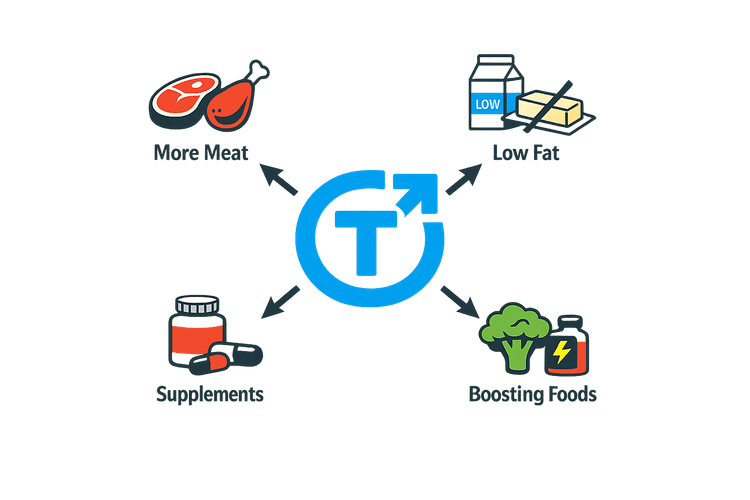
The market for testosterone boosters is built on claims that rarely match the trial data. Supplements are marketed on social media and online marketplaces with promises to significantly increase testosterone, but lax industry regulation allows these products to sell without verification of their purported benefits. When you search for foods that boost testosterone or over-the-counter supplements, you encounter pages of products that have never been tested in humans or that failed when they were.
The Evidence Gap
A systematic review of 52 studies published over two decades examined 27 proposed testosterone boosters across four populations: male athletes, men with late-onset hypogonadism, infertile men, and healthy men. The finding: most fail to increase total testosterone. Of the 27 ingredients reviewed, only β-hydroxy β-methylbutyrate and betaine showed efficacy, and only in male athletes—a narrow population that does not represent men seeking general hormone support.
The problem is not limited to exotic herbs. Common supplements like Tribulus terrestris, which appears in countless formulations, showed no testosterone increase in controlled trials. Zinc and magnesium, often bundled together in "ZMA" products, were studied in five separate trials with inconsistent results. Creatine, D-aspartic acid, Lepidium meyenii (maca), and isoflavones each appeared in multiple studies, and none demonstrated reliable testosterone elevation.
Marketing Myths and Missing Data
Testosterone-boosting supplements dominate Amazon.com, with dedicated pages and high review counts. An analysis of the highest-rated and most-reviewed products found that formulations often combine multiple ingredients—none of which have been tested together in the combinations sold. The individual ingredients lack evidence, and the blends have never been studied at all.
This creates a gap between what is advertised and what the FDA labels specify. Marketing materials emphasize benefits while glossing over the absence of efficacy data and the need to monitor health markers when altering hormone levels. Men diagnosed with hypogonadism who do not meet the criteria for testosterone therapy often turn to these dietary adjuncts, expecting improvements in libido, energy, and physical performance. The trials say otherwise.
What This Means for You
Before spending money on a supplement or changing your diet based on a claim, check whether the claim comes from a human trial. If the product contains Tribulus terrestris, Eurycoma longifolia, Withania somnifera, or any of the other 24 ingredients that failed in the review, you are buying something that did not work when it was tested. If the product is a blend, you are buying something that has never been tested at all.
For more on evidence-based approaches to raising testosterone, see How to Raise Testosterone Naturally: Evidence-Based Methods.
Solution Steps
Before adding any food to your diet for testosterone, test twice. Get two morning blood draws, at least a week apart, and ask for total testosterone, free testosterone, LH and SHBG. One number tells you nothing. Two numbers and a full panel tell you whether food or lifestyle changes are worth trying, or whether you need a prescription.
Step 1: Test First, Then Adjust
Step 1
Get a baseline panel
Test total and free testosterone, LH, SHBG and estradiol in the morning, fasted. Repeat the test one to two weeks later. If both results fall below the reference range and LH is low or normal, diet alone will not fix it. If testosterone is low-normal and LH is elevated, your body is already trying to produce more — food will not override that signal.
If your numbers are borderline and LH is normal, non-medication levers — weight, sleep, alcohol, training load — matter more than any single food. The research on foods that boost testosterone focuses on specific extracts and compounds, not whole-food diets, and most of it comes from animal models.
Step 2: Focus on Nutrient Density, Not Magic Ingredients
No food raises testosterone the way a drug does. The trial data on fenugreek, for example, comes from concentrated saponin extracts given to rats, not from adding fenugreek seeds to your meals. In one 42-day study, a formulation containing fenugreek saponins, black ginger polymethoxyflavones and zinc methionine raised serum testosterone in male rats compared to controls. That is a rat study. It tells you the extract has biological activity in that species, not that eating fenugreek will move your number.
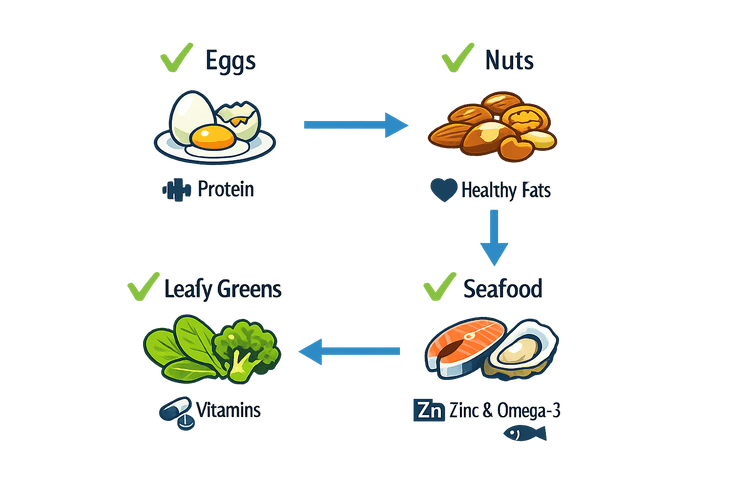
Zinc matters if you are deficient. Oysters, red meat and pumpkin seeds supply it. If your zinc is already normal, adding more does nothing for testosterone. The same applies to vitamin D: correct a deficiency, and you may see a modest rise in total testosterone. Add it when levels are normal, and you will not.
Step 3: Address Weight and Insulin First
If your body mass index is above 30, losing 10 to 15 pounds will raise testosterone more reliably than any food. Fat tissue converts testosterone to estradiol. Insulin resistance lowers SHBG, which changes the free-to-total testosterone ratio. Both are reversible with weight loss, and the effect size is larger than anything you will get from a seed or a spice.
How weight loss affects testosterone levels covers the mechanism and the numbers from trials that measured it. The short version: calorie deficit, resistance training and improved insulin sensitivity move the number. Fenugreek does not.
Step 4: Retest After Three Months
If you change your diet, your training or your weight, retest at three months. Use the same lab, the same time of day, the same fasting protocol. Compare the new panel to your baseline. If total testosterone rose by 50 to 100 ng/dL and free testosterone followed, the changes worked. If the numbers stayed flat or dropped, food is not the lever you need.
Most men who test low twice and show low or low-normal LH end up on testosterone replacement or a medication like enclomiphene. The foods that boost testosterone in a healthy range will not pull you out of clinical hypogonadism. Test first, test twice, then decide.
Tips and Tricks
Start with what you avoid, not what you add. Diets high in preserved meats, deep-fried foods and processed fish correlate with lower testosterone in the published data. A 2021 study of 3,283 men found that those who ate the most preserved vegetables, processed meat, deep-fried foods and innards had measurably lower testosterone than men who ate the least. That pattern held regardless of body weight.
If you drink, keep triglycerides in check. The same study found that men with higher triglyceride levels had lower testosterone, with a negative correlation of β = -0.84 (p < 0.001). Alcohol, excess sugar and high-fat Western diets all raise triglycerides, and the effect on testosterone appears independent of body weight. Ask your doctor for a lipid panel before changing your diet, then retest after three months.
Mediterranean patterns show the clearest benefit. Olive oil, in particular, contains oleocanthal, which inhibits COX-1 and COX-2 enzymes, and resveratrol, which reduces oxidative stress. A 2025 review found that olive oil enhances testicular antioxidant capacity and restores the SREBP2 cholesterol pathway, which testosterone synthesis depends on. The effect comes from the whole dietary pattern—olive oil, nuts, fish, vegetables—not a single ingredient.
Ketogenic diets increase cholesterol availability, which may support testosterone synthesis, but the long-term data is thin. One mechanism: elevated ketone bodies suppress neuropeptide Y and ghrelin, which may indirectly support hormone balance. The short answer is that we have plausible mechanisms and short trials, not multi-year human data. If you try it, test before and after.
| Dietary Pattern | Testosterone Effect | What the Evidence Shows |
|---|---|---|
| Mediterranean | Positive | Synergistic bioactive nutrients, antioxidant support, cholesterol pathway restoration |
| Ketogenic | Possibly positive | Increased cholesterol availability, reduced inflammation markers, short-term data only |
| Vegetarian | Mixed | High fiber reduces cholesterol bioavailability, but antioxidants support reproductive health |
| Western | Negative | Excess fat and sugar promote obesity, hepcidin overproduction, disrupted iron homeostasis |
Vegetarian diets present a trade-off. High fiber and low fat intake reduce cholesterol bioavailability, which can impair testosterone synthesis. The same diets provide abundant antioxidants, which counteract oxidative stress and support male reproductive health. The net effect depends on how you structure the diet—adequate fat, zinc and vitamin D matter.
Supplements are not foods. Fenugreek saponins, black ginger polymethoxyflavones and zinc methionine appear in formulations marketed for testosterone support. A 2025 study characterized one such product with 20% saponins, 0.93% polymethoxyflavones and 1.4% elemental zinc. That is a product study, not a dietary intervention, and it tells you nothing about eating fenugreek seeds or ginger root. For supplement evidence, see How to Raise Testosterone Naturally: Evidence-Based Methods.
What we don't know yet: dose-response curves for specific foods, long-term adherence data, and whether dietary changes move the needle enough to matter clinically. The studies measure correlations and short-term biomarker shifts, not whether men who switch diets avoid TRT five years later. Test first, change one variable, test again.
Conclusion
The short answer: no single food will fix low testosterone. The evidence for specific foods is thin, the effect sizes are small, and nobody selling supplements will tell you that the trial data comes from rats or from a 60-person study funded by the ingredient supplier.
What the research does show is this: obesity, alcohol, sleep apnea and training volume all move the number more than any food on a plate. Fix those first. Test twice in the morning, read the full panel, and then decide whether you need medication or just need to lose weight and sleep more.
Fenugreek extract appears in several trials, including one where 60 men took 600 mg per day for six weeks and reported improved libido. That is a small, short study. The formulation tested was Testofen, a standardized extract with added minerals — not the ground seed you buy at the grocery store. The trial measured self-reported sexual function, not testosterone levels directly. Worth knowing before you buy a bottle.
If your morning testosterone is consistently low and your symptoms are real, food will not be enough. The options are enclomiphene, hCG or TRT, and each one has a different cost in money, monitoring and fertility. That is where you need a doctor who will test you correctly and explain the trade-offs plainly.
In my research, I've often encountered discrepancies between what the FDA labels specify and what is advertised by sellers. A trial might show promising results for a particular food or supplement, but it's important to note the specific population and conditions under which the trial was conducted. By focusing on these aspects, we can better navigate the complex landscape of testosterone-boosting foods and make informed decisions.
Eat whole foods, lift heavy, sleep enough, and test before you treat. That is the free option, and it works for more men than the clinic ads suggest.
Explore which foods boost testosterone levels, supported by research evidence. Learn what actually works and what to avoid.
Related reading
Sources(14)
- The journal of sexual medicine (2019)
- International journal of impotence research (2023)
- Journal of advanced research (2025)
- RSC advances (2026)
- Advances in clinical and experimental medicine : official organ Wroclaw Medical University (2025)
- RSC advances (2026)
- Nutrients (2021)
- PloS one (2016)
- The Journal of steroid biochemistry and molecular biology (2021)
- Journal of human kinetics (2014)
- Frontiers in nutrition (2026)
- Nutrients (2018)
- The Journal of the American Board of Family Practice (2001)
- European journal of endocrinology (2013)