Comparing TRT Cost: Local Clinic vs Telehealth vs Self-Pay
Updated
Top takeaways
- TRT costs vary widely by delivery method: local clinics, telehealth platforms, and self-pay arrangements each carry different price structures and hidden fees
- Monthly costs range from under $50 for self-pay generic testosterone to over $500 for full-service clinic programs with monitoring and consultations
- Insurance coverage, lab frequency, and medication formulation drive the biggest cost differences between options
- Understanding what each price includes—and what it doesn't—helps you compare TRT cost accurately before committing
Introduction
Comparing TRT cost means looking past the advertised monthly fee. A local clinic might quote $200 per month but bill labs separately. A telehealth service advertises $99 but requires a $250 consultation upfront. Self-pay at a pharmacy runs $30 for a vial of testosterone cypionate, but you still need a prescription, baseline labs, and follow-up monitoring.
The number that matters is what you actually pay over six months, including every consultation, lab panel, and refill. That total changes based on whether you use insurance, how often your doctor orders labs, and which testosterone formulation you receive. Some men pay under $500 for six months of treatment. Others spend $3,000 for the same period, and both are using real TRT.
This guide breaks down what local clinics, telehealth platforms, and self-pay options cost in money and monitoring. It covers what each method includes, what it leaves out, and where the surprise charges appear. Before choosing between these, you need to know what "TRT cost" means in each model—and what you're actually comparing. For men considering alternatives to injectable testosterone, Clomid for Men: How It Raises Testosterone and What It Costs You explains how clomiphene works and what it runs per month.
Understanding TRT Cost Variability
Comparing TRT cost is harder than it should be. Clinics advertise monthly subscription fees that do not include lab work. Telehealth platforms show a single price on the landing page, then add consultation charges, shipping and monitoring panels after you sign up. Insurance coverage changes the math entirely, but most clinics do not tell you whether they bill insurance until you ask.
The advertised price is rarely what you pay. A local clinic might quote $150 per month for testosterone cypionate injections, but that assumes you already have a diagnosis, recent labs and a prescription. Add the initial consultation, the baseline hormone panel, follow-up testing at three months and six months, and the first year costs two to three times the monthly rate. Telehealth platforms bundle some of those services, but the package price often covers only one formulation. If you need to switch from injections to a cream or add hCG to preserve fertility, the subscription resets at a higher tier.
Self-pay pricing is the clearest number, but it excludes monitoring. When you fill a prescription at a retail pharmacy without insurance, the testosterone vial has a fixed price. The syringes, alcohol wipes and sharps container add a few dollars. What self-pay does not include is the doctor who writes the prescription, the lab that runs your panels, or the follow-up visit that adjusts your dose when your hematocrit climbs. Those services exist outside the pharmacy transaction, and each one bills separately.
What Drives the Variation
Formulation is the biggest lever. Testosterone cypionate in a multi-dose vial costs less than single-dose prefilled syringes, which cost less than compounded creams, which cost less than brand-name gels, which cost less than oral testosterone capsules. The active ingredient is the same; the delivery system and the manufacturing process set the price. Compounded formulations sit in the middle. A compounded cream often costs more than generic injections but less than a brand-name transdermal, and insurance rarely covers compounding.
Monitoring frequency changes the total. The first year of TRT requires more lab work than later years. Baseline panels measure total testosterone, free testosterone, estradiol, hematocrit, PSA and lipids. Follow-up panels at six to twelve weeks check whether the dose is working and whether hematocrit is rising. After the dose stabilizes, most protocols call for labs every six months. Telehealth platforms that include labs in the subscription fee spread that cost across every month; clinics that bill labs separately front-load the expense.
Insurance coverage is unpredictable. Some plans cover testosterone injections but not gels. Some cover gels but require prior authorization and a failed trial of injections first. Some cover the drug but not the lab work. Some cover everything if your total testosterone is below 264 ng/dL and nothing if it is 265. The same plan may reimburse a urologist's prescription but deny an endocrinologist's, or cover treatment for secondary hypogonadism but not primary. Calling the number on the back of your insurance card will not give you a reliable answer until a claim is submitted.
The number that matters is what you pay per year, not per month, and it includes the drug, the labs, the doctor visits and the add-ons you did not know you needed.
Clinics structure their pricing to match how they operate. A local urology practice bills insurance for everything and you pay the copay. A men's health clinic that does not take insurance charges a flat program fee and includes the first round of labs. A telehealth platform sells a subscription that covers the medication, the provider messaging and sometimes the labs, but shipping, syringes and optional add-ons like hCG or anastrozole cost extra. None of these models is better or worse; they are optimized for different patient flows, and the total cost depends on which services you actually use.
The cheapest option on paper is often the one with the most hidden steps. A $99-per-month telehealth subscription looks attractive until you realize it does not include the initial consultation, the diagnostic labs, or the follow-up visit that adjusts your protocol when the first dose does not work. A local clinic that charges $200 for the first visit and bills your insurance for everything else might cost less over twelve months, or it might cost more if your plan does not cover testosterone. You will not know until you add up every line item for a full year.
Evaluating TRT Cost Options
Comparing TRT cost means breaking it into pieces you can measure. Every option has three parts: the drug itself, the monitoring labs, and the clinic or subscription fee. What looks cheap at first can get expensive once you add blood work every three months and a monthly membership. Here is how to evaluate each path.
Start with the Drug Cost
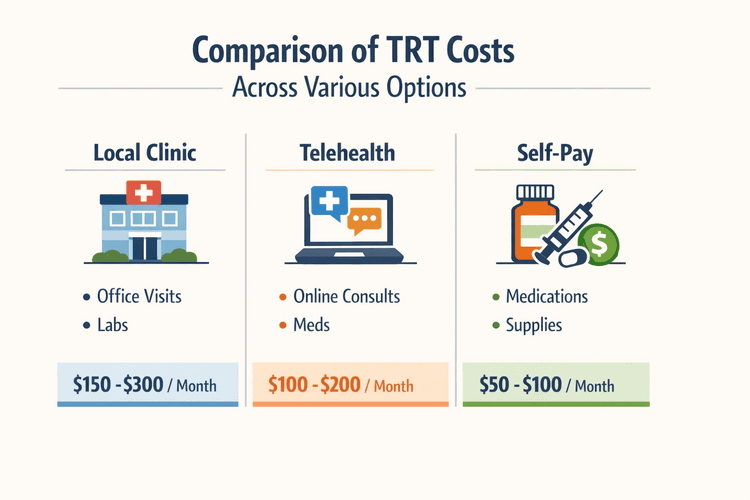
Testosterone injections are the cheapest form of the drug. A 10 mL vial of testosterone cypionate or enanthate runs $30 to $80 at most pharmacies when you pay cash. That vial lasts two to three months for typical TRT doses. Compounded testosterone from telehealth clinics often costs more—$90 to $150 per month—because it is not a generic you can price-shop at CVS or Costco.
Gels and patches cost more than injections. Brand-name gels run $400 to $600 per month without insurance. Generic versions bring that down to $150 to $300. Patches sit in the same range. Oral testosterone—Jatenzo, Kyzatrex, Tlando—costs $500 to $900 per month and rarely gets covered by insurance for TRT. If cost matters, injections win on the drug alone. For more on oral options, see Oral Testosterone: Kyzatrex, Jatenzo, and Tlando Explained.
| Delivery method | Typical monthly drug cost (self-pay) | Frequency |
|---|---|---|
| Injectable (cypionate/enanthate) | $10–$27 (vial lasts 2–3 months) | 1–2 injections per week |
| Compounded injectable (telehealth) | $90–$150 | 1–2 injections per week |
| Generic gel | $150–$300 | Daily application |
| Brand-name gel | $400–$600 | Daily application |
| Oral (Jatenzo, Kyzatrex, Tlando) | $500–$900 | 2–3 doses per day |
Add Monitoring Labs
TRT requires blood work before you start and every three to six months after. The baseline panel should include total testosterone, free testosterone, SHBG, LH, FSH, estradiol, hematocrit, and PSA. That panel costs $200 to $400 if you order it yourself through a direct-to-consumer lab like Ulta Lab Tests or Request A Test. If your doctor orders it and you pay cash, expect $300 to $600 depending on the facility.
Telehealth clinics usually include labs in their membership fee, but read the fine print. Some cover only two panels per year. If your hematocrit climbs or your estradiol swings, you will pay out of pocket for the extra draw. Local clinics that take insurance may bill the labs to your plan, but you still owe the copay or the full cost until you hit your deductible.
Factor in the Clinic or Membership Fee
Local endocrinology or urology practices usually bill an office visit—$150 to $300 without insurance—for the initial consult and then $100 to $200 for follow-ups every three to six months. Some practices include the follow-up in a treatment package, others bill each visit separately. Ask before you book.
Telehealth TRT clinics charge a monthly membership that bundles the consult, the prescription, and sometimes the labs. Membership fees run $99 to $199 per month. That sounds simple until you add it up: $1,200 to $2,400 per year just for access, before the drug and any extra labs. If the clinic also marks up compounded testosterone, your total annual cost can hit $3,000 to $4,000.
Step 1
List every cost before you sign up
Write down the drug cost, the lab cost, the visit or membership fee, and the shipping or handling fee if the clinic mails the medication. Add them for one year. Compare that number across three options: local clinic with insurance, local clinic self-pay, and telehealth. The lowest monthly fee is not always the lowest total.
Step 2
Check what the membership includes
Does the monthly fee cover unlimited messaging with the provider, or do you pay per consult? How many lab panels per year are included? Does the clinic require you to use their compounded drug, or can you fill the prescription at your own pharmacy? If you can use your own pharmacy, the membership is just a prescribing service, and you can price-shop the drug.
Step 3
Ask about the exit terms
Can you cancel anytime, or is there a minimum commitment? If you stop the membership, do you keep the prescription, or does it expire with the account? Some clinics let you take the script to your own doctor after the first few months. Others require you to stay enrolled to keep refills coming.
Compare Self-Pay to Insurance
If your insurance covers TRT, the copay for the drug is usually $10 to $50 per month for injections, higher for gels. The office visit copay is $20 to $75, and labs may be fully covered or cost you $50 to $150 depending on your plan. That can bring your annual cost below $1,000.
If your insurance does not cover TRT—because your total testosterone is above 264 ng/dL, or because the plan excludes it—you will pay full price for everything. In that case, self-pay injections plus direct-to-consumer labs can cost less than a telehealth membership. Run the numbers both ways.
The cheapest option is the one where you can see every line item and cancel without a penalty.
Watch for Hidden Costs
Some telehealth clinics charge a one-time enrollment fee—$50 to $250—on top of the first month's membership. Others charge shipping and handling every month, adding $15 to $30. If the clinic requires you to buy syringes, alcohol wipes, and sharps containers from them instead of Amazon, that is another $10 to $20 per month.
Local clinics may charge a facility fee for the blood draw separate from the lab fee. If they administer the injection in the office instead of teaching you to do it at home, you pay an injection fee every week—$25 to $75 per visit. That turns a $30 vial into a $400-per-month service.
Evaluating Comparing TRT Cost in Practice
Here is what comparing TRT cost looks like for one year on each path, assuming weekly injections and quarterly labs:
- Local clinic, insurance: $600 drug copays + $300 visit copays + $200 lab copays = $1,100
- Local clinic, self-pay: $120 drug + $800 visits + $1,200 labs = $2,120
- Telehealth with compounded drug: $1,800 membership + $1,200 drug (included or separate) + $0 labs (included) = $1,800 to $3,000 depending on what the membership covers
- Self-pay injections, DIY labs: $120 drug + $800 labs (direct-to-consumer) + $400 initial and follow-up visits (cash-pay doctor) = $1,320
The self-pay path with your own pharmacy and your own labs often costs less than a telehealth membership, especially after the first year when you need fewer visits. Insurance wins if your plan covers it without a fight.
Nobody selling it will tell you that the membership is optional once you have the prescription. Many men pay monthly fees for a year, then realize they can refill the same drug at Costco for $10 and order their own labs for $250. Comparing TRT cost means checking if you are paying for convenience you do not need.
Tips for Navigating TRT Costs
Comparing TRT cost options means looking past the monthly subscription price. The number that matters is what you pay over a year, including labs, consultations, medication and shipping. A clinic advertising $99 per month may bill separately for each video call, each lab panel and each prescription refill. Add those up before you sign.
Ask for the full price breakdown before enrollment
Request a written estimate that includes consultation fees, lab fees, medication cost and any platform or membership charges. Telehealth clinics structure billing in different ways — some bundle labs and consultations into one monthly fee, others charge each separately. If a clinic will not provide a written breakdown, that is worth knowing before you give them a credit card.
Compare insurance coverage before choosing self-pay
If your insurance covers TRT, the copay for a local endocrinologist visit and a branded prescription may cost less than a telehealth subscription. Does insurance cover TRT walks through how to check your plan's formulary and prior-authorization requirements. Some plans cover injections but not gels, or cover generic but not compounded formulations. Call your insurer with the specific drug name and NDC code to confirm coverage before assuming self-pay is cheaper.
| Cost factor | Local clinic with insurance | Telehealth self-pay |
|---|---|---|
| Initial consultation | Copay ($20–50) | $0–150 |
| Follow-up visits | Copay per visit | Often bundled in monthly fee |
| Labs | Copay or covered | $50–200 per panel |
| Medication | Copay ($10–50/month) | $50–200/month |
| Total annual estimate | $500–1,500 | $1,200–3,000 |
Use GoodRx or pharmacy discount cards for self-pay prescriptions
If you pay out of pocket for a prescription written by a local provider, check GoodRx, SingleCare and your pharmacy's discount program before filling it. Generic testosterone cypionate or enanthate often costs $30–60 per vial with a discount card, compared to $80–150 without one. Compounded formulations from telehealth clinics do not qualify for these discounts because they are not dispensed through retail pharmacies.
Confirm what monitoring the clinic actually performs
Some telehealth platforms advertise "full monitoring" but send lab kits only once or twice a year. The standard of care for TRT is labs at baseline, 3–6 months, then annually, checking total and free testosterone, hematocrit, PSA and sometimes estradiol and liver function. Ask the clinic how often they order labs, which markers they test and whether those labs are included in the membership fee or billed separately.
Understand the refill and cancellation terms
Read the membership agreement for auto-refill, subscription renewal and cancellation policies. Some clinics require 30 days' notice to cancel, others bill month-to-month with no penalty. If you want to pause treatment or switch providers, know whether you can keep your remaining medication or whether the clinic requires you to return it. Compounded medications are non-transferable — you cannot take a prescription from one compounding telehealth clinic and fill it at another.
Conclusion
Comparing TRT cost means looking at three numbers: the monthly bill, the time you spend managing it, and what happens if you need to stop. Local clinics charge more but handle the logistics. Telehealth costs less and ships to your door, but you coordinate your own labs and follow-up. Self-pay through a cash pharmacy is the cheapest per vial, but you pay for every test and visit separately, and nobody reminds you when to reorder.
The cheapest option is not always the one that costs you least. A $99-per-month telehealth subscription that includes quarterly labs and unlimited messaging may cost you less over a year than a $40 vial you buy yourself but forget to monitor, leading to a $300 hematocrit problem six months in. The expensive local clinic that takes your insurance and runs your labs in-house may be cheaper than the telehealth service that doesn't, if your plan covers it.
Before you sign up, ask what the first year costs in total: initial consult, labs, medication, follow-up visits, and the monitoring tests guidelines say you need. Ask what happens if your insurance changes, if the medication goes on backorder, or if you move to a state the telehealth service doesn't cover. The answers tell you whether the advertised price is the price you actually pay.
Test first, price second, and read the membership terms before you agree to anything. The right choice depends on what you can afford, what your insurance covers, and whether you want someone else to handle the follow-up or you'd rather do it yourself. For more details on insurance coverage, see Does Insurance Cover TRT? What You Need to Know.
Sources(22)
- The Journal of urology (2020)
- Sexual medicine reviews (2017)
- F&S reviews (2020)
- International journal of pharmaceutical compounding (2015)
- The journal of sexual medicine (2013)
- International journal of general medicine (2022)
- The aging male : the official journal of the International Society for the Study of the Aging Male (2015)
- The journal of sexual medicine (2019)
- International journal of impotence research (2023)
- RSC advances (2026)
- RSC advances (2026)
- Journal of human kinetics (2014)
- The journal of sexual medicine (2022)
- European urology focus (2017)
- The journal of sexual medicine (2009)
- Andrology (2025)
- American family physician (2024)
- European journal of endocrinology (2024)
- American Urological Association — Evaluation and Management of Testosterone Deficiency (AUA Guideline) (2018)
- Journal of Clinical Endocrinology & Metabolism — Testosterone Therapy in Men With Hypogonadism: An Endocrine Society Clinical Practice Guideline (2018)
- International journal of impotence research (2023)
- The journal of sexual medicine (2021)