Testosterone Injections vs Gel: Testosterone Gel, Cream, Pellets
Updated
Introduction
Testosterone delivery methods determine how replacement therapy enters your bloodstream, how steady the levels stay, and what you pay in money, time, and monitoring. Testosterone replacement therapy raises your testosterone when your body no longer makes enough on its own. The hormone itself is the same regardless of delivery method — what changes is the absorption pattern, peak-and-trough variation, and daily management burden.
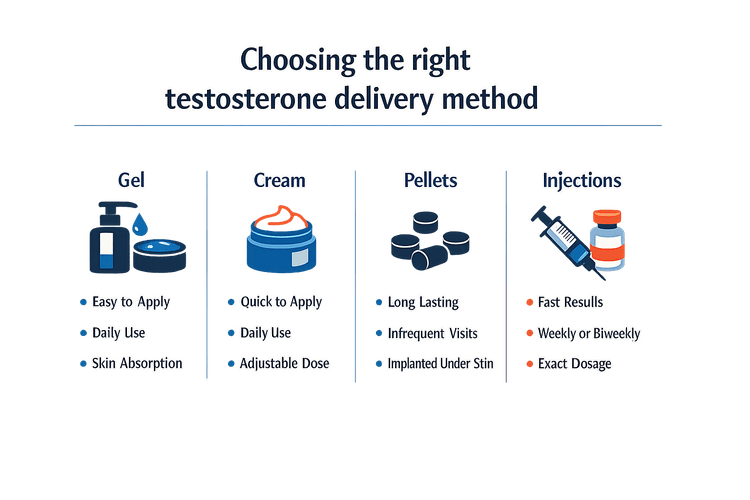
The four main testosterone delivery methods are gels, creams, pellets, and injections. Gels and creams go on your skin daily. Pellets sit under your skin for months. Injections go into muscle weekly or less often. Each has a different profile for transfer risk to partners and children, insurance coverage, and out-of-pocket cost.
Choosing between testosterone delivery methods starts with understanding what each method does to your testosterone curve over a day or a week, and what that curve does to your symptoms, your labs, and your willingness to stick with it. The best method is the one that keeps your levels in range without creating new problems you will not tolerate. If you are comparing options, start with how to choose an online TRT clinic that offers more than one delivery method and explains the monitoring required for each.
This guide walks through what the trials measured, what each method costs, and how to match your situation to the option most likely to work for you.
What Makes Choosing Between Testosterone Delivery Methods Difficult?
Every testosterone delivery method trades one problem for another. Gels and creams are easy to start but require daily application and carry transfer risk to partners and children. Injections deliver the most predictable blood levels but mean needles every week or two. Pellets last months but require a minor surgical procedure and can't be adjusted once implanted. The method that works depends on what you're willing to monitor, how your body metabolizes testosterone, and what fits your life.
Why the Delivery Method Matters More Than You Think
Testosterone replacement therapy raises your testosterone level — but how it raises it changes what you deal with day to day. Topical methods (gels and creams) absorb through the skin and produce steady levels if you apply them consistently. Injectable testosterone creates a peak-and-trough pattern: levels rise sharply after the shot, then decline until the next dose. Pellets release testosterone slowly over three to six months, with no daily routine but also no way to stop or adjust mid-cycle.
The absorption rate, the frequency of dosing, and the monitoring schedule all differ by method. What you pay, how often you see a clinic, and whether you need to worry about skin contact with others — those details shift depending on which delivery system your doctor prescribes.
The Trade-Offs You Can't Avoid
No method is universally better. Gels and creams avoid needles but require washing your hands after application and keeping the treated skin covered until the gel dries — failure to do so can transfer testosterone to anyone who touches that area. Injections eliminate transfer risk but mean learning to inject (or paying a clinic to do it) and accepting that your testosterone level swings between doses. Pellets remove the daily or weekly task but lock you into a dose for months, and removing them early requires a second procedure.
Cost and convenience also vary. Gels and creams are often covered by insurance but cost more out of pocket if they're not. Injections are the cheapest option when paid cash, especially if you inject at home. Pellets are the most expensive upfront and usually aren't covered. Monitoring frequency — how often you need blood work — depends partly on the method and partly on how your levels stabilize.
The method that works is the one you'll actually use for years, not the one that sounds best in the first conversation.
What Disqualifies a Method for You
Some men can't use certain delivery methods. Testosterone therapy is not appropriate if you have suspected or known prostate cancer, breast cancer, or significant kidney, liver, or heart problems. Beyond those contraindications, specific methods carry additional restrictions. If you have young children or a female partner trying to conceive, topical testosterone creates a transfer risk that makes gels and creams harder to manage safely. If you have a bleeding disorder or take anticoagulants, injections may require extra caution. If you travel frequently or have an unpredictable schedule, pellets remove the compliance problem; if you need dose flexibility, they remove your ability to adjust.
Before choosing, you need two morning testosterone results, an LH level, and a conversation with a doctor about what each method requires. The choice starts with what your labs show, what your life allows, and what risks you're prepared to manage. For more on how to evaluate a clinic before signing up, see Best Online TRT Clinic: How to Choose and What to Avoid.
How Do You Choose the Right Testosterone Delivery Method?
There is no single best testosterone delivery method. The right one depends on your tolerance for needles, your daily routine, how your body metabolizes the drug, and what your insurance will cover. Here is how to narrow the field.
Step 1: Rule out contraindications first
Before choosing a delivery method, confirm you are a candidate for testosterone therapy at all. Men with suspected or known prostate cancer, breast cancer, or significant kidney, liver, or heart problems should not use testosterone therapy. Your doctor orders a PSA, hematocrit, and basic metabolic panel before writing the prescription. If those come back clear, you move to the next step.
Step 2: Decide whether daily application is realistic for you
Gels and creams require once-daily application to clean, dry skin — usually the shoulders, upper arms, or abdomen. You apply it in the morning, let it dry for a few minutes, then cover the area with clothing. You cannot shower or swim for several hours, and you must avoid skin-to-skin contact with women and children until the area is washed or covered.
If your morning routine is unpredictable, if you share a bed with a partner who might touch the application site, or if you train early and shower immediately after, daily topicals become harder to manage. Injections and pellets remove that variable.
Step 1
Assess your daily routine
Ask yourself: Can I apply a gel at the same time each morning, avoid contact with others for several hours, and delay showering? If the answer is no more than once or twice a week, injections or pellets fit better.
Step 3: Compare injection frequency and self-administration comfort
Testosterone injections are typically given once every one to two weeks, though some protocols use smaller doses twice a week to smooth out peaks and troughs. Most men inject intramuscularly into the thigh or gluteal muscle using a 1-inch needle. Some clinics teach subcutaneous injection with a shorter needle, which many find less intimidating.
If you are comfortable with needles and prefer fewer daily tasks, injections are straightforward. If needles are a dealbreaker, gels or pellets are the alternative. For men already managing other injectable medications, adding testosterone is usually not a burden.
Step 4: Weigh pellets against the other options
Pellets are implanted under the skin of the hip or buttock every three to six months in a minor office procedure. They release testosterone steadily without daily application or weekly injections. The trade-off is that once they are in, you cannot adjust the dose until the next insertion. If your levels come back too high or too low, you wait it out.
Pellets work well for men who want the lowest maintenance option and whose testosterone needs are stable. They are a poor fit for men starting therapy for the first time, because dose adjustments in the first six months are common. Most doctors start with injections or gels, then consider pellets once the target dose is established.
Step 2
Match delivery method to your monitoring tolerance
Gels and injections allow dose changes within days to weeks. Pellets lock you in for months. If you are new to testosterone therapy, start with a method that allows faster adjustments.
Step 5: Check what your insurance covers and what you will pay out of pocket
Insurance coverage for testosterone therapy varies widely. Generic testosterone cypionate for injection is usually the least expensive option and the most likely to be covered. Brand-name gels are often subject to prior authorization or high copays. Pellets are rarely covered and typically cost several hundred dollars per insertion.
Before choosing, call your insurance and ask what your copay will be for each option. If you are paying out of pocket, injections are almost always cheaper than gels, and gels are cheaper than pellets. Some online TRT clinics bundle the medication into a monthly subscription, which can simplify budgeting but may cost more than a local pharmacy.
| Method | Frequency | Self-administered | Typical monthly cost (out of pocket) |
|---|---|---|---|
| Gel | Daily | Yes | $200–$500 |
| Injection | Weekly to biweekly | Yes | $30–$100 |
| Pellets | Every 3–6 months | No (office procedure) | $300–$800 per insertion |
Step 6: Start with the method that allows the easiest monitoring
Testosterone therapy requires regular blood work — total and free testosterone, hematocrit, PSA, and estradiol at a minimum. In the first few months, you test every six to eight weeks to confirm the dose is working and not driving hematocrit or estradiol too high.
Gels and injections make it easier to adjust the dose based on those results. Pellets do not. If your first set of labs shows your testosterone is too high or your hematocrit is climbing, you cannot remove the pellets. You wait, retest, and adjust at the next insertion. That delay matters when managing side effects.
Most experienced prescribers start new patients on injections or gels, dial in the dose over three to six months, then offer pellets as a maintenance option once the target is stable.
Tips and Tricks for Successful Testosterone Treatment
Once you have chosen a testosterone delivery method, the work is not over. Treatment success depends on consistent monitoring, honest reporting, and realistic expectations. Here is what matters after the prescription is written.
Test Before You Adjust
Your first follow-up testosterone level should come six to eight weeks after starting treatment, not sooner. Levels stabilize at different rates depending on the delivery method, and testing too early produces numbers that do not reflect steady state. When you do test, use the same time of day and the same lab network you used for your baseline. Switching labs or testing at different times introduces variability that makes it harder to tell whether a dose change is working.
Do not chase a single number. One high or low result can come from sleep, stress, or lab error. If a level looks off, repeat it before changing your dose. Your doctor should be tracking more than total testosterone: free testosterone, hematocrit, estradiol, and PSA belong on the panel. Elevated hematocrit shows up in roughly 20 percent of men on TRT and requires dose reduction or therapeutic phlebotomy if it climbs above 54 percent.
Keep a Symptom Log
Lab numbers do not always line up with how you feel. Some men feel best at the low end of the reference range; others need levels near the top. A short daily log — energy, mood, libido, sleep quality — gives you and your doctor a pattern to compare against your labs. If your testosterone level is in range but symptoms persist, the delivery method may not be the problem. Weight, sleep apnea, alcohol intake, and training volume all affect how you respond to treatment.
The number that matters is the one that matches your symptoms, not the one that looks best on paper.
Before assuming your dose is wrong, check the variables you control. A 10-pound weight loss can raise testosterone more than a dose increase, and untreated sleep apnea blunts the response to any delivery method. If you are still symptomatic after three months at stable levels, ask your doctor whether non-medication levers are in play. For a detailed look at what actually moves testosterone without drugs, see How to Increase Testosterone Naturally: What Actually Moves the Number.
Stick to the Schedule
Gels and creams work only if you apply them every day at roughly the same time. Missing doses creates peaks and valleys that make it impossible to interpret your labs or stabilize your symptoms. Injections give you more flexibility, but skipping a dose or delaying it by several days produces the same problem. If your schedule makes daily application difficult, injections are the better fit. If you travel frequently and cannot carry syringes, gels or pellets may work better.
Pellets require the least daily effort, but they lock you into a dose for three to six months. If the dose is wrong, you wait it out or have the pellets removed. That makes pellets the wrong choice for your first round of treatment, when you are still finding the dose that works.
Plan for the Long Term
Testosterone replacement is not a short course of treatment. Most men who start stay on it indefinitely, because stopping returns testosterone to baseline or lower. If fertility is a concern now or in the future, discuss it with your doctor before starting any form of TRT. All testosterone delivery methods suppress sperm production in most men, and recovery is not guaranteed even after stopping treatment.
Cost matters over the long term. A delivery method that costs 50 dollars more per month adds up to 600 dollars per year, and insurance coverage can change. Compounded preparations — custom-mixed gels, creams, and troches — are usually cheaper than branded products, but they are not FDA-approved and quality varies by pharmacy. If you choose a compounded product, verify that the pharmacy is registered with your state board and accredited by PCAB or a similar organization.
Conclusion
Choosing between testosterone delivery methods comes down to three numbers: your morning testosterone level, your willingness to stick yourself or remember daily application, and what you pay after insurance processes the claim. Test first, test twice, then pick the delivery method that fits your schedule and your wallet. A gel you skip three times a week delivers less testosterone than an injection you take every ten days without fail.
The short answer is that injections cost less and hold levels steady if you tolerate needles. Gels and creams cost more, require daily discipline, and carry transfer risk to anyone who touches your application site before it dries. Pellets cost the most up front, last three to four months, and leave you stuck with that dose until they dissolve. None of these differences matter if your starting testosterone level does not justify treatment, so the number that matters is the one on your lab report, not the one in a clinic ad.
What we don't know yet is how long you will stay on whichever method you choose, because adherence data in the trials rarely extends past twelve months. The free option—losing weight, fixing sleep apnea, cutting alcohol—works for some men and costs nothing but time. The expensive option is switching testosterone delivery methods every six months because the first one annoyed you. Pick the method you can sustain, monitor your levels every three to six months, and adjust when the data say to adjust. For a detailed look at choosing a provider, see Best Online TRT Clinic: How to Choose and What to Avoid.
That is the reading. The evidence is thin on long-term adherence, but it is clear on short-term efficacy: all four testosterone delivery methods raise testosterone when dosed correctly and monitored properly. The one that works for you is the one you will actually use.
Frequently asked questions
What are the main testosterone delivery methods?
The four main testosterone delivery methods are gels, creams, pellets, and injections. Gels and creams are applied to the skin daily, pellets are implanted under the skin every three to six months, and injections are given into muscle weekly or biweekly.
Which testosterone delivery method is most cost-effective?
Injections are typically the most cost-effective testosterone delivery method, ranging from $30–$100 per month out of pocket. Gels cost $200–$500 monthly, while pellets run $300–$800 per insertion every three to six months.
How do I choose between testosterone delivery methods?
Choose based on your tolerance for needles, daily routine consistency, insurance coverage, and monitoring preferences. Injections suit those comfortable with needles who want lower cost. Gels fit men who prefer daily routines and can avoid transfer risk. Pellets work for those wanting minimal maintenance with stable doses.
Can I switch between testosterone delivery methods?
Yes, you can switch between testosterone delivery methods after discussing with your doctor. Most prescribers start with injections or gels to establish the right dose, then may offer pellets once levels stabilize. Switching requires new blood work to confirm levels remain in range.
Do all testosterone delivery methods have the same side effects?
All testosterone delivery methods share core risks including elevated hematocrit (in roughly 20 percent of men), suppressed sperm production, and potential cardiovascular effects. Topical methods add transfer risk to partners and children, while injections create peak-and-trough hormone swings.