TRT and Prostate Cancer: Current Evidence and Insights

Updated
Introduction
Testosterone Replacement Therapy treats men with clinically low testosterone levels, a condition also called hypogonadism. The treatment raises testosterone through injections, gels, patches, or pellets. For decades, doctors withheld TRT from men with any history of prostate cancer, based on the theory that testosterone fuels prostate growth and malignancy.
That theory came from early lab work and a single 1941 case report. More recent trials have tested whether TRT actually increases prostate cancer risk or worsens existing disease. The short answer: the data do not show a clear link, but the studies are small, short, and exclude men with aggressive disease. Nobody has run a long-term randomized trial large enough to settle the question.
Before choosing TRT, you need two morning testosterone results, a full hormone panel, and a prostate-specific antigen (PSA) test. If PSA is elevated or a digital rectal exam is abnormal, further workup comes first. Men already diagnosed with prostate cancer face a separate decision tree, and the evidence there is thinner. Selecting a clinic that follows published guidelines — rather than one that sells the drug first and tests later — matters. Best Online TRT Clinic: How to Choose and What to Avoid walks through what to check before signing up.
This article reviews what the trials measured, what they left out, and how to weigh the evidence when TRT and Prostate Cancer intersect in your own decision.
The Problem Statement
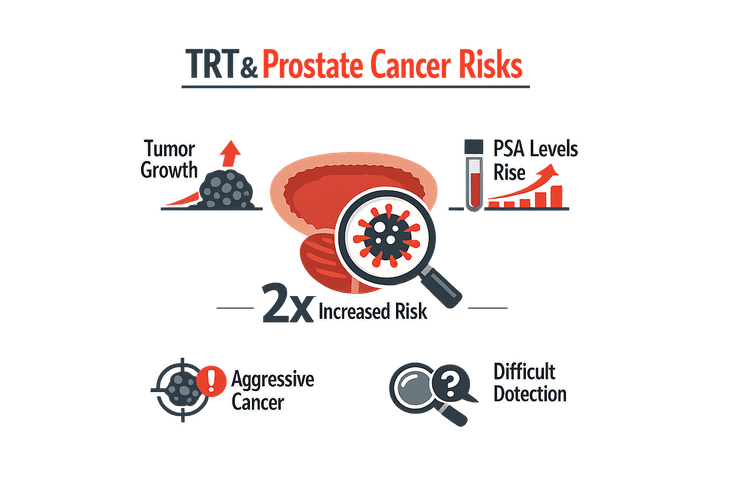
The question is straightforward: if you have low testosterone and need treatment, does TRT increase your risk of developing prostate cancer? For years, the answer seemed obvious — testosterone fuels prostate tissue, so adding more must be dangerous. That assumption shaped clinical guidelines and kept many men from treatment. The newer data tell a more careful story, and the gap between what clinics advertise and what the trials actually measured is worth understanding before you start.
The Old Concern: Testosterone Feeds Prostate Cancer
Testosterone is known to stimulate the growth of prostate cancer in men already diagnosed with the condition. That fact is not in dispute. If you have active prostate cancer, TRT is contraindicated — it can accelerate tumor growth. The question that matters for most men is different: does TRT cause new prostate cancer in men who do not already have it?
For decades, guidelines said yes, or at least assumed enough risk to recommend against it. Men at high risk for prostate cancer or with severe urinary symptoms from prostate enlargement were told to approach testosterone therapy with caution. That caution was built on older observational data and biological plausibility, not randomized trials.
What Recent Trials Found
Recent clinical trials in men with testosterone deficiency show no apparent increased risk of developing new prostate cancer from testosterone replacement therapy. These studies tracked men on TRT for several years and compared cancer incidence to controls. The signal that earlier guidelines feared — a spike in new diagnoses among treated men — did not appear in the data.
That does not mean the risk is zero. It means the trials, as designed, did not detect an increase. Sample sizes were limited, follow-up periods were finite, and men with known cancer or very high baseline PSA were excluded. The evidence is reassuring within those bounds, but it is not a blanket clearance.
The Screening Question
Before starting TRT, your doctor should assess your risk for prostate cancer. That means a baseline PSA test, a digital rectal exam if indicated, and a discussion of your family history and symptoms. If your PSA is elevated or your exam is abnormal, you need further workup before any testosterone prescription.
The problem is that not every clinic does this consistently. Telehealth providers vary widely in how thoroughly they screen. Some require a full panel and a follow-up PSA at three and six months. Others approve you based on a single total testosterone number and a questionnaire. Knowing what screening you are actually getting — and what you are skipping — matters if prostate cancer is a concern for you.
What We Still Don't Know
The trials that found no increased risk were not designed to detect small increases in rare cancers. They were powered to show cardiovascular outcomes, sexual function, or bone density. Prostate cancer incidence was a secondary endpoint, tracked but not the primary focus. That means the confidence intervals are wide, and a modest increase in risk could exist without showing up in the published results.
We also do not have long-term data on men who start TRT in their thirties or forties and stay on it for decades. The men in the trials were older, treated for shorter periods, and monitored more closely than the average telehealth patient. Extrapolating those results to younger men on indefinite therapy requires assumptions the data do not support.
The Bottom Line for This Section
The fear that TRT directly causes prostate cancer in men without existing disease is not supported by recent trials. The fear that TRT accelerates growth in men who already have cancer is supported and remains a hard contraindication. The gap between those two facts is where the clinical judgment lives. If you are considering TRT, you need baseline screening, ongoing PSA monitoring, and a clear understanding of what your clinic actually checks — not just what the consent form says they check. For more on how to choose an online TRT clinic that handles screening seriously, see our clinic evaluation guide.
Solution Steps
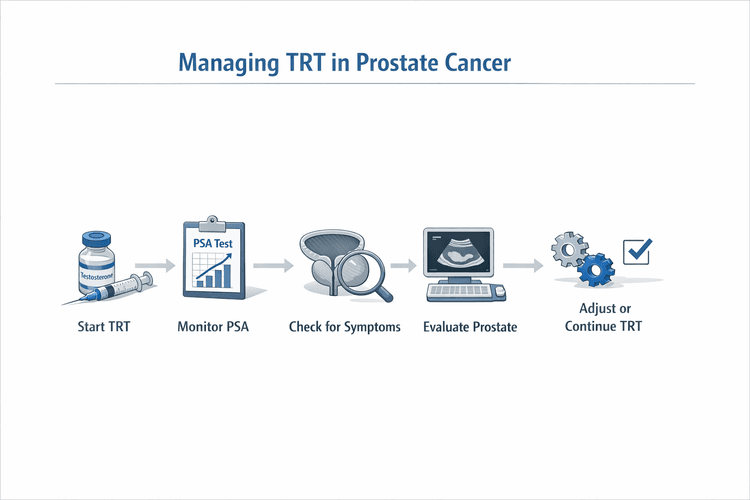
Before starting TRT, your doctor should assess your risk for prostate cancer. This means a baseline PSA test, a digital rectal exam, and a conversation about your family history. If any red flags appear, a urologist should clear you before testosterone touches your system.
Step 1: Get a Baseline PSA and DRE
Step 1
Get a Baseline PSA and DRE
Before the first dose, you need a PSA level and a digital rectal exam. These establish your starting point. If your PSA is elevated or your exam is abnormal, TRT waits until a urologist rules out existing cancer.
The PSA test measures prostate-specific antigen in your blood. A rising PSA during treatment can signal prostate growth or, rarely, cancer. The exam checks for lumps or hardness. Both are quick, both are non-negotiable.
Step 2: Discuss Fertility and Monitoring Before You Start
TRT usually lowers sperm production. If you want children later, ask about alternatives like enclomiphene or hCG that preserve fertility while raising testosterone. Once you start TRT, sperm count drops within weeks, and recovery is not guaranteed when you stop.
Regular monitoring through blood tests and physical exams is essential for men undergoing TRT to mitigate risks associated with the therapy. Your doctor should recheck PSA every three to six months for the first year, then annually if stable. Hematocrit, liver function, and lipids also need tracking.
Step 3: Weigh Risks and Benefits With Your Doctor
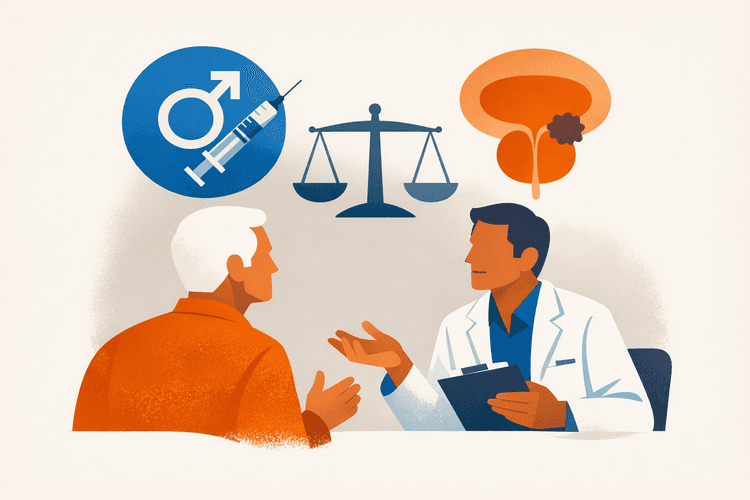
Men and their doctors should weigh these issues before committing to long-term testosterone therapy.
TRT raises testosterone reliably, but it is not risk-free. Cardiovascular events, blood clots, and prostate monitoring are part of the package. The evidence does not show that TRT causes prostate cancer, but it does require ongoing surveillance. If your symptoms are mild or your testosterone is borderline, ask whether non-medication options—weight loss, sleep, training—might move the number first.
If you are comparing TRT to other options, Best Online TRT Clinic: How to Choose and What to Avoid walks through what to look for in a provider before you sign up.
Step 4: Follow the Monitoring Schedule
Once you start, stick to the follow-up schedule. PSA, hematocrit, and symptom checks are not optional. If your PSA climbs or your blood thickens, your doctor will adjust or pause treatment. Missing appointments means missing problems until they are harder to fix.
Tips and Tricks
Before signing up for TRT, get two morning testosterone results and a full panel that includes PSA. One low number is not a diagnosis, and nobody can tell you whether treatment fits your risk profile without a baseline PSA and a clear picture of your prostate health. If you have a family history of prostate cancer or you are over 50, ask for a digital rectal exam and discuss whether additional screening makes sense before starting.
Know What You're Monitoring
Once you start TRT, your doctor should check PSA at three months, six months, and annually after that. A rapid rise in PSA—more than 1.4 ng/mL in a year or more than 0.4 ng/mL in six months—triggers further evaluation, not panic, but it is a signal worth acting on. Hematocrit also climbs on TRT, and levels above 54% increase clot risk; regular monitoring catches this before it becomes a problem.
Men at high risk for prostate cancer—those with a strong family history, prior abnormal PSA, or severe urinary symptoms from prostate enlargement—should approach testosterone therapy with caution and discuss potential side effects with their doctor. The evidence does not show that TRT causes prostate cancer, but it does stimulate prostate tissue, and that matters if cancer is already present or if your baseline risk is elevated.
What to Ask Your Provider
Ask what form of testosterone the clinic prescribes, how often you will need labs, what those labs cost, and whether PSA is included in the standard panel or billed separately. Ask whether the clinic works with a urologist for consultation if PSA rises or if you develop urinary symptoms. Choosing a clinic that coordinates care instead of operating in a silo reduces the friction when monitoring flags something.
The cheapest TRT subscription is the one that includes the labs you actually need, not the one with the lowest advertised monthly price.
If you have been told you are not a candidate for TRT because of prostate concerns, ask whether the concern is based on current evidence or outdated guidelines. Many providers still cite the old belief that testosterone fuels prostate cancer, even though the trials do not support it. A second opinion from a urologist or endocrinologist who follows the literature can clarify whether the caution is warranted or reflexive.
What the Free Option Looks Like
Before committing to TRT, try the interventions that cost nothing: lose weight if you are carrying extra, treat sleep apnea if you snore and wake unrefreshed, cut alcohol to two drinks or fewer per day, and lift heavy twice a week. These moves raise testosterone in men who are overweight or sedentary, and they improve the numbers enough that some men no longer meet the threshold for treatment. Testing again after three months of consistent effort tells you whether you respond.
Conclusion
The question of TRT and prostate cancer has moved from absolute prohibition to careful individual assessment. The old belief that testosterone fuels prostate cancer in every case does not hold up in the controlled trials conducted over the past two decades. Some studies now suggest that men who have been successfully treated for prostate cancer may be candidates for TRT as long as they are closely watched for signs of disease. That is not permission to skip monitoring — it is a framework that requires baseline PSA, digital rectal exam, discussion of personal and family history, and regular follow-up.
TRT can improve symptoms of low testosterone, such as sexual function and energy levels, but it does not cure the underlying causes of low testosterone. It is a management tool, not a reset button. The decision to start therapy involves weighing the documented benefits against the unknowns that remain, particularly for men with a history of prostate issues or elevated PSA at baseline. Men and their doctors should weigh these issues before committing to long-term testosterone therapy.
Before signing up with any clinic, ask what the monitoring schedule includes, how often PSA is checked, and what happens if your PSA rises or your hematocrit climbs above the safe range. A clinic that does not have clear answers to those questions is not equipped to manage TRT safely. The evidence supports careful use in selected patients — it does not support handing out prescriptions without a plan.
For men exploring their options, understanding how to increase testosterone naturally can provide additional context before deciding whether medication is necessary. The choice is not binary — it is a process that starts with two morning lab draws, a full panel, and a conversation about what you are willing to monitor and what you are not.