Vitamin D and Testosterone: When Supplementing Helps

Updated
Top takeaways
- Observational studies show a positive association between vitamin D and testosterone levels, but correlation is not causation
- One trial in overweight men found a significant testosterone increase with vitamin D supplementation; three later trials in men with normal baseline testosterone found no effect
- The evidence is thin here: small sample sizes, short durations, and conflicting results
- Vitamin D supplementation may help when you are deficient and your testosterone is low — not as a general testosterone booster
- Test first, test twice: a single vitamin D or testosterone result is not a diagnosis
Introduction
Vitamin D and testosterone levels both matter for men's health, and both are common deficiencies. Observational research shows that men with higher vitamin D levels tend to have higher testosterone. That association led to the question: does supplementing vitamin D raise testosterone?
The short answer is that it depends on who was studied. One randomized trial in overweight men with low vitamin D found a meaningful testosterone increase after a year of supplementation. Three later trials in men with normal baseline testosterone found no effect. The difference matters because the populations were different, the durations were different, and the starting hormone levels were different.
Before deciding whether vitamin D supplementation fits your situation, you need to know what your vitamin D level actually is and what your testosterone panel shows. Without those numbers, nobody can tell you whether supplementation will move the needle. For men looking at testosterone supplements for men, vitamin D is worth understanding because it shows up in many formulas — but the evidence for it is narrower than the marketing suggests.
This article walks through what the trials actually measured, who was studied, and when supplementation may be worth considering. It is not a recommendation to supplement or a diagnosis tool. It is a research desk summary of what the published evidence shows and what it does not.
Understanding the Problem: Low Testosterone Levels
Low testosterone affects a measurable portion of men, particularly as they age, lose lean mass, or develop metabolic conditions. Symptoms include fatigue, reduced muscle mass, low libido, and difficulty concentrating. The diagnosis requires two morning blood draws showing total testosterone below the lab's reference range, typically under 300 ng/dL, along with symptoms. One result is not enough — testosterone fluctuates daily, and a single low number can reflect poor sleep, recent illness, or the time of day you walked into the lab.
Vitamin D deficiency is common in the same populations. Observational studies indicate a positive association between circulating 25-hydroxyvitamin D (25OHD) and testosterone concentrations. Men with low vitamin D tend to have lower testosterone, and men with low testosterone tend to have low vitamin D. That correlation does not prove causation — both deficiencies cluster in men who are overweight, inactive, or chronically ill — but it raises the question of whether correcting one might improve the other.
The mechanism is plausible. Vitamin D receptors are present in testicular tissue, the hypothalamus, and the pituitary gland — all parts of the hormonal axis that regulates testosterone production. Animal studies show that vitamin D influences steroidogenesis, the process by which cholesterol is converted to testosterone. Whether supplementing vitamin D in deficient men reliably raises testosterone is a different question, and the human trials on that are smaller and more mixed than the observational data.
Before attributing low testosterone to a vitamin D problem, you need a full hormone panel: total and free testosterone, sex hormone-binding globulin (SHBG), luteinizing hormone (LH), and follicle-stimulating hormone (FSH). You also need a 25OHD level. If both are low, correcting the vitamin D deficiency is a low-cost, low-risk step to take before considering prescription options. If your testosterone is low but your vitamin D is normal, supplementing vitamin D will not fix it — and if your LH is low, the problem is upstream in the pituitary or hypothalamus, not in the testes, and vitamin D is unlikely to be the answer.
The short answer: low testosterone and low vitamin D often appear together, the biology supports a link, and testing both is the starting point. What the trials show about supplementation comes next.
How Does Vitamin D Supplementation Affect Testosterone?
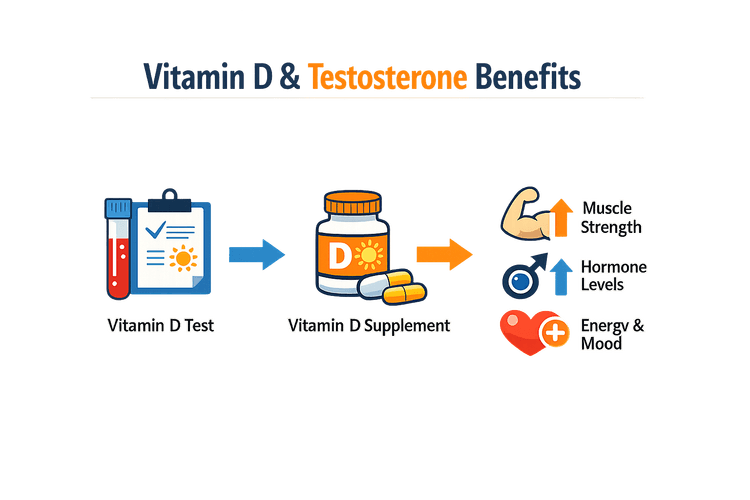
Vitamin D and testosterone: supplementation raises testosterone only in men who start with low vitamin D. The trial that showed an effect enrolled 54 men with baseline 25(OH)D below 50 nmol/L and testosterone at the lower end of the reference range. After one year of 3,332 IU daily, total testosterone rose from 10.7 nmol/L to 13.4 nmol/L, free testosterone from 0.222 nmol/L to 0.267 nmol/L, and bioactive testosterone from 5.21 nmol/L to 6.25 nmol/L. The placebo group saw no change.
A later trial in infertile men found no testosterone increase in the full group. But when the researchers looked only at men with 25(OH)D below 50 nmol/L, the vitamin D group had a significantly higher testosterone-to-LH ratio than placebo. That ratio matters because it tells you how much testosterone the testes produce per unit of pituitary signal. A higher ratio means the Leydig cells are working better.
What This Means for You
If your 25(OH)D is above 50 nmol/L, vitamin D supplementation probably will not move your testosterone. If it is below 50 nmol/L and your testosterone is at the low end of the range, supplementation may help. The effect size in the trial was about 2.7 nmol/L, or roughly 78 ng/dL. That is not a replacement for testosterone therapy if you need it, but it is a measurable shift for a supplement that costs less than most options.
Dosage and Duration
The trial that showed the testosterone increase used 3,332 IU daily for one year. That is higher than the standard 1,000–2,000 IU maintenance dose but well below the tolerable upper limit of 4,000 IU per day. The men in the trial were overweight and participating in a weight-reduction program, which may have influenced both baseline vitamin D status and response to supplementation.
Vitamin D is fat-soluble, so it accumulates over weeks and months. One morning dose does not change your testosterone. The trial measured outcomes at one year. If you correct a deficiency, retest 25(OH)D at three to six months to confirm you have reached a sufficient level, then retest testosterone to see if it moved.
When Supplementation Is Not Enough
Vitamin D corrects one input. If your testosterone is low for other reasons—primary hypogonadism, obesity, sleep apnea, chronic opioid use—fixing vitamin D will not fix the whole problem. The men in the trial had baseline testosterone at the lower end of normal, not diagnosed hypogonadism. If your total testosterone is below 300 ng/dL on two morning tests, vitamin D alone is unlikely to bring you into a healthy range. For men who need clinical treatment, choosing the right online TRT clinic becomes the next step.
The trials enrolled men with deficiency and borderline testosterone. If you are already sufficient or your testosterone is well below normal, the evidence for a benefit is thin.
Vitamin D is the free option. Test it, correct it if it is low, and retest testosterone after a few months. If the number does not move, you have ruled out one variable and can focus on the others.
Tips and Tricks for Effective Supplementation
Before you buy a bottle, test first. A 25-hydroxyvitamin D blood test costs fifteen to thirty dollars at most labs and tells you whether you need supplementation at all. Anything above 30 ng/mL is considered sufficient by most guidelines; below 20 ng/mL is deficiency. Without that number, you are guessing.
Test Twice: Vitamin D and Testosterone Together
If you are considering vitamin D to raise testosterone, get both labs drawn on the same morning visit. Total and free testosterone, plus 25(OH)D. That gives you a baseline. If your vitamin D is already 40 ng/mL and your testosterone is low, the supplement will not fix the testosterone. If your vitamin D is 12 ng/mL and your testosterone is low, correcting the deficiency is worth trying—but it is not guaranteed to move the testosterone number.
Dosing: What the Trials Used
Most trials that measured testosterone as an endpoint used 3,000 to 4,000 IU of vitamin D3 daily, sometimes given as a weekly or monthly bolus. The Endocrine Society guideline for correcting deficiency suggests 6,000 IU daily for eight weeks, then retesting. Over-the-counter bottles typically come in 1,000, 2,000, or 5,000 IU softgels.
Higher is not always better. Vitamin D is fat-soluble and can accumulate. Levels above 100 ng/mL carry risk of hypercalcemia. If you take more than 4,000 IU daily for months, retest every twelve weeks.
Timing and Absorption
Vitamin D absorbs better with fat. Take it with a meal that includes some fat—eggs, avocado, nuts, olive oil. Morning or evening does not matter for absorption, but if you are testing testosterone in the morning, you may as well take the vitamin D then too and keep the routine simple.
Monitoring: Retest in Twelve Weeks
If you start supplementation, retest 25(OH)D and testosterone after twelve weeks. That is long enough to see whether your vitamin D level corrected and whether testosterone moved. If testosterone did not budge, the supplement is not the lever you need. If it rose modestly and you were deficient to start, you have corrected one variable—but do not expect a large or sustained increase unless deficiency was severe.
For more on non-supplement interventions that move testosterone, see How to Increase Testosterone Naturally: What Actually Moves the Number.
What We Don't Know Yet
The trials that found a testosterone increase were small, short, and often did not control for weight loss, exercise, or other concurrent changes. The populations studied were heterogeneous—some with heart failure, some with obesity, some with confirmed hypogonadism. Future trials need to focus on men with both confirmed vitamin D deficiency and biochemical hypogonadism, because that is the subgroup where an endocrine effect is most biologically plausible.
Observational associations between vitamin D and testosterone may reflect shared determinants—adiposity, activity, sunlight exposure—rather than a direct causal pathway.
The Free Option
Sunlight exposure triggers vitamin D synthesis in the skin. Twenty minutes of midday sun on arms and legs, two to three times per week, can maintain adequate levels in many people during warmer months. If you live above 37° latitude or spend most daylight hours indoors, dietary sources and supplementation become more important. Fatty fish, fortified milk, and egg yolks provide some vitamin D, but not enough to correct deficiency on their own.
Conclusion
Vitamin D and testosterone are connected in cross-sectional data — men with higher vitamin D levels tend to have higher testosterone. But when researchers tested whether raising vitamin D raises testosterone, the answer split by starting point.
One trial in overweight men with low vitamin D showed a significant increase in total, bioactive and free testosterone after one year of supplementation. Three other trials in men with normal baseline testosterone showed no increase, even when vitamin D levels rose. The difference appears to be deficiency. If your vitamin D is low and your testosterone is low, correcting the deficiency may help. If your testosterone is already normal, vitamin D supplementation does not push it higher.
This is where the evidence stops being simple. The positive trial lasted a year; the negative trials ran shorter. The positive trial enrolled overweight men on a weight-reduction program; the negative trials enrolled heart-failure patients, nursing-home residents and non-Western immigrants. Nobody has run a large, long trial in men who look like the majority of supplement buyers — generally healthy, mildly low testosterone, no diagnosed deficiency. That trial would answer the question most men are asking, and it has not been done yet.
What we do know: vitamin D deficiency is common, easy to test and cheap to correct. If you test low in both, treating the vitamin D deficiency is a reasonable first step before considering prescription options. If your vitamin D is already normal, adding more to raise testosterone is not supported by the trials. For a broader look at what moves testosterone without prescriptions, see How to Increase Testosterone Naturally: What Actually Moves the Number.
Test first, test twice, and know what the number is before you decide.
Sources(26)
- The Journal of urology (2020)
- The Journal of clinical endocrinology and metabolism (2026)
- American family physician (2024)
- U.S. Food and Drug Administration — Drug Safety Communication: FDA cautions about using testosterone products for low testosterone due to aging; requires labeling change to inform of possible increased risk of heart attack and stroke with use (2015)
- Journal of Clinical Endocrinology & Metabolism — Testosterone Therapy in Men With Hypogonadism: An Endocrine Society Clinical Practice Guideline (2018)
- International journal of general medicine (2022)
- American Urological Association — Evaluation and Management of Testosterone Deficiency (AUA Guideline) (2018)
- International journal of impotence research (2023)
- The journal of sexual medicine (2019)
- Journal of human kinetics (2014)
- RSC advances (2026)
- The Journal of urology (2015)
- F&S reviews (2020)
- The world journal of men's health (2026)
- U.S. Food and Drug Administration — Enclomiphene Citrate: FDA presentation to the Pharmacy Compounding Advisory Committee, June 8, 2022 (Madeline Wolfert, MD, CDER)
- European journal of endocrinology (2024)
- American journal of cardiovascular drugs : drugs, devices, and other interventions (2025)
- The aging male : the official journal of the International Society for the Study of the Aging Male (2015)
- Hormone and metabolic research = Hormon- und Stoffwechselforschung = Hormones et metabolisme (2010)
- International journal of molecular sciences (2025)
- Andrology (2023)
- Hormone and metabolic research = Hormon- und Stoffwechselforschung = Hormones et metabolisme (2013)
- International journal of molecular sciences (2025)
- Clinical endocrinology (2015)
- Nutrients (2026)
- Nutrients (2018)