Does Enclomiphene Work? A Review of Human Trials

Updated
Top takeaways
- Enclomiphene is a selective estrogen receptor modulator studied for treating low testosterone without shutting down natural production
- Human trials show median testosterone increases around 166 ng/dL with fewer adverse effects than clomiphene citrate
- Development as an FDA-approved drug was discontinued in 2021, leaving it available only through compounded prescriptions
- The evidence base comes from comparative studies against clomiphene, not large placebo-controlled trials
- Understanding what the trials actually measured matters before choosing between enclomiphene, clomiphene, or TRT
Introduction
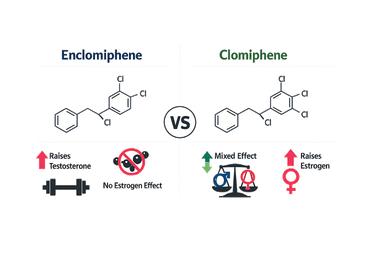
Enclomiphene is a selective estrogen receptor modulator, or SERM, that raises testosterone by signaling your pituitary to produce more luteinizing hormone. It is one isomer of clomiphene citrate, the mixed compound used off-label for male hypogonadism for decades. The promise: enclomiphene delivers the testosterone boost without zuclomiphene, the other isomer in clomiphene that accumulates and drives unwanted estrogenic effects.
The question is whether human trials back that promise, and what trade-offs the data actually show. Enclomiphene appeared in studies as a treatment for low testosterone and hypogonadism, with early results suggesting it maintained androgenic benefit while reducing side effects. Development as a standalone drug was discontinued in 2021, meaning it never received FDA approval for any indication. Today it is prescribed off-label through compounding pharmacies, often marketed by telehealth clinics as a fertility-preserving alternative to testosterone replacement therapy.
Before signing up, you need two morning testosterone results and a full panel including LH, FSH, and estradiol. Without those numbers, nobody can tell you whether a SERM like enclomiphene will work for you or whether TRT is the safer bet. The trials compared enclomiphene to clomiphene in small populations; they did not compare it head-to-head with TRT or establish long-term safety in men using it for years.
This review walks through what the human studies actually measured, who was studied, how much testosterone moved, what side effects appeared, and what the regulatory status means for cost and monitoring. For a deeper look at the mechanism and trial design, see Enclomiphene Citrate: What the Research Actually Shows.
Understanding the Problem
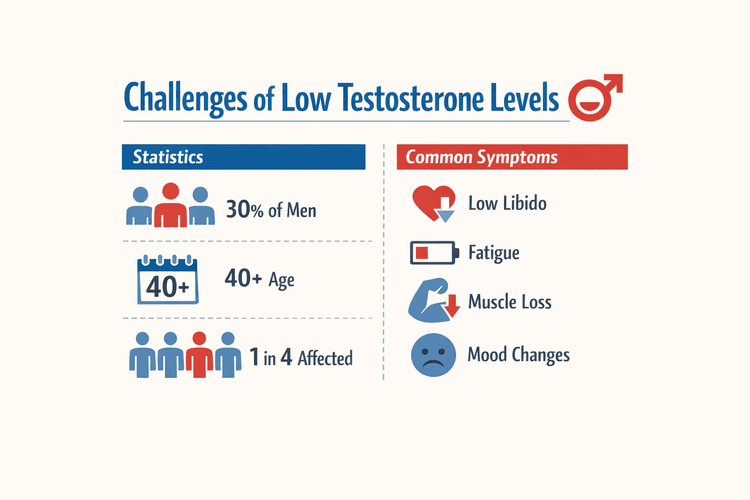
Low testosterone affects millions of men, but the standard fix — testosterone replacement therapy — comes with a trade-off most clinics bury in the fine print. TRT shuts down your own production. LH and FSH drop, the testes shrink, and sperm counts fall. For men who want children or prefer to keep their natural hormonal axis running, that creates a problem with no easy answer.
Does Enclomiphene Work for Fertility?
TRT works reliably to raise testosterone, but it usually tanks fertility. Younger men, men planning families, and men who simply want to preserve testicular function face a choice: live with low testosterone or accept the fertility risk. That gap has driven interest in alternatives that raise testosterone without suppressing the signals from the brain to the testes.
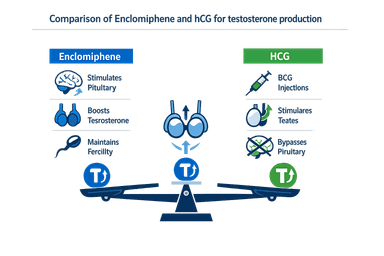
Enclomiphene sits in that gap. It is a selective estrogen receptor modulator that blocks estrogen feedback at the pituitary, which in turn raises LH and FSH. Higher LH tells the testes to make more testosterone. The mechanism preserves — and in some cases improves — sperm production, which makes it appealing to men for whom TRT is not suitable.
Who Needs an Alternative
The published trials focus on men with secondary hypogonadism — low testosterone caused by a problem at the pituitary or hypothalamus, not the testes themselves. These men typically have low or low-normal LH alongside low testosterone. Obesity, metabolic syndrome, and age-related decline all fit this pattern. For them, a drug that restores the brain-to-testes signal can work where lifestyle changes alone do not.
Enclomiphene Citrate: What the Research Actually Shows covers the mechanism in detail, but the short version is this: if your LH is already high and your testosterone is still low, your testes are not responding. Enclomiphene will not fix that. If your LH is low or normal and your testosterone is low, you are a candidate.
The Cost of Waiting
Low testosterone is not just a number. Fatigue, loss of muscle mass, reduced libido, difficulty concentrating, and mood changes all cluster together. Some men wait years before testing, assuming the symptoms are just aging. By the time they get labs, the problem has compounded. Weight gain worsens insulin resistance, which further suppresses testosterone. Sleep apnea develops, which lowers it more. The longer the delay, the harder it is to reverse without medication.
The question is not whether low testosterone needs treatment. The question is which treatment fits your situation: your age, your fertility goals, your willingness to monitor labs, and your tolerance for the unknowns that come with any drug still working through regulatory approval.
Evaluating the Evidence: Solution Steps
Enclomiphene blocks estrogen receptors in the hypothalamus and pituitary. That releases the brake on LH and FSH, which signal your testes to make more testosterone. The question is whether that mechanism translates into reliable, sustained increases in the numbers that matter.
Here is how to read the trial data.
Step 1: Check the Study Population and Duration
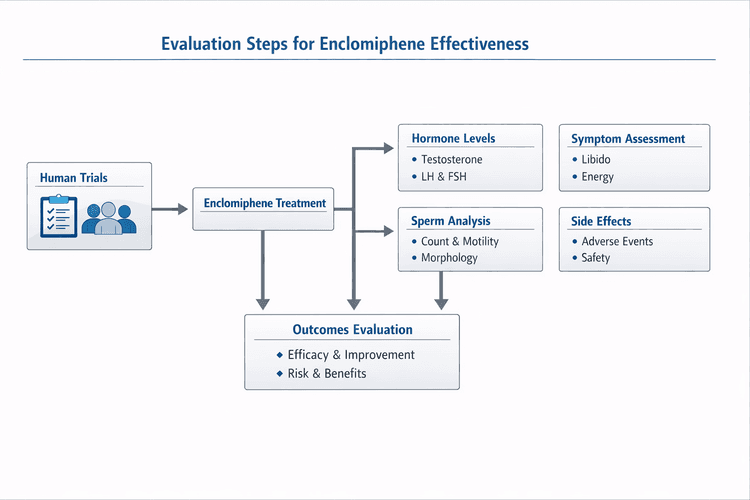
The FDA safety study tracked 499 men with secondary hypogonadism for 26 weeks. One group received 12.5 mg daily; the other started at 12.5 mg and titrated up to 25 mg if needed. That is a real-world dosing range, not a single dose locked in from day one.
Short-term clinical safety data for enclomiphene have been satisfactory and equivalent to safety data for testosterone gels and placebo. The trial was open-label and non-randomized, which means both patients and clinicians knew who got what. That introduces bias, but it also reflects how the drug would be used outside a blinded trial.
When you see "26 weeks," remember that is six months. Testosterone changes slowly. A four-week pilot tells you almost nothing about whether the effect holds.
Step 2: Look at Testosterone Improvement and Adverse Events
Enclomiphene provides the same magnitude of improvement in testosterone levels as other treatments, with a lower rate of documented adverse events. The comparison group in that analysis was not placebo; it was other hypogonadism treatments, including testosterone replacement.
Serious adverse events were rare but included deep vein thrombosis, pulmonary embolism, atrial flutter, and transient ischemic attack. These are the same cardiovascular and clotting risks that appear in TRT trials. Enclomiphene does not eliminate them; it shifts the mechanism but keeps some of the same monitoring requirements.
Step 3: Assess What the Trial Did Not Measure
The FDA safety study was designed to track adverse events, not fertility outcomes. It measured testosterone levels and safety signals, but it did not follow sperm counts, pregnancy rates, or long-term testicular function. If fertility preservation is your goal, you are working from mechanism and short-term surrogate markers, not from a trial that proved the outcome you care about.
That is the FDA's own assessment. The safety data are satisfactory. The testosterone response is real. The controlled efficacy data for fertility, metabolic outcomes, and head-to-head comparisons with TRT are still missing.
For a deeper look at what the research shows across all endpoints, see Enclomiphene Citrate: What the Research Actually Shows.
Step 4: Understand the Regulatory Context
Enclomiphene is not FDA-approved for secondary hypogonadism. It is available through compounding pharmacies and prescribed off-label. That means no standardized dosing, no FDA-reviewed labeling, and no post-market surveillance system tracking long-term outcomes.
When a clinic offers enclomiphene, ask what dose they prescribe, how they monitor response, and what happens if your testosterone does not rise or if side effects appear. The trial used 12.5 mg and 25 mg. If a clinic prescribes a different dose or skips the titration step, they are not following the published protocol.
Tips and Tricks for Patients

Before you sign up for enclomiphene, get two morning testosterone results a week apart. One low number is not a diagnosis. If both are low, ask for the full panel: total and free testosterone, LH, FSH, SHBG, and estradiol. Without LH, nobody can tell you whether enclomiphene fits your situation.
Enclomiphene works by blocking estrogen receptors in the brain, which raises LH and tells your testes to make more testosterone. If your LH is already high and your testosterone is still low, that signal chain is broken and enclomiphene will not fix it. You need the LH number before you start.
What to Ask Before You Start
Ask the clinic what they monitor and how often. Enclomiphene raises testosterone, but it also raises LH and can change estradiol. The trial data show a median testosterone increase of 166 ng/dL with enclomiphene compared to 98 ng/dL for clomiphene, though the difference was not statistically significant (P=0.20). Estradiol dropped by a median of 5.92 pg/mL with enclomiphene, while clomiphene raised it by 17.50 pg/mL (P=0.001).
If the clinic does not recheck labs in the first three months, you are flying blind. Ask what the retest costs and whether it is included in the monthly price.
Watch for Side Effects Early
The same trial found that adverse effects were statistically significantly less frequent with enclomiphene than with clomiphene. Decreased libido (P=0.001), reduced energy (P=0.044), and mood changes (P=0.03) all occurred less often. Regression analysis confirmed lower odds of adverse events with enclomiphene (OR: 0.18; 95% CI: 0.07–0.44, P=0.02).
If you notice mood changes, low energy, or libido problems in the first month, contact the prescriber. These are documented effects, and they may mean the dose is wrong or the drug does not fit you. Do not wait three months to report them.
Fertility and Sperm Production
Enclomiphene usually preserves sperm production because it raises LH and FSH, which signal the testes. TRT usually suppresses those signals and shuts down sperm production. If fertility matters to you now or in the next few years, tell the prescriber before you choose a treatment. For more on how to evaluate clinics and what to ask, see Best Online TRT Clinic: How to Choose and What to Avoid.
If you are already on TRT and want to preserve fertility, switching to enclomiphene may help, but recovery is not guaranteed. Ask for a baseline semen analysis before you switch.
Cost and Membership Structure
Enclomiphene is compounded, not FDA-approved. That means it is not covered by insurance. Monthly prices range from $99 to $250 depending on the clinic, dose, and whether labs are included. Ask what the total cost is for the first three months, including the initial consult, labs, and medication. Some clinics bill monthly; others require a quarterly commitment.
Read the cancellation terms before you sign up. Some memberships auto-renew and require 30 days' notice to stop. If the drug does not work for you or causes side effects, you want to be able to stop without paying for months you do not use.
Conclusion
Enclomiphene raises testosterone in the trials that measured it, usually preserves sperm production, and shows fewer side effects than its racemic parent clomiphene. Those findings come from small studies, short durations, and populations that were carefully selected. The evidence is thin here, and the sample sizes do not yet support sweeping conclusions about long-term safety or effectiveness across all men with low testosterone.
As of 2021, development of enclomiphene as a drug has been discontinued for all medical purposes, and it has not been approved by the FDA for any use. That regulatory status matters. When a compound is prescribed off-label or compounded, you lose the standardized dosing, quality control, and post-market surveillance that come with an approved drug. The clinics offering it are working outside the approval framework, and the monitoring burden falls on you and your prescriber.
Further research and more extensive studies are warranted to validate the conclusions about enclomiphene. Until those trials are published, the decision to use it rests on small datasets, individual response variability, and the trade-offs you are willing to accept in monitoring, cost, and regulatory uncertainty. Test first, test twice, and ask your doctor for the full panel before committing to any treatment—prescription or otherwise. For a detailed breakdown of how to evaluate telehealth providers and avoid common pitfalls, see Best Online TRT Clinic: How to Choose and What to Avoid.
The short answer: enclomiphene works in the narrow sense that it raises testosterone and LH in the men studied. Whether it works for you depends on your baseline labs, your fertility goals, your tolerance for off-label prescribing, and whether you have access to the monitoring required to catch problems early. Nobody selling it will tell you that the approval pathway stalled and the long-term data are missing. Worth knowing before you sign up.
Sources(17)
- Translational andrology and urology (2024)
- Translational andrology and urology (2024)
- IDrugs : the investigational drugs journal (2009)
- U.S. Food and Drug Administration — Enclomiphene Citrate: FDA presentation to the Pharmacy Compounding Advisory Committee, June 8, 2022 (Madeline Wolfert, MD, CDER)
- Expert review of endocrinology & metabolism (2019)
- Expert opinion on pharmacotherapy (2016)
- Fertility and sterility (2014)
- BJU international (2015)
- The journal of sexual medicine (2013)
- Journal of assisted reproduction and genetics (2026)
- Andrologia (2019)
- Fertility and sterility (2024)
- The world journal of men's health (2026)
- The Cochrane database of systematic reviews (2000)
- Therapeutic advances in urology (2022)
- Medicina (Kaunas, Lithuania) (2025)
- Journal of endocrinological investigation (2010)