Foods That Increase Testosterone: What Is Real and What Is Myth
Updated
Top takeaways
- Most food-based testosterone claims rest on small studies or animal data, not large human trials
- Dietary patterns may influence testosterone indirectly through body weight, inflammation and cholesterol availability
- The gap between a supplement label and the trial that tested it is often wide—population, dose and duration matter
- Declining testosterone is linked to reduced muscle mass, fatigue and reproductive challenges, making accurate information critical
- This article separates marketing claims from what the research actually measured
Introduction
Foods that increase testosterone appear in headlines every week, promising natural hormone support through simple dietary changes. The reality is more careful. When you review clinical trials for population, sample size and duration, most claims rest on thin evidence—animal studies, small cohorts or mechanisms that sound plausible but have not been tested in men at scale.
Dietary patterns do affect testosterone, but the pathways are indirect. A ketogenic diet may increase cholesterol availability, a precursor to testosterone synthesis. A vegetarian diet may reduce it through high fiber and low fat intake. A Mediterranean diet emphasizes healthy fats and anti-inflammatory foods. A western diet, heavy in processed carbohydrates and saturated fat, correlates with metabolic dysfunction. What matters is the whole pattern, not a single food.
Marketing often skips the fine print. A trial might study overweight men with secondary hypogonadism, making the findings less applicable to lean, healthy men. Sample sizes are frequently small—twenty participants, eight weeks, no placebo control. The endpoint might be total testosterone, which is easier to move than free testosterone, or a surrogate marker like luteinizing hormone. Without reading the methods section, you cannot tell whether the headline matches what was actually measured.
Declining testosterone levels are associated with reduced muscle mass, fatigue and reproductive challenges in men. Testosterone replacement therapy is available, but it carries risks including cardiovascular complications and endocrine imbalance. That creates demand for safer alternatives, and the supplement industry fills it with products that range from well-studied to entirely speculative. The question is not whether food influences hormones—it does—but whether the effect is large enough to matter and whether the evidence is strong enough to rely on.
This article walks through the common claims about foods that increase testosterone, the dietary patterns that have been studied, and the gap between what sellers promise and what trials deliver. Before choosing between a food, a supplement or a prescription option like testosterone replacement therapy, you need to know what the evidence actually shows and what it leaves out.
Do Foods That Increase Testosterone Actually Work?
The market for foods that increase testosterone is built on a foundation of incomplete claims. Marketing often highlights single nutrients or exotic ingredients without disclosing the size, duration or population of the studies behind them. What you get is a headline that says "boosts testosterone" and a footnote that points to a twelve-week trial in twenty overweight men, or worse, a rodent study that has no clear human translation.
Many of these claims skip the parts that matter. They do not tell you whether the effect was measured in total testosterone, free testosterone or bioavailable testosterone — three different numbers that do not move together. They do not mention whether the participants had low testosterone to begin with, whether the change was statistically significant or whether it persisted after the intervention stopped. When you dig into the methods section, the headline often falls apart.
What the Research Actually Shows
The evidence on diet and testosterone is thin and contradictory. A 2021 study of 209 men identified a dietary pattern high in preserved vegetables, processed meat, deep-fried foods and rice or flour products cooked in oil — and found that men who ate this way most often had lower testosterone and poorer markers of testicular function. The pattern was not about a single food; it was about a cluster of processed, high-sodium, high-fat choices that appeared together in the diets of men with the worst hormone profiles.
Another review examined ketogenic, vegetarian, Mediterranean and Western diets. Ketogenic diets may support testosterone synthesis by increasing cholesterol availability, the precursor to all steroid hormones. Vegetarian diets, by contrast, often reduce cholesterol bioavailability due to high fiber and low fat intake, which may limit the raw material the body uses to make testosterone. Western diets — high in sugar and industrial fats — are linked to obesity and declining testosterone, partly through inflammation and disrupted iron metabolism that impairs testicular function.
None of this tells you that eating more of one food will raise your testosterone by a measurable, clinically meaningful amount. It tells you that the overall pattern matters, and that the foods associated with poor metabolic health are also associated with poor hormone health. The reverse is not a prescription; it is an observation.
The Gap Between Marketing and Methods
When a supplement or food is marketed as a testosterone booster, the claim is often built on one of three things: a nutrient deficiency study, an animal model or a small human trial with a narrow population. Zinc supplementation, for example, raises testosterone in men who are zinc-deficient. It does not raise it in men with normal zinc status. Vitamin D follows the same pattern. The effect is real in deficiency; it is absent in sufficiency.
Marketing does not make that distinction. It takes the deficiency result and applies it universally, as if every man eating the food will see the same benefit. The truth is narrower: if you are low in the nutrient, correcting it may help. If you are not low, adding more does nothing, and in some cases — selenium, vitamin A — adding too much creates new problems.
Before assuming a food will raise your testosterone, you need to know whether you have a deficiency that food can address. That requires a blood test, not a smoothie recipe. For a detailed look at what the numbers mean and which ones matter most, see Testosterone Free vs Total: Which Number Matters Most?.
The cheapest intervention is fixing what is broken, not adding what is already sufficient.
The problem is not that diet does not matter. The problem is that the relationship between individual foods and testosterone is weaker, more conditional and less direct than the marketing suggests. Most of the effect comes from body composition, insulin sensitivity and inflammation — all of which respond to overall diet quality, not to isolated ingredients.
How to Use Diet to Support Testosterone Levels
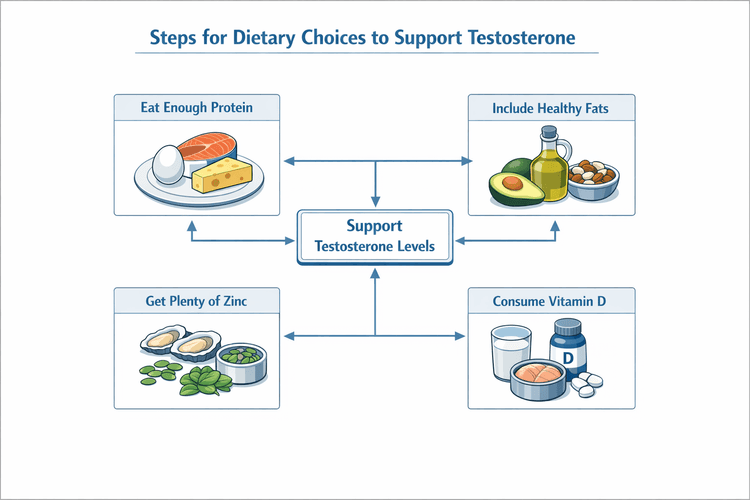
Step 1: Address weight first
If you carry extra weight, losing it will do more for your testosterone than any single food. In overweight and obese men, weight loss raises total testosterone, sex hormone binding globulin and overall sexual function. A 52-week trial of 100 men showed that result held across both high-protein and high-carbohydrate diets — the macronutrient split mattered less than the weight itself.
The trial tracked men for 52 weeks. Testosterone climbed during the first 12 weeks of weight loss and continued rising through week 52. No food added to your plate will outpace what losing 10 or 15 pounds can do if you start above a healthy weight.
Step 2: Choose a sustainable eating pattern
Diet comparisons show that ketogenic, vegetarian, Mediterranean and Western patterns all affect testosterone through different mechanisms. Ketogenic diets may enhance testosterone synthesis by increasing cholesterol availability, a key precursor for hormone production. Vegetarian diets, conversely, often reduce cholesterol bioavailability due to high fiber and low fat intake, which may impair testosterone production in some men.
The evidence does not crown a single winner. Pick the pattern you can follow long enough to lose weight and keep it off. Consistency beats optimizing macronutrient ratios on paper.
Step 3: Test before and after
Before changing your diet, get a baseline testosterone panel: total and free testosterone, SHBG, LH and FSH. Retest 12 weeks later, using the same lab and the same morning time slot. One measurement tells you nothing about direction; two measurements separated by a dietary intervention tell you whether the change worked for you.
Obesity is associated with reduced testosterone and worsened sexual function. Weight loss reverses both. The only way to know if your approach is working is to measure it. How to Test Testosterone Levels: Testosterone Free vs Total explains the panel you need and what each number means.
Step 4: Set realistic expectations
No food will raise your testosterone by 200 ng/dL. The dietary interventions studied show modest improvements tied to weight loss, not to adding a specific ingredient. If your baseline is in the low-normal or clinically low range, food alone will not bring you into the upper quartile. Establishing an evidence-based foundation for nutritional approaches helps you separate realistic gains from marketing hype.
If diet and weight loss do not move your numbers after 12 weeks, that is useful information. It tells you that the next step is a conversation with your doctor, not a different superfood.
What Foods That Increase Testosterone Have Real Evidence?
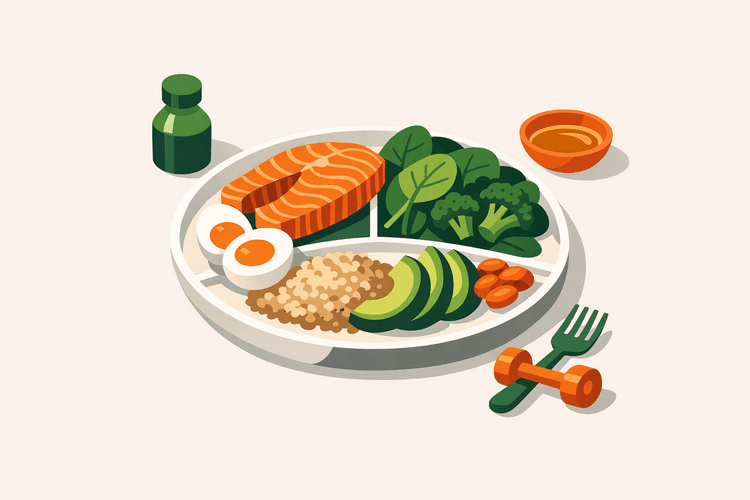
Most foods marketed as testosterone boosters deliver no measurable effect. The two exceptions with human trial data are fenugreek and ashwagandha, both herbal extracts studied in supplement form. If you want to try either, here is what to know before you buy.
Start with the Basics First
Before adding any supplement, fix the free variables. Sleep seven to nine hours. Drop alcohol below seven drinks per week. If you are overweight, lose ten to fifteen pounds. These changes produce larger testosterone increases than any food or extract, and they cost nothing.
Once those are handled, test your testosterone twice in the morning before 10 AM. Without two morning results and a free testosterone calculation, you are guessing. For more on delivery methods once you know your numbers, see Testosterone Injections vs Gel: Testosterone Gel, Cream, Pellets.
If You Choose a Supplement, Check the Dose and Duration
Fenugreek and ashwagandha trials used standardized extracts at specific doses for eight to twelve weeks. A grocery-store product with an undisclosed blend and no stated saponin or withanolide percentage is not the same thing. Read the label. If it does not list the active compound concentration, you have no way to match the trial dose.
Zinc shows up in many formulations. It raises testosterone only in men who are zinc-deficient, which is uncommon unless you are vegan or have malabsorption. Taking extra zinc when you are not deficient does not raise testosterone further and can interfere with copper absorption.
Track One Variable at a Time
If you add three supplements at once, you will not know which one worked or caused a side effect. Pick one extract, take it for eight weeks at the trial dose, then retest your testosterone. If the number moved and you feel better, keep it. If nothing changed, stop and save the money.
Do not stack multiple testosterone-support products unless you are working with a clinician who can monitor your full panel. Some combinations raise estradiol or hematocrit faster than testosterone, and you will not catch that without labs.
What Not to Waste Time On
Oysters, red meat, and eggs supply nutrients that support general health, but eating more of them does not raise testosterone in men with adequate nutrition. The trials that show an effect used isolated extracts at doses you cannot reach through food.
Avoid any product that claims to "optimize" or "unlock" testosterone without naming a specific compound and dose. Those are marketing terms, not mechanisms. If the seller will not show you the trial, assume there is not one.
A supplement works if a human trial measured testosterone before and after in a control group, not if a rat study showed a pathway or a marketing page says "clinically studied."
Conclusion
The evidence for foods that increase testosterone is thin. Weight loss raises testosterone in overweight men — a 52-week trial of 100 men measured total testosterone, sex hormone binding globulin and free testosterone, and all three improved. The diet composition did not matter; high-protein and high-carbohydrate plans produced the same result. The number that moved was body weight, not the menu.
Supplement sellers claim their products "naturally" boost testosterone, but most formulations lack human trials that measure actual hormone levels. The gap between the marketing claim and the published data is wide. When you see a supplement ranked highly or reviewed frequently, that tells you about its sales funnel, not its effect on your labs.
Before buying a supplement or changing your diet based on a claim, ask for the trial: population size, duration, what they measured and how much it moved. If the answer is a rat study or a proprietary blend with no published results, you know what you are buying. For a clearer picture of whether supplementation or medical treatment fits your situation, see Testosterone Booster vs TRT: What Each Can Realistically Do.
Test first, test twice. Read the label. Check the trial. That is how you tell what is real and what is myth.
FAQ
Which foods actually raise testosterone?No single food raises testosterone by a clinically meaningful amount in men with adequate nutrition. Weight loss in overweight men produces the largest dietary effect on testosterone levels.
Do oysters increase testosterone?Oysters contain zinc, which raises testosterone only in men who are zinc-deficient. If your zinc status is normal, eating oysters will not raise your testosterone further.
How long does it take for diet to affect testosterone?In weight-loss trials, testosterone began rising within 12 weeks and continued through 52 weeks. Dietary changes without weight loss show minimal testosterone effects in most studies.
Are testosterone-boosting supplements worth it?Fenugreek and ashwagandha have human trial data showing modest testosterone increases. Most other supplements lack trials measuring actual hormone levels in men.
Sources(24)
- The Journal of urology (2020)
- The Journal of clinical endocrinology and metabolism (2026)
- American family physician (2024)
- U.S. Food and Drug Administration — Drug Safety Communication: FDA cautions about using testosterone products for low testosterone due to aging; requires labeling change to inform of possible increased risk of heart attack and stroke with use (2015)
- Journal of Clinical Endocrinology & Metabolism — Testosterone Therapy in Men With Hypogonadism: An Endocrine Society Clinical Practice Guideline (2018)
- International journal of general medicine (2022)
- American Urological Association — Evaluation and Management of Testosterone Deficiency (AUA Guideline) (2018)
- The journal of sexual medicine (2019)
- International journal of impotence research (2023)
- RSC advances (2026)
- Journal of human kinetics (2014)
- RSC advances (2026)
- F&S reviews (2020)
- The journal of sexual medicine (2013)
- The Journal of arthroplasty (2025)
- International journal of pharmaceutical compounding (2015)
- European urology focus (2017)
- The Journal of the American Board of Family Practice (2001)
- The aging male : the official journal of the International Society for the Study of the Aging Male (2015)
- Journal of advanced research (2025)
- Advances in clinical and experimental medicine : official organ Wroclaw Medical University (2025)
- Nutrients (2021)
- Andrology (2025)
- European journal of endocrinology (2024)