Testosterone Patches: Are They Right for You?

Updated
Top takeaways
- Testosterone patches are FDA-approved prescription devices that deliver a continuous dose of testosterone through the skin for men diagnosed with hypogonadism
- They offer convenience compared to injections, but require daily application and come with specific application site requirements
- The choice between patches, gels, and injections depends on your lab results, lifestyle, cost tolerance, and willingness to manage daily adherence
- Before choosing any delivery method, you need two morning testosterone results, plus LH and FSH levels, to confirm primary hypogonadism
- Patches are one delivery route for the same hormone — the question is whether the trade-offs fit your situation
Introduction
Testosterone patches deliver a slow, continuous dose of testosterone through the skin. They are an FDA-approved prescription treatment for men with confirmed low testosterone, also called hypogonadism. The patch releases hormone steadily over 24 hours, avoiding the peaks and troughs that come with less-frequent injections.
The appeal is convenience. You apply a patch once daily instead of injecting every few days or weeks. The patch delivers what the label calls a physiological amount of testosterone — meaning it aims to restore levels within the normal range, not push them higher. That sounds simple, but the real question is whether daily skin application, the cost, and the monitoring requirements make sense for you compared to other testosterone replacement options.
When evaluating testosterone patches, it helps to understand that clinical trials often focus on specific populations. A study might report benefits for low testosterone, but the enrolled men may have been overweight with secondary hypogonadism — not representative of every man considering treatment. The FDA label for testosterone therapies includes monitoring requirements, such as tracking hematocrit levels, that clinic ads do not always highlight. This gap between marketing and the primary source matters when you are deciding what to ask your doctor for.
Telehealth clinics advertise monthly fees that appear to cover medication, but lab tests, initial consultations, and follow-up visits are often billed separately. Knowing the full cost structure before signing up prevents surprises. The same principle applies to choosing between oral testosterone options and transdermal delivery: the cheapest advertised price is not the number that matters.
This article walks through what testosterone patches are, how they compare to gels and injections, what the trials measured, who qualifies, what it costs in money and monitoring, and what alternatives exist. The goal is to give you the facts supported by the label and the published evidence, so you can ask the right questions before choosing a delivery method.
Quick Verdict
Testosterone patches deliver a physiological amount of testosterone through the skin and avoid the fluctuations that come with injections. They are convenient — apply one daily, usually to the back, abdomen, upper arms or thighs — and they work for men with confirmed low testosterone who need replacement therapy.
The trade-off: skin irritation is common, the patches are visible under tight clothing, and they cost more than injections. Most insurance plans cover them when prescribed for documented hypogonadism, but you will still pay more out-of-pocket than you would for a vial of testosterone enanthate.
Patches work best for men who want stable testosterone levels without injections and who can tolerate daily application. If you have sensitive skin or prefer the lowest-cost option, injections or gels may fit better. For men who need to preserve fertility, neither patches nor injections are the right choice — enclomiphene or hCG raise your own testosterone production instead of replacing it.
The short answer: testosterone patches are a reliable middle option. They deliver consistent levels, require no needles, and fit men who value convenience over cost. Before choosing them, get two morning testosterone tests, a full panel including LH and PSA, and ask your doctor what monitoring the patch requires.
Key Features
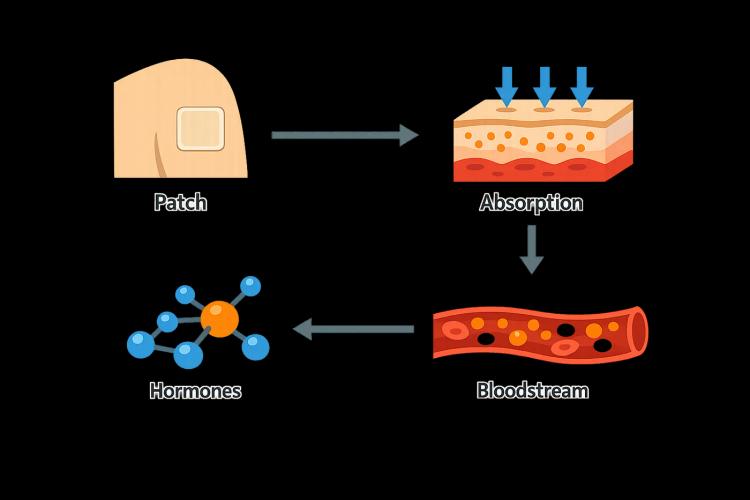
Testosterone patches are FDA-approved prescription devices that deliver a continuous dose of hormone through the skin. One or two patches, designed to nominally deliver 2–4 mg of testosterone during 24 hours, are applied daily on nonpressure areas of the body. The brand name is AndroDerm, and it requires a prescription.
How Testosterone Patches Work
The patch releases testosterone slowly and continuously into the bloodstream, restoring serum testosterone, DHT, and E2 concentrations to the physiological male range. This is different from injections, which create peaks and troughs, or gels, which can transfer to others through skin contact. The steady release pattern mimics natural hormone production more closely than some other delivery methods.
Application Method
You apply the patch once daily, typically in the evening. The application site should rotate to avoid skin irritation. The patch stays on during showering and normal activity, though swimming and heavy sweating can reduce adhesion. Each patch is worn for 24 hours, then removed and replaced with a new one on a different site.
For men who need higher doses, two patches may be applied simultaneously. Serum testosterone concentrations in some men may be in the low-normal range with one patch, requiring two patches daily to reach target levels. This is determined by follow-up lab work, not by symptoms alone.
What the Patch Delivers
Beyond raising testosterone, the patch also affects related hormones. It restores DHT (dihydrotestosterone) and estradiol (E2) to normal male ranges. DHT is the more potent androgen that testosterone converts into; E2 is the estrogen that testosterone also converts into. Both matter for how you feel and what side effects you might see. The clinical significance of moderately high DHT concentrations from patch use is not fully known.
If you are comparing patches to oral testosterone options, note that oral formulations bypass the skin entirely and are absorbed through the gut or cheek lining, with different effects on liver metabolism and hormone ratios.
Pros and Cons
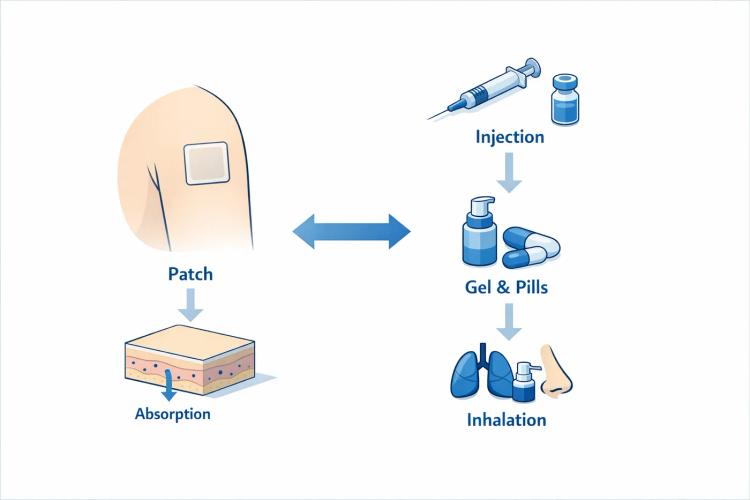
Testosterone patches restore serum testosterone, DHT and estradiol concentrations to the physiological male range. They are applied once daily to non-pressure areas of the skin. Some men find the daily routine straightforward; others do not.
What Works in Their Favor
Patches are easy to apply. You stick one on, leave it for 24 hours, then replace it. No injections, no gels that transfer to partners or children through skin contact. The delivery is steady across the day, which some men prefer over the peaks and troughs of injections.
The patch is FDA-approved for testosterone replacement therapy, so insurance may cover it when other TRT options are not covered. It is a prescription product with a known regulatory path, not a compounded formulation.
What Costs You
Skin irritation at the application site occurs frequently in many patients. This is not a rare reaction; clinical data list it as a common problem. Some men rotate sites to manage it, others stop using patches entirely.
Serum testosterone concentrations in some testosterone-deficient men may be in the low-normal range with one patch. These men may need applications of two patches daily to reach target levels. That doubles the cost, doubles the adhesive exposure, and doubles the chance of skin reactions.
Patches are visible. They show through tight clothing, and they sometimes peel at the edges during sleep or exercise. If discretion matters to you, this is worth knowing before you sign up.
| Factor | Advantage | Disadvantage |
|---|---|---|
| Application | Once daily, no injections | Frequent skin irritation |
| Dosing | Steady 24-hour delivery | May need two patches for target levels |
| Transfer risk | No skin-to-skin transfer to others | Visible, can peel during activity |
| Insurance | FDA-approved, may be covered | Higher out-of-pocket if two patches required |
The short answer: patches work for men who tolerate the adhesive, do not mind the visibility, and reach target testosterone levels with one patch per day. For everyone else, the trade-offs add up quickly.
Detailed Analysis
Testosterone patches deliver hormone replacement through the skin. The evidence base is narrow — most published trials studied patches in populations that do not match the typical low-testosterone patient.
What the Trial Data Actually Measured
The PATCH trial enrolled men with locally advanced or metastatic prostate cancer, not men with primary hypogonadism. The goal was cardiovascular safety during androgen deprivation therapy, not testosterone normalization for symptomatic low testosterone. Participants received four 100 μg patches per 24 hours, changed twice weekly, with dose reduction to three patches if testosterone dropped to castrate levels (≤1.7 nmol/L) at four weeks. The trial ran across 52 UK sites and used a randomized design, but the population and endpoint — cardiovascular morbidity and mortality in cancer patients — limit how much you can extrapolate to otherwise healthy men seeking testosterone replacement therapy.
This is where the headline and the methods section diverge. A trial might headline its findings as beneficial for low testosterone, but the details often reveal it was conducted on a specific group. This specificity limits the applicability of the results to a broader population.
What We Know and What We Don't
Patches deliver testosterone transdermally, avoiding first-pass liver metabolism. That mechanism is sound. What is missing is robust trial data in the population that uses them most: men with primary or secondary hypogonadism seeking symptom relief and normalized testosterone levels. The PATCH trial tells you how patches behaved in a cancer cohort under androgen suppression. It does not tell you how they perform in a 45-year-old with a morning total testosterone of 250 ng/dL and fatigue.
The FDA label for testosterone therapies includes requirements for monitoring hematocrit, PSA, and lipid panels — markers not always highlighted in telehealth clinic ads. These monitoring requirements are not optional; they are part of the approval. If a clinic does not mention them, ask why.
Dosing and Adjustment
The trial protocol allowed dose reduction from four patches to three based on a single testosterone measurement at four weeks. In clinical practice, dose adjustments depend on serial lab results, symptom response, and side-effect profile. One morning result is not a diagnosis, and one follow-up result is not a treatment plan. You need at least two baseline measurements and ongoing monitoring to know if the patch is working for you.
The cheapest patch is the one that comes with a monitoring plan you can actually follow.
Patient Experience and Adherence
Patches require twice-weekly application. That schedule is simpler than daily gels but more frequent than injections. Skin irritation is common — rotation of application sites helps, but some men discontinue because of persistent rash or discomfort. Adherence data in the general low-testosterone population is thin. The trial did not report adherence rates, and real-world persistence is not well documented outside of manufacturer registries.
Who Is It For?
Testosterone patches fit a narrow patient profile. You need confirmed low testosterone from two morning tests, symptoms that match the lab numbers, and a reason to avoid injections. The patch works best for men who want steady dosing without the twice-weekly injection schedule and who can tolerate daily skin application.
Before choosing a patch, your doctor should rule out conditions that make testosterone replacement unsafe. Breast cancer, prostate cancer, and elevated PSA levels are absolute contraindications. If you have untreated sleep apnea, severe heart failure, or a hematocrit above 50%, those need to be addressed first. The patch raises testosterone systemically, and that affects blood thickness, prostate tissue, and cardiovascular load just like any other form of TRT.
When the Patch Makes Sense
You might prefer the patch if you cannot do injections—whether that is a needle aversion, a clotting disorder, or a work schedule that makes twice-weekly dosing impractical. The patch delivers testosterone through the skin in a controlled release over 24 hours, avoiding the peak-and-trough pattern of weekly injections. That steadier level can reduce mood swings and energy crashes for some men.
The patch also fits men who want to avoid the mess and monitoring of gels. Gels transfer to partners and children through skin contact, and that risk does not exist with a patch applied to the back, abdomen, upper arms, or thighs. If you live with young children or share a bed, the patch removes the transfer concern without requiring you to cover application sites or time your showers.
When It Probably Does Not
If cost is a primary concern, the patch is expensive compared to generic injectable testosterone. Monthly out-of-pocket costs often exceed $200 without insurance, and insurance coverage for TRT varies widely by plan and diagnosis code. Injections cost a fraction of that, and gels often fall in between.
Skin irritation is common. Redness, itching, and rash at the application site occur in a meaningful percentage of users, and rotating sites does not always prevent it. If you have sensitive skin, eczema, or a history of contact dermatitis, the patch may not last past the first month. Men who sweat heavily during the day or sleep hot sometimes find the patch does not adhere well, leading to inconsistent dosing.
Finally, the patch does not preserve fertility. Like all forms of TRT, it suppresses your body's own testosterone and sperm production by shutting down LH and FSH. If you want to maintain fertility, ask your doctor about enclomiphene or hCG instead—those stimulate your own production rather than replacing it.
Pricing
Testosterone patches cost more than injections and usually more than gels, measured in dollars per month at the pharmacy counter. The number that matters is what you pay after insurance decides what it will cover, and that varies by plan, formulary tier, and whether a generic exists for the specific patch you need.
Androderm, the most commonly prescribed patch in the U.S., typically runs $400 to $600 per month at retail without insurance. Generic testosterone transdermal systems cost less—often $200 to $400 per month—but not all pharmacies stock them, and not all insurance plans treat the generic and brand-name versions the same way on their formulary. Some plans place patches on a higher tier than injections or gels, which means a higher copay even when the plan covers the drug.
What Insurance Covers
Most commercial insurance and Medicare Part D plans cover testosterone patches when prescribed for documented hypogonadism, but they usually require prior authorization. That means your doctor submits lab results—typically two morning total testosterone readings below the reference range, often with symptoms—and the insurer reviews the request before approving the prescription. Some plans also require you to try a cheaper option first, such as generic testosterone cypionate injections, before they will approve a patch. This is called step therapy.
If your plan does cover patches after prior authorization, your copay depends on the formulary tier. A tier-three drug might cost you $40 to $80 per month; a tier-four specialty drug might cost $100 to $200 or a percentage of the retail price. Does Insurance Cover TRT? What You Need to Know walks through how to check your plan's formulary and what prior authorization typically requires.
Cash-pay telehealth clinics rarely offer patches. Most structure their pricing around injectable testosterone because it costs them less to source and ship. When a clinic does offer patches, the monthly fee is higher—sometimes $150 to $250 per month compared to $99 to $129 for injections—and that fee usually covers only the medication, not the labs or the initial consultation, which are billed separately.
Out-of-Pocket Reality
If you pay cash, testosterone patches are the most expensive common form of TRT. Injectable testosterone cypionate costs $30 to $60 per month at many pharmacies with a GoodRx coupon; compounded testosterone cream runs $50 to $100; brand-name gels like Androgel cost $400 to $500, but generic versions cost $100 to $200. Patches sit at the high end because they are single-use, you apply one every day, and the manufacturing process is more complex than filling a vial or a tube.
Some men find the convenience worth the extra cost. Others switch to injections after a few months when they realize the patch budget adds up to $5,000 or more per year. That is a decision you make after you see what your insurance actually pays and what your copay actually is, not before.
Alternatives
Testosterone patches are one option among several. The main alternatives are testosterone injections, gels, pellets, and oral formulations. Each delivers testosterone through a different route, with different trade-offs in cost, convenience, monitoring and side-effect profile.
Testosterone Injections
Intramuscular injections remain widely used. Testosterone enanthate and testosterone cypionate are the most common esters. Despite the popularity of transdermal preparations like testosterone patches, many hypogonadal men still receive treatment with intramuscular esters, with testosterone enanthate being the most commonly prescribed.
Injections are typically given every one to two weeks, though some protocols use weekly dosing to reduce fluctuations. The main advantage is cost: generic testosterone enanthate or cypionate is inexpensive, often under $50 per month at a retail pharmacy with a GoodRx coupon. The main disadvantage is the pharmacokinetics. Testosterone esters, while effective in improving bone and muscle mass, have unfavorable pharmacokinetics that can lead to mood, energy, and sexual function fluctuations. Peak levels occur in the first few days after injection, then decline until the next dose. Some men report feeling the drop as energy and mood shift.
Subcutaneous injection is an alternative to intramuscular. It uses a smaller needle, can be self-administered more easily, and may produce steadier levels. The evidence comparing subcutaneous to intramuscular is limited, but early data suggests similar efficacy with fewer injection-site reactions. For more detail, see Subcutaneous vs Intramuscular Testosterone Injections.
Testosterone Gels
Topical gels are applied daily to the shoulders, upper arms or abdomen. They deliver a steady dose and avoid the peak-and-trough pattern of injections. The main advantage is convenience: no needles, no weekly routine. The main disadvantages are cost and transfer risk. Brand-name gels can exceed $500 per month; generics are cheaper but still more expensive than injections. Transfer to a partner or child through skin contact is a labeled risk, requiring careful hand-washing and covering the application site.
Testosterone Pellets
Pellets are implanted under the skin, typically in the hip or buttock, and release testosterone over three to six months. The advantage is infrequent dosing. The disadvantages are the minor surgical procedure required for insertion, the upfront cost (often $700 to $1,200 per insertion), and the difficulty of adjusting dose mid-cycle if levels are too high or too low. Pellets are not reversible once implanted.
Oral Testosterone
Oral testosterone formulations—Jatenzo, Kyzatrex, and Tlando—are newer options that avoid first-pass liver metabolism by using lipid-based delivery or buccal absorption. They are taken twice daily with food. The advantage is no needles and no transfer risk. The disadvantages are cost (brand-only, often $600+ per month) and the twice-daily dosing requirement. Oral testosterone is still being evaluated for long-term safety and efficacy. For a detailed comparison, see Oral Testosterone: Kyzatrex, Jatenzo, and Tlando Explained.
| Option | Dosing Frequency | Typical Cost per Month | Main Advantage | Main Disadvantage |
|---|---|---|---|---|
| Injections (IM) | Every 1–2 weeks | $30–$100 | Low cost | Fluctuating levels |
| Injections (SubQ) | Weekly | $30–$100 | Steadier levels, smaller needle | Limited long-term data |
| Gels | Daily | $100–$500+ | Steady levels, no needles | Transfer risk, higher cost |
| Patches | Daily | $200–$400 | Steady levels, no transfer risk | Skin irritation |
| Pellets | Every 3–6 months | $700–$1,200 per insertion | Infrequent dosing | Upfront cost, not reversible |
| Oral | Twice daily | $600+ | No needles, no transfer | High cost, frequent dosing |
Non-TRT Options
Before starting any form of TRT, some men consider medications that stimulate the body's own testosterone production. Enclomiphene and hCG are the main options. These preserve fertility and testicular function, which exogenous testosterone suppresses. For men who want to maintain sperm production or avoid long-term dependence on injections or patches, these are worth evaluating. For a detailed comparison, see Enclomiphene vs hCG: Compare Two Options for Testosterone Production.
Choosing Between Them
The right option depends on your priorities. If cost matters most, injections win. If you want steady levels without daily application, pellets or injections may fit. If you want to avoid needles and can tolerate daily application, gels or patches are options. If you want to preserve fertility, enclomiphene or hCG should be considered before any form of TRT. No single option is best for everyone. The decision starts with testing, understanding your baseline levels, and discussing trade-offs with your doctor.
Final Verdict
Testosterone patches deliver a physiological amount of testosterone and avoid the injection schedule. They work for men with confirmed hypogonadism who want steady levels without needles and who can tolerate daily application and the occasional skin reaction.
The short answer: patches are a middle option. Gels are more convenient for most men — no adhesive, no removal schedule, applied in seconds. Injections cost less and require no daily routine, but they create peaks and troughs that some men feel. Patches sit between those two: daily commitment, higher price than injections, fewer fluctuations than long-acting esters, and a prescription-only product with FDA monitoring requirements.
What the trial data shows: transdermal preparations are convenient and deliver testosterone without the mood and energy swings reported with older intramuscular esters. The patch studies that led to FDA approval measured testosterone levels, not long-term outcomes like bone density or cardiovascular events. The label requires monitoring hematocrit and PSA, and patches are contraindicated in men with breast or prostate cancer or elevated PSA.
When considering testosterone patches as a treatment option, the FDA label includes requirements for monitoring certain health markers, like hematocrit levels, which are not always highlighted in marketing materials from clinics. This discrepancy emphasizes the importance of consulting primary sources and guidelines when evaluating treatment options.
Worth knowing before you start: patches cost more per month than injections and less than some branded gels. Insurance coverage varies; many plans require prior authorization and step therapy. If you are paying cash through a telehealth clinic, ask what the monthly fee covers — some advertise a subscription price that includes medication, while lab tests and initial consultations may be billed separately.
Patches are not for everyone. Men who cannot tolerate adhesives, who have significant skin sensitivity, or who prefer a once-weekly or twice-monthly schedule will find other testosterone delivery methods more practical. Men who want to preserve fertility should ask their doctor about enclomiphene or hCG before starting any form of TRT, including patches.
The final consideration: test first, test twice. One morning result is not a diagnosis. You need two fasting morning testosterone levels, plus LH and other markers, to confirm hypogonadism and rule out secondary causes. Without that baseline, no form of TRT — patch, gel or injection — is the right choice.
Sources(30)
- Hormone molecular biology and clinical investigation (2010)
- American Urological Association — Evaluation and Management of Testosterone Deficiency (AUA Guideline) (2018)
- Expert opinion on pharmacotherapy (2005)
- Cureus (2023)
- The Journal of clinical endocrinology and metabolism (2026)
- Endocrine practice : official journal of the American College of Endocrinology and the American Association of Clinical Endocrinologists (2016)
- Cureus (2023)
- Fertility and sterility (1991)
- The world journal of men's health (2022)
- The Journal of the American Board of Family Practice (2001)
- Quest Diagnostics (questhealth.com) (2026)
- The aging male : the official journal of the International Society for the Study of the Aging Male (2015)
- International journal of impotence research (2023)
- RSC advances (2026)
- Maturitas (2020)
- Journal of human kinetics (2014)
- The journal of sexual medicine (2019)
- American journal of men's health (2015)
- F&S reviews (2020)
- The journal of sexual medicine (2013)
- The Journal of arthroplasty (2025)
- International journal of pharmaceutical compounding (2015)
- The Cochrane database of systematic reviews (2024)
- Cureus (2022)
- The aging male : the official journal of the International Society for the Study of the Aging Male (2015)
- Therapeutic advances in urology (2022)
- The aging male : the official journal of the International Society for the Study of the Aging Male (2025)
- The aging male : the official journal of the International Society for the Study of the Aging Male (2023)
- The Journal of clinical endocrinology and metabolism (2004)
- Sexual medicine reviews (2017)