Does Ashwagandha Increase Testosterone? What Research Shows
Updated
Top takeaways
- Ashwagandha testosterone research shows modest increases, but most trials are small and short
- The published research shows mixed results, and few studies test the supplement in men with diagnosed low testosterone
- Before adding any supplement, test first with a morning total and free testosterone panel
- The evidence is thin compared to prescription options, and nobody selling it will tell you what the trials actually measured
- Worth knowing before you sign up: supplement claims rarely match the study populations or doses used in research
Introduction
Ashwagandha testosterone supplementation is marketed heavily, but does the research support the claims? Testosterone matters. It drives muscle, bone density, libido and energy. When it drops, men notice. The supplement industry noticed too, and ashwagandha—a root extract used in Ayurvedic medicine—now appears in dozens of testosterone-support formulas.
The question is whether the research supports the marketing. Does ashwagandha increase testosterone in the populations most likely to buy it? What did the trials actually measure, how large were they, and how long did they run? Those details separate a supplement with evidence from one with a good story.
Most men searching for natural testosterone support have not tested twice, do not know their LH or free testosterone, and have not ruled out weight, sleep apnea or alcohol as contributors. One morning result is not a diagnosis. If you are considering ashwagandha, the first step is understanding what the trials show—and what they do not. For a detailed breakdown of the clinical evidence, see Does Ashwagandha Increase Testosterone? Reading the Trials.
This article walks through the research, grades the evidence, and explains how to evaluate a supplement before you buy it. The short answer: ashwagandha may raise testosterone modestly in some populations, but the effect size, consistency and applicability to men with clinically low testosterone remain unclear. Here is what the data actually says.
The Problem Statement
Testosterone declines with age in most men, starting around thirty. The drop is gradual — one to two percent per year — but it compounds. By the time a man hits fifty, the number on the lab report can sit well below the reference range he saw a decade earlier. Symptoms follow: fatigue, strength loss, libido decline, difficulty building or keeping muscle. Some men notice nothing. Others notice everything.
The conventional answer is testosterone replacement therapy. TRT works reliably, but it costs you in monitoring, fertility and commitment. Once you start, stopping is complicated. The body's own production shuts down within weeks, and restarting it requires time, medication and patience. For men who want children or who prefer to avoid injections, patches or gels, TRT is not the first choice. For coverage details, see Does Insurance Cover TRT? What You Need to Know.
That gap creates demand for alternatives. Supplement sellers fill it with long lists of botanicals, amino acids and minerals, each one promising to raise testosterone naturally. Ashwagandha sits near the top of those lists. It is an adaptogen, a traditional herb from Ayurvedic medicine, and it has been studied in human trials. The question is whether those trials support the claims you see in the ads.
Why Men Look for Natural Options
The reasons are practical. TRT requires a prescription, regular blood work, and a clinic relationship. It suppresses sperm production in most men, which matters if fertility is still a goal. It raises hematocrit, which means monitoring for blood thickness and sometimes donating blood to keep levels safe. It is a long-term commitment, not a short intervention.
Supplements, by contrast, require none of that. You order online, take a capsule daily, and wait. No prescription, no monitoring, no needles. The pitch is simple: raise your testosterone without the trade-offs. For men who test low-normal or who want to avoid medical intervention, the pitch is appealing.
The problem is that most supplement ingredients have thin evidence. Animal studies outnumber human trials. Small human trials outnumber large ones. Funding often comes from the ingredient supplier, and the population studied rarely matches the man reading the label. Does Ashwagandha Increase Testosterone? Reading the Trials walks through the specific studies, their sample sizes, and what they actually measured.
What Low Testosterone Actually Means
Low testosterone is not one number. The reference range for total testosterone runs from around 300 to 1,000 ng/dL, depending on the lab. A result of 350 ng/dL is technically normal, but it sits at the low end. Free testosterone — the fraction not bound to SHBG — matters more for symptoms, and many labs do not measure it directly. LH and FSH tell you whether the problem is in the testes or the pituitary. Estradiol, hematocrit and PSA round out the picture. For SHBG considerations, see High SHBG in Men: Causes and Questions to Ask Your Doctor.
One morning result is not a diagnosis. Testosterone fluctuates with sleep, stress, training and time of day. The guideline is two morning measurements, taken on separate days, both below the reference range, with symptoms that match. Without that, you are guessing.
Supplements do not require that standard. You can buy ashwagandha without a lab result, without symptoms, and without a second measurement. The marketing does not ask you to test first. It assumes you need it, and it sells you the bottle. That is the gap between a medical diagnosis and a wellness purchase.
Test first, test twice. Without baseline numbers, you cannot measure whether a supplement worked.
What Does Ashwagandha Do to Testosterone Levels?
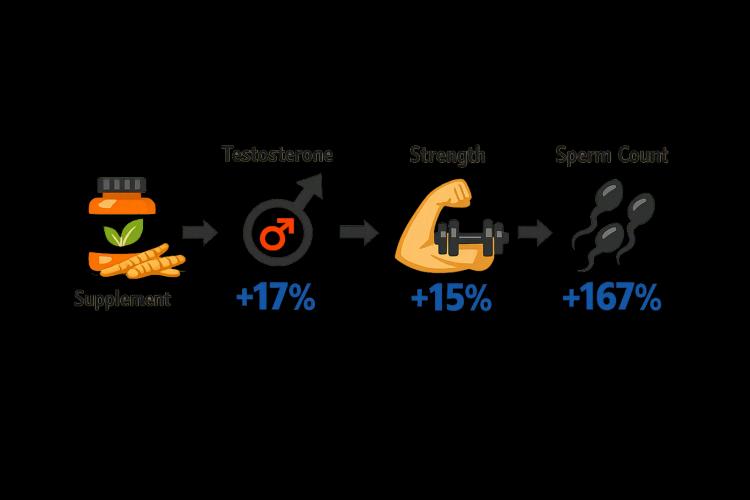
Research indicates ashwagandha testosterone studies show modest increases in specific populations. Two controlled trials measured ashwagandha's effect on testosterone in men. Both ran eight weeks, used a placebo group, and reported a statistically significant increase. The numbers are modest, the populations were narrow, and the variance was high enough that post-intervention testosterone levels between groups did not always separate cleanly.
The 2015 Strength-Training Study
Fifty-seven men aged 18–50 with little resistance-training experience took either ashwagandha extract or placebo while following a supervised strength program. The ashwagandha group's testosterone rose an average of 96.19 ng/dL over eight weeks, versus 18.00 ng/dL in the placebo group (p = 0.004). The difference in the change was statistically significant. The final testosterone levels—726 ng/dL in the ashwagandha group versus 693 ng/dL in placebo—were not statistically different, because the spread of individual results was wide.
This trial enrolled young men starting a new training stimulus. Ashwagandha was one variable; the training program was another. The study did not separate how much of the testosterone change came from the supplement versus the exercise.
The 2019 Aging-Men Study
Fifty overweight men aged 40–70 with mild fatigue took either a standardized ashwagandha extract (Shoden beads, 21 mg withanolide glycosides daily) or placebo for eight weeks. Ashwagandha intake was associated with an 18% greater increase in DHEA-S (p = 0.005) and a 14.7% greater increase in testosterone (p = 0.010) compared to placebo. The trial reported no significant between-group differences in cortisol, estradiol, fatigue, vigor, or sexual well-being. Forty-three of the original fifty-seven participants completed all sixteen weeks.
The authors stated that larger sample sizes are required to substantiate the findings. The testosterone increase was real but did not translate into measurable changes in the symptom questionnaires.
What the Trials Did Not Measure
Neither study enrolled men with diagnosed hypogonadism. Neither tested ashwagandha in men already on testosterone replacement therapy. Neither ran longer than eight weeks. Neither measured sperm parameters, LH, or FSH. A 2025 systematic review concluded that ashwagandha supplementation increases testosterone in adults without chronic disorders, but the review did not specify the magnitude, the duration of effect, or the populations for which the increase is clinically meaningful.
If you are comparing ashwagandha to prescription options like enclomiphene or hCG, the trial data for those drugs includes larger samples, longer follow-up, and fertility endpoints. Ashwagandha has two eight-week trials in healthy or mildly fatigued men. That is the evidence base. For another supplement option with thin evidence, see Fadogia Agrestis Side Effects: Evidence and Safety Considerations.
How to Evaluate Ashwagandha Testosterone Supplements
Before you buy, know what the trials actually tested. Most ashwagandha studies that measured testosterone used 300 to 600 mg daily of a root extract standardized to withanolides, the active compounds. Duration mattered: benefits appeared after 8 to 12 weeks, not overnight. If a label does not state the dose, the standardization, or the extract type, you are guessing what you are taking.
Check the Withanolide Percentage
Withanolides are the marker compounds in ashwagandha root. Research extracts typically contain 5 to 10 percent withanolides. A supplement that lists only "ashwagandha root powder" without a percentage may deliver far less of the active fraction. Look for "standardized to X% withanolides" on the label. If the bottle is silent on this, the manufacturer did not test for it.
Match the Dose and Duration to the Evidence
The trials that showed modest testosterone increases used 300 to 600 mg daily for at least two months. One small study reported fat loss and strength gains after 30 days, but the sample was small and the endpoint was not testosterone. Starting at the lower end of the range and running it for 8 weeks gives you a fair test of whether it does anything for you. Shorter trials or lower doses have thin support.
Third-Party Testing and Label Claims
Supplement labels are not pre-approved. A third-party seal from NSF, USP, or Informed Sport tells you the bottle was tested for what it claims and screened for contaminants. Without that seal, you are trusting the seller's word. Heavy metals, microbial contamination, and spiking with undisclosed ingredients have all turned up in ashwagandha products sent for independent analysis.
What the Label Will Not Tell You
No supplement can promise a specific testosterone increase, because the trials show wide individual variation. Some men in the studies saw no change at all. If the marketing copy guarantees a number or uses the phrase "clinically proven" without naming the trial, the claim is not tied to evidence. For a detailed breakdown of what the human trials actually measured, see Does Ashwagandha Increase Testosterone? Reading the Trials.
Ashwagandha is not a prescription. It is not regulated the way testosterone therapy is. That makes label accuracy and third-party verification the only quality controls you have. Test first, buy from a source that tests its product, and give it the time the research used before deciding whether it works for you.
Conclusion
The short answer: ashwagandha may raise testosterone, but the trials are small, short and mostly in narrow populations. The largest increase measured was 14.7% over eight weeks in overweight men aged 40–70. That is a real result, not a rounding error, but it came from 50 people who finished the trial and no one knows if the effect holds past two months.
The studies that exist suggest ashwagandha supplementation is associated with modest increases in DHEA-S and testosterone. The mechanism appears to involve cortisol reduction, though no trial has shown a statistically significant between-group difference in cortisol itself. The effect on testosterone is more consistent than the effect on mood, fatigue or sexual well-being, where between-group differences often disappear.
What we don't know yet: whether the effect persists beyond eight weeks, whether it works in women or older adults, whether it changes anything downstream of the number on the lab report, and whether the standardized extracts used in trials perform the same way as the powders and capsules sold retail. Further studies with larger sample sizes are required to substantiate the current findings, and research studying the possible beneficial effects of ashwagandha needs to be conducted for longer periods of time and for different populations including females and older adults of both genders.
Before choosing any supplement or treatment option, understand what the evidence actually measured and who was studied. For a detailed breakdown of the trial design, dosing and endpoints, see Does Ashwagandha Increase Testosterone? Reading the Trials. If you are comparing ashwagandha to prescription options, the trials on enclomiphene, clomiphene and hCG show larger, longer-duration effects with more robust monitoring—but different trade-offs in cost, fertility and side effects.
Ashwagandha is not a replacement for diagnosing low testosterone correctly or for understanding the full panel. The number that matters is not one total testosterone result; it is the pattern across two morning draws, plus LH, FSH, SHBG and the clinical picture. Supplements may move the needle, but they do not replace the reading.
Related reading
Sources(32)
- American Urological Association — Evaluation and Management of Testosterone Deficiency (AUA Guideline) (2018)
- The Journal of the American Board of Family Practice (2001)
- The Journal of urology (2020)
- Therapeutic advances in urology (2022)
- The aging male : the official journal of the International Society for the Study of the Aging Male (2015)
- The world journal of men's health (2026)
- The Journal of urology (2015)
- Journal of cachexia, sarcopenia and muscle (2024)
- International journal of impotence research (2023)
- Journal of cachexia, sarcopenia and muscle (2024)
- American journal of men's health (2015)
- RSC advances (2026)
- Evidence-based complementary and alternative medicine : eCAM (2014)
- Journal of the International Society of Sports Nutrition (2015)
- American journal of men's health (2019)
- Medicine (2019)
- Medicine (2019)
- American journal of men's health (2019)
- Journal of the International Society of Sports Nutrition (2015)
- Journal of Clinical Endocrinology & Metabolism — Testosterone Therapy in Men With Hypogonadism: An Endocrine Society Clinical Practice Guideline (2018)
- Health technology assessment (Winchester, England) (2024)
- Internal medicine journal (2020)
- Public health reports (Washington, D.C. : 1974) (2015)
- American family physician (2024)
- Current opinion in clinical nutrition and metabolic care (2019)
- Journal of cachexia, sarcopenia and muscle (2025)
- The aging male : the official journal of the International Society for the Study of the Aging Male (2025)
- Biomolecules (2025)
- Sports medicine (Auckland, N.Z.) (2021)
- International journal of sports physiology and performance (2021)
- BMC cancer (2016)
- BMC cancer (2016)